Design Ideas
10 Drought Tolerant Landscaping Ideas to Transform Your Yard
Discover 10 stunning drought tolerant landscaping ideas to save water and create a beautiful, low-maintenance garden. Explore xeriscaping, natives, and more.
Free landscaping tool
Enter your area, depth, and stone type to see how much gravel to order, in tons and cubic yards. Mix units freely, or work backwards from the amount you already have. No sign-up.
Switch every field at once, or set units field by field below. Feet for the area and inches for the depth is fine.
About 105 lb/ft³
Area
= 120.0 sq ft
Depth & amount
Set the depth to get the amount to order, or type a volume or weight you already have to solve for the depth.
Cost (optional)
What you need
Weight (US tons)
1.58
Volume (cu yd)
1.11
Depth (in)
3.00
Total area
120 sq ft
Order about 5 to 10% extra for spread and compaction. Suppliers quote by the ton, so that's usually the number to give them.
Wonder how it'll actually look?
Upload one photo of your yard and OutdoorBrite redesigns it in seconds. Try a gravel path, a dry desert bed, or a new patio before you order a single ton.
Redesign your yard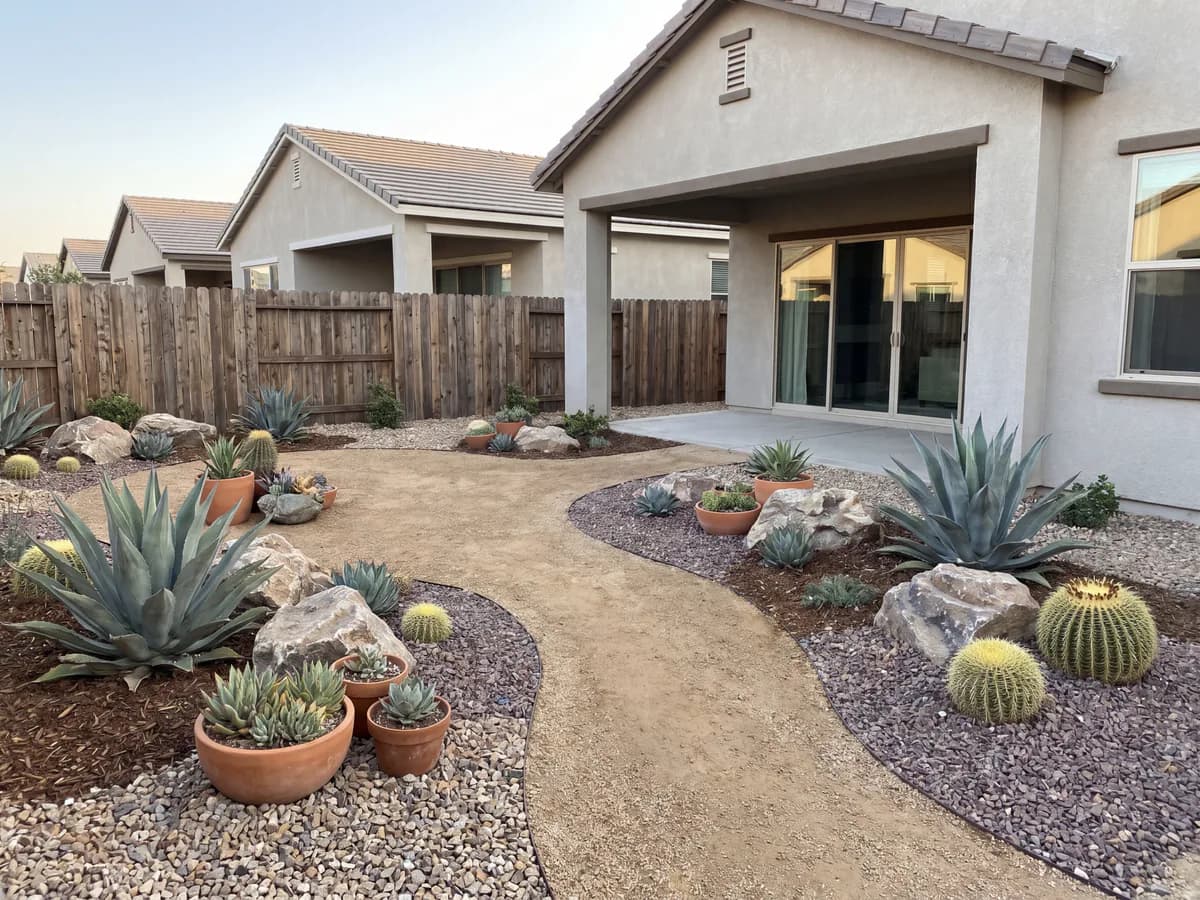
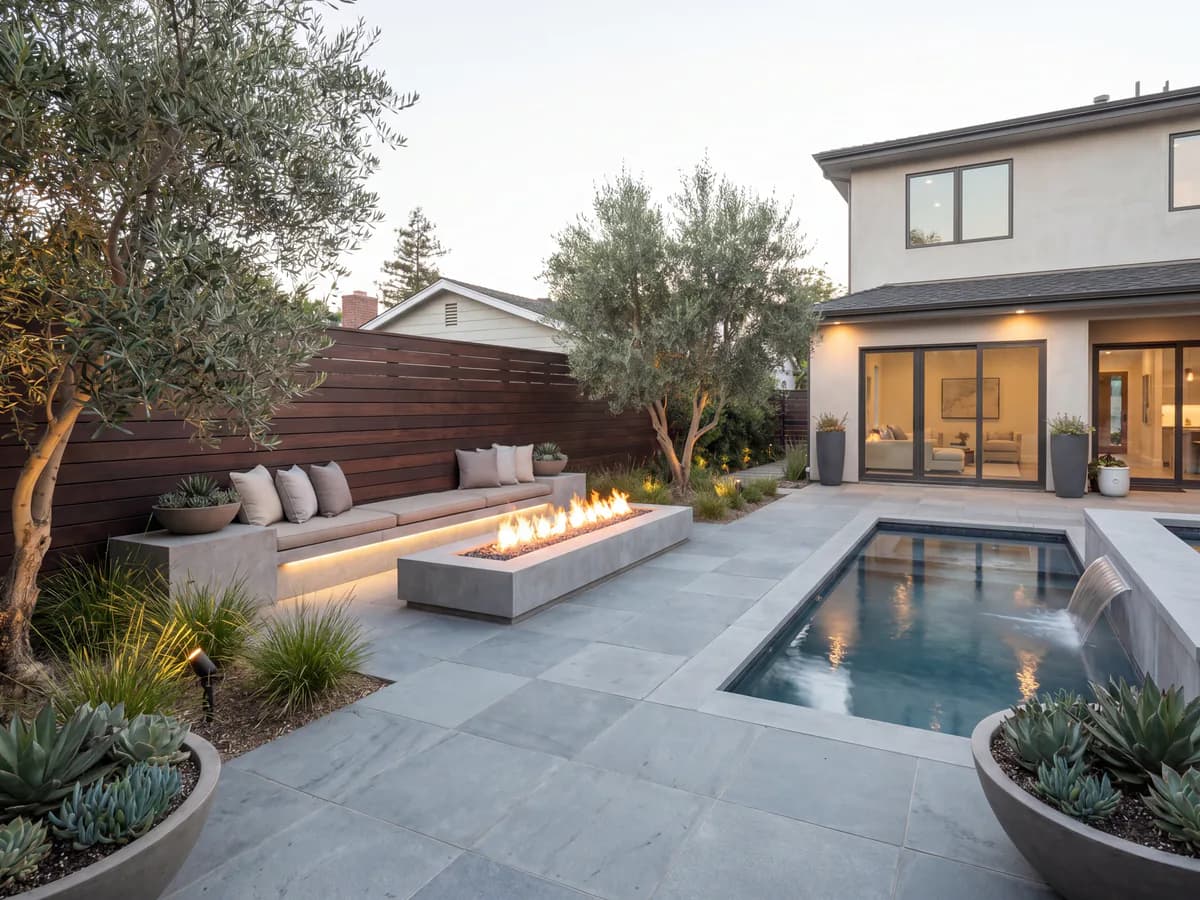
Upload one photo of your yard and OutdoorBrite redesigns it in seconds. Try a gravel path, a dry desert bed, or a new patio before you order a single ton.
Redesign your yardPlanning a gravel path, a driveway, or a dry creek bed? This gravel calculator (some people call it a gravel estimator or aggregate calculator) works out how much you need, in tons and cubic yards, from your area, depth, and the type of stone. Enter your measurements and you get the amount to order, plus a cost estimate.
Gravel is sold by weight, so the tonnage is the number most suppliers quote. Below the calculator you'll find how the math works, a coverage-per-ton chart, the density of each gravel type, and how to handle an area that isn't a clean rectangle.
Five quick steps from your measurements to the amount of gravel to order.
Pick the gravel type
Choose your stone so the weight uses the right density. Know the exact figure? Pick 'Custom density' and enter it in lb/ft³ or kg/m³.
Enter the area
Type the length and width, each with its own unit, or switch to 'Total area' and enter the square footage directly for a shape that isn't rectangular.
Set the depth
Enter how deep the gravel goes. Depth has its own unit, so you can keep the area in feet and the depth in inches, the way gravel is usually spec'd.
Read the amount to order
The calculator shows the weight in tons and the volume in cubic yards right away. Switch the result units with the dropdown on each field.
Add a price (optional)
Enter your price per ton or per cubic yard for a quick cost estimate.
Working backwards? Type into the Volume or Weight field instead. Say your path is 100 sq ft and you can only get one ton delivered: enter 100 sq ft for the area and 1 US ton for the weight, and the calculator tells you it spreads about 2.3 inches deep.
Start with the volume, which equals the volume of the area you're filling: multiply the area in square feet by the depth in feet (inches divided by 12). Divide that by 27 for cubic yards. To get the weight, multiply the volume by the gravel's density, then divide by 2,000 for tons. The calculator runs all of it as you type.
For depth, 2 inches covers paths and decorative beds, 2 to 3 inches suits patios, and driveways want 4 to 6 inches in layers. Gravel packs down once it's walked or driven on, so order a little more than the exact figure.
Worked example
A gravel path 12 ft long and 10 ft wide, 3 inches deep, in standard gravel:
Prefer metric? A 5 m by 1 m path, 15 cm deep, is 5 m² × 0.15 m = 0.75 m³. At 1,680 kg/m³ that comes to about 1.26 tonnes.
To get the weight, multiply the volume by the density. A cubic yard of standard gravel is about 1.4 tons, or 2,400 to 2,900 pounds depending on the stone and how wet it is. The calculator sets the density for you, but you can override it for an unusual aggregate.
Gravel is usually priced per ton delivered, sometimes per cubic yard. Enter your price in the calculator and it returns the total. Bulk by the ton almost always beats bagged gravel once you need more than a few hundred pounds, even with a delivery fee.
Gravel is sold by the ton, so coverage per ton is the figure that matters. How far a ton spreads comes down to depth.
| Depth | Coverage per ton |
|---|---|
| 1 inch | 229 sq ft |
| 2 inches | 114 sq ft |
| 3 inches | 76 sq ft |
| 4 inches | 57 sq ft |
| 6 inches | 38 sq ft |
Based on standard gravel at about 105 lb/ft³. Lighter stone like lava rock covers more per ton; denser, wet, or compacted gravel covers less.
Weight depends on the stone. These are the densities the calculator uses, so you can check them or swap in your supplier's own number with the custom option. Most landscape gravel runs 95 to 125 pounds per cubic foot, with lava rock far lighter.
| Gravel type | Pounds per cu ft | Kg per cu m | Tons per cu yd |
|---|---|---|---|
| Standard gravel (1/4-2 in) | 105 | 1,682 | 1.42 |
| Gravel (dry) | 95 | 1,522 | 1.28 |
| Gravel (wet, 1/4-2 in) | 125 | 2,002 | 1.69 |
| Pit-run gravel | 122 | 1,954 | 1.65 |
| Gravel & sand (dry) | 120 | 1,922 | 1.62 |
| Gravel & sand (wet) | 130 | 2,082 | 1.76 |
| Gravel & clay (dry) | 100 | 1,602 | 1.35 |
| Gravel & clay (wet) | 115 | 1,842 | 1.55 |
| Pea gravel | 96 | 1,538 | 1.3 |
| Crushed stone | 100 | 1,602 | 1.35 |
| Crushed limestone | 100 | 1,602 | 1.35 |
| River rock | 98 | 1,570 | 1.32 |
| Decomposed granite | 108 | 1,730 | 1.46 |
| Dolomite gravel | 116 | 1,858 | 1.57 |
| Lava rock | 50 | 801 | 0.68 |
Typical loose, as-delivered weights. Wet or compacted gravel weighs more.
Real paths rarely form one clean rectangle, especially when they wrap around a pool, a bed, or a corner. Split the shape into rectangles, find the area of each, add them up, then enter the total in the calculator's 'Total area' mode and carry on as normal.
Worked example: a path in four sections
Total area: 45 + 18 + 90 + 54 = 207 sq ft. At 3 inches deep that's about 1.9 cu yd, or 2.7 tons of standard gravel.
Depth depends on the job and on what runs over it. Foot traffic needs less than a car, and a base layer needs more than a decorative topping.
| Use | Depth | Notes |
|---|---|---|
| Paths & walkways | 2 in | Foot traffic over compacted soil or landscape fabric. Edge it so stones stay put. |
| Patios & seating | 2-3 in | Angular gravel packs firm and drains well under furniture or a fire pit. |
| Driveways | 4-6 in | Two layers: a coarse base under a finer top. Heavier use, deeper base. |
| Drains & trenches | Fill the trench | For a French drain or dry well, the gravel volume equals what you dug out. |
Gravel is one of the most flexible materials in a yard. Here's where people lay it most, each with a depth the calculator can size for you.
Paths and walkways. A 2-inch decorative layer over fabric, comfortable to walk and quick to lay.
Driveways. A 4 to 6 inch base of angular stone that carries vehicles and sheds rain.
Patios and seating. A firm, well-drained pad for furniture, a grill, or a fire pit.
Drainage. The fill in French drains, dry wells, and trenches that move water away from the house.
Dry creek beds. River rock set in a shallow channel that carries runoff and looks natural doing it.
Beds and borders. A low-upkeep ground cover that won't rot or wash away the way bark mulch can.
Gravel rarely works alone. Laying it as a base under a paver patio? Size the pavers with our paver calculator. Mixing it with planted beds? The mulch calculator handles the bark and mulch.
Gravel is sorted three ways: by size, shape, and color. The math is the same whichever you choose (volume is volume), but the stone changes the density, and so the weight.
Gravel runs from rock about 4 inches across down to chips the size of a fingernail. A good path is often two or three layers: a larger machine-crushed stone as a base, with finer gravel on top settling into the gaps. Bigger stone for structure, smaller stone for the surface you walk on.
Pea gravel is smooth and rounded, easy on bare feet but it shifts underfoot and needs raking back now and then. Angular stone like decomposed granite, lava rock, or quartzite locks together and stays put, which is why it makes a firmer path or base, even if it's less comfortable to walk on.
Color is mostly taste, but it has practical effects. Gray and light brown read as natural; golden tones and marble chips stand out. Darker stone holds more heat, so it dries faster after rain but can get hot underfoot on a sunny day.
Order by the ton. Most suppliers price and deliver gravel by weight, so convert your volume to tons before you call.
Add about 5 to 10% over the calculator. Gravel spreads unevenly and compacts down once it's walked or driven on.
For driveways and patios, lay a coarse base first, then a finer top, and compact each layer before adding the next.
Put landscape fabric under decorative gravel so it doesn't sink into the soil or mix with mud over time.
Edge paths and beds with steel, stone, or timber. A clean edge keeps loose gravel where you want it.
Rent a plate compactor for anything load-bearing. Hand-tamping won't firm up a driveway base.
The math is the same one the trade uses: volume = area × depth, and weight = volume × density. The calculator runs it in the background and converts between units, so you can mix feet and inches or work entirely in metric, and it solves in reverse when you enter a volume or weight.
Densities are typical loose, as-delivered figures for each stone, taken from standard aggregate references; wet or compacted material weighs more. When you have a quote, enter your supplier's own density with the custom option for the most accurate weight, and always order a little extra for spread and settling.
For depth and driveway guidance we follow the Federal Highway Administration's Gravel Roads Construction and Maintenance Guide, and the densities come from published aggregate tables. The formulas sit right above, so you can check the numbers yourself or plug in your own.
These are estimates to help you plan and order. Actual weight and coverage vary with the stone, how wet or compacted it is, and how level your ground is. Round up rather than down.
Planning the space this gravel goes in? These walk through the rest.
Discover 10 stunning drought tolerant landscaping ideas to save water and create a beautiful, low-maintenance garden. Explore xeriscaping, natives, and more.
Discover 10 actionable low maintenance garden ideas to create a beautiful, effortless outdoor space. From xeriscaping to smart tech, save time and water.
Learn how to plan a garden layout with our expert guide. From assessing your site to choosing plants, discover the steps to create your dream garden.
Quick answers to the questions people ask while estimating gravel.
Multiply the area in square feet by the depth in feet to get cubic feet, then multiply by the gravel's density for the weight and divide by 2,000 for tons. This calculator does it for you. As a rule, a ton of gravel covers about 100 square feet at 2 inches deep.
About 1.4 tons for standard gravel. A cubic yard is 27 cubic feet and gravel weighs roughly 105 pounds per cubic foot, so 27 × 105 ÷ 2,000 is close to 1.4. Lighter stone like lava rock is less; denser or wet gravel is more.
About 0.71 cubic yards for standard gravel, the reverse of the figure above. A ton is 2,000 pounds and gravel runs about 105 pounds per cubic foot, so 2,000 ÷ 105 ÷ 27 is close to 0.71. Multiply your tonnage by 0.71 for cubic yards, or a bit more for lighter stone.
Around 2,400 to 2,900 pounds, or about 1.2 to 1.5 tons, depending on the stone and how wet it is. Standard dry gravel is close to 2,835 pounds a yard.
About 100 square feet at 2 inches deep for standard gravel. At 1 inch a ton covers roughly 200 square feet; at 4 inches, about 57. Coverage halves as the depth doubles.
Two inches suits paths and decorative beds. Patios want 2 to 3 inches of angular gravel, and driveways want 4 to 6 inches, usually in two layers.
Measure length by width, use a 4 to 6 inch depth, and the calculator returns the tons. A 20 ft by 10 ft drive at 4 inches needs about 3.5 tons of standard gravel.
Most suppliers sell by the ton, so order by weight. The calculator gives both, so you can match whichever your supplier quotes.
Split it into rectangles, measure each one, and add the areas together, then enter the total in the calculator. For curves, measure the longest length and widest width and round down a little.
It changes the weight, not the volume. A cubic yard is a cubic yard whatever the stone, but lava rock weighs far less per yard than crushed stone, so the tonnage shifts with the type.
At 2 inches deep, 100 square feet needs about 17 cubic feet, or roughly 0.6 cubic yards, close to 1 ton of standard gravel. At 3 inches it's about 25 cubic feet, or 0.9 cubic yards.
Yes. Type into the Volume needed or Weight needed field and the calculator solves the depth that amount covers over your area, so you can plan around a load you can actually get.
Yes, it's completely free with no sign-up. It's one of OutdoorBrite's landscaping tools, alongside our AI design app that shows your yard in a new style from a single photo.
Practical tools for planning and picturing an outdoor space — built around your own photo.
The whole-yard tool. Redesign any space from a single photo.
Pool, deck, and fire-pit layouts on your real backyard.
Garden beds and planting plans by style, cottage to xeriscape.

Your AI garden designer: redesign beds and borders from one photo.
Your AI garden planner: lay out beds and planting from one photo.
Your patio designer: redesign your patio and compare materials from one photo.
Upload one photo and see your yard finished, in seconds. Compare real styles on your own space, then build the one you love. No designer, no software.