7 best AI tools for deck design in 2026
Stop guessing what a new deck will look like on your yard. We compared 7 AI deck design tools on realism, price, and platform so you can pick the right one and start picturing your space today.
Picturing a new deck is hard. You can see the patch of yard out the back door, but you can't see the boards, the railing, the built-in seating, or how the whole thing reads once it's built. So the project stalls. You save photos of other people's decks, get quotes that assume a layout you haven't decided on, and put off the call to a builder because you're not sure what you're even asking for.
AI deck design tools close that gap. Most let you upload a photo of your yard or existing deck and get back realistic concepts in seconds, so you can react to a real picture instead of imagining one. The catch is that "AI deck design" now covers very different things: pure AI render tools, AR apps you steer by hand on your phone, and human design services that use software behind the scenes. This guide compares 7 of them, with verified 2026 pricing, so you can match a tool to how you actually want to work: DIY, done-for-you, or selling a job to a client. One thing to set straight up front: these are visual concept tools that show how a deck looks in your yard, not structural software that produces framing or permit drawings.
Best AI deck design tools: a brief overview
- OutdoorBrite, best overall: upload a photo of your yard or existing deck, pick a style, and get realistic concepts in under a minute with an AI editor to refine them.
- Yardzen, best for a human-designed, build-ready plan: real designers turn your photos into a 2D/3D plan with plant and material lists.
- iScape, best for hands-on manual design with AR: place decking, planting, and hardscape by hand on your phone and preview them in AR.
- DreamzAR, best for an AR 3D walk-through on your phone: drop 3D objects onto your space and walk through the design in augmented reality.
- ShrubHub, best for an affordable online design service: a designer builds a custom 3D plan for a flat fee, well under a traditional studio.
- Planner5D, best for DIY 3D layout and measured planning: draw your deck to scale and lay out levels, railings, and furniture in 2D/3D.
- REimagine Home, best for quick free AI exterior restyling: fast AI restyles of an exterior photo, with a free tier to test it.
| Tool | Key strength | Pricing | Platforms |
|---|---|---|---|
| OutdoorBrite | Realistic AI concepts from your own photo, fast | From $29/mo (no free plan) | Web (mobile-first) |
| Yardzen | Human-designed, build-ready plan | From $995 per project | Web |
| iScape | Hands-on manual design with AR | Free tier; Pro $29.99/mo | iOS (Android limited) |
| DreamzAR | AR 3D walk-through on your phone | $19.99/mo ($16.60/mo yearly) | iOS, web |
| ShrubHub | Affordable online design service | From $197 per yard (sale) | Web |
| Planner5D | DIY 3D layout, measured to scale | Free tier; Premium $4.99/mo yearly | Web, iOS, Android |
| REimagine Home | Quick free AI exterior restyling | Free tier; from $14/mo | Web |
1. OutdoorBrite, best overall
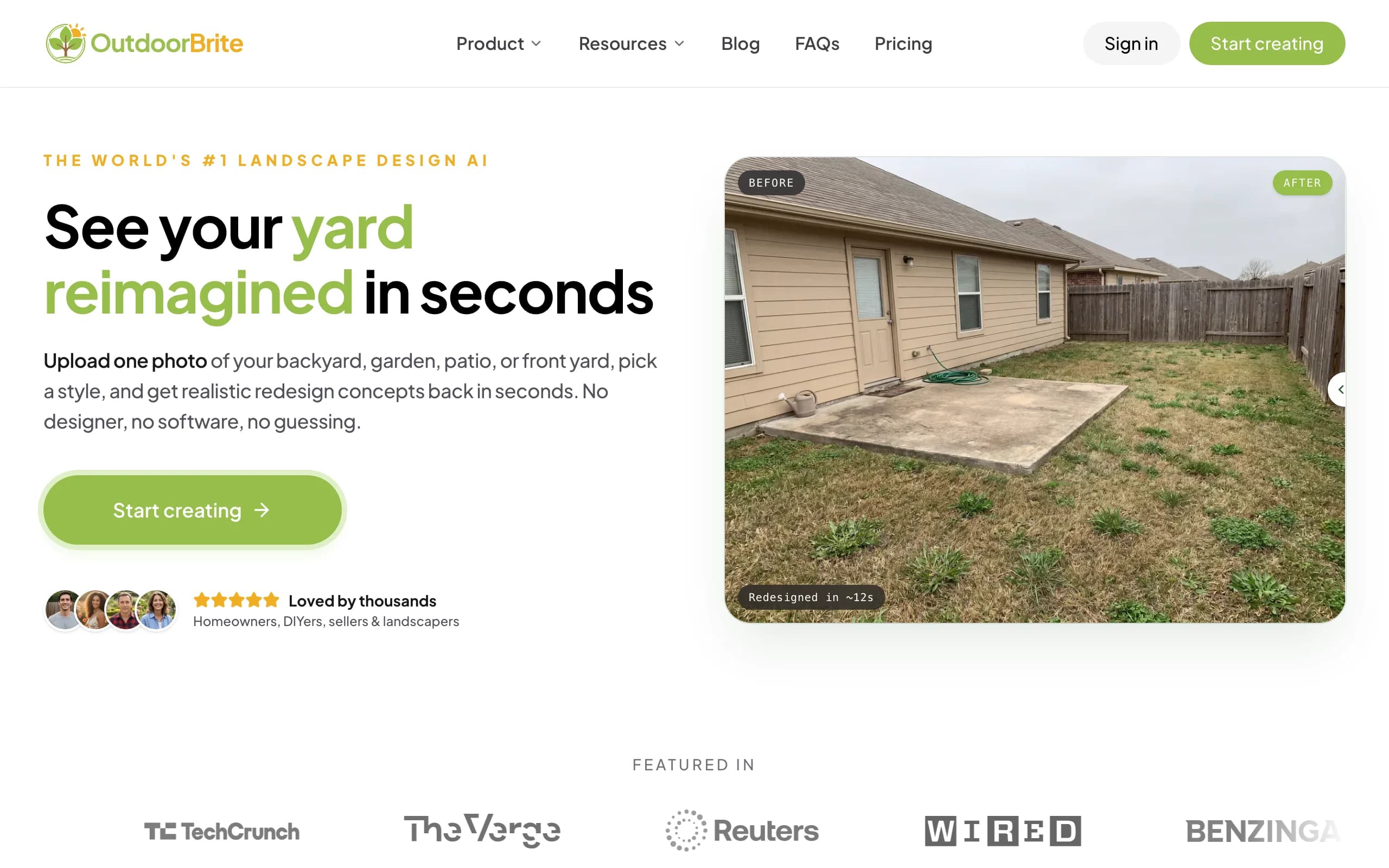
OutdoorBrite is an AI deck design tool built around one job: showing you what your own deck could look like, fast. You upload a photo of the space, whether it's a bare patch of yard or a tired old deck, pick a style (modern, cottage, desert or xeriscape, tropical, Mediterranean), describe what you want in plain words, and it generates realistic concepts in under a minute. You get multiple concepts per upload, so you're comparing real options on your real yard instead of staring at a saved photo of someone else's deck. An in-app AI editor lets you refine a concept after the fact, change the decking colour, swap a railing, add a pergola over the deck, or adjust the planting around it.
It goes well beyond decks. The same flow handles backyards, patios, gardens, fences, pergolas, pools, front yards, and full xeriscapes, and plant choices are aware of your climate and hardiness zone, so the greenery around a deck concept is something that could actually survive where you live. You can save and share designs, and paid plans include full commercial rights, which matters if you're a landscaper using the render as your on-site pitch. If you want the broader picture, the AI landscape design and AI backyard design pages cover the rest of the space; for decks specifically, the deck design tool is the place to start. You can also see how planting and lighting fill in the space underneath in this walkthrough of under deck landscaping ideas.
The honest limit: OutdoorBrite visualizes the look of a deck and the space around it. It does not produce framing layouts, joist spans, or permit drawings, so you take the concept to a builder or an engineer for the structural side.
Key features
- Photo-to-design AI: upload your yard or deck, get realistic concepts in under a minute
- Style presets plus a plain-language prompt to direct the look
- Multiple concepts per upload, with an in-app AI editor to refine
- Change decking colour, railings, levels, built-in seating, and a pergola over the deck
- Climate and hardiness-zone-aware planting around the deck
- Works for decks, patios, pergolas, pools, gardens, front and back yards
- Save, share, and full commercial rights on paid plans
Best for
- Homeowners who want to see a deck redesign on their own photo before spending
- DIY users who'll take the concept to a plant and materials list
- Landscapers and contractors using the render as a closing tool on-site
Pricing
- Paid-only, no free plan and no free trial. 1 credit = 1 design or 1 AI edit.
- Starter $29/mo ($23/mo billed yearly): 25 redesigns/mo, HD output.
- Plus $49/mo ($39/mo yearly): 100 redesigns/mo, sharp 2K output. Most popular.
- Pro $149/mo ($119/mo yearly): 200 redesigns/mo, 4K output, agency and commercial rights. Annual billing saves about 20%; top-up packs never expire.
Pros
- Realistic results on your actual yard or deck photo, not a generic template
- Fast enough to compare several deck styles in one sitting
- Editor lets you refine instead of restarting from scratch
- Planting suggestions respect your zone
Cons
- No free tier to test before you commit
- Visual concepts only, not framing or permit drawings
- Web-first, so heavy AR phone users may want a dedicated AR app alongside it
2. Yardzen, best for a human-designed, build-ready plan
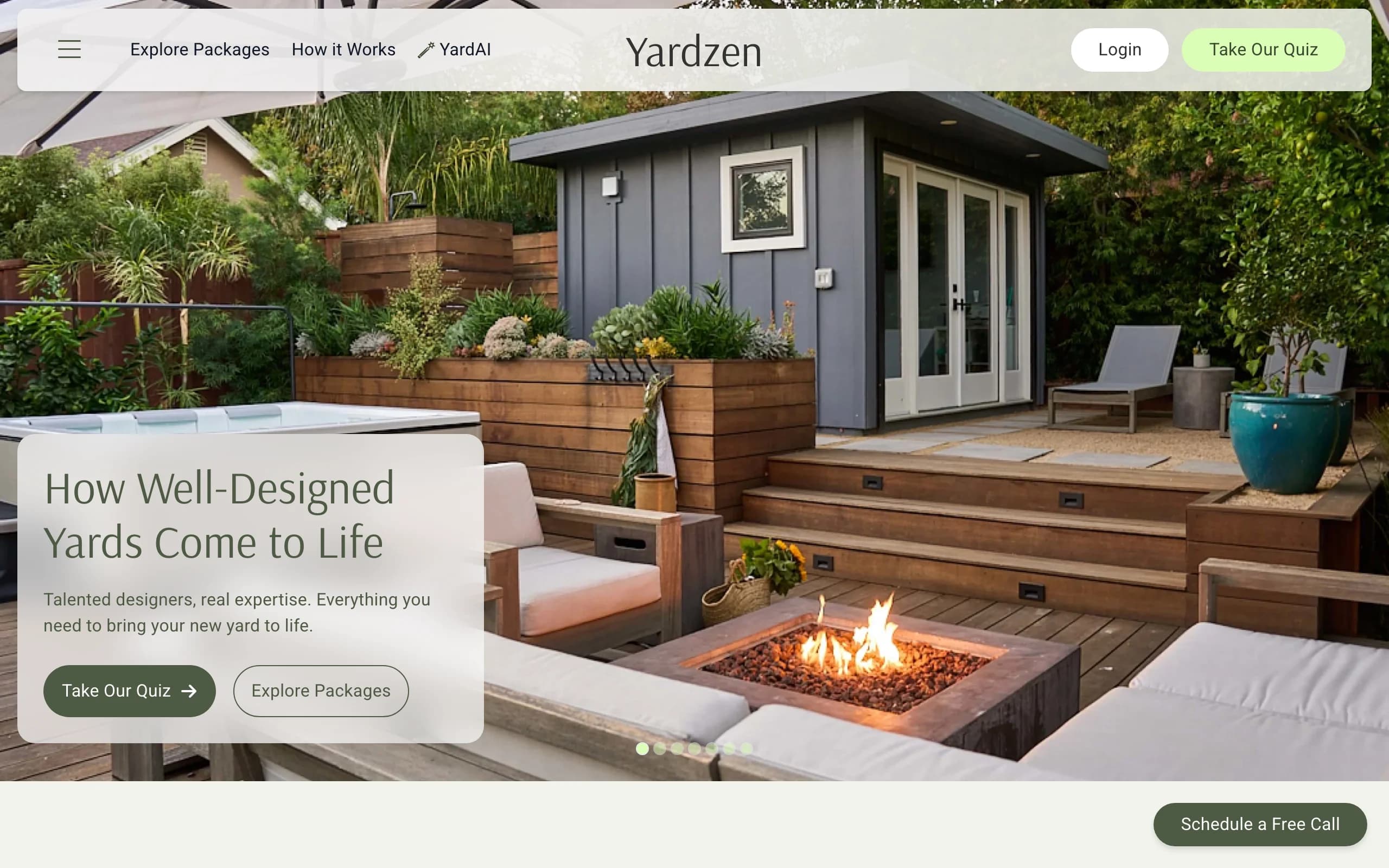
Yardzen is not an instant-render app. It's an online design service where real designers build you a custom plan from photos and a questionnaire about your space, budget, and taste. You get back 2D and 3D renders, plant and material lists, and, depending on the package, a cost advisor and a path to hiring vetted local contractors. The trade-off is time and money: this is a multi-week project with a designer in the loop, not a same-day render you generate yourself.
That makes Yardzen a good fit when you're past the inspiration phase and want a build-ready document you can hand to a deck crew. The plant and material lists are the real value, they turn a pretty render into something a contractor can quote and build. If you just want to try a few deck looks quickly, it's overkill, and the price reflects a human service rather than software.
Key features
- Custom plan from real designers based on your photos and goals
- 2D and 3D renders of the proposed design
- Plant and material lists you can hand to a contractor
- Cost advisor and contractor matching on higher tiers
Best for
- Homeowners ready to build who want a professional, documented plan
- Larger deck and full-yard projects where a designer earns their fee
- People who'd rather hand off the work than drive the tool themselves
Pricing
- Project-based, one-time fees, not a subscription. No free design tier.
- Packages: Essential $995, Classic $1,395, Signature $1,995, Premium $3,495.
- Higher tiers add revisions, a cost advisor, and full-property scope.
Pros
- A real designer and a build-ready plan, beyond a picture
- Plant and material lists make quoting and building concrete
- Contractor matching shortens the path to execution
Cons
- Expensive next to software, and it's a multi-week turnaround
- You can't quickly self-test several deck looks on your own
3. iScape, best for hands-on manual design with AR
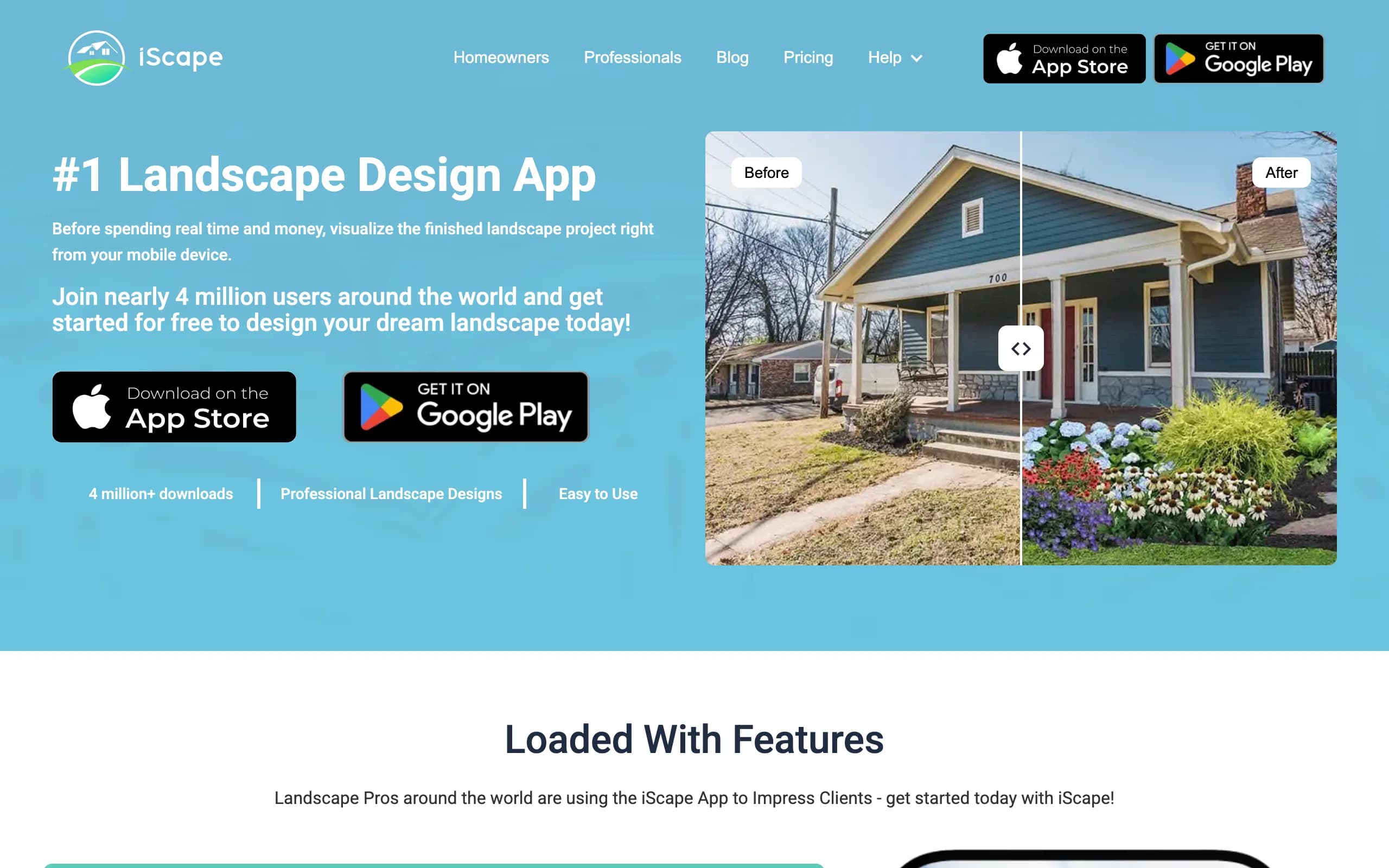
iScape is a phone-first app for people who want to design by hand rather than let AI do it. You build a deck scene by placing decking, planting, and hardscape onto a photo of your space, then preview the result in augmented reality on-site. It's closer to a manual design canvas with an AR preview than an automatic render engine, so you're in control of every element, which is great if you have a clear vision and the patience to lay it out.
The free plan lets you try the basics and save a couple of designs, while Pro adds the full plant and hardscape library, image uploads, and a proposal tool aimed at landscapers. The main limits are platform and effort: it's iOS-first with limited Android support, and because you're placing items manually, getting a polished deck scene takes real time compared with a one-click AI concept.
Key features
- Manual design: place decking, planting, and hardscape by hand on a photo
- AR preview to see the design on-site at scale
- Large plant and hardscape library on Pro
- Proposal tool aimed at pros
Best for
- DIYers who want full manual control over the layout
- iPhone users who like designing in AR on location
- Landscapers who want a proposal tool on a phone
Pricing
- Free plan: limited features, save up to 2 designs.
- Pro: $29.99/mo or $299.99/year (saves about two months).
- Enterprise: contact for multi-license pricing.
Pros
- Free tier to test the workflow
- AR preview is genuinely useful on-site
- Full control over every element of the design
Cons
- Manual placement is slower than AI generation
- iOS-first, with limited Android support
4. DreamzAR, best for an AR 3D walk-through on your phone
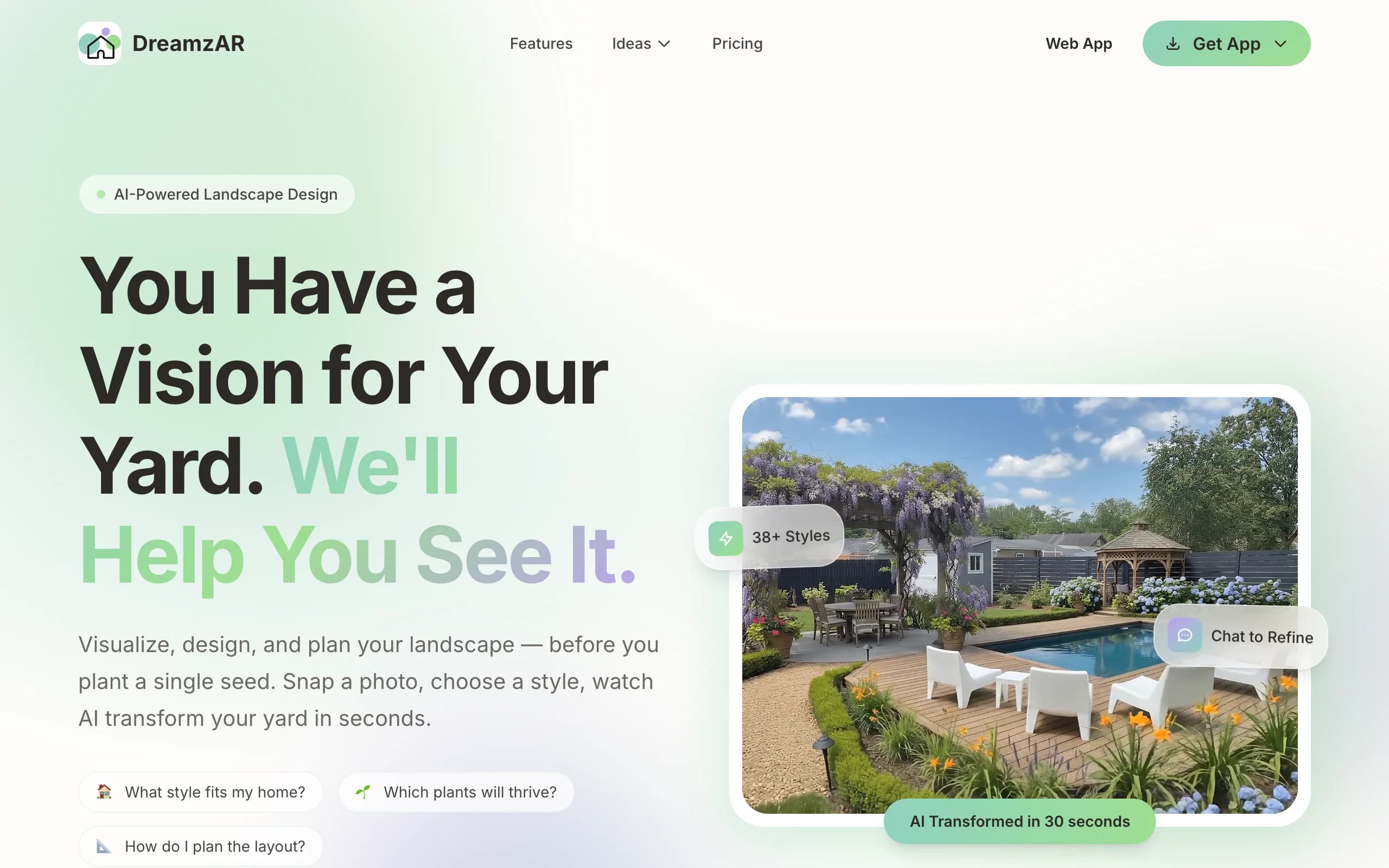
DreamzAR leans hardest into augmented reality. You drop 3D objects (planters, furniture, hardscape) onto your space and then walk through the design in AR, seeing it at real scale through your phone. It pairs that with AI styling and a chat refinement option, plus a large library of garden styles and plants, so you can both generate ideas and place them in three dimensions on your actual yard.
The AR walk-through is the standout: standing in your yard and seeing a raised deck or a pergola rendered in place is more convincing than a flat image for a lot of people. The flip side is that AR-heavy workflows depend on your phone and lighting, and the experience varies by device. There's a small free tier to test it before you subscribe.
Key features
- AR 3D walk-through of your design at real scale
- 3D object placement (planters, furniture, hardscape)
- AI styling plus chat-based refinement
- Large garden-style and plant library
Best for
- Homeowners who want to experience the design in AR, beyond a flat view
- Phone-first users comfortable steering a 3D scene
- People who value spatial preview over speed
Pricing
- $19.99/mo, or $16.60/mo billed annually at $199 (save 17%).
- A small free tier with limited generations to try first.
- Cancel anytime.
Pros
- Strong AR walk-through that puts the design in your real space
- Free tier to test before paying
- Chat refinement makes tweaks approachable
Cons
- AR quality depends on your phone and lighting
- 3D placement takes more effort than a flat AI render
5. ShrubHub, best for an affordable online design service
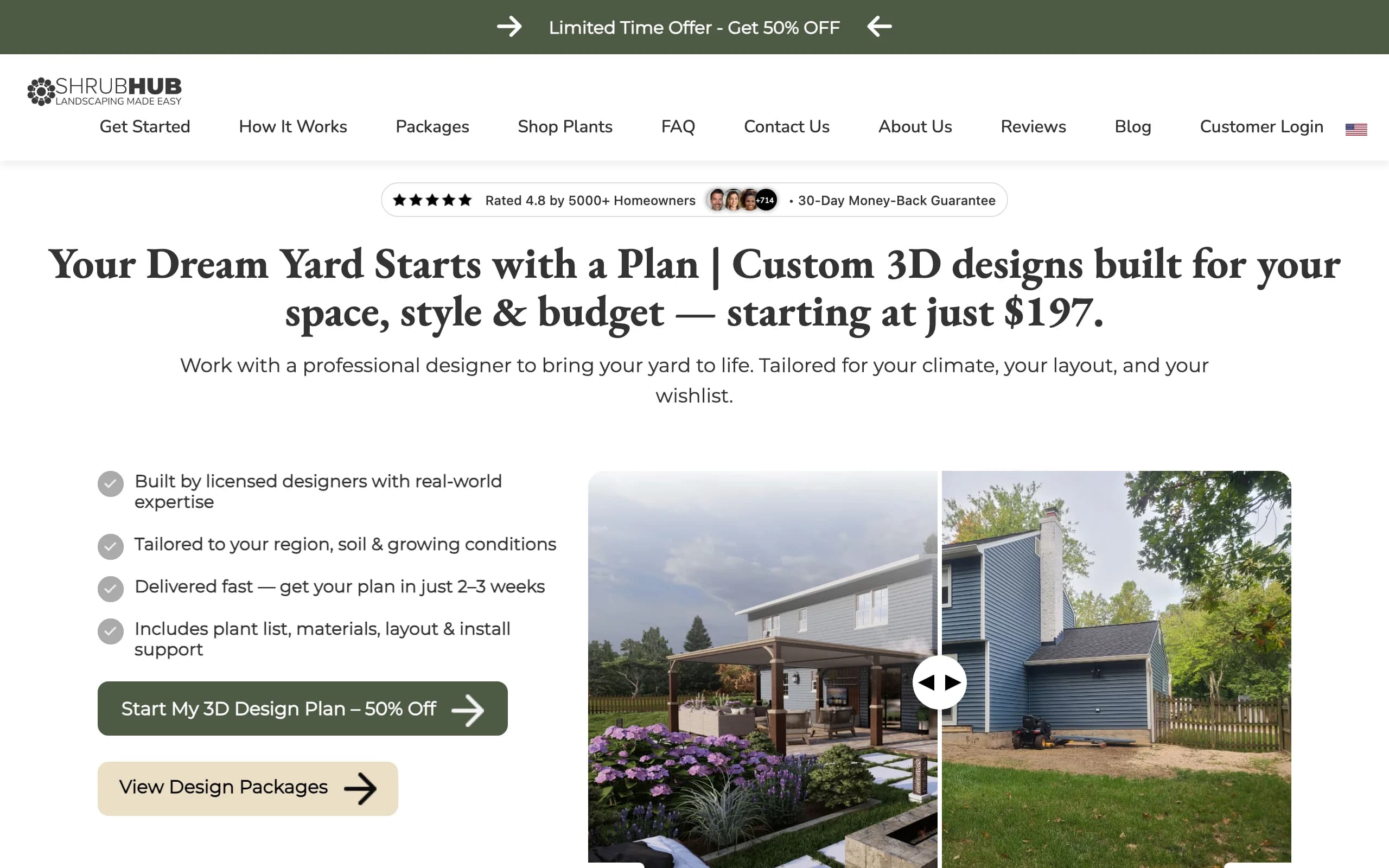
ShrubHub is the budget-friendly version of the human design service. You share photos and goals, a designer builds you a custom 3D plan, and you get a plant and material shopping list plus a connection to local contractors. It covers the same ground as a premium studio at a fraction of the cost, with unlimited revisions until you're happy and a money-back guarantee.
The value is the price-to-service ratio: a real 3D plan and a shopping list for a few hundred dollars, often under sale pricing, instead of thousands. The catch is the same as any service: a turnaround of a couple of weeks, and you're depending on a designer rather than generating concepts yourself. If you want a documented deck plan without Yardzen's price, ShrubHub is the obvious middle ground.
Key features
- Custom 3D plan built by a designer
- Plant and material shopping list
- Unlimited revisions until you approve
- Contractor connections and a money-back guarantee
Best for
- Homeowners who want a designed plan on a tight budget
- People who'd rather hand off than DIY, but can't justify a premium studio
- DIFM buyers heading straight to hiring labor
Pricing
- Flat per-yard fees, frequently on sale. No free design tier.
- Sale pricing: Front Yard $197, Back Yard $237, Both Yards $297, Premium $997.
- Regular prices run higher ($594 to $1,994); packages start at $297 off-sale.
Pros
- Far cheaper than a traditional studio for a real plan
- Unlimited revisions and a money-back guarantee
- Shopping list and contractor connections aid execution
Cons
- Multi-week turnaround, not instant
- You don't drive the design or self-test quick looks
6. Planner5D, best for DIY 3D layout and measured planning
Planner5D is a general home-design app that works well for decks when you care about precise layout. You draw your deck to scale, then arrange levels, railings, furniture, and structures in a 2D plan you can flip to 3D. It's less about photoreal AI restyling and more about getting measurements, proportions, and the arrangement right, which is exactly what you need before you order boards or plan a multi-level deck. It still stops short of structural engineering, but it gets the footprint and the layout honest.
It's cross-platform (web, iOS, Android) with a usable free tier, and the Premium plan is cheap on annual billing. Two things to know: the visual output is 3D-model rendering rather than photoreal AI on your actual photo, and iOS app pricing tends to run higher than the web prices, so subscribe on the web if you can.
Key features
- Draw your deck to scale in 2D, view in 3D
- Level, railing, furniture, and structure layout
- Large object catalog for arranging the space
- Cross-platform: web, iOS, Android
Best for
- DIYers who want accurate measurements and layout
- People planning levels and railing placement before buying
- Anyone who prefers a model-based plan to an AI render
Pricing
- Free plan with limited features.
- Premium: $4.99/mo billed annually ($59.99/year), or higher month-to-month.
- Professional: $33.33/mo ($399.99/year). iOS app pricing runs higher than web.
Pros
- Strong for measured, to-scale layout
- Affordable Premium tier on annual billing
- Works across web and mobile
Cons
- 3D-model output, not photoreal AI on your own photo
- iOS pricing is higher than the web prices
7. REimagine Home, best for quick free AI exterior restyling
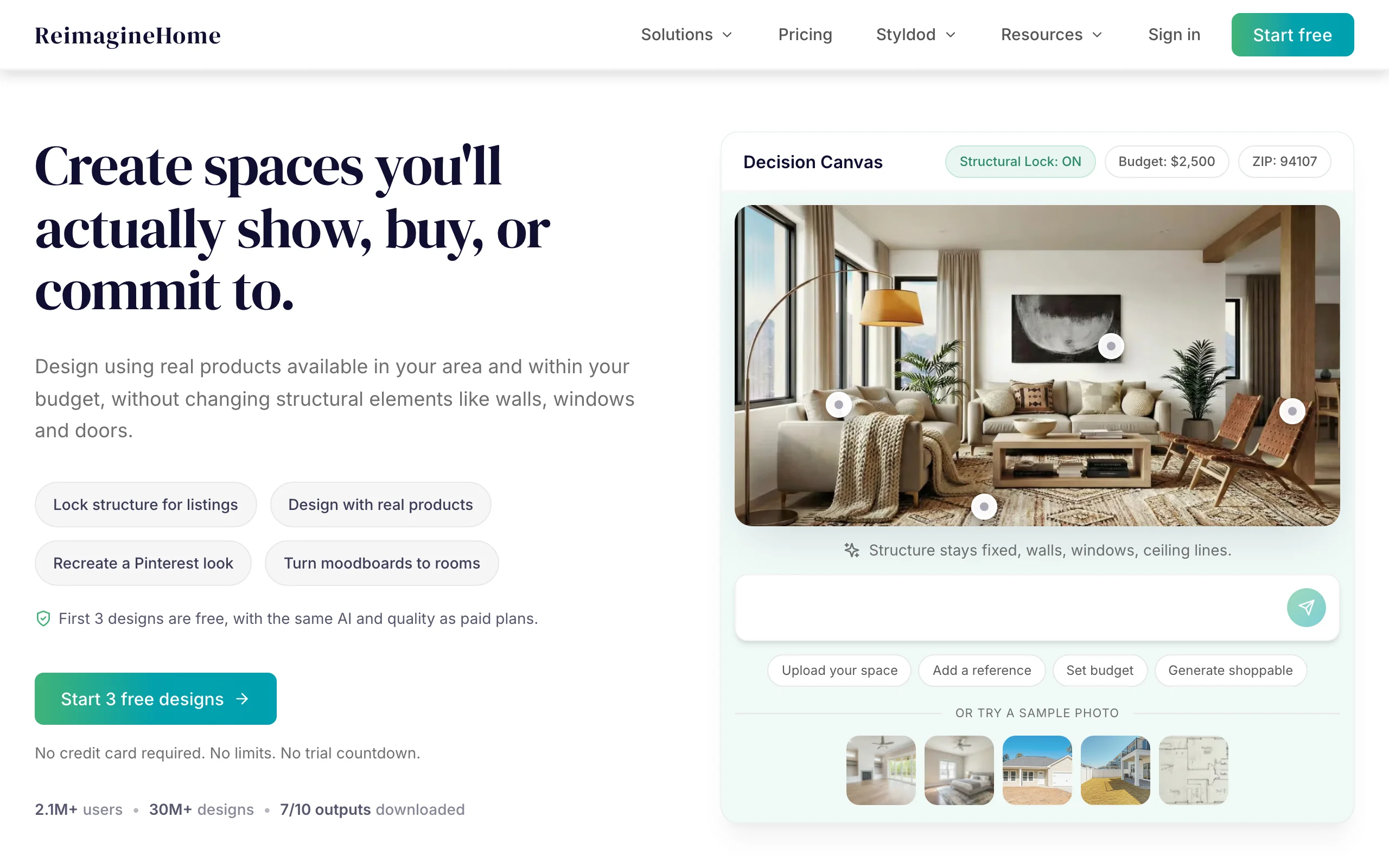
REimagine Home is a fast, photo-first AI restyle tool that covers interiors and exteriors. For decks, you upload an exterior photo and it restyles the space with AI, quickly and with a genuinely useful free tier (a few designs to test, no card required). It's built for speed and breadth across home design rather than landscape-specific depth, so it's a good way to see a quick "what if" on an exterior photo at no cost.
Because it's a general home-AI tool, it doesn't carry landscape-specific features like climate-aware plant lists, and the strongest results lean toward broad restyling rather than a buildable deck plan. As a free, low-commitment first look, it's hard to beat; as the tool you take all the way to a build, it's thinner than the deck-focused options.
Key features
- Photo-first AI restyling for interiors and exteriors
- Quick generations from an uploaded photo
- Credit-based plans (1 credit = 1 generation)
- Free designs for new users to test the quality
Best for
- People who want a free, fast first look at an exterior restyle
- Users testing AI design quality before paying
- Interior-plus-exterior projects in one tool
Pricing
- Free: 3 designs for new users, plus a 7-day trial, no card required.
- Essential $14/mo (30 credits), Pro $29/mo (200), Advanced $49/mo (400).
- Agency $99/mo (900). Monthly billing only as of this writing.
Pros
- Genuinely useful free tier to start
- Fast results from a single photo
- Covers interior and exterior in one place
Cons
- General home-AI, not landscape-specific
- No climate-aware plant choices for deck planting
How to choose the best AI deck design tool for your needs
1) DIY, done-for-you, or a contractor's sales tool
Start with who's doing the work. If you want to drive it yourself and end up with a plant and materials list to build from, an instant AI tool like OutdoorBrite or a manual app like iScape fits. If you'd rather hand it off and get a documented plan, the services win: ShrubHub for budget, Yardzen when you want a premium designer and contractor matching. And if you're a landscaper, the question flips: you want a render fast enough to show a client on-site and close the job. That's where OutdoorBrite's commercial rights and speed, or iScape's proposal tool, earn their place.
2) Visual concept versus engineered build plan
This is the call that trips people up, so be clear about it before you pick a tool. Every option here, including the human services, is about how the deck looks and roughly how it lays out. None of them produces the engineered framing plan, joist and beam spans, footing details, or stamped permit drawings a build actually needs. AI tools like OutdoorBrite and REimagine Home get you a believable picture fast. Planner5D gets you a to-scale layout. Yardzen and ShrubHub get you a designed plan with material lists. For the structural drawings, you still go to a deck builder or an engineer, and you check local permit rules. Use these tools to decide the look and brief the build, then let a pro draw the structure.
3) Realism on your own yard photo
A render only helps if it looks like your yard, not a stock deck. Tools that restyle your actual uploaded photo (OutdoorBrite, REimagine Home) get you there fastest; AR tools (DreamzAR, iScape) put the deck in your real space in 3D, which some people find more convincing than a flat image. Model-based planners (Planner5D) trade photorealism for measured accuracy. Decide whether you care more about "does it look real on my photo" or "are the measurements exact," because few tools lead at both.
4) Pricing and credit math
Match the pricing model to how much you'll actually use it. A flat-fee service (Yardzen, ShrubHub) makes sense for one big project you only design once. A subscription (OutdoorBrite, DreamzAR, Planner5D, REimagine Home) makes sense if you'll iterate across several looks or several yards. With credit-based AI tools, do the math: OutdoorBrite's Plus plan gives 100 redesigns a month, which is a lot of comparing, while a free tier (iScape, Planner5D, REimagine Home) is fine if you only need a couple of concepts. Remember that "free" usually caps saves, resolution, or features.
FAQ
What is AI deck design? AI deck design uses software to generate or restyle a picture of your deck from a photo and a few inputs like style and budget. Instead of imagining the finished space, you see realistic concepts you can react to. Some tools render automatically; others let you place elements by hand or preview them in augmented reality.
Is there a free AI deck design tool? Yes, a few. REimagine Home gives new users free designs and a short trial, iScape has a free plan with limited features, and Planner5D has a free tier. Free tiers usually cap how many designs you can save, the output resolution, or the feature set, so they're best for testing rather than finishing a full project.
Can AI design a deck from a photo? Yes. Photo-first tools like OutdoorBrite and REimagine Home take a single photo of your yard or existing deck and return restyled concepts, often in under a minute. The closer your photo matches the real conditions (good light, a clear view of the space), the more usable the result. You can work decking colour, railings, levels, and built-in seating into the concept.
Do AI deck tools make structural or permit-ready plans? No. These are visual concept tools. They show how a deck looks in your yard and roughly how it sits in the space, but none of them produces engineered framing plans, joist and beam spans, footing details, or stamped permit drawings. Use them to settle the look and brief the project, then take it to a licensed deck builder or an engineer for the structural design, and check your local permit rules.
Which tool is best for homeowners versus contractors? Homeowners who want speed and a buildable look lean toward OutdoorBrite or, for a hands-off plan, ShrubHub and Yardzen. Contractors want a render fast enough to show a client on-site and the rights to use it commercially, which points to OutdoorBrite's paid plans or iScape's proposal tool. The deciding factor is whether the output is for your own build or to sell a job.
Is an AI deck render realistic enough to build from? A good render is realistic enough to decide direction, choose a style, and brief a builder, but it's a concept, not an engineering drawing. For the actual build, pair the render with a material list and a builder's measurements and structural plan. Services like Yardzen and ShrubHub deliver documented design plans; AI tools like OutdoorBrite get you to that conversation faster.
What photo gives the best results? Shoot in good daylight, hold the phone steady, and frame the whole deck area with a bit of the surroundings so the tool understands the space. Avoid heavy shadows, clutter, and extreme angles. A clear, well-lit, straight-on photo gives the AI the most to work with and produces the most believable redesign.
How much does AI deck design cost? It ranges widely. Subscription AI tools run from about $14 to $49 a month for typical homeowner use (OutdoorBrite starts at $29/mo, REimagine Home at $14/mo, DreamzAR at $19.99/mo), and DIY planners like Planner5D start around $5/mo on annual billing. Human design services are one-time fees: ShrubHub from $197 per yard on sale, Yardzen from $995. Match the price model to whether you're designing once or iterating often.
Do AI deck tools suggest plants that survive my climate? Some do, many don't. OutdoorBrite makes plant choices aware of your climate and hardiness zone, so the greenery around a deck concept could realistically grow where you live. General home-AI tools like REimagine Home restyle the image but don't tailor planting to your zone, so you'll want to check any plant suggestions against your local conditions before buying.
Ready to see it on your own yard? Open the AI deck design tool, or start designing at outdoorbrite.com.