Retaining Wall Cost in 2026: Price per Foot by Material
What a retaining wall costs in 2026 by material, height and length, with sourced prices per foot and the engineering, drainage and permit costs contractors quote separately.
Most homeowners pay between $3,200 and $9,200 to have a retaining wall built, and the national average sits around $6,100, according to Angi's 2026 project data. That spread is wide for a reason. The retaining wall cost on your quote depends mostly on three things: how tall the wall is, what it's made of, and how much digging and drainage the slope needs before the first block goes down.
Height matters more than people expect. Once a retaining wall holds back more than about 4 feet of soil, most building codes treat it as a structure, and you start paying for an engineer, a permit, reinforcement and a deeper base. Those items are often quoted as separate lines, which is why two bids for "the same wall" can differ by thousands.
This guide puts the 2026 numbers in one place: price per square foot and per linear foot by material, totals for common wall sizes, the extras contractors add, and where you can save. Every figure is sourced and dated October 2026.
Average retaining wall cost in 2026
Here is what the main cost guides report for a professionally built wall, materials and labor included:
| Source (date checked) | Average total | Typical range | Per square foot of wall face |
|---|---|---|---|
| Angi (updated Sep 2026) | $6,083 | $3,191 to $9,202 | $10 to $150 depending on material |
| HomeGuide (Jan 2026) | Not stated | Contractor minimum $1,500 to $3,000 | $35 to $65 |
| LawnStarter (2026) | $6,300 | $3,500 to $9,400 | $20 to $53 |
| Homewyse (May 2026) | Not stated | 120 sq ft block wall: $4,256 to $5,844 | $35 to $49 |
Two numbers are worth keeping in your head. A typical installed wall costs $35 to $65 per square foot of wall face (length times height), and most contractors won't take a job under $1,500 to $3,000. That minimum is why a short garden wall rarely comes in as cheap as the per-foot math suggests.
To measure your wall in square feet, multiply its length by its exposed height. A wall 40 feet long and 3 feet tall is 120 square feet.
Retaining wall cost per foot
Contractors price walls two ways. Per square foot is the cleaner comparison between materials. Per linear foot (one foot of wall length, at whatever height you need) is easier to picture when you're standing at the slope.
You can convert one into the other by multiplying by the height. At HomeGuide's $35 to $65 per square foot, that gives:
| Wall height | Cost per linear foot | What changes at this height |
|---|---|---|
| 2 feet | $70 to $130 | Garden and border walls; usually no permit |
| 3 feet | $105 to $195 | The most common backyard wall; deeper base and drainage pipe |
| 4 feet | $140 to $260 | Permit threshold in many towns; engineering often starts here |
| 6 feet | $210 to $390, plus engineering | Geogrid or rebar, footings, stamped drawings, inspections |
Angi's 2026 figures land in the same zone: about $40 to $200 per linear foot for a 2-foot wall and up to $360 or more for a 6-foot wall. The jump above 4 feet comes from the structural work behind the wall, not the face you see. More on that below.
Retaining wall cost by material
Material sets both the price per square foot and how long you'll keep the wall. The ranges below are installed costs from Angi and HomeGuide, checked October 2026. The middle column shows what a 30-foot wall, 3 feet tall (90 square feet), would cost at those rates before any extras.
| Material | Installed cost per sq ft | 30 ft x 3 ft wall | Typical lifespan | Best for |
|---|---|---|---|---|
| Vinyl | $10 to $20 | $900 to $1,800 | About 50 years | Short decorative walls, light loads |
| Timber (pressure-treated) | $15 to $30 | $1,350 to $2,700 | 10 to 40 years | Budget walls under 3 ft |
| Gabion (wire baskets of rock) | $10 to $40 | $900 to $3,600 | 10 to 75 years | Erosion control, modern or rustic looks |
| Segmental concrete block | $15 to $50 | $1,350 to $4,500 | 50 to 100 years | Most residential walls |
| Poured concrete | $20 to $45 | $1,800 to $4,050 | 50 to 100 years | Tall structural walls, tight spaces |
| Brick (usually veneer on concrete) | $20 to $60 | $1,800 to $5,400 | 100+ years | Matching a brick house |
| Natural stone | $20 to $100 | $1,800 to $9,000 | 50 to 200 years | Low garden walls, high-end looks |
| Steel or Corten | $15 to $150 | $1,350 to $13,500 | 20 to 40 years | Contemporary designs |
Lifespans come from HomeGuide and LawnStarter. The totals assume a straightforward site; the contractor minimum often pushes the cheaper rows up to $1,500 or more.
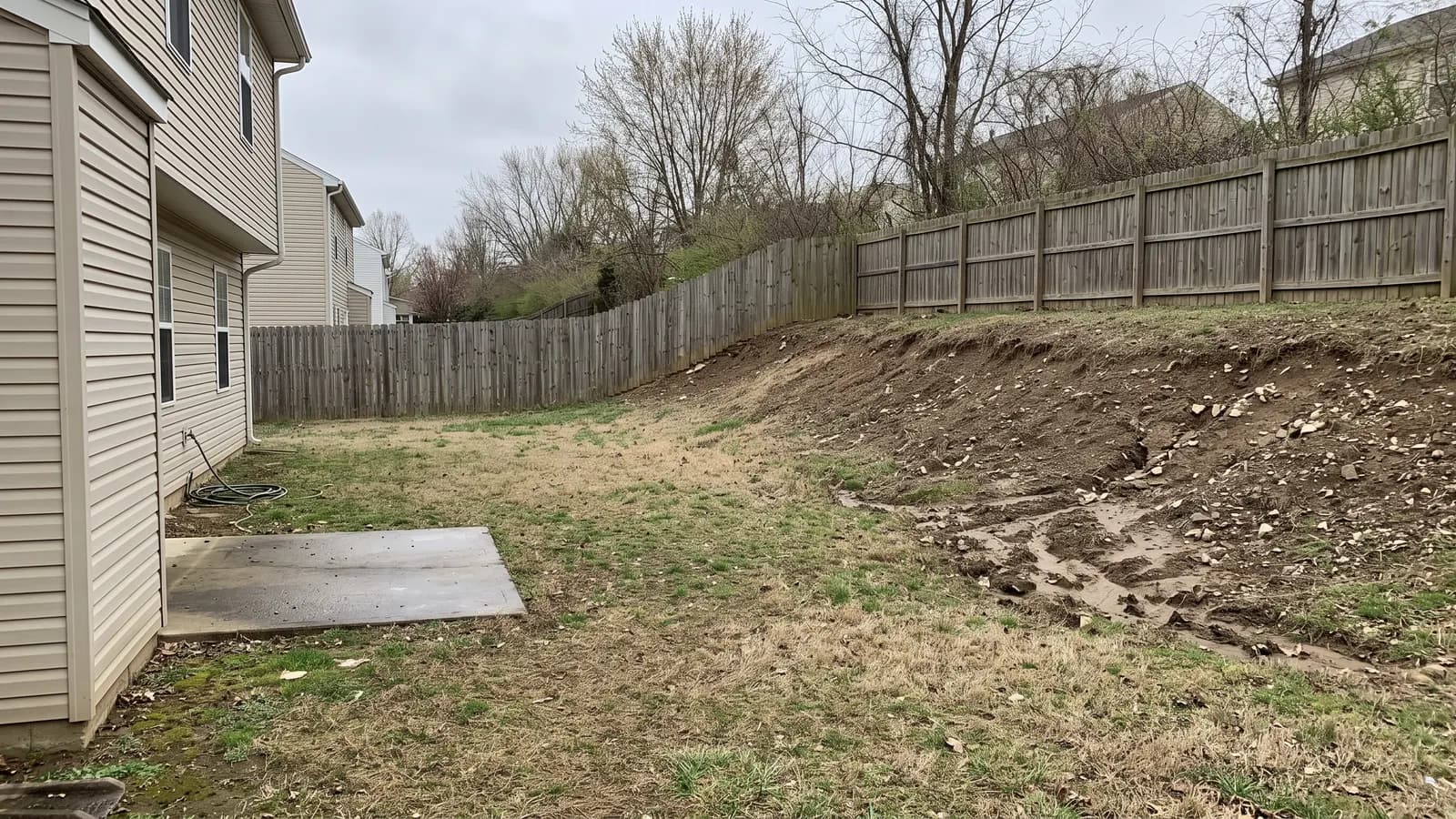
Here is the same sloped yard from the top of this page as three AI concepts, one per common material. Same bank, same fence, same camera spot:
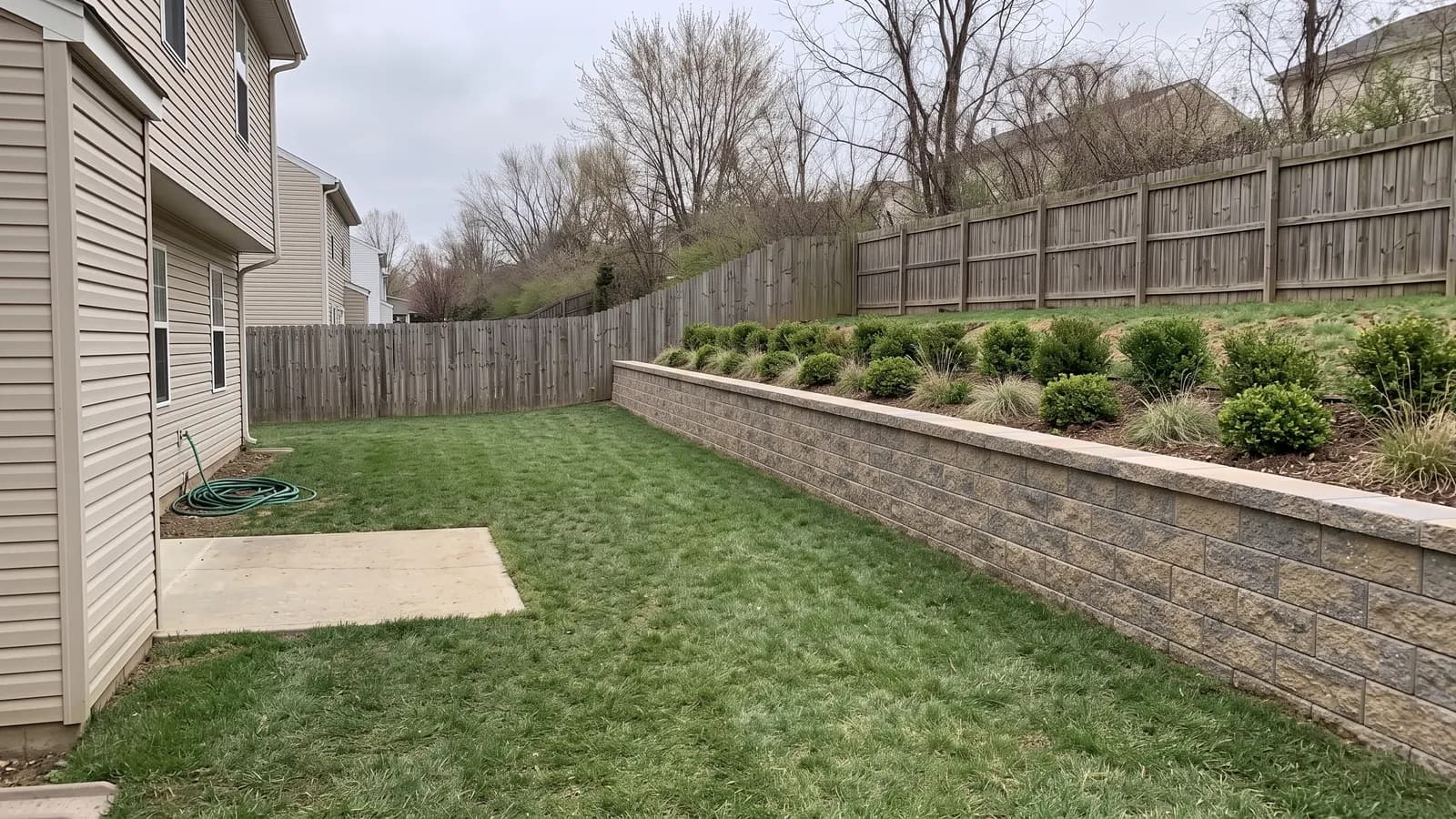
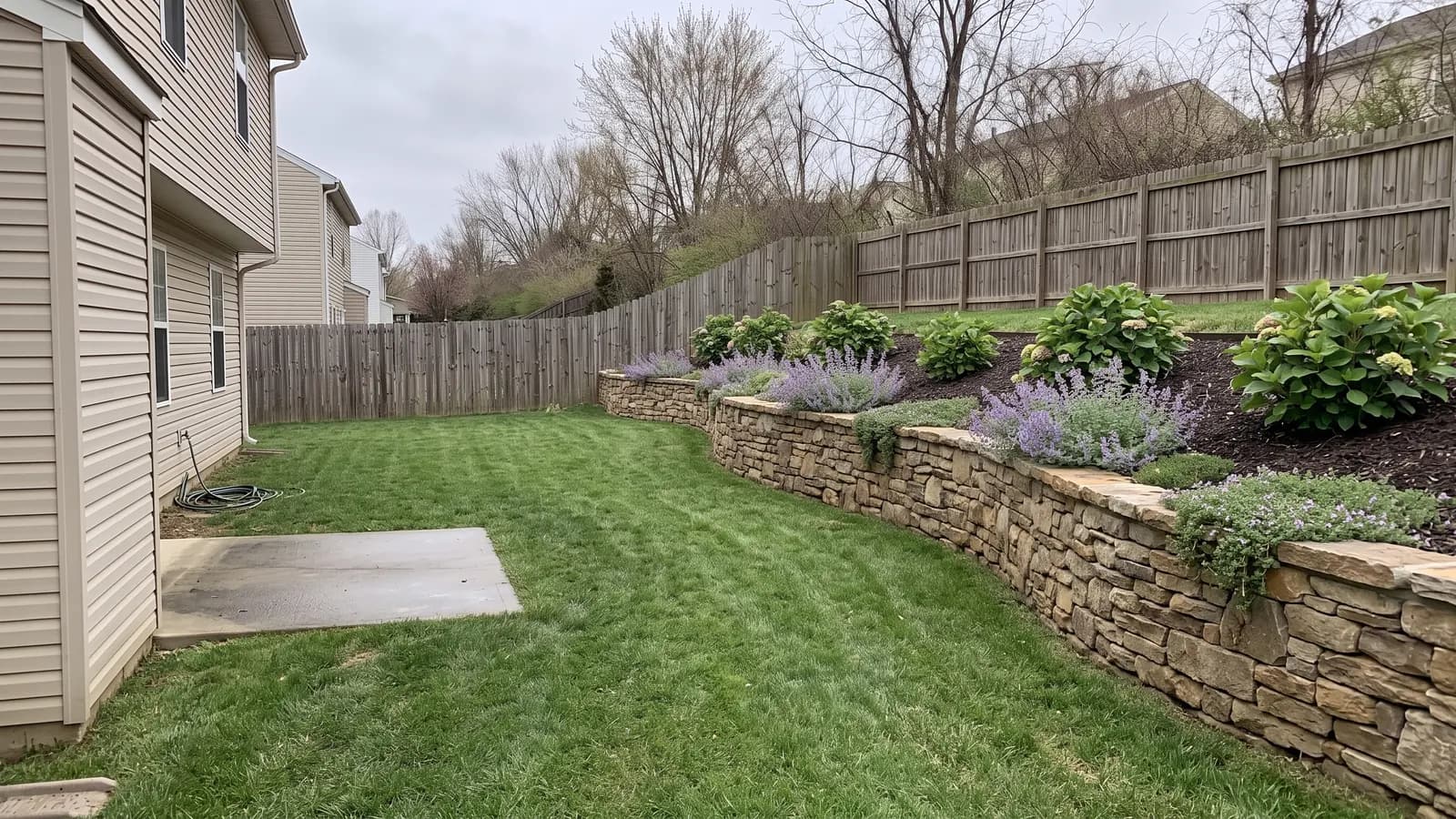
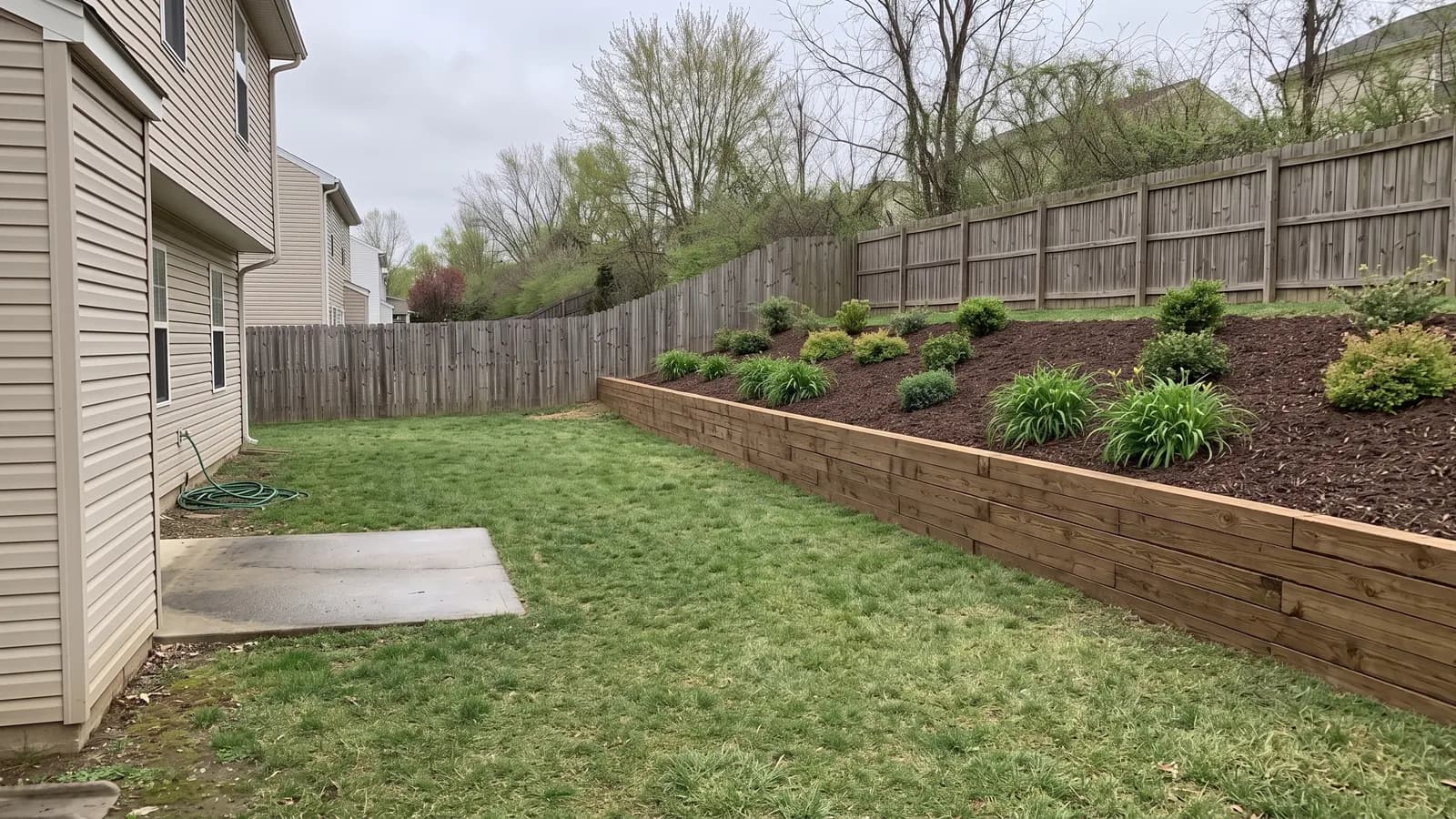
On a 30-foot run, those three walls could be $1,350 apart or $6,000 apart depending on the stone you pick. Seeing them on your own slope first makes it easier to decide whether stone is worth the premium or block looks fine.
Concrete block
Interlocking segmental block is what most contractors recommend for walls under 4 feet. The blocks stack dry (no mortar), handle freeze and thaw, and come in finishes that imitate stone. Blocks cost about $2 to $10 each at retail, per LawnStarter. Above 4 feet, block walls need geogrid reinforcement layers that run back into the slope, which adds digging and material.
Natural stone
Stone has the widest price range of any material, from local fieldstone at the low end to cut limestone at the top. Dry-stacked stone suits short walls, where its irregular shape is a feature. Labor is the expensive part: fitting stones by hand takes longer than stacking uniform blocks.
Timber
Timber is the cheapest wall that still looks like landscaping. The trade-off is life span. Pressure-treated wood eventually rots, and many walls start to lean within 15 to 20 years. Skip old railroad ties: they're treated with creosote, and some towns ban them.
Poured concrete
Poured concrete costs more to form but is the go-to for tall walls, walls next to driveways, and tight spots where a block wall's setback won't fit. It's plain unless you pay for a stamped or veneered face.
Gabion
A gabion wall is a stack of wire baskets filled with rock. Material cost is moderate, and the open structure drains on its own, so you may spend less on drainage. Prices swing with the cost of rock delivered to your area.
Cost by wall height and length
Size drives the total more than anything else. This table uses HomeGuide's $35 to $65 per square foot rate, the same rate behind its own 2, 4 and 6-foot figures (the 3-foot column is calculated the same way):
| Wall length | 2 ft tall | 3 ft tall | 4 ft tall | 6 ft tall |
|---|---|---|---|---|
| 10 ft | $700 to $1,300 | $1,050 to $1,950 | $1,400 to $2,600 | $2,100 to $3,900 |
| 25 ft | $1,750 to $3,250 | $2,625 to $4,875 | $3,500 to $6,500 | $5,250 to $9,750 |
| 50 ft | $3,500 to $6,500 | $5,250 to $9,750 | $7,000 to $13,000 | $10,500 to $19,500 |
| 100 ft | $7,000 to $13,000 | $10,500 to $19,500 | $14,000 to $26,000 | $21,000 to $39,000 |
Two caveats. Short walls usually hit the contractor minimum, so a 10-foot wall rarely costs under $1,500. And walls 4 feet and up need extras (below) that this simple rate doesn't include.
Length works in your favor. Mobilization, equipment and setup are spread over more footage on a long wall, so the price per foot tends to fall as the wall gets longer.
Two short walls vs one tall wall
If your slope needs 5 or 6 feet of retained height, ask about terracing it with two shorter walls instead. Each wall stays under the engineering threshold, you get a level planting bed between them, and the result is often cheaper than one tall engineered wall. It needs more horizontal room, so it works on long, gentle slopes better than on a steep bank next to the house.
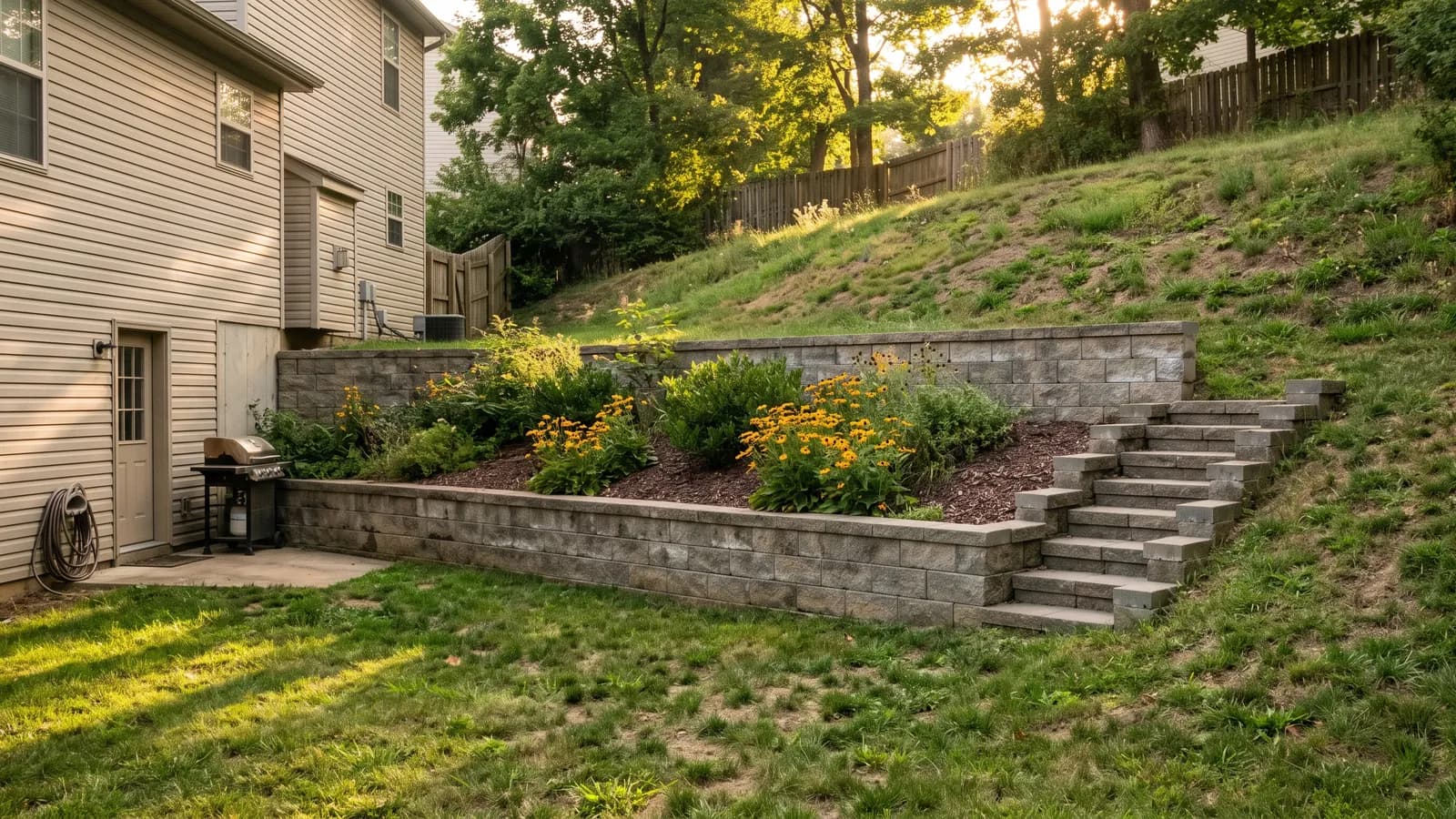
If you're terracing on a tight budget, our hillside landscaping ideas on a budget cover lower-cost ways to hold and plant a slope, including where a wall isn't needed at all.
Labor vs materials
Labor is usually the bigger half. HomeGuide puts it at 40% to 60% of the total, with crews charging $50 to $75 an hour; Angi quotes the same hourly range, or $15 to $50 per square foot.
Homewyse's May 2026 example shows the split on a basic 3-foot dry-stack block wall of about 120 square feet:
| Line item | Low | High |
|---|---|---|
| Blocks (with waste allowance) | $2,254 | $3,400 |
| Basic installation labor (about 20 hours) | $1,890 | $2,291 |
| Supplies and equipment rental | $112 | $153 |
| Total | $4,256 | $5,844 |
That estimate assumes easy access and good soil. It excludes permits, and Homewyse says to add 13% to 22% if a general contractor supervises the job.
Labor climbs when the crew has to hand-carry block through a side gate, dig through clay or rock, or build curves and steps. Sloped, rocky or tight sites can push labor up by 50% or more, according to both HomeGuide and Angi.
Hidden costs: engineering, drainage, permits, excavation
These are the items that separate a $4,000 quote from a $9,000 one. Many contractors list them separately, and some leave them out until the dig starts. Prices checked October 2026:
| Item | Typical cost | When you need it |
|---|---|---|
| Structural engineer | $350 to $750 (Angi); $500 to $2,000+ (HomeGuide) | Walls over about 4 ft, or walls carrying a driveway, fence or building above |
| Building permit | $50 to $450 | Often over 3 to 4 ft; check your town |
| Drainage pipe and gravel backfill | French drain $10 to $85 per linear ft | Every wall needs drainage; cost rises with wet or clay soil |
| Excavation | Excavator $100 to $300 per hour | Cutting into the slope for the base and backfill zone |
| Grading | $900 to $3,000 per job, or $0.40 to $2 per sq ft | Leveling above or below the wall |
| Footings | $18 to $55 per linear ft | Tall and poured concrete walls |
| Rebar | $0.80 to $2.50 per sq ft | Concrete walls and walls over 4 ft |
| Waterproofing | $2 to $10 per sq ft | Concrete and block faces, wet sites |
| Old wall removal | $15 to $30 per linear ft | Replacing a failed wall |
| Material delivery | $30 to $100 per truckload | When block or stone isn't in the quote |
| Fill dirt | $150 to $600 per truckload | Building up a level area behind the wall |
| Tree removal | $200 to $2,000 | Roots or trunks in the wall line |
Sources: Angi, HomeGuide and Homewyse, 2026 pages.
When you need an engineer
The International Residential Code (section R404.4) requires an engineered design for any retaining wall that isn't braced at the top and holds back more than 48 inches of soil. It also applies to walls over 24 inches tall that carry extra loads besides the soil, like a driveway or a structure above. Many towns adopt that rule as is, and some are stricter. Your local building department has the final word, and a reputable contractor will tell you up front if your wall crosses the line.
Drainage is not optional
Water pressure behind a wall is the most common reason walls bow and fail. A properly built wall has a gravel backfill zone, filter fabric, and a perforated pipe at the base that carries water to a daylight outlet or a French drain. If a quote doesn't mention drainage, ask. Our gravel calculator will tell you roughly how much drainage stone a backfill zone takes if you're pricing materials yourself.
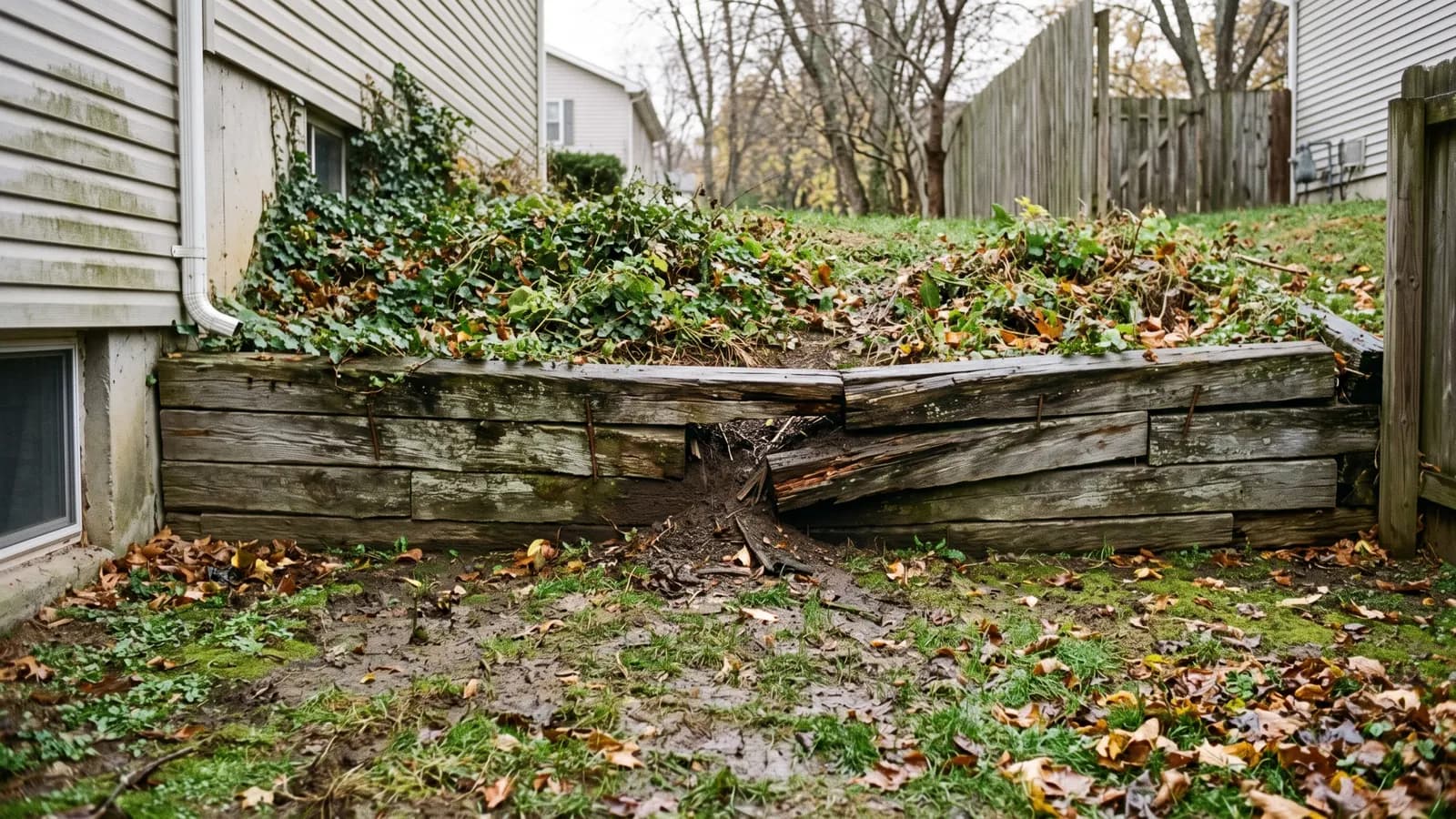
A wall like this one is usually a drainage failure, not a material failure. Replacing it means paying for demolition and fixing the drainage on top of the new wall, which is why the cheapest bid on a new wall isn't always the cheapest wall.
DIY vs hiring a pro
Building it yourself cuts the cost roughly in half or better. LawnStarter puts a DIY wall at $4 to $20 per square foot, against $20 to $53 for professional installation, plus about $160 in tools (level, tamper, rubber mallet, shovel, tape and a saw rental).
| DIY | Professional | |
|---|---|---|
| Cost per sq ft | $4 to $20 | $20 to $65 |
| 30 ft x 2 ft garden wall | About $240 to $1,200 in materials | Usually the contractor minimum, $1,500 to $3,000 |
| Equipment | Rent a plate compactor and possibly a mini excavator | Included |
| Warranty | None | Often included on workmanship |
| Sensible height | Under about 3 ft, ideally 2 ft | Any height |
DIY makes sense for short, straight walls on well-drained ground where a lean or collapse wouldn't hit anything important. Leave it to a crew when the wall is over 3 feet, sits near your foundation or a property line, has clay soil behind it, or needs a permit.
The usual DIY mistake is skimping on the base and the backfill. Blocks stacked on loose soil and backfilled with the clay that came out of the hole will look fine for a season or two, then start to tip.
How to get accurate retaining wall quotes
Retaining wall bids are hard to compare because contractors draw the line in different places. To get numbers you can line up:
- Measure first. Length along the slope and the height of soil to be held back at the tallest point. Note where water runs after rain.
- Decide the look before you call. Settle on material and rough shape (straight, curved, terraced) so every contractor prices the same wall. An AI concept of your own slope is a quick way to do this; AI retaining wall design shows block, stone or timber on a photo of your yard. It gives you a picture to brief from, not measurements or a price.
- Ask for three itemized quotes. Excavation, base, wall material, drainage, backfill, caps, cleanup and haul-away on separate lines.
- Ask who handles the engineer and permit, and whether those costs are in the price.
- Ask about access. If equipment can't reach the slope, labor goes up, and you want that in the quote, not a change order.
- Get the warranty in writing, including what happens if the wall leans within the first few years.
Ways to save on a retaining wall
- Keep it under 4 feet. Staying below the engineering threshold, or terracing with two short walls, is the single biggest saving on a steep slope.
- Pick block over stone where looks matter less. Segmental block has a tighter price range and installs faster.
- Use local material. Stone quarried nearby costs less to deliver. Ask what your supplier stocks.
- Combine projects. If a patio or steps are coming, building them with the wall shares the excavation and equipment costs.
- Book outside peak season. Frozen ground raises labor costs, and spring is busy. Late summer and early fall are often easier to schedule.
- Do the soft work yourself. Let the crew build the wall, then handle the planting, mulch and lawn repair.
- Don't cut drainage to save money. It's the part that keeps you from paying for the wall twice.
Key takeaways
- Budget $3,200 to $9,200 for most walls, or $35 to $65 per square foot of wall face installed, with a $1,500 to $3,000 contractor minimum.
- Height is the biggest lever. Above about 4 feet of retained soil you add an engineer, a permit and reinforcement.
- Material is the second lever. Timber and vinyl are cheapest up front; block is the usual value pick; natural stone has the widest range.
- Read quotes for the extras. Drainage, excavation, delivery and engineering are where bids differ most.
- Choose the look before you collect bids. Compare materials on a photo of your slope with OutdoorBrite, then ask three contractors to price the same wall.
FAQ
How much does a retaining wall cost? Most professionally built retaining walls cost $3,200 to $9,200, with an average near $6,100 in 2026 (Angi). Per square foot of wall face, expect $35 to $65 installed. Height, material and site work (drainage, excavation, access) decide where you land.
What is the retaining wall cost per foot? Per linear foot, a 2-foot wall runs about $70 to $130 and a 3-foot wall about $105 to $195 at typical installed rates. A 6-foot wall can reach $210 to $390 per linear foot before engineering. Divide by the wall height if you want the price per square foot instead.
How much does a 100 ft retaining wall cost? At 2 feet tall, a 100-foot wall costs about $7,000 to $13,000; at 3 feet, $10,500 to $19,500; at 4 feet, $14,000 to $26,000. Long walls often get a lower rate per foot because setup costs are spread out, so get quotes before you budget at the top of the range.
What is the cheapest retaining wall material? Vinyl and gabion start around $10 per square foot installed, and timber around $15. Timber has the shortest life, often 15 to 20 years before it leans. Segmental concrete block costs a bit more but lasts 50 years or longer, so it's usually the better value per year.
Do I need an engineer for a retaining wall? Usually if the wall holds back more than 48 inches of soil, or if it carries an extra load such as a driveway or building above it. That's the International Residential Code rule many towns adopt; some are stricter. An engineer typically adds $350 to $2,000 to the project.
Do I need a permit to build a retaining wall? Many towns require one for walls over 3 or 4 feet, and permits cost about $50 to $450. Rules vary, and walls near property lines or in setbacks may need approval at any height. Call your building department before you get quotes.
What is the cost to build a retaining wall yourself? DIY walls run about $4 to $20 per square foot in materials, plus roughly $160 in tools and a compactor rental. That's realistic for a short, straight garden wall under 3 feet. Taller walls or walls near the house are worth paying a crew for.
How long does a retaining wall last? Concrete block and poured concrete walls last 50 to 100 years, natural stone can last far longer, and timber typically lasts 10 to 40 years. Drainage matters more than material: a well-drained timber wall can outlive a block wall built with no gravel or pipe behind it.
Sources: Angi: retaining wall cost, HomeGuide: retaining wall cost, Homewyse: cost to install a retaining wall, LawnStarter: retaining wall cost, International Residential Code R404.4, all checked October 20, 2026