Cost to Build a Deck in 2026: Price per Sq Ft by Material
What a new deck costs in 2026 by material and by size, the railings, stairs and permits that move a quote, the DIY material bill, and how a deck compares with a patio.
Most deck quotes land somewhere between $4,300 and $12,700. That's the middle of Angi's 2026 data from more than 20,000 projects, with a national average of $8,321. The cost to build a deck on your own lot comes down to three things: how big it is, what the boards are made of, and how high it sits off the ground.
Height is the one people forget. A low platform by the back door needs no railing and barely any stairs. Raise the same deck to meet a door 3 feet up and you're paying for a railing on every open side, a staircase and deeper footings, which can add thousands to the quote.
This guide gives you 2026 prices per square foot for each decking material, a size-by-material grid from 10x10 to 20x20, the line items that change a quote, the DIY material bill, and how a deck compares with a patio on price.
Quick answer: how much does it cost to build a deck?
A new deck costs $25 to $50 per square foot installed in pressure-treated pine and $40 to $80 per square foot in composite, according to HomeGuide's 2026 guides. A typical 12x12 wood deck runs about $3,600 to $7,200, and a 20x20 runs $10,000 to $20,000. Railings, stairs, permits and a raised height push the total toward the top of those ranges.
Deck cost per square foot by material
Material is the biggest choice after size. It sets the price on day one and decides how much you'll spend on upkeep for the next 20 years.
| Decking material | Installed cost per sq ft | Lifespan | Upkeep |
|---|---|---|---|
| Pressure-treated pine | $25 to $50 | 10 to 25 years | Stain or seal every 1 to 2 years |
| Cedar | $30 to $47 | 10 to 25 years | Reseal yearly; soft, dents easily |
| Redwood | $28 to $54 | 10 to 25 years | Reseal yearly |
| Composite (all brands) | $40 to $80 | 25 to 50 years | Wash once or twice a year |
| Trex composite | $45 to $70 | 25 to 50 years | Wash once or twice a year |
| PVC (AZEK) | $60 to $80 | 40 to 50+ years | Wash once or twice a year |
| Ipe hardwood | $50 to $70 | 40 to 70 years | Oil to keep the color, or let it gray |
| Aluminum | $100 to $125 | Decades | Very little |
Installed prices and lifespans from HomeGuide's 2026 deck, composite and AZEK cost guides, for average attached decks on one-story homes.
A few things the table doesn't tell you:
- Composite and PVC decks still sit on wood. The framing under almost every residential deck is pressure-treated lumber, whatever the boards on top are. Trex prices its materials at $10 to $27 per square foot including that substructure, and says labor and management make up nearly two-thirds of the total.
- Material-only prices look much lower. Angi lists pressure-treated deck boards at $2 to $5 per square foot and composite at $12 to $22. Those numbers exclude framing, footings, fasteners and labor, which is why a contractor's per-foot price is several times higher.
- The cheap deck isn't always cheap. Angi puts yearly power washing and resealing of a wood deck at $700 to $1,600 when you hire it out. Over 15 years that can close most of the gap with composite.
Pressure-treated, cedar or composite on the same house
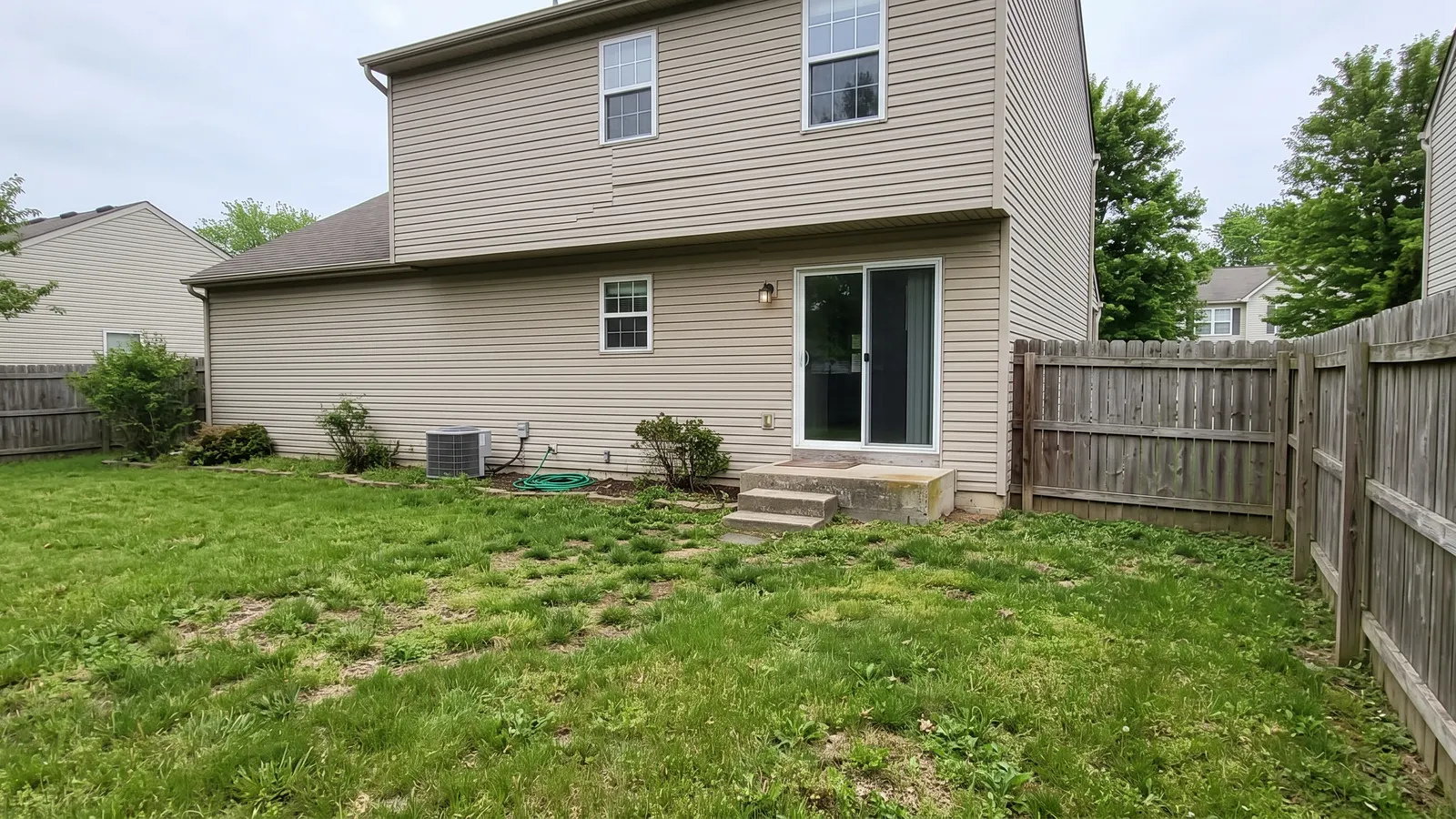
Per-square-foot prices are easier to judge when you can see what you're paying for. Here is the yard from the top of this post with the same 16x20 deck in three materials, each an AI concept made from that one photo. Only the deck changes:
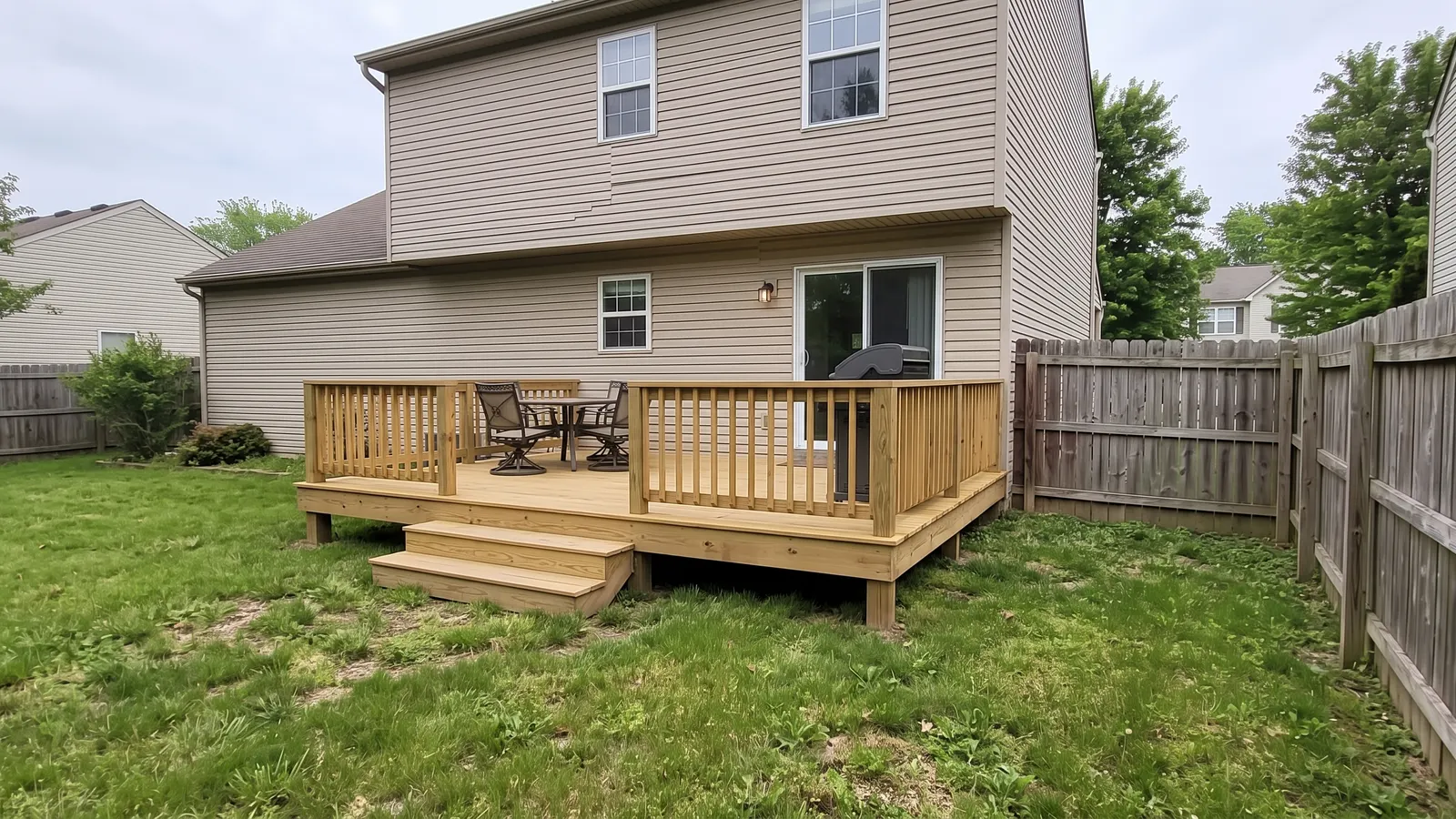
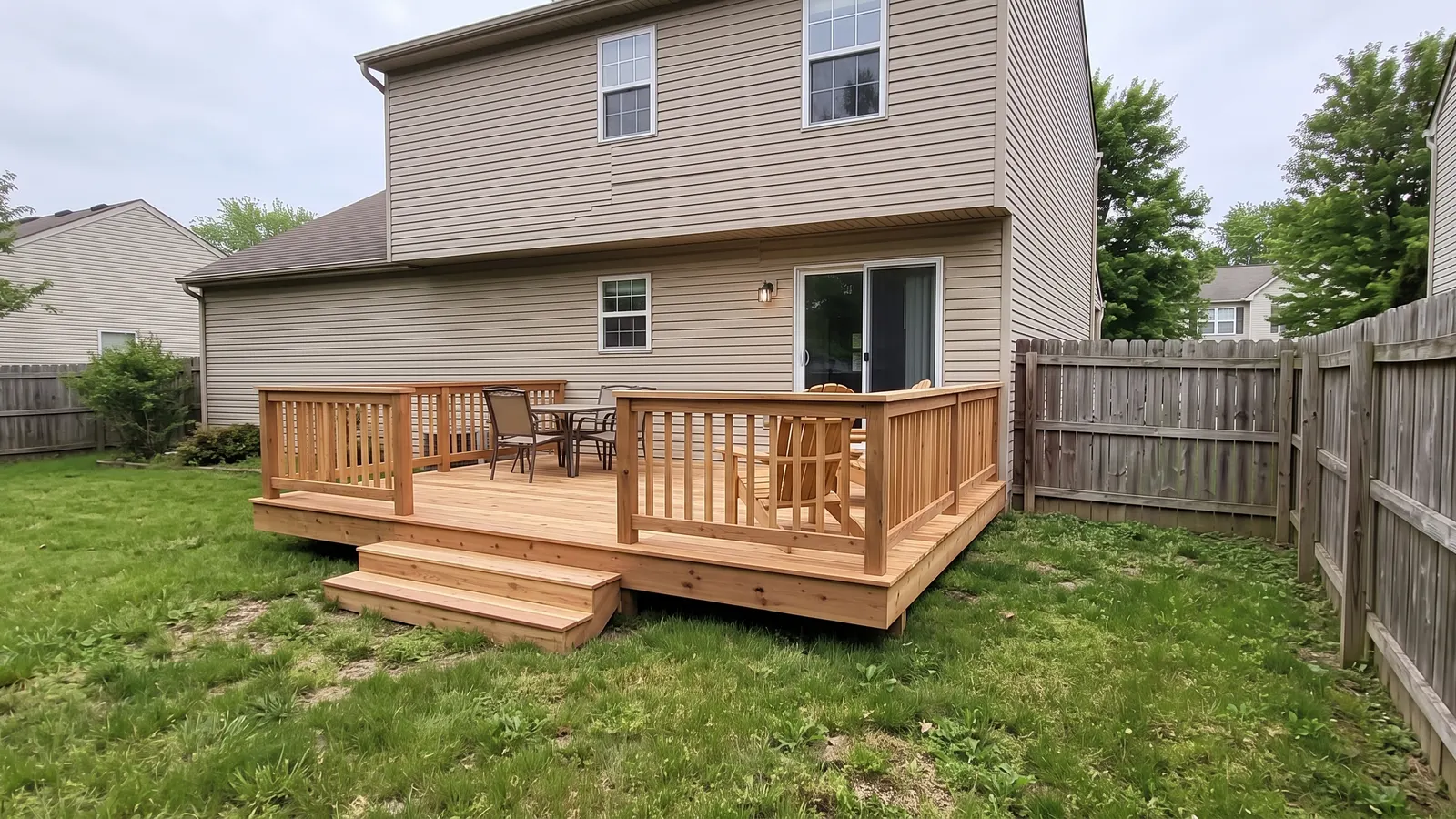
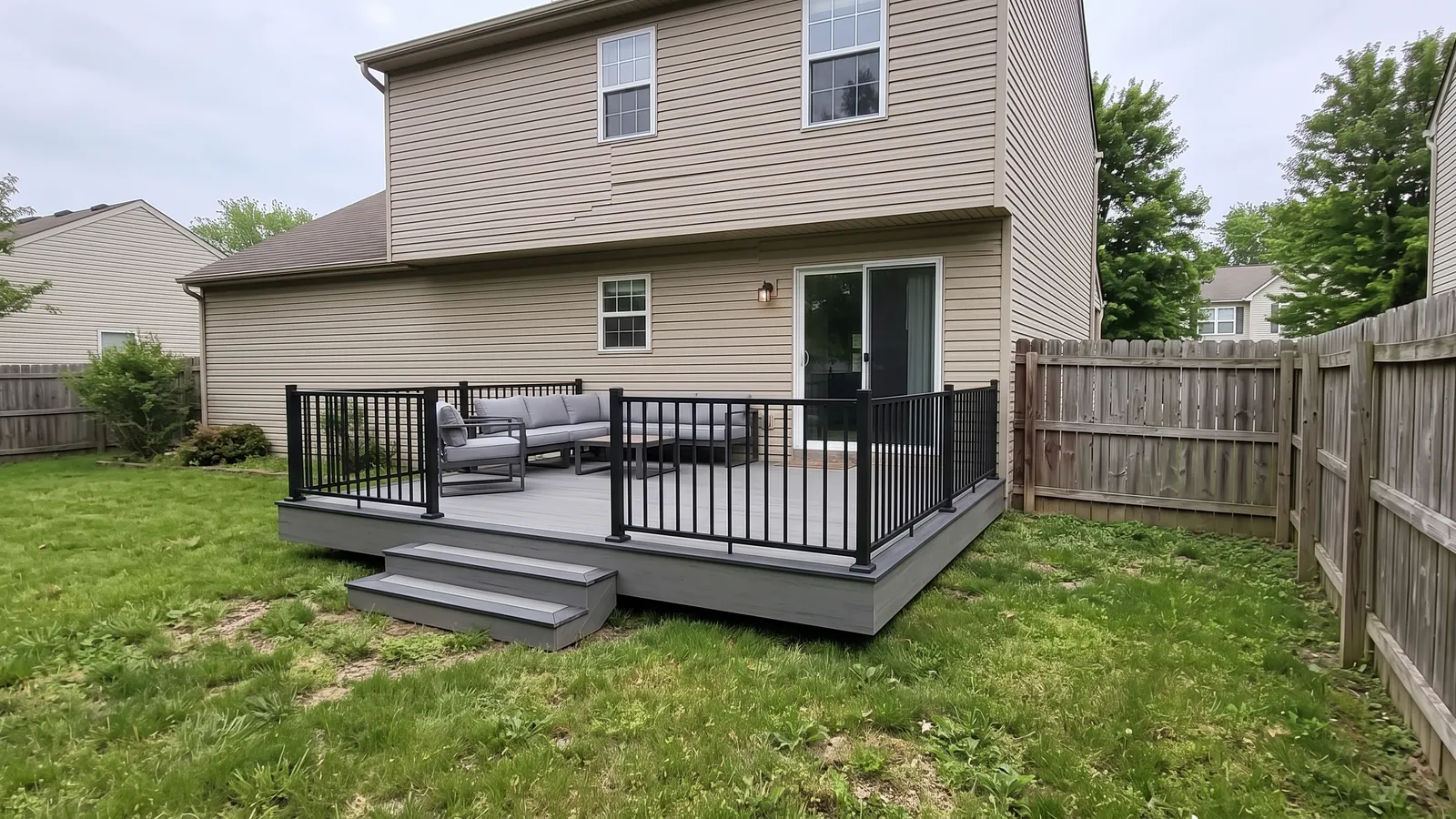
At HomeGuide's rates, that 320-square-foot deck runs roughly $8,000 to $16,000 in pressure-treated pine, $9,600 to $15,050 in cedar and $12,800 to $25,600 in composite, before railing and stairs. Seeing them on your own house makes the composite premium much easier to judge. You can try it with any backyard photo using AI deck design: upload the photo, pick a style, and compare boards and railings before you ask anyone for a quote.
Deck cost by size
Here are HomeGuide's 2026 per-square-foot ranges turned into totals for the deck sizes people build most often. Pressure-treated and composite figures for 12x12 and 20x20 come straight from HomeGuide; the rest is our math from the same rates, rounded to the nearest $50.
| Deck size | Square feet | Pressure-treated | Cedar | Composite | PVC |
|---|---|---|---|---|---|
| 10x10 | 100 | $2,500 to $5,000 | $3,000 to $4,700 | $4,000 to $8,000 | $6,000 to $8,000 |
| 12x12 | 144 | $3,600 to $7,200 | $4,300 to $6,750 | $5,750 to $11,500 | $8,650 to $11,500 |
| 12x16 | 192 | $4,800 to $9,600 | $5,750 to $9,000 | $7,700 to $15,350 | $11,500 to $15,400 |
| 16x20 | 320 | $8,000 to $16,000 | $9,600 to $15,050 | $12,800 to $25,600 | $19,200 to $25,600 |
| 20x20 | 400 | $10,000 to $20,000 | $12,000 to $18,800 | $16,000 to $32,000 | $24,000 to $32,000 |
These totals cover a basic attached deck. Angi's own size table runs a little higher (a 12x12 at $5,760 to $8,640, a 20x20 at $16,000 to $24,000), because its $30 to $60 per square foot rate already leans toward raised decks with railings.
Two size effects are worth knowing before you settle on dimensions:
- Small decks cost more per square foot. A contractor still has to pour footings, attach a ledger and build stairs for a 10x10, so the fixed costs weigh more. A small landing can cost nearly as much as a deck twice its size.
- Height costs more than area. HomeGuide prices a ground-level deck at $25 to $30 per square foot, an elevated deck at $30 to $50 and a second-story deck at $50 to $60. A multi-level deck runs $60 to $100.
Size the deck for what goes on it. A table for four with chairs pulled out needs about 10x10. A dining set for six plus a grill and a couple of lounge chairs fits better on 12x16 or 16x20.
What a full-featured deck really costs
National averages describe plain rectangles. The Cost vs Value report prices a realistic project instead: a 16x20 pressure-treated deck on concrete piers, with a full wood railing, three steps to grade, a built-in bench and a planter. In 2025 that job cost $18,263 nationally, and the composite version cost $25,096 (JLC/Zonda Cost vs Value 2025). That's above the top of the plain-deck ranges in the grid, and the railing, stairs and built-ins make up the difference.
Railings, stairs and extras that change a deck quote
Two decks with the same size and boards can still be quoted $5,000 apart. The difference is usually railing, stairs, height and the ground under the deck.
| Line item | Typical cost | When it applies |
|---|---|---|
| Wood railing | $20 to $50 per linear foot | Decks over 30 inches high, or by choice |
| Vinyl or composite railing | $25 to $60 per linear foot | Low-maintenance match for composite decks |
| Aluminum railing | $50 to $200 per linear foot | Slim, modern look |
| Cable or glass railing | $60 to $600 per linear foot | Keeps the view open |
| Stairs, built with the deck | Adds $200 to $600 | Basic stairs in standard materials |
| Stairs, added to an existing deck | $1,400 to $2,600 | Four to eight steps |
| Concrete landing pad for stairs | $300 to $500 | Where the stairs meet the lawn |
| Permit | $50 to $500 | Most attached or raised decks |
| Yard leveling | $500 to $1,000 | Sloped or uneven ground |
| Drainage work | $1,000 to $4,000 | Wet spots under or near the deck |
| Staining a wood deck | $1.50 to $4 per sq ft | At install and every 1 to 2 years |
| Built-in bench | $1,000 to $1,500 | Saves buying furniture |
| Deck lighting | $80 to $300 per fixture | Post caps, stair lights, rail lights |
| Structural engineer | $100 to $220 per hour | Tall, large or unusual decks |
Costs from HomeGuide's 2026 deck, railing and stair cost guides; permit range combines HomeGuide ($50 to $150) and Angi ($230 to $500).
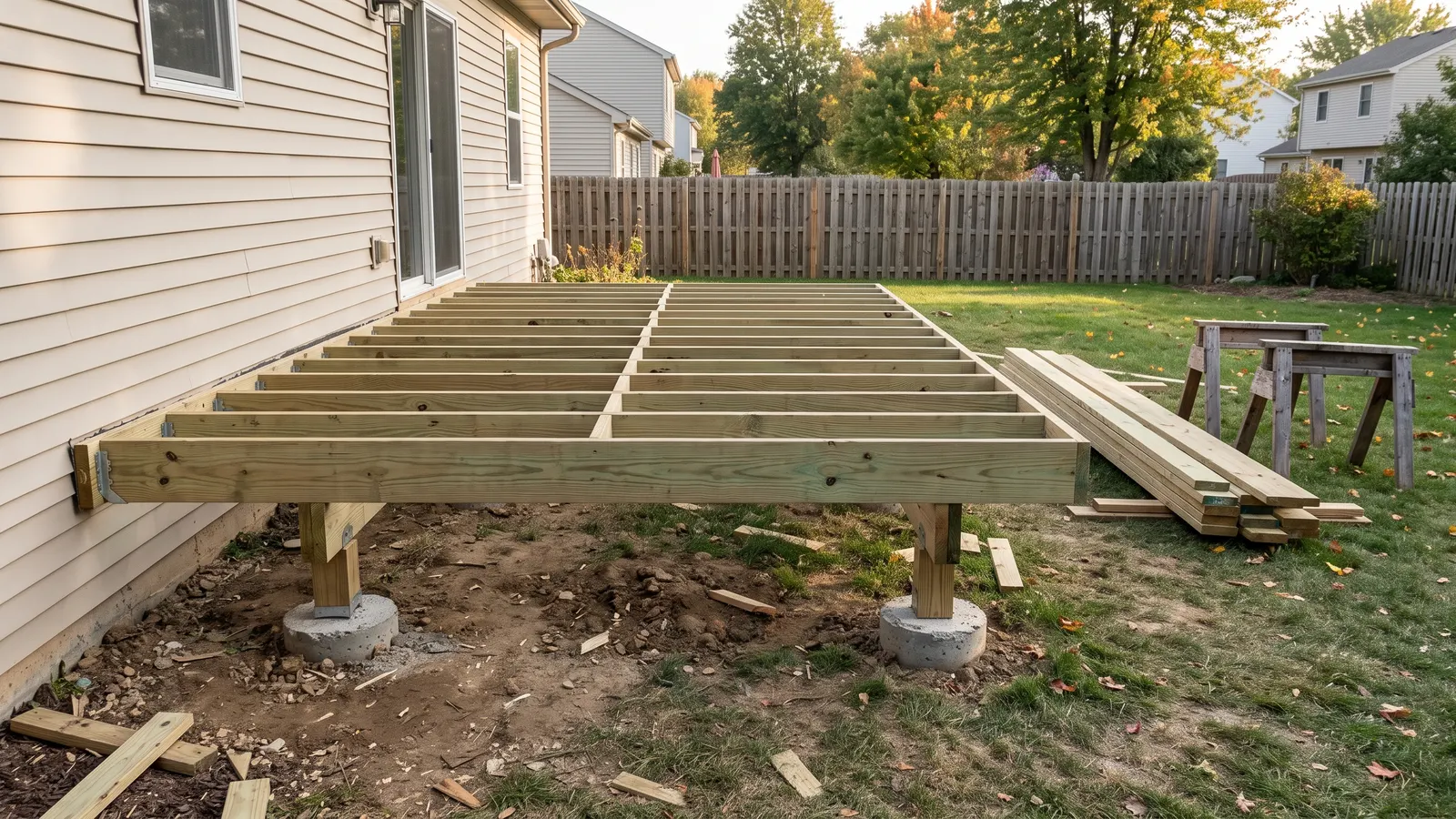
The frame in the photo above is the part of the price you never see again. Footings, posts, beams, joists and the ledger that ties the deck to the house are most of the structure and much of the labor. Ask every contractor how deep the footings go and how the ledger is flashed, because a poorly flashed ledger is where rot starts.
When does a deck need a railing?
Under the International Residential Code, a guard is required on any open side where the walking surface is more than 30 inches above the ground, and the railing must be at least 36 inches tall (Trex's summary of IRC R312). Some local codes raise that to 42 inches, so check yours. On a 16x20 deck 3 feet up, that's roughly 47 feet of railing once you leave a gap for the stairs: about $950 to $2,350 in wood, $1,200 to $2,800 in composite and $2,350 to $9,400 in aluminum.
That 30-inch line is also one of the easiest ways to save. If the door sits low enough that the deck can stay under it, the railing becomes optional.
Labor and permits
Labor is the largest single line on a deck quote. HomeGuide puts it at $11 to $22 per square foot for a wood deck, Angi at $15 to $35, and Trex says labor and management make up nearly two-thirds of a composite deck's total. Composite labor runs higher (HomeGuide: $24 to $48 per square foot) because the boards need hidden fasteners, more joists and careful gapping.
What should be in an installed price:
- Footings, posts, beams, joists and the ledger
- Deck boards, fasteners and trim
- Railing and stairs, if the design has them
- Permit drawings and inspections, or a clear note that you pull the permit
- Removal of an old deck if there is one (HomeGuide puts replacement at $30 to $55 per square foot, about $5 more than a new build)
- Cleanup and haul-away
Permits are cheap compared with the deck, but skipping one can cost you when you sell. Angi notes that some places don't require a permit for small decks (under 200 square feet), low to the ground and not attached to the house. Attached and raised decks almost always need one. Call your building department before you sign anything, and call 811 to have utility lines marked before anyone digs footings.
DIY vs hiring a deck builder
Building it yourself saves most of the labor, which is about half the price or more. HomeGuide puts the DIY material bill for a 12x12 wood deck at $2,000 to $4,000, against $3,600 to $7,200 for the same deck built by a pro.
| 12x12 deck | DIY materials | Installed by a pro |
|---|---|---|
| Pressure-treated | $2,000 to $4,000 | $3,600 to $7,200 |
| Composite boards on wood framing | About $1,450 to $3,900 in Trex materials | $5,750 to $11,500 |
DIY wood figure from HomeGuide; composite figure is our math from Trex's $10 to $27 per square foot materials estimate, which covers substructure, decking, hardware and fasteners but not railing.
The math looks good on paper. The risk is structural: a deck carries people, furniture, a grill and snow, and the parts that fail (footings, ledger, joist hangers) are the parts that take the most skill. This Old House rates even a simple ground-level 10x16 deck as moderate to hard, a four-to-six-day build for at least two people, according to CostHelper.
DIY makes sense when:
- The deck is low, freestanding and rectangular, like a floating deck
- You've built framing before and own or can rent the tools
- Your town lets you pull an owner-builder permit and inspect it
Hire a builder when the deck attaches to the house, sits more than 30 inches up, or needs stairs with more than a few steps. A middle route works too: pay a crew to set the footings and frame, then lay the boards and build the railing yourself.
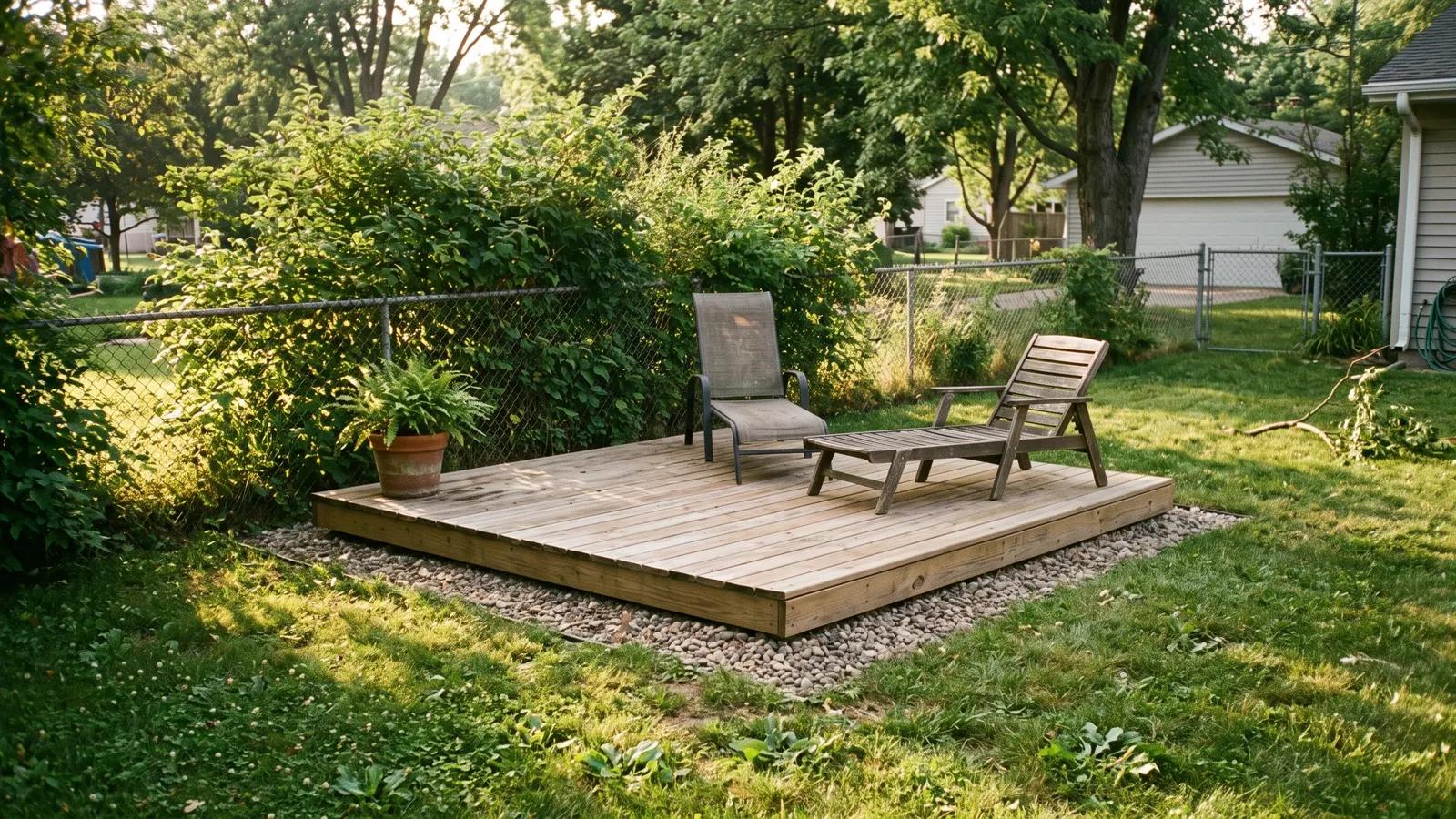
A low freestanding deck like the one above is the cheapest deck you can build and the best DIY project. HomeGuide prices it at $20 to $25 per square foot installed, it needs no railing or stairs, and it can sit on gravel and concrete blocks instead of footings below the frost line.
Deck vs patio: which costs less?
A patio is almost always cheaper for the same footprint. A deck is often the only practical choice when the back door is several feet above the yard or the ground slopes away from the house.
| Option | Installed cost per sq ft | 10x20 total | Typical lifespan |
|---|---|---|---|
| Pressure-treated deck | $25 to $50 | $5,000 to $10,000 | 10 to 25 years |
| Composite deck | $40 to $80 | $8,000 to $16,000 | 25 to 50 years |
| Poured concrete patio | $5 to $15 | $1,000 to $3,000 | 30 to 50 years |
| Paver patio | $10 to $17 | $2,000 to $3,400 | 25 to 75 years |
Prices from HomeGuide's 2026 deck vs patio cost guide. Lifespans from HomeGuide's deck and patio guides.
Pick a patio when the yard is flat and the door is close to ground level. Pick a deck when you'd otherwise need a tall retaining wall and a lot of fill to bring a patio up to the door, or when you want a raised view. Our guide to concrete patio cost breaks down what a slab costs by finish if you want to price both.
If you can't decide, it helps to see both on the actual house. A patio deck designer can show a ground-level patio and a raised deck on a photo of your yard side by side.
Ways to save on a new deck
The cheapest decks share a few traits. Most of these cost nothing but a decision made early:
- Keep it rectangular and single-level. Angles, curves and multiple levels add cuts, framing and labor.
- Stay under 30 inches if you can. No required railing, shorter posts and simpler stairs.
- Size it to standard board lengths. Boards come in 12, 16 and 20 foot lengths; a 12x16 or 16x20 deck wastes far less than a 13x17.
- Build stairs with the deck, not later. HomeGuide prices stairs at $200 to $600 as part of a new build and $1,400 to $2,600 added afterward.
- Spend where you touch it. Composite boards and a wood railing, or wood boards and a composite top cap, split the difference on price and upkeep.
- Book in the off-season. Angi suggests building in fall or winter, when demand for deck builders drops off.
- Do the easy parts yourself. Demolition of an old deck, staining and the planting around it are all safe DIY jobs.
Plan what happens around the deck too. The space underneath a raised deck needs a plan for weeds, drainage and skirting; our guide to above-ground pool deck ideas shows how people handle decks at pool height, and the best deck design software compares tools for drawing a plan to scale before you price it.
Key takeaways
- Budget $25 to $50 per square foot for a wood deck and $40 to $80 for composite. Most decks land between $4,300 and $12,700 all in.
- Height drives the extras. Above 30 inches you need a railing, real stairs and deeper footings, which can add several thousand dollars.
- Get line items in writing. Railing, stairs, permits, demolition and footings are where the cheapest quote usually hides gaps.
- Compare materials on your own house before choosing. With OutdoorBrite you can see wood and composite versions of a deck on a photo of your backyard, which makes the composite premium easier to weigh.
FAQ
How much does a 12x12 deck cost? A 12x12 deck (144 square feet) costs about $3,600 to $7,200 in pressure-treated pine and $5,750 to $11,500 in composite, based on HomeGuide's 2026 rates. Railing and stairs are often extra. Building it yourself costs about $2,000 to $4,000 in materials for wood.
What is the deck cost per square foot in 2026? Pressure-treated wood decks cost $25 to $50 per square foot installed, cedar $30 to $47, composite $40 to $80, PVC $60 to $80 and Ipe $50 to $70. Height matters too: a ground-level deck runs $25 to $30 per square foot, a second-story deck $50 to $60.
Is composite decking worth the extra cost? Often, yes, if you'll stay in the house for 10 years or more. Composite costs roughly 40% to 60% more up front but lasts 25 to 50 years with washing instead of yearly staining, while a wood deck can cost $700 to $1,600 a year in hired-out cleaning and resealing (Angi). If you'll sell within a few years, pressure-treated wood recoups more: 95% of its cost versus 89% for composite in the 2025 Cost vs Value report.
Is it cheaper to build a deck or a patio? A patio is cheaper. A 10x20 paver patio costs about $2,000 to $3,400 and a concrete patio $1,000 to $3,000, against $5,000 to $10,000 for a pressure-treated deck of the same size (HomeGuide). A deck makes more sense when the door sits well above the yard or the ground slopes.
How much does a 16x20 deck cost? A 16x20 deck (320 square feet) costs about $8,000 to $16,000 in pressure-treated wood and $12,800 to $25,600 in composite for the deck itself. A full project with railing, stairs and a built-in bench cost $18,263 in wood and $25,096 in composite in the 2025 Cost vs Value report.
Do I need a permit to build a deck? Usually, for attached or raised decks. Fees typically run $50 to $500. Some towns skip the permit for small freestanding decks low to the ground (often under 200 square feet), so call your building department before you start.
How long does it take to build a deck? A simple ground-level deck takes a two-person crew about four to six days, plus up to a week for concrete footings to cure, according to CostHelper. Permits can add several weeks before work starts, and raised or multi-level decks take longer.
Does a deck add value to a house? Yes. In the 2025 Cost vs Value report, a wood deck addition recouped about 95% of its cost at resale and a composite deck about 89%, both among the best returns of any project in the report.
Sources: HomeGuide: cost to build a deck, HomeGuide: composite decking prices, HomeGuide: AZEK decking prices, HomeGuide: deck railing cost, HomeGuide: deck stairs cost, HomeGuide: deck vs patio cost, Angi: cost to build a deck, JLC Cost vs Value 2025, Trex: deck cost, Trex: deck railing height requirements, CostHelper: pressure-treated wood deck cost, all checked October 20, 2026