Modern Landscape Design: 15 Ideas, Plants and Materials
What makes a yard look modern, the materials and what they cost, a plant palette for each US region, 15 backyard and front yard ideas, and the mid-century modern take on the style.
Most yards that look modern in photos have less in them than you'd expect. One kind of grass instead of twelve perennials, a rectangle of lawn instead of a wandering one, and a patio of big plain slabs. Modern landscape design is mostly about editing: straight lines, a short plant list, and a few hard materials that repeat from the house to the back fence.
That restraint is also why it goes wrong so easily. Strip out too much and the yard feels like a parking lot. Pick the wrong grass and it seeds into your neighbor's beds. This guide covers what actually makes a landscape read as modern, which materials to use and what they cost, a plant palette for each part of the US, and 15 backyard and front yard ideas you can borrow.
Every image in this post is an AI design concept, the same kind of render OutdoorBrite makes from a photo of your own yard.
What makes a landscape modern
A modern landscape uses geometry, repetition and a small number of materials to make a yard feel calm and deliberate. If you only remember one test, use this one: could you draw the plan with a ruler? If yes, you're most of the way there.
The traits that show up in nearly every modern yard:
- Straight lines and right angles. Rectangular lawns, linear beds, square pavers. Curves are rare, and when they appear they're one bold shape rather than a meandering edge.
- Few plant species, planted in masses. Five to eight kinds of plants for a whole yard is normal. The University of Florida's gardening extension describes it as mostly shades of green with one or two accent colors.
- Plants with a strong shape. Upright grasses, spiky agaves, clipped evergreens and columnar trees. Loose, sprawling shrubs work against the look.
- Hard materials doing real work. Concrete, steel, gravel and stained wood carry as much of the design as the plants do.
- Open space. An empty gravel courtyard or plain lawn panel is part of the composition, not a gap waiting to be filled.
- A link to the house. The paving lines up with the doors and windows, and the colors pick up the siding and trim.
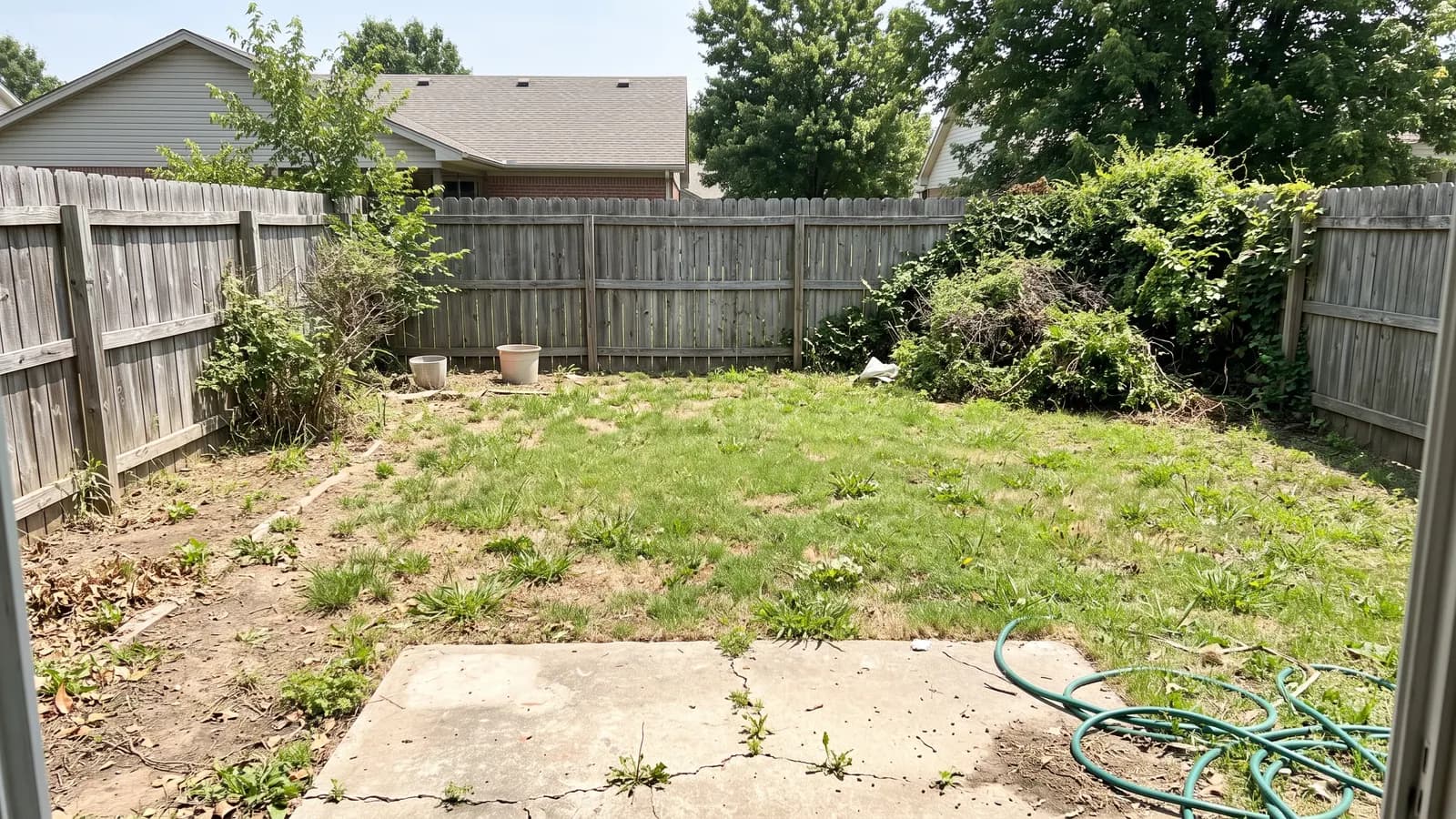
Here's that same backyard as an AI concept in the modern style. Notice how little was added: one paving material, one lawn shape, one grass repeated along the fence, and a new horizontal fence.
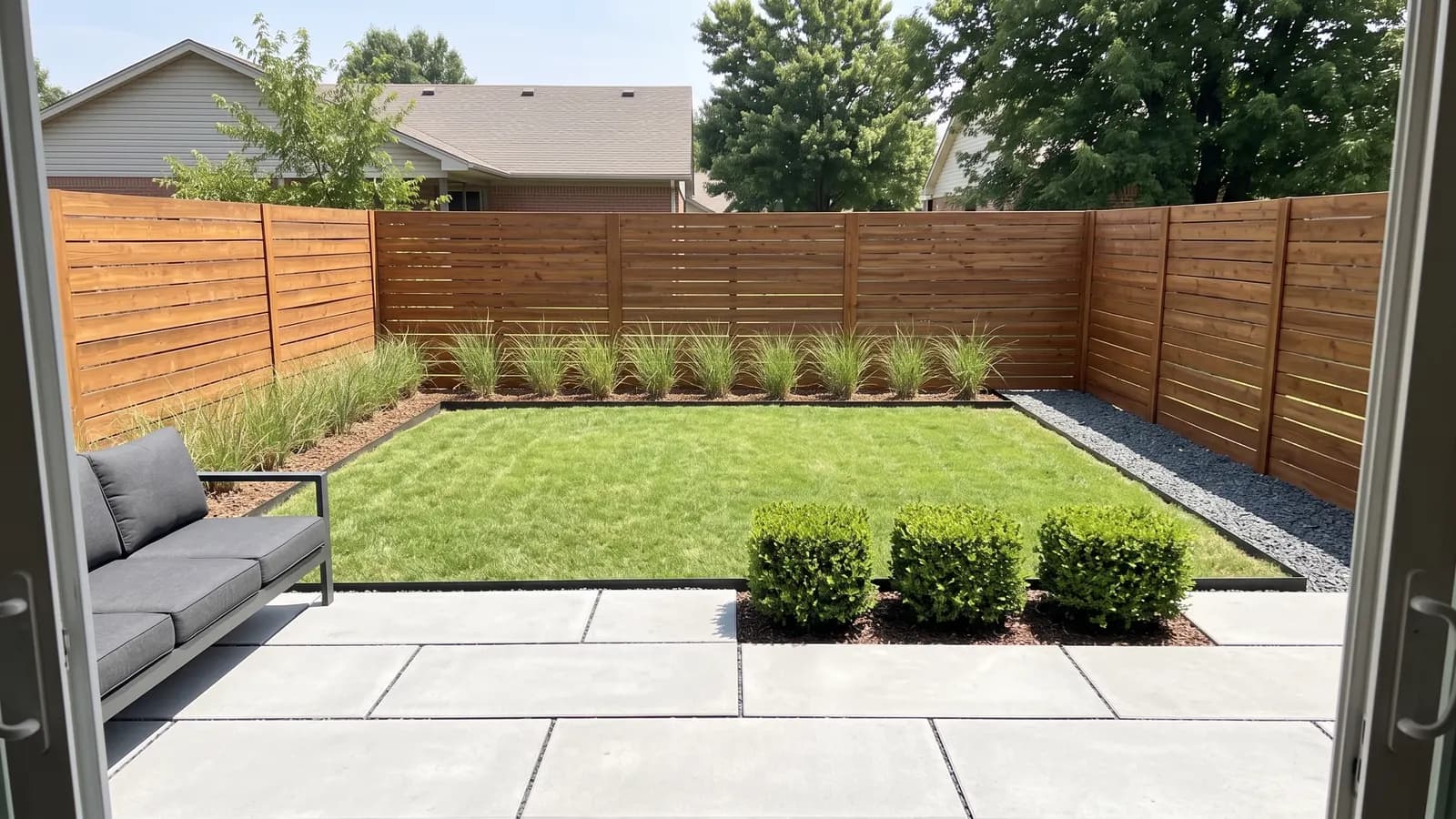
Modern isn't the same as minimalist, although minimal is one branch of it. Yardzen's style guide splits the family into modern minimal, modern farmhouse, "Moditerranean" and modern bohemian, which range from bare gravel and concrete to something much warmer and leafier. If you're still deciding between modern and other looks, our guide to landscape design styles compares them side by side. The short definition of modern landscaping is in the glossary.
Modern landscaping materials and what they cost
The hardscaping is where a modern yard gets its structure, so it's also where most of the budget goes. These are the materials that show up again and again, with installed price ranges where a current national source exists.
| Material | Where it's used | Typical cost (checked October 2026) |
|---|---|---|
| Poured concrete | Patios, walks, steps, seat walls | $4 to $12 per sq ft for a plain patio, installed (HomeGuide) |
| Large-format concrete or porcelain pavers | Patios and paths with tight or grass joints | $10 to $30 per sq ft installed (HomeGuide) |
| Gravel or decomposed granite | Courtyards, paths, bed surfaces, lawn replacement | $1.21 to $2.47 per sq ft installed (Homewyse, May 2026) |
| Steel edging | Lawn and bed edges | $5 to $11 per linear foot for metal edging, before labor (LawnStarter) |
| Horizontal wood fence | Boundary screens and backdrops | $18.50 to $46.50 per linear foot installed for cedar (Angi) |
| Weathering steel (Corten) | Planters, retaining edges, water features | Varies widely by size and fabricator |
A few material notes that the photos don't tell you:
- Concrete and gravel hold heat. UF/IFAS warns that in Florida, large areas of rock and concrete make a yard hotter and less comfortable. In hot climates, leave planted gaps between slabs and keep trees close to seating.
- Warm materials keep it from feeling cold. Stained cedar, tinted concrete and rusty steel stop an all-gray palette from looking like an office plaza.
- Gravel needs an edge. Without steel or concrete edging, gravel walks into the lawn within a season. A gravel calculator gives you tons and cubic yards once you know the area and depth.
Modern plants by region
The plants in modern magazine yards often come from coastal California, which is no help if you garden in Minnesota. What matters is the shape, not the species, so choose plants that hold a clean form in your climate. Check your hardiness zone first; the zones below come from the Missouri Botanical Garden's Plant Finder unless noted.
| Region | Structure plants | Grasses and fillers | Watch out for |
|---|---|---|---|
| Cold North and Midwest (zones 3 to 6) | Columnar arborvitae (American arborvitae, zones 2 to 7), inkberry holly (zones 4 to 9) as a clipped hedge | Feather reed grass 'Karl Foerster' (zones 5 to 9), prairie dropseed (zones 3 to 9), little bluestem (zones 3 to 9) | Boxwood where box tree moth is spreading |
| Northeast and Mid-Atlantic (zones 5 to 7) | Inkberry holly, columnar hornbeam, serviceberry as a multi-stem tree | Feather reed grass, Hakone grass for shade (zones 5 to 9) | Box tree moth quarantines in several states |
| Southeast and Florida (zones 8 to 10) | Clumping bamboo, agaves in dry sunny spots (both on the UF/IFAS list) | Muhly grass, ornamental grasses | Heat from large concrete and rock areas |
| Desert Southwest | Agave, desert spoon, a small desert tree like palo verde | Decomposed granite as the ground plane | Overwatering succulents near irrigated lawn |
| Coastal California and Pacific Northwest | Olive, rosemary, clipped evergreens | Native grasses and sedges | Mexican feather grass, an emerging invasive in California |
Two warnings worth taking seriously. Box tree moth, a pest that can strip and kill boxwood, was found in New York in 2021 and has since been confirmed in Delaware, Kentucky, Maryland, Massachusetts, Michigan, Ohio, Pennsylvania, Virginia and West Virginia, according to USDA APHIS. Inkberry holly gives the same clipped green block in most of the same zones. And Mexican feather grass, the wispy grass in a lot of modern photos, is on the California Invasive Plant Council list (rated Limited) and seeds itself aggressively in mild climates. Use a native bunchgrass instead.
If your yard is dry and sunny, our desert landscaping ideas go deeper on agaves, gravel and drought-tolerant planting.
Modern backyard landscaping ideas
1. Lay Big Pavers With Grass Joints
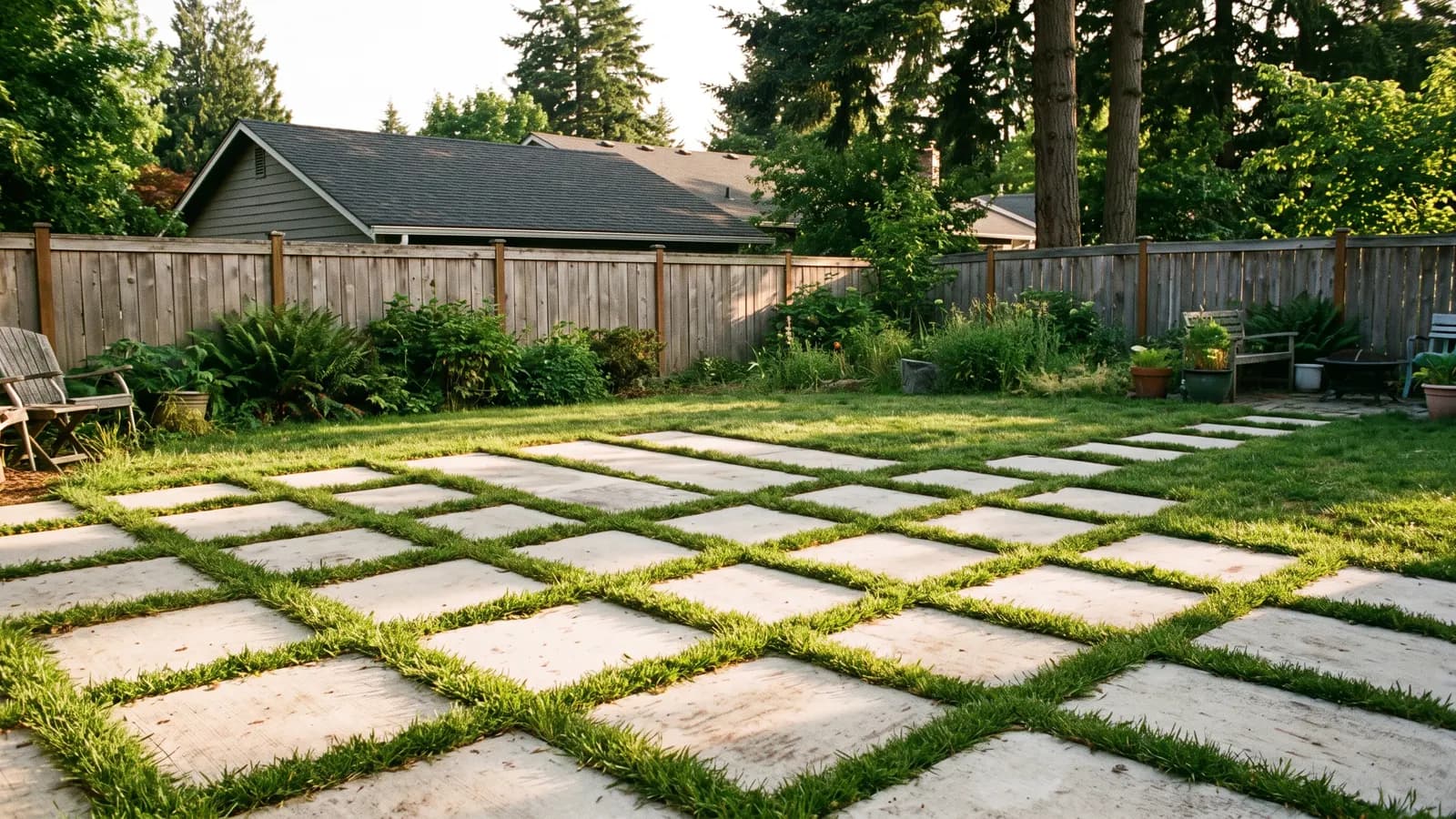
Large slabs set in a grid with 3-inch grass strips between them give you a patio that drains and still reads as hardscape. It suits a yard where you want lawn and paving to blend. The catch is mowing: you need a mower that can run over the slabs, or a string trimmer pass every week. In shady yards, swap the grass for a low creeping thyme or small gravel.
2. Turn the Lawn Into a Rectangle
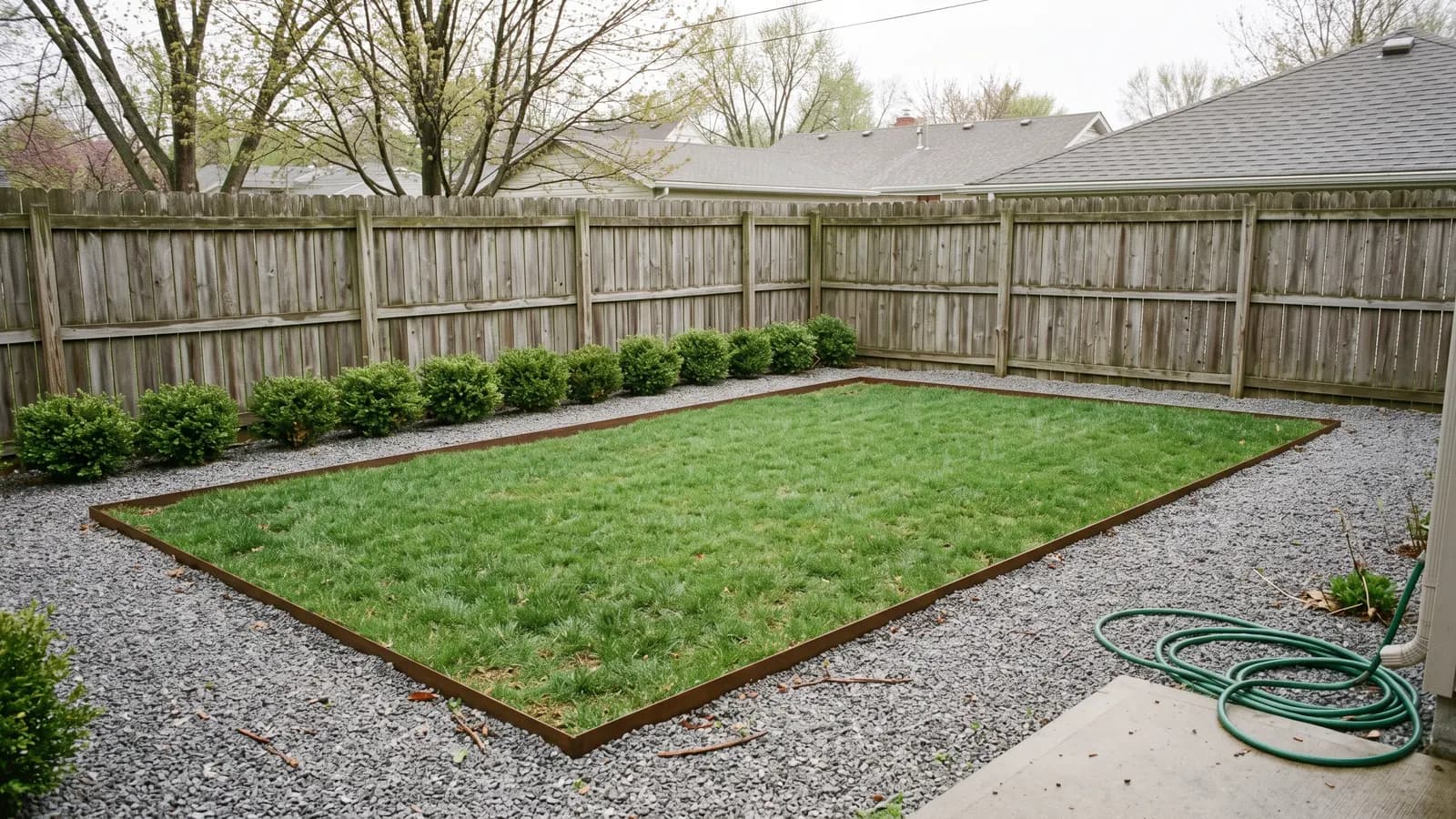
Keep the lawn, but give it a hard edge. A rectangle of grass framed in steel or a concrete mowing strip makes even a tired lawn look intentional. Size it to your mower: a panel 2 feet narrower than you'd like is still easier to keep sharp than one with fussy corners. Metal edging runs about $5 to $11 per linear foot before labor, so a 15 by 30 foot panel needs roughly 90 feet of it.
3. Build a Gravel Courtyard Around One Tree
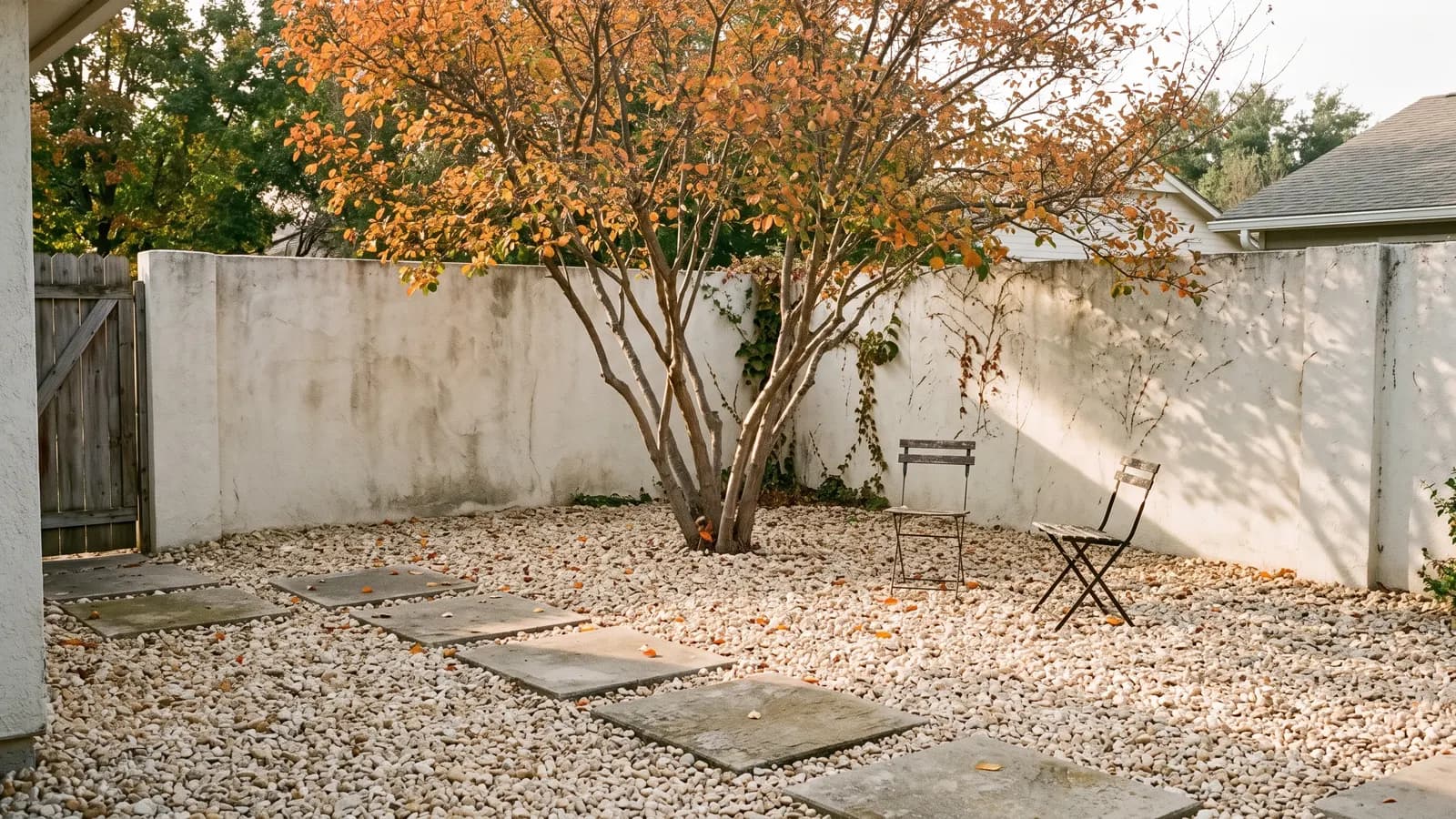
For small or awkward yards, drop the lawn and surface the whole space in gravel, then plant one good tree. A multi-stem serviceberry or Japanese maple gives four seasons of interest without crowding. Gravel costs about $1.21 to $2.47 per square foot installed, a fraction of pavers. Lay landscape fabric under it, keep it 2 to 3 inches deep, and use pea gravel only where you won't wheel a barrow.
4. Plant One Grass, Many Times
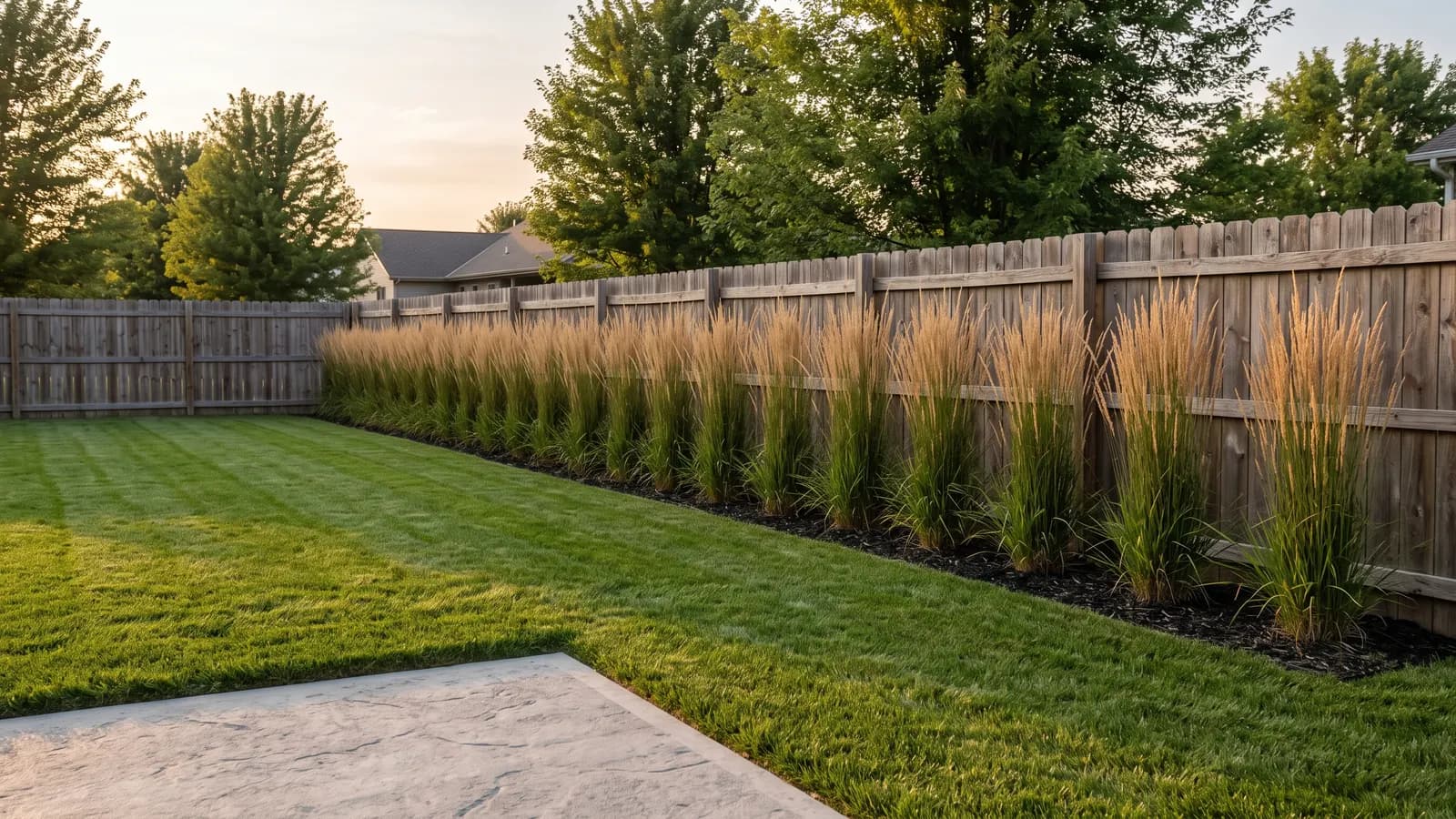
Repetition does more for a modern look than any single plant. Fifteen clumps of the same upright grass in a straight line reads as a hedge with movement. 'Karl Foerster' feather reed grass is the default in zones 5 to 9: it stands upright from June into winter and needs one cut back to 6 inches in early spring. Space clumps 18 to 24 inches apart so they knit into a band.
5. Put Up a Horizontal Slat Fence
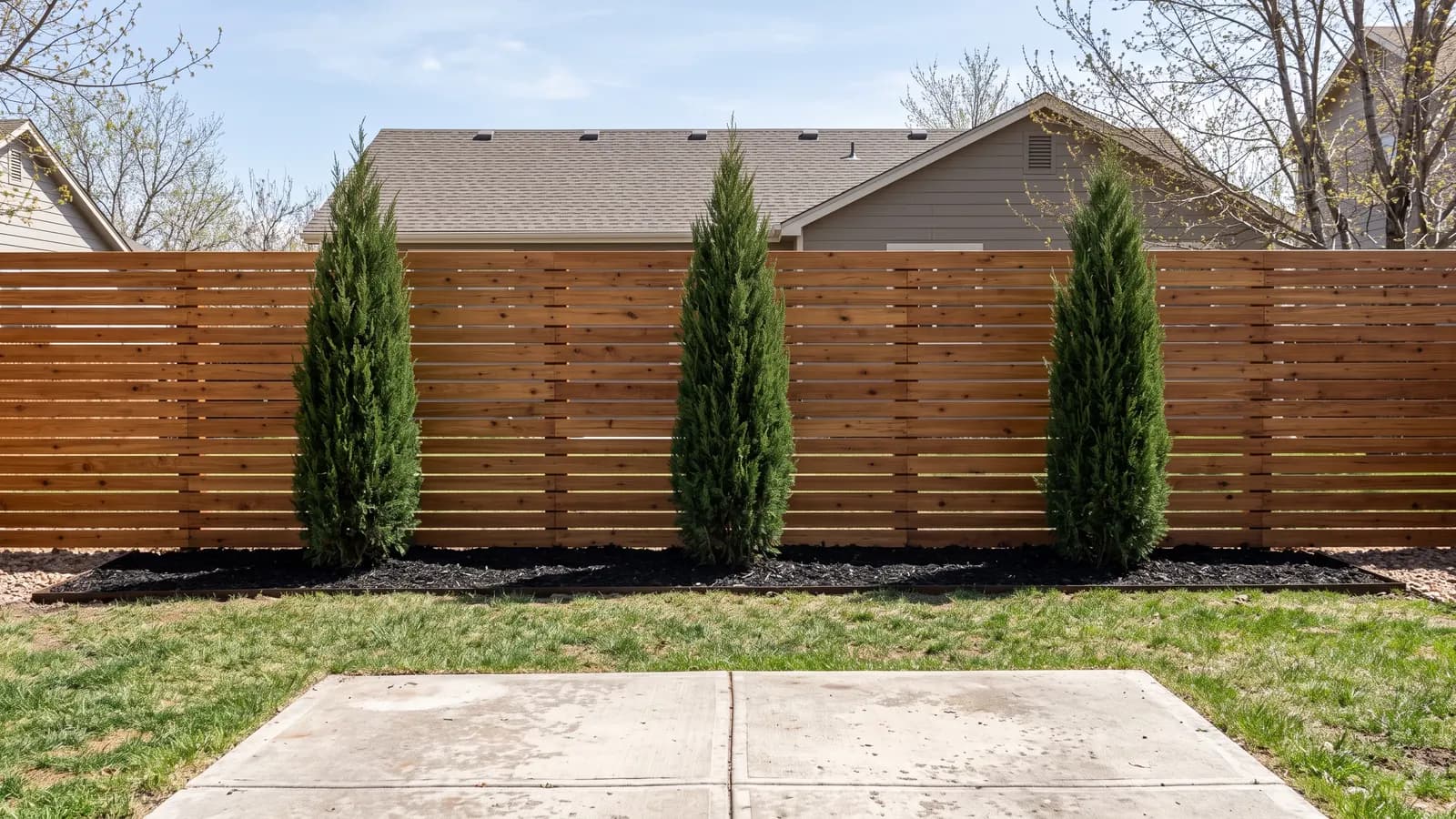
Often the old fence is the least modern thing in the yard. Horizontal boards with narrow gaps make a backdrop that ties the whole space together, and the stain color can match the house trim. Cedar runs about $18.50 to $46.50 per linear foot installed nationally. Check your local fence height rules first; many towns cap backyard fences at 6 feet. We have more layouts in our horizontal fence ideas.
6. Grow in Weathering Steel Planters
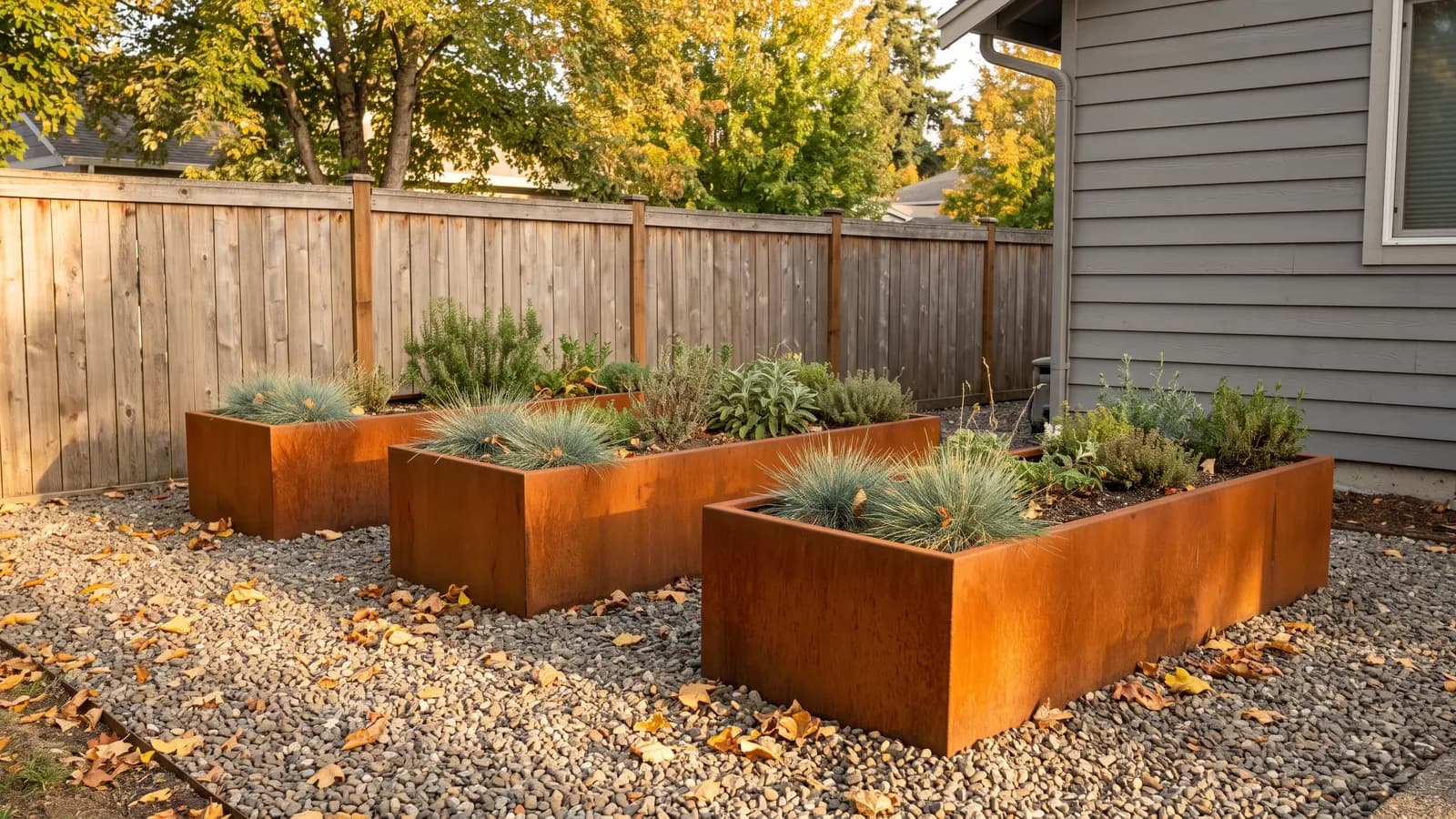
Rectangular planters in weathering steel bring warm color into a gray scheme and turn a vegetable patch into something that looks designed. The rust surface stabilizes on its own, but it stains concrete during the first months, so set planters on gravel or put down a drip tray. Two feet tall is a comfortable working height and holds enough soil for herbs, greens and shallow-rooted grasses.
7. Go Long and Low With the Fire Pit
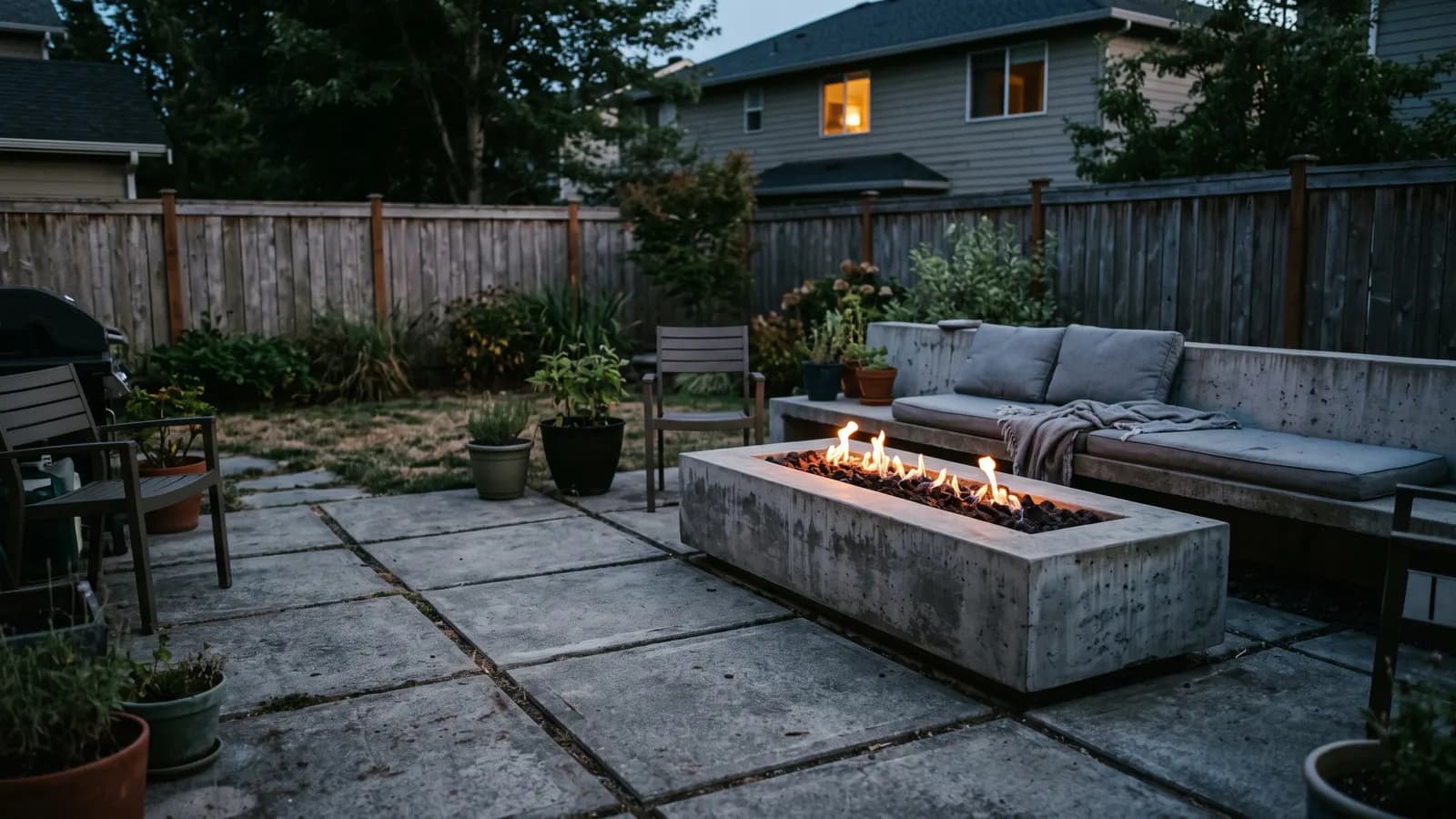
A round stone fire ring looks rustic. A long rectangular fire feature with a built-in bench looks modern, and the bench saves you buying chairs. Most linear fire tables run on propane or natural gas, which means a gas line and usually a permit. Keep the burner at least 10 feet from the house and fence unless the manufacturer's clearances say otherwise.
8. Float Stepping Pads Across Gravel
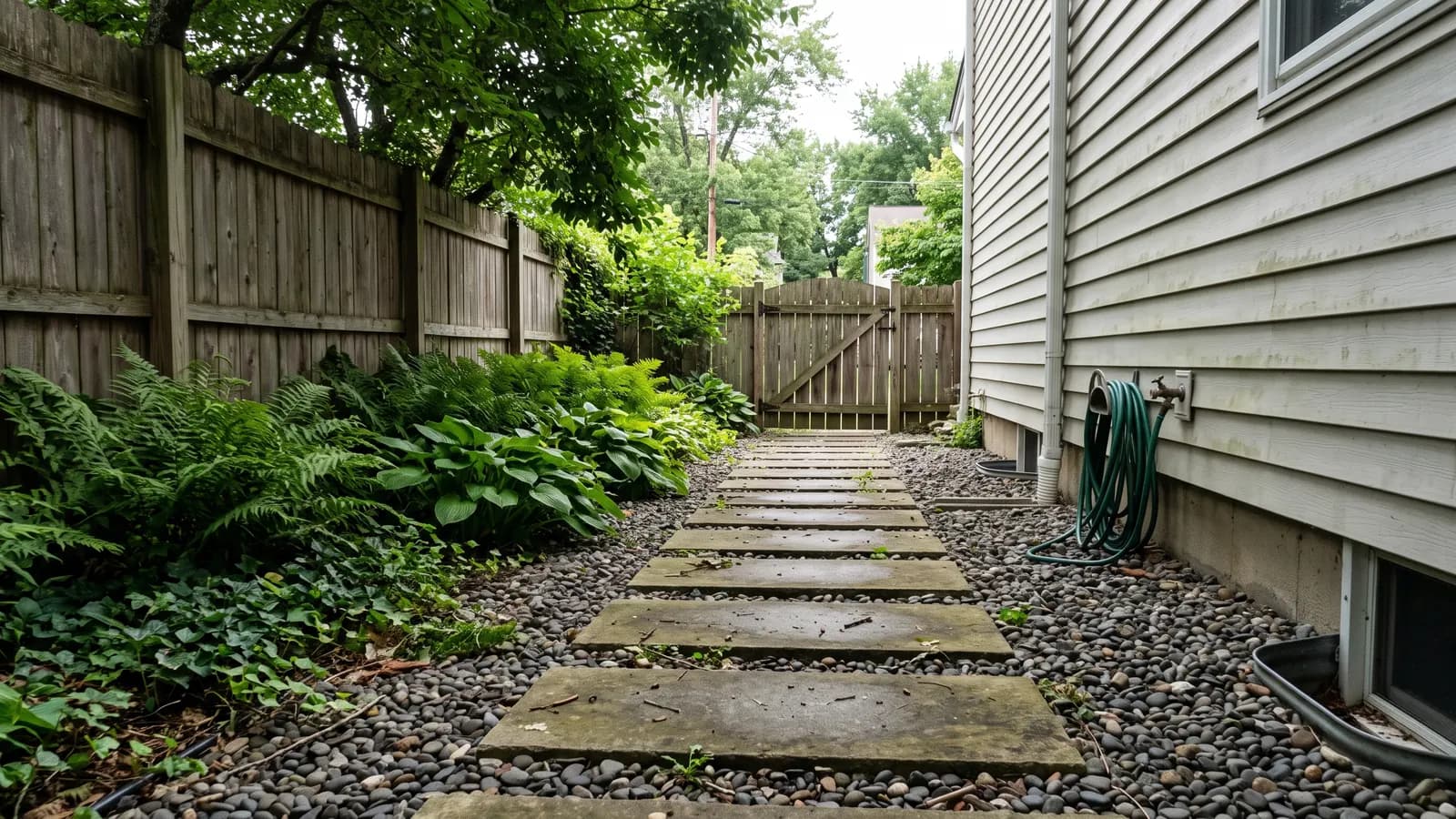
Side yards are usually leftover space. Big precast slabs spaced one stride apart across dark gravel turn the passage into a path. Pads around 24 by 36 inches feel generous; set them on a compacted gravel base so they don't rock. In shade, ferns and hostas along the fence soften the hard lines without breaking them. More ideas for narrow strips are in our side yard landscaping ideas.
9. Add a Still Water Trough
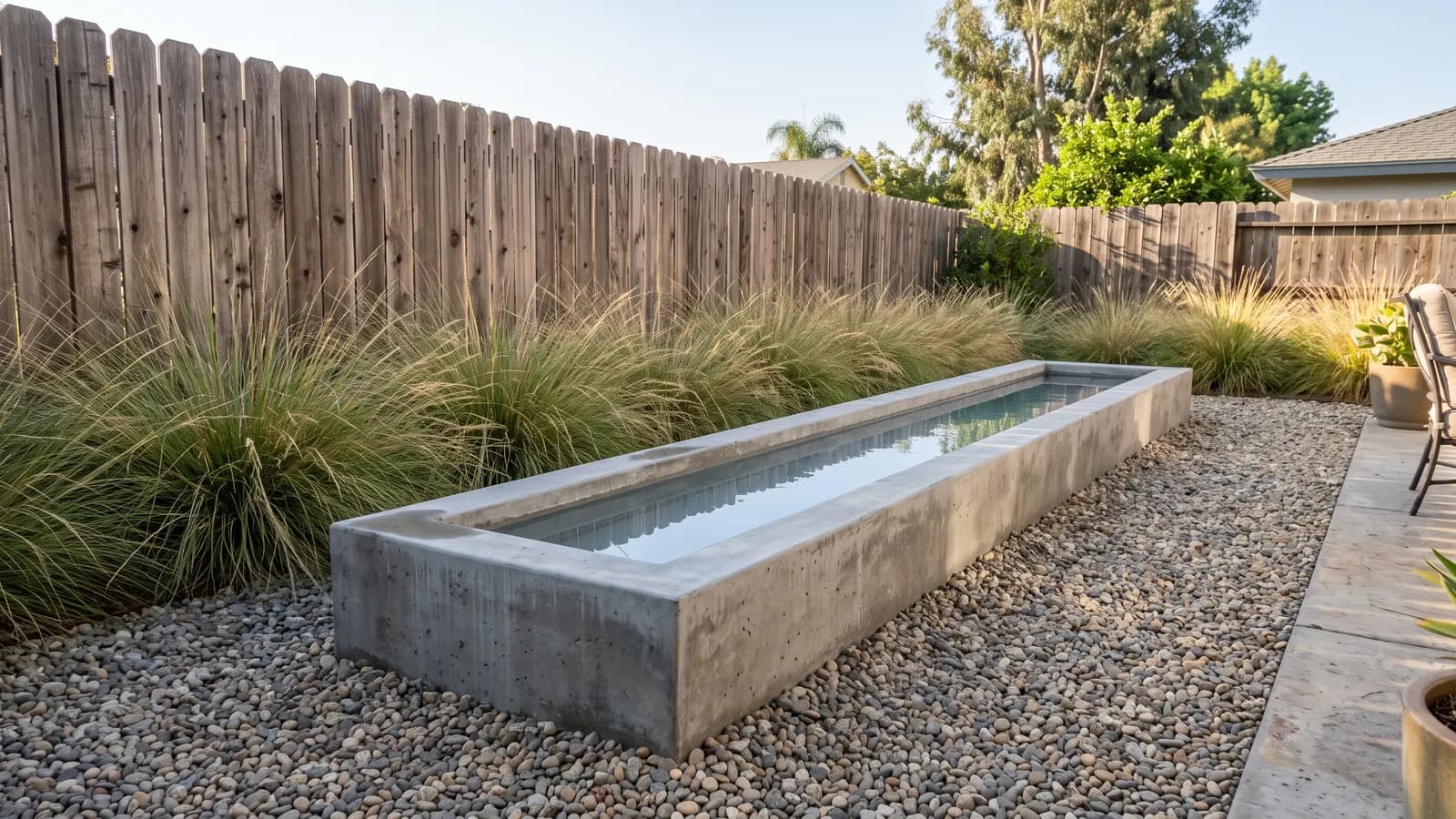
A narrow rectangle of still water acts like a mirror and suits a modern yard far better than a bubbling rock fountain. Buy a precast concrete or steel trough rather than building one. Keep the water moving with a small pump so mosquitoes don't breed in it, and put a GFCI-protected outlet nearby before you start. Knee height means nobody steps into it by accident.
10. Light the Lines, Not the Whole Yard
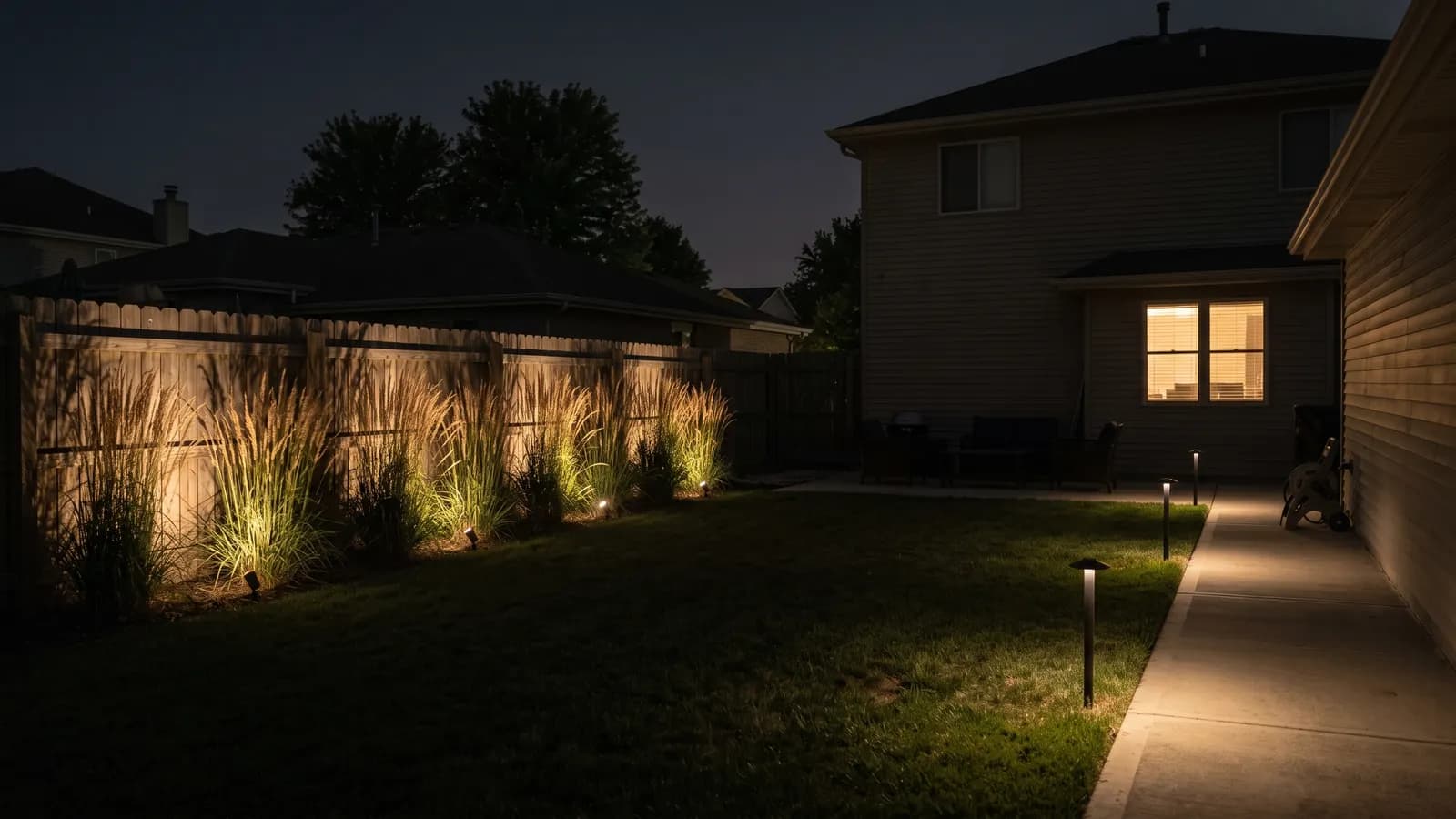
Modern yards look best at night when the lighting follows the design: uplights behind a row of grasses, low bollards along a straight walk, a strip light under a bench. Low-voltage LED kits run off a plug-in transformer, so most homeowners can install them. Aim for pools of light with dark between them. Floodlighting the whole yard flattens all the geometry you just paid for.
Modern front yard ideas
11. Rebuild the Walk in Offset Pads
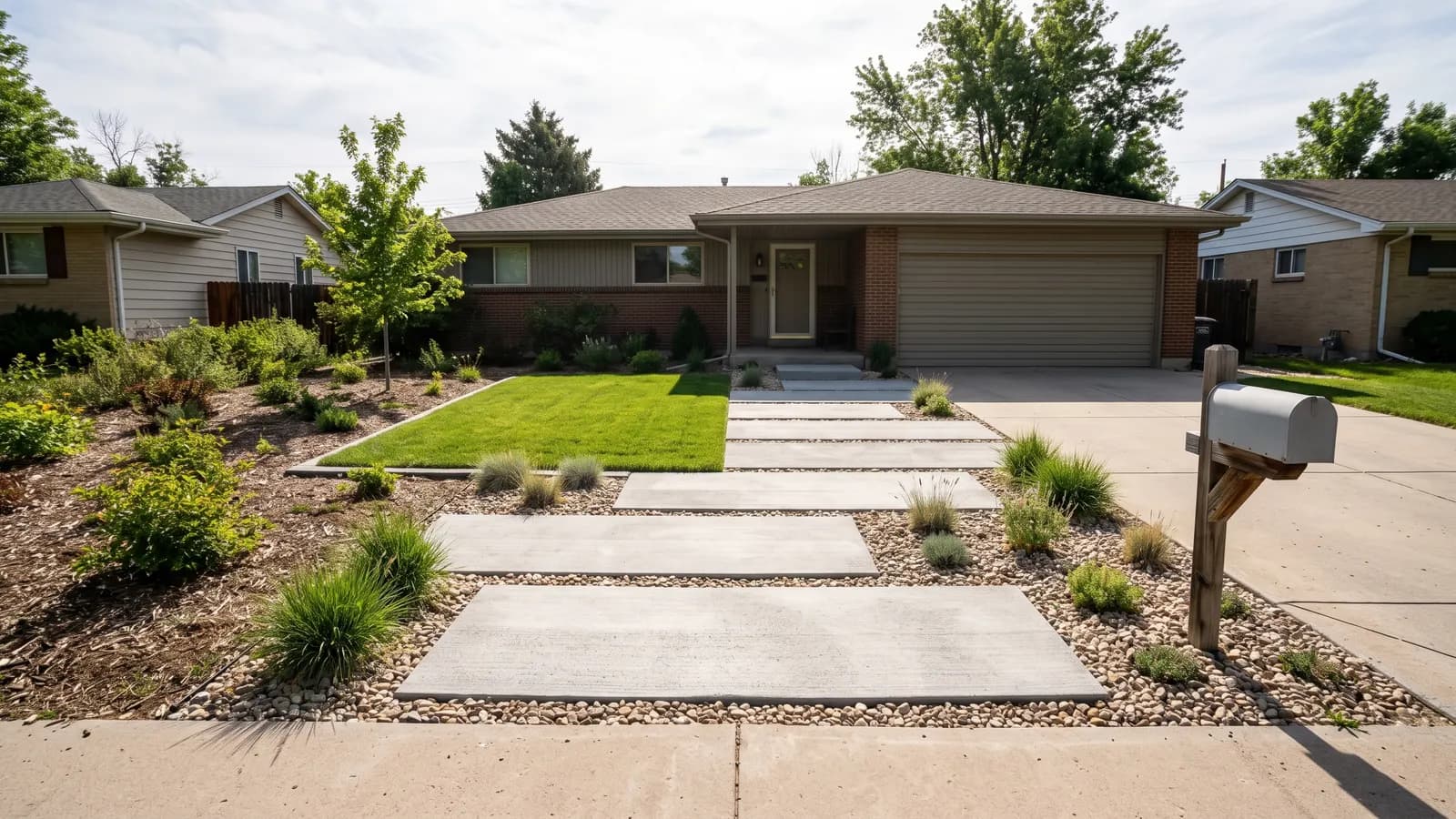
The front walk is the first line anyone sees. Replacing a narrow curved path with wide concrete pads that step slightly left and right makes a ranch or split-level look updated without touching the house. Keep the walk at least 4 feet wide so two people can pass, and plant low grasses or gravel in the offsets.
12. Swap the Lawn for Gravel and Agaves
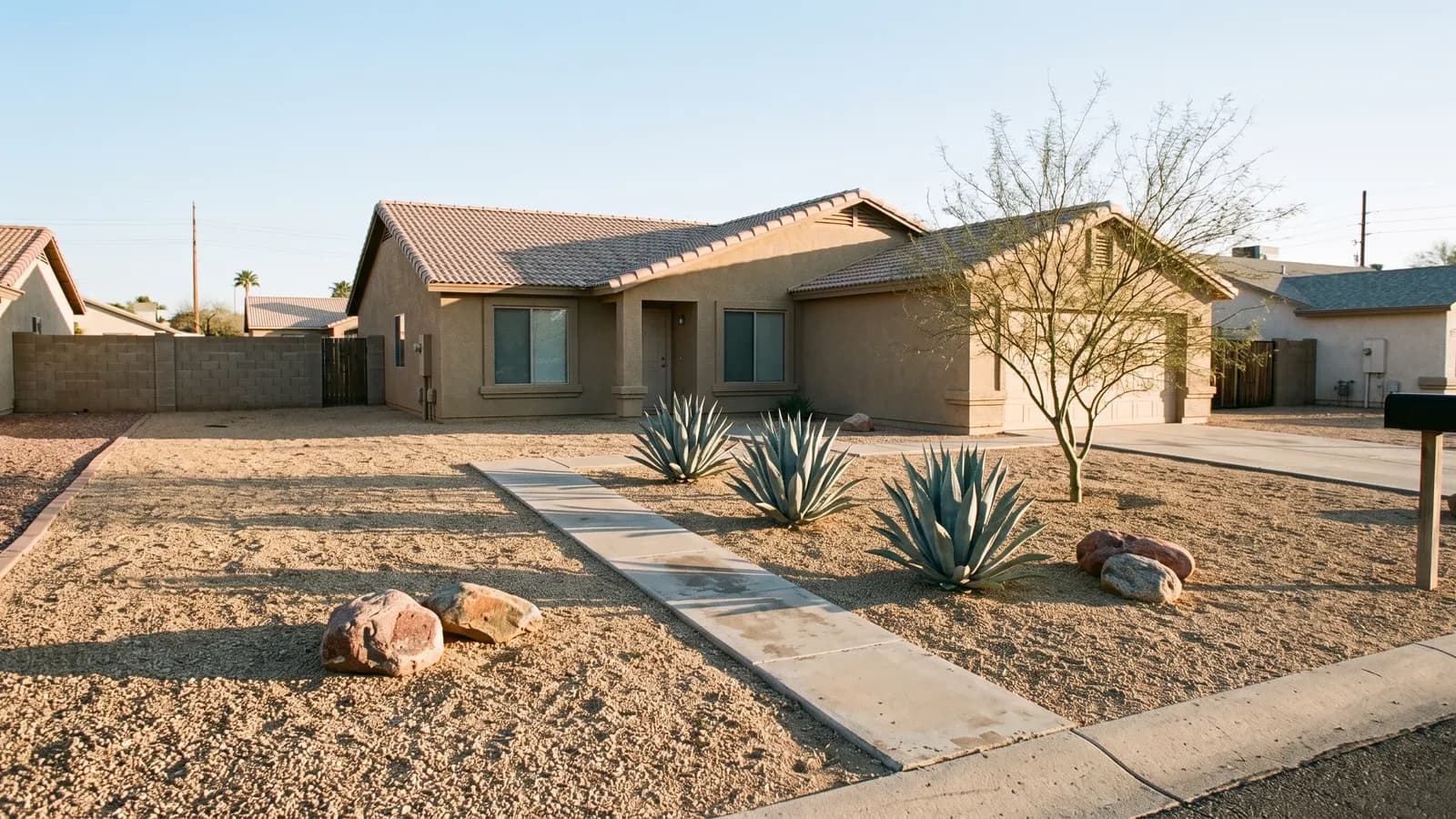
In dry climates a modern front yard can drop the lawn entirely. Decomposed granite, three large agaves in a line and a couple of boulders is about as low-water as a yard gets. Plant agaves well back from the walk, since the leaf tips are sharp, and check the species' cold hardiness: many large agaves are reliable only in zone 8 and warmer.
13. Run One Clipped Hedge Across the Facade
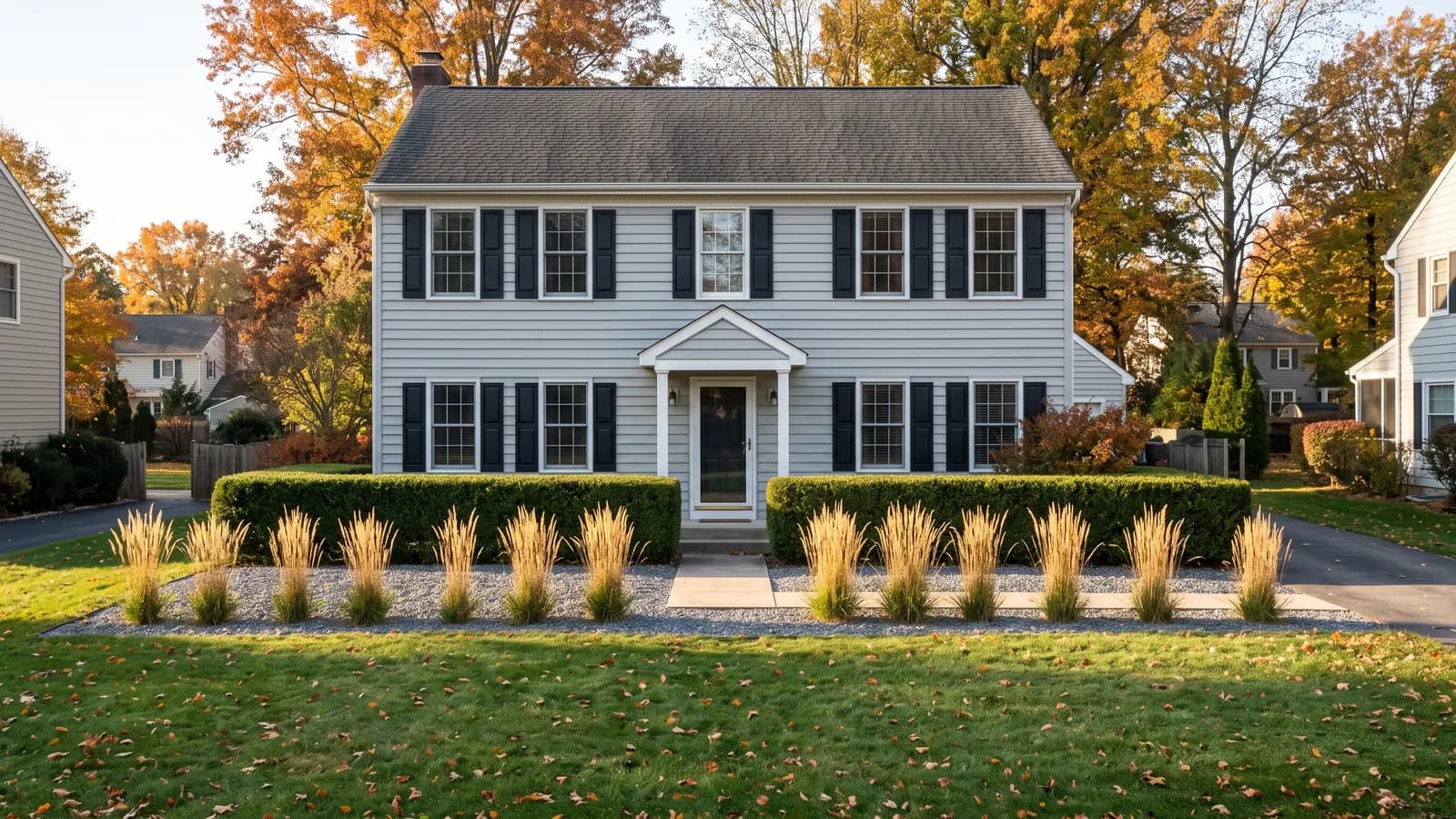
Traditional foundation planting is a row of different round shrubs. The modern version is one long clipped hedge in a single species, with a band of gravel and a line of grass in front. It works on a colonial or a ranch as well as a modern house. Inkberry holly is a good boxwood substitute in zones 4 to 9, and two trims a year keep it crisp.
14. Add a Concrete Seat Wall
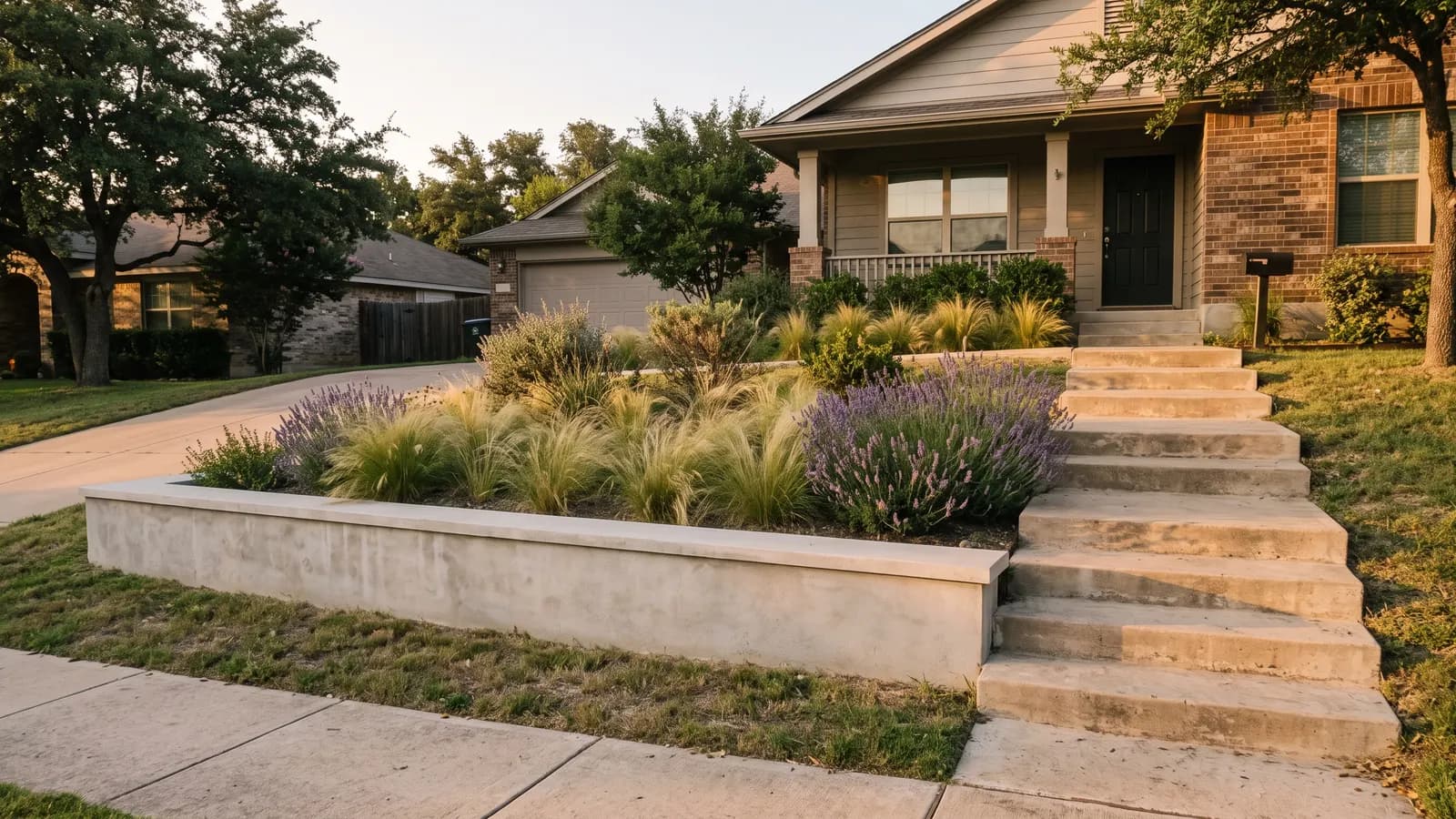
A gently sloped front yard is a chance for one low wall that holds the soil and doubles as a bench. Around 18 inches is a comfortable seat height. Walls under about 3 to 4 feet often don't need an engineer, but rules vary by town, so check before you pour. Plant the raised bed above with something drought tolerant, since soil behind a wall dries fast.
15. Frame the Door With Matching Planters
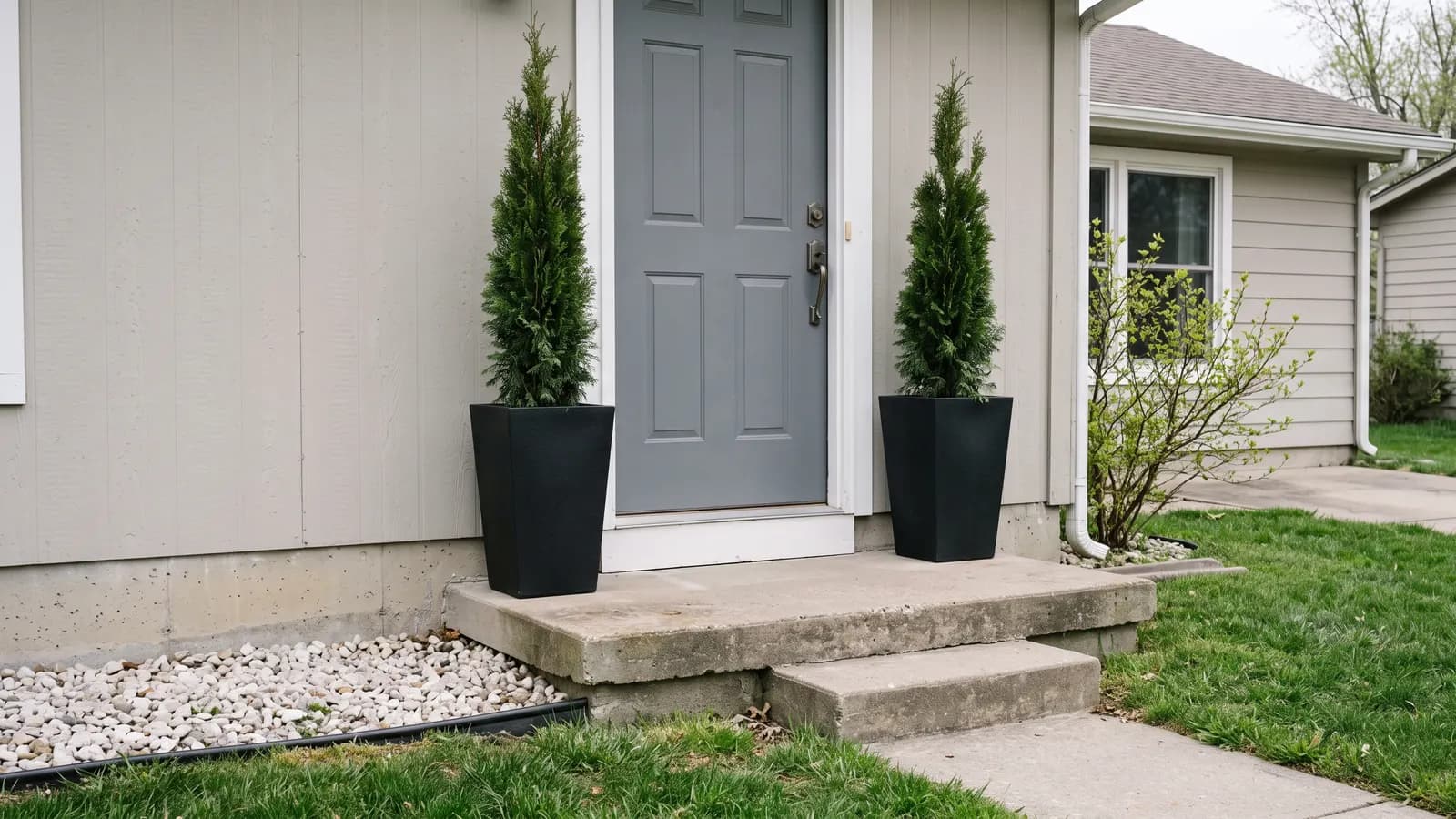
The cheapest modern update on this list. Two identical tall planters with a columnar evergreen in each give the entry symmetry and height for a few hundred dollars. In cold zones, pick planters at least 20 inches wide and an evergreen rated two zones colder than yours, because roots in a pot freeze harder than roots in the ground.
Mid-century modern landscaping
Mid-century modern is the original version of the style. In the 1940s and 1950s, California designers like Thomas Church and Garrett Eckbo threw out formal garden rules and designed yards as outdoor rooms for ordinary families. Church's Donnell Garden in Sonoma, completed in 1948 with Lawrence Halprin and George Rockrise, is the famous example: a kidney-shaped pool, a checkerboard wood deck built around existing trees, and easy movement between house and garden.
Compared with today's modern yards, mid-century modern landscaping is warmer and a bit more playful:
- One bold curve. A kidney-shaped lawn or pool against otherwise straight lines.
- Breeze blocks. Patterned concrete screen blocks for privacy that still lets air through.
- Square pads and gravel. Large concrete squares with gravel or grass between them.
- Sculptural plants. Agaves, yuccas, Japanese maples and other plants with a strong outline.
- Color in the furniture. Mustard, teal and orange on chairs and doors, with the planting kept green.
Here's the same backyard from the top of this post as a mid-century modern AI concept:
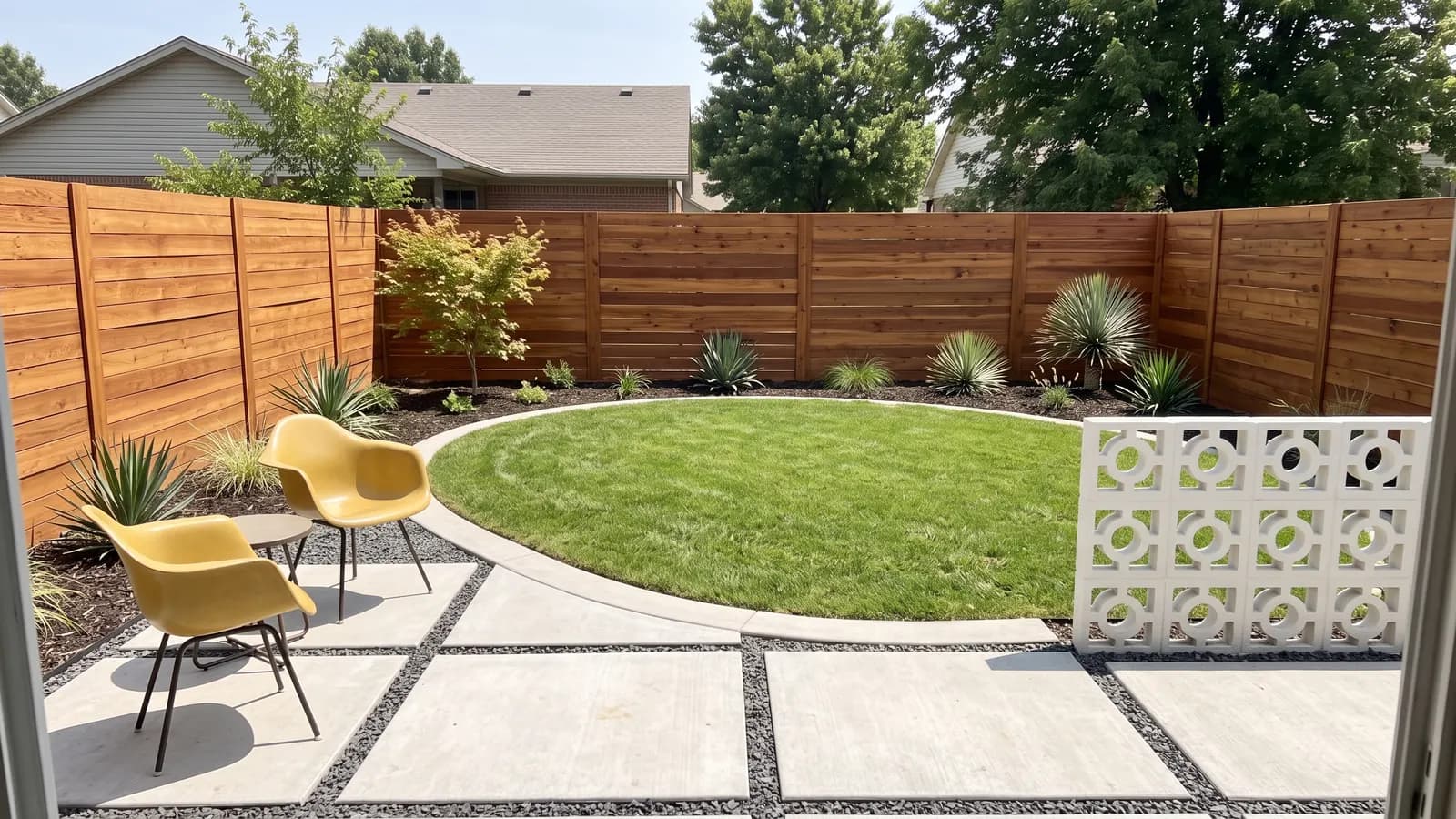
It works best with a ranch, split-level or post-war house, where the low rooflines and big windows were designed for exactly this kind of yard. Put the modern and mid-century concepts next to the original photo and you can see the choice clearly. That comparison is what AI backyard design is for.
Common modern landscaping mistakes
- Too many plant types. The fastest way to lose the look. If you've used more than eight species, cut some and repeat the rest.
- All gray, nothing warm. Gray pavers, gray gravel, gray furniture and a gray fence feel cold. Add wood, rusted steel or a tinted concrete.
- Gravel in the planting beds. UF/IFAS points out that rock mulch heats the soil and doesn't hold water. Use it on paths and around foundations, and mulch beds with shredded bark.
- A boxwood-only design in pest country. One hedge species is a single point of failure. Where box tree moth is present, plant inkberry or another local evergreen.
- Plants that outgrow the grid. A shrub that wants to be 8 feet wide will wreck a 3-foot bed. Check mature size, not the size in the pot.
- Invasive grasses. Mexican feather grass looks perfect in photos and seeds everywhere in mild climates. Choose a native bunchgrass instead.
- No mowing edge. Grass against gravel or a planting bed needs a steel or concrete strip, or the clean line lasts one summer.
How to choose the right modern ideas for your yard
Start from your yard's size, climate and budget, then test the shortlist on a photo of your own space with AI landscape design before you order materials.
- Small yard or townhouse: start with the gravel courtyard (3), stepping pads (8) and matching planters (15).
- Cold winters: lean on feather reed grass (4), a rectangular lawn (2) and the clipped hedge (13), all of which hold their shape through snow.
- Hot, dry climate: gravel and agaves (12), the water trough (9) and a shade tree near seating. Go easy on concrete.
- Tight budget: planters (15), a steel-edged lawn (2) and lighting (10) change the look for around $2,000 or less.
- Bigger renovation: large pavers (1), a new horizontal fence (5) and a linear fire feature (7) do most of the transformation.
FAQ
What plants are used in modern landscaping? Modern landscapes favor plants with a strong, tidy shape: upright ornamental grasses like feather reed grass and prairie dropseed, clipped evergreens like inkberry holly, columnar trees, and agaves in warm dry climates. They're planted in large groups of one species rather than mixed. Pick the versions that are hardy in your zone.
What is modern landscape design? Modern landscape design is a style built on straight lines, simple geometric shapes, a small plant palette and hard materials like concrete, steel and gravel. It grew out of mid-century modernism and aims for a calm, uncluttered yard that connects to the architecture of the house.
Is modern landscaping low maintenance? It can be, because fewer plant types and more hardscape mean less weeding and deadheading. But clean lines show every flaw, so edges need trimming, gravel needs raking and clipped hedges need shaping once or twice a year. Choosing plants that stay within their space keeps the work down.
How much does a modern landscape cost? It depends mostly on how much hardscape you add. Gravel runs about $1.21 to $2.47 per square foot installed, plain concrete about $4 to $12, and large pavers $10 to $30, so a planting-and-gravel refresh can cost a few thousand dollars while a full patio and fence project often runs well into five figures.
What's the difference between modern and contemporary landscaping? The terms overlap a lot. "Modern" usually refers to the clean-lined style that came out of mid-century modernism, while "contemporary" means whatever is current, which today tends to be modern with warmer materials and more planting. In practice, most designers and searchers use them interchangeably.
What is mid-century modern landscaping? It's the 1940s to 1960s version of the style, created by designers like Thomas Church and Garrett Eckbo. Expect a mix of straight lines and one bold curve, breeze block screens, square concrete pads, sculptural plants and colorful furniture. It suits ranch and post-war homes especially well.
Sources: UF/IFAS Gardening Solutions: Modern landscape design, Yardzen: A guide to landscaping styles, HomeGuide: concrete patio cost, Homewyse: cost to install crushed granite, LawnStarter: landscape edging cost, Angi: cedar fence cost, Missouri Botanical Garden Plant Finder, USDA APHIS: box tree moth, Cal-IPC: Mexican feathergrass, The Cultural Landscape Foundation: Donnell Garden, all checked October 20, 2026