27 Desert Landscaping Ideas That Cut Water Use and Look Designed
Dry does not have to mean bare gravel and three shrubs. These 27 ideas cover ground, plants, front yard, backyard, lighting, and budget, each with a real cost band, a hardiness zone on every plant named, and the honest limitation nobody mentions.
Most yards in Phoenix, Las Vegas, and Albuquerque gave up on grass years ago. What replaced it is usually a flat tan field with three shrubs pushed against the house, which is why so many people assume dry has to mean dull. The good desert landscaping ideas start from the opposite premise: less water, more structure. Shade where you sit, height where the eye lands, and stone picked to match the house instead of whatever the previous owner had dumped.
The 27 ideas below are grouped into ground, plants, front yard, backyard, lighting, and small budgets. Every one carries a real cost band, a hardiness zone on any plant it names, and the limitation nobody puts in the caption. Each image is an AI-generated design concept built from an ordinary yard photo, the same kind of render AI xeriscape design produces from a picture of yours.
One number to check before you buy anything: if you are pulling out lawn, your water provider may pay you by the square foot to do it. In Southern Nevada that is currently $5 per square foot. Idea 27 has the details.
Start with the ground
1. Reset the whole yard in decomposed granite
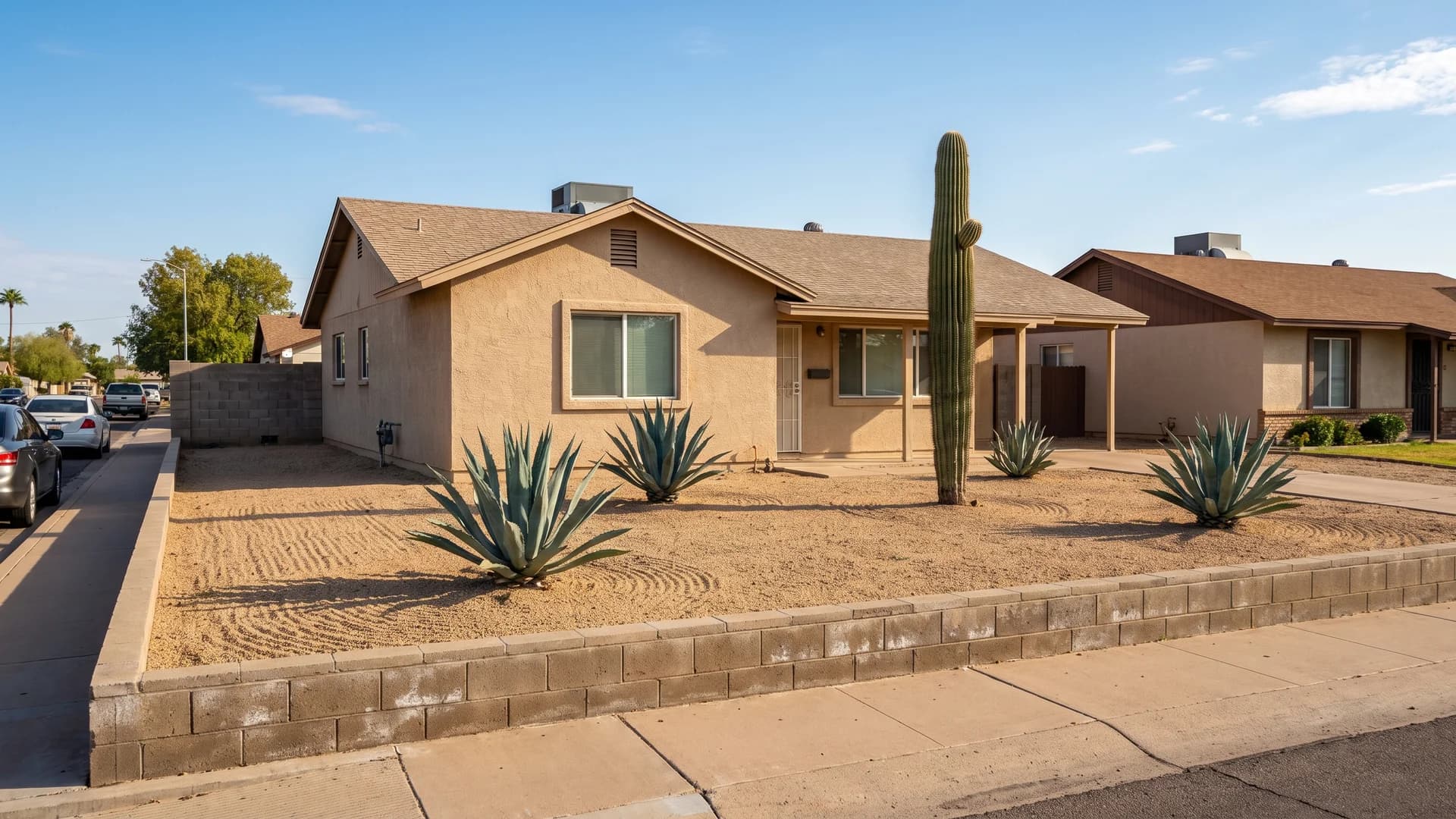
Decomposed granite is the cheapest way to reset a whole yard at once. A 1,000-square-foot area at 2 inches deep takes roughly 8 to 10 tons, which runs $400 to $800 delivered from a rock yard and three or four times that in bags from a big-box store. Compact it in two lifts, or the fines track indoors on every shoe. Expect to top it up every few years where monsoon runoff crosses it.
2. Zone the yard with two gravel colors
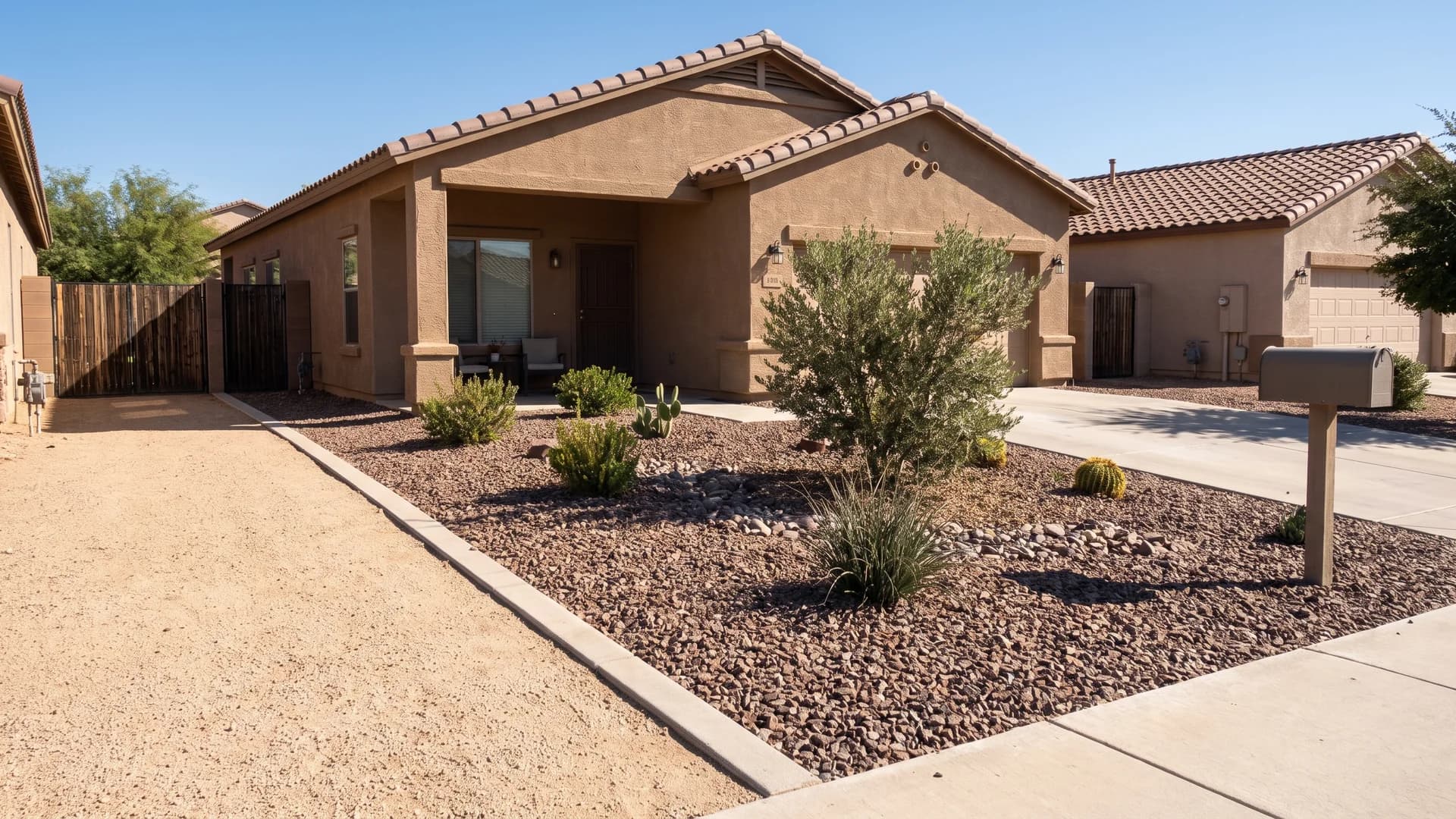
A color change does the same job as edging and costs nothing extra when both materials arrive on one delivery. Pale 3/8-inch screening for the walking surface, a darker 1-inch crushed stone for the beds, and the yard suddenly reads as zones instead of a parking lot. The boundary has to be held by something buried, though. Two gravels sitting loose against each other will trade places within a season.
3. Dig a dry creek bed where water already runs
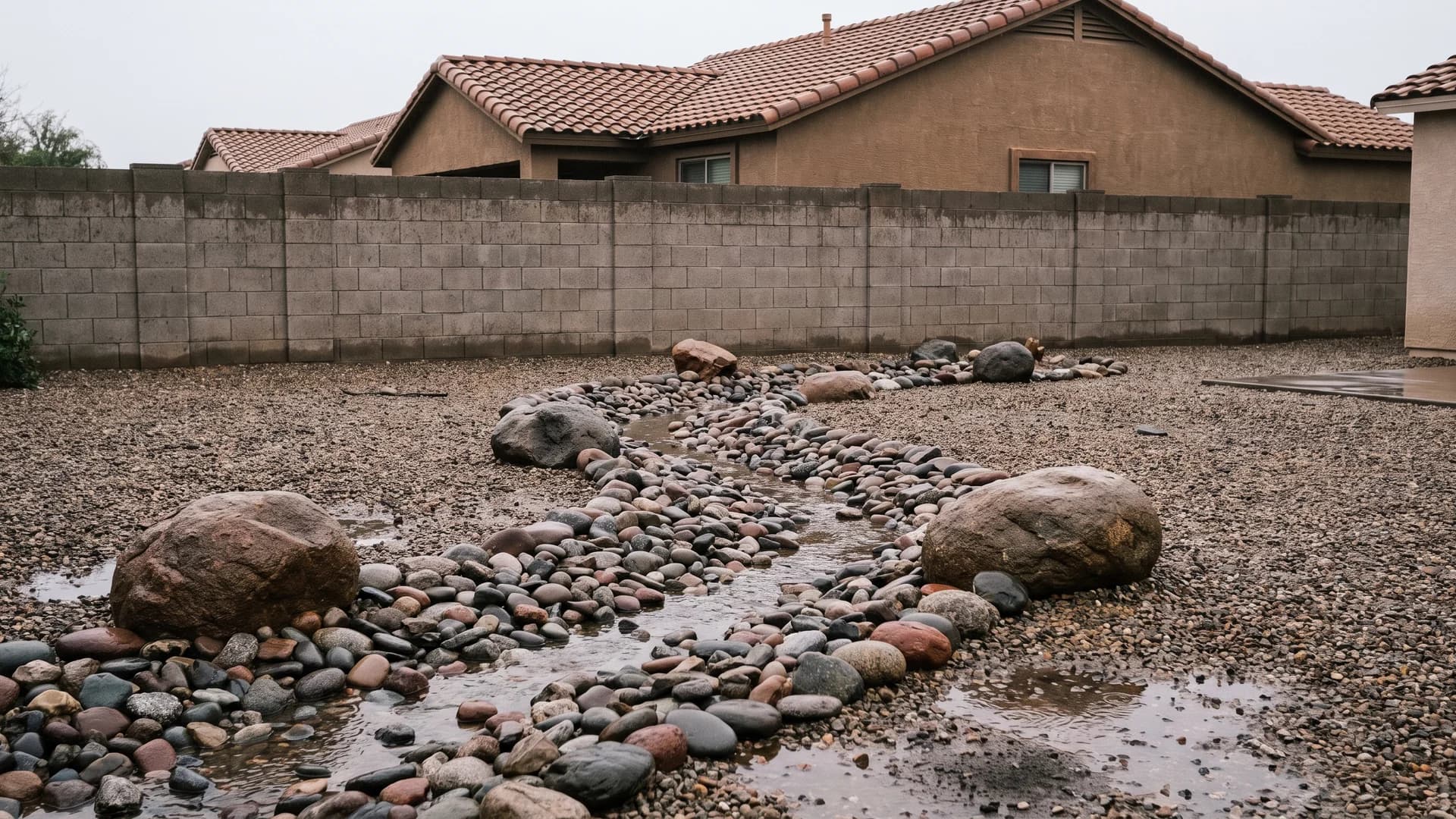
Watch your yard during one real monsoon storm and the route draws itself. Line that channel with fabric, fill it with mixed stone, and set the biggest pieces at the bends where a creek would drop them. A 20-foot run takes about a ton and a half, $120 to $220. Sizing and per-ton math are covered in our river rock sizes and costs guide.
4. Group boulders in odd numbers
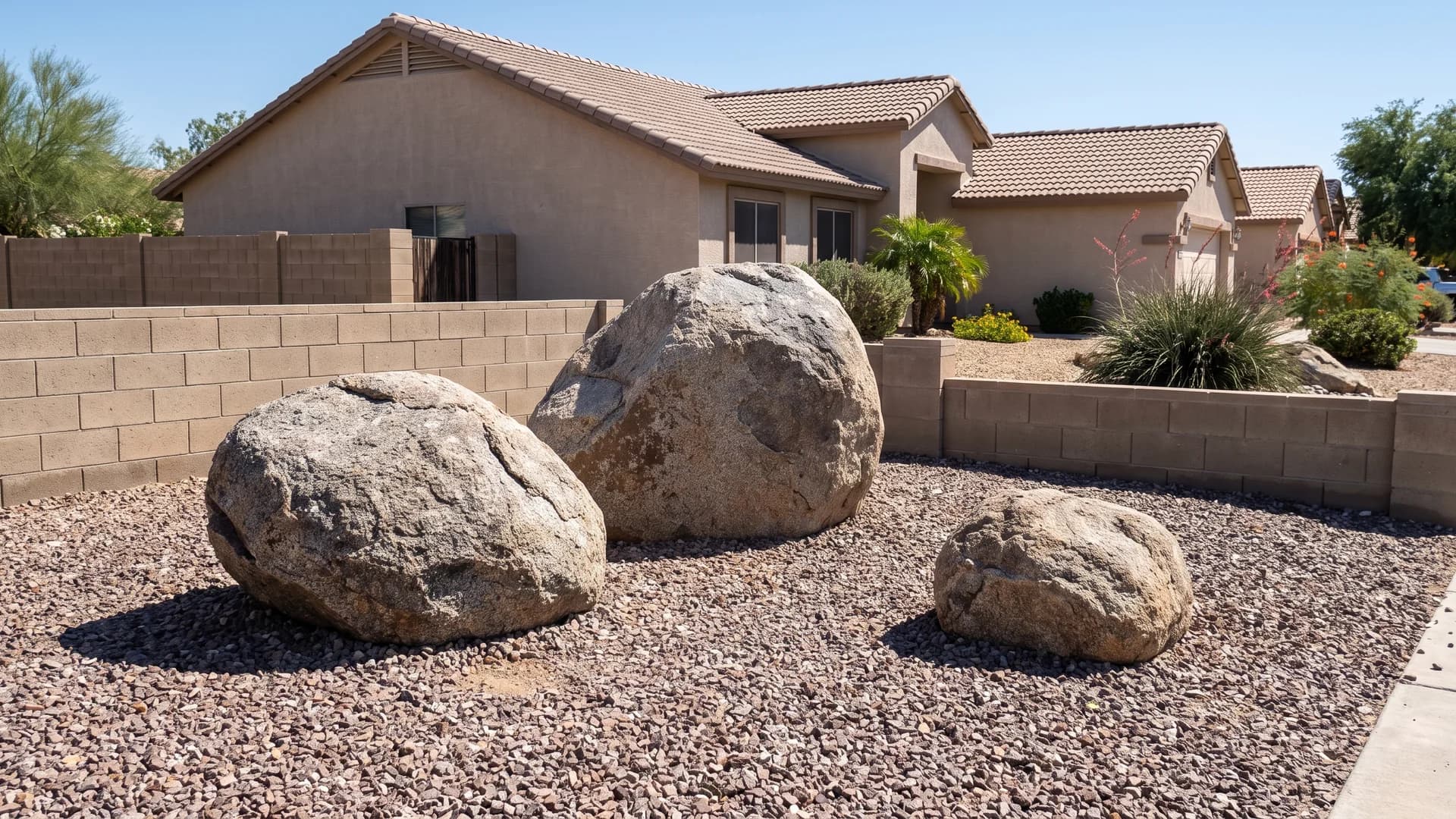
One boulder looks delivered. Three of different sizes look like the yard was always that way. Bury each one about a third deep so the soil line hides the flat quarry face, and vary the spacing instead of lining them up. Landscape boulders run $100 to $300 each delivered, and a single group fills 40 square feet of empty yard for the price of one shrub bed. Ask whether the yard has a boom truck before you buy anything over 300 pounds.
5. Draw one clean line with steel edging
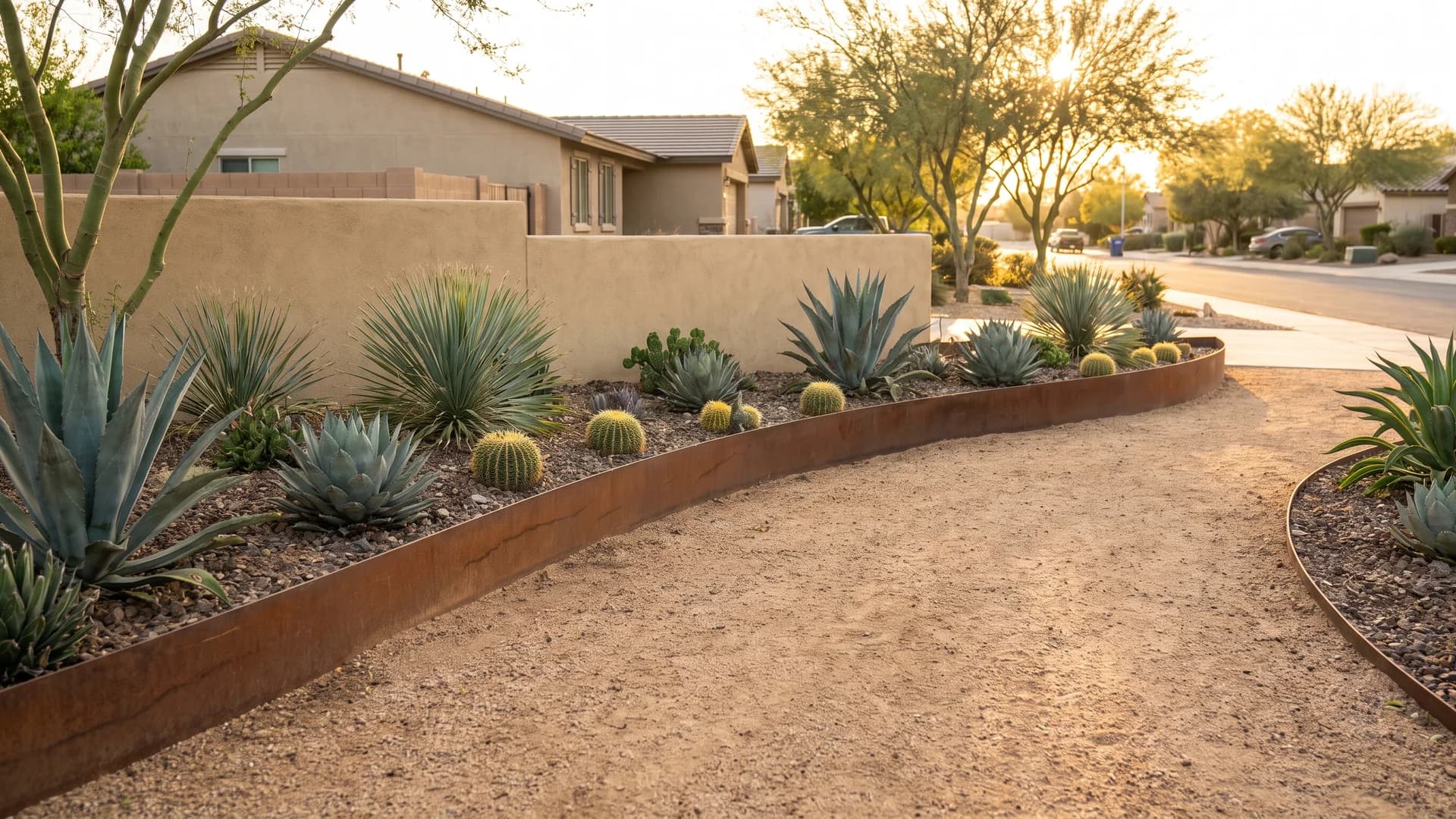
This is the detail that separates a designed yard from a neglected one. Painted steel landscape edging costs $2 to $5 a linear foot, corten $6 to $12, and both hold a curve that plastic never will. Stake it every 3 feet and leave a quarter inch proud of the gravel. Corten stains lighter stone as it weathers, so keep it away from pale walkways.
Plants that survive real desert heat
6. Anchor the bed with one agave
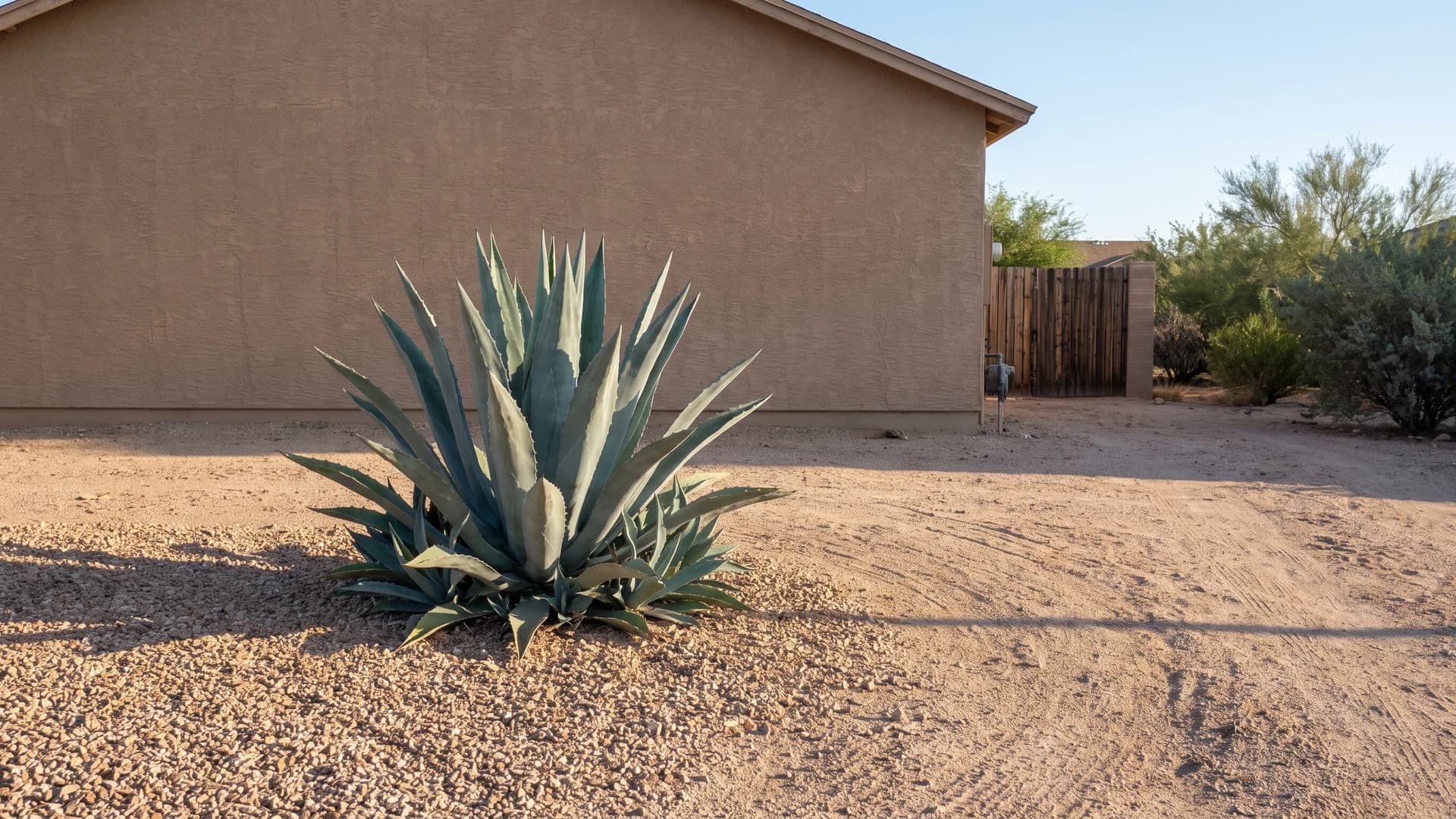
Pick the species by winter, not by looks. Agave americana wants zone 8 and up and spreads past 6 feet across by its fourth year, which is why so many end up sawn off a sidewalk. Agave parryi stays near 3 feet and takes zone 5 cold. Either runs $30 to $60 in a 5-gallon pot. Give it the mature width now and fill the gap with gravel, not another plant.
7. Repeat golden barrels in threes
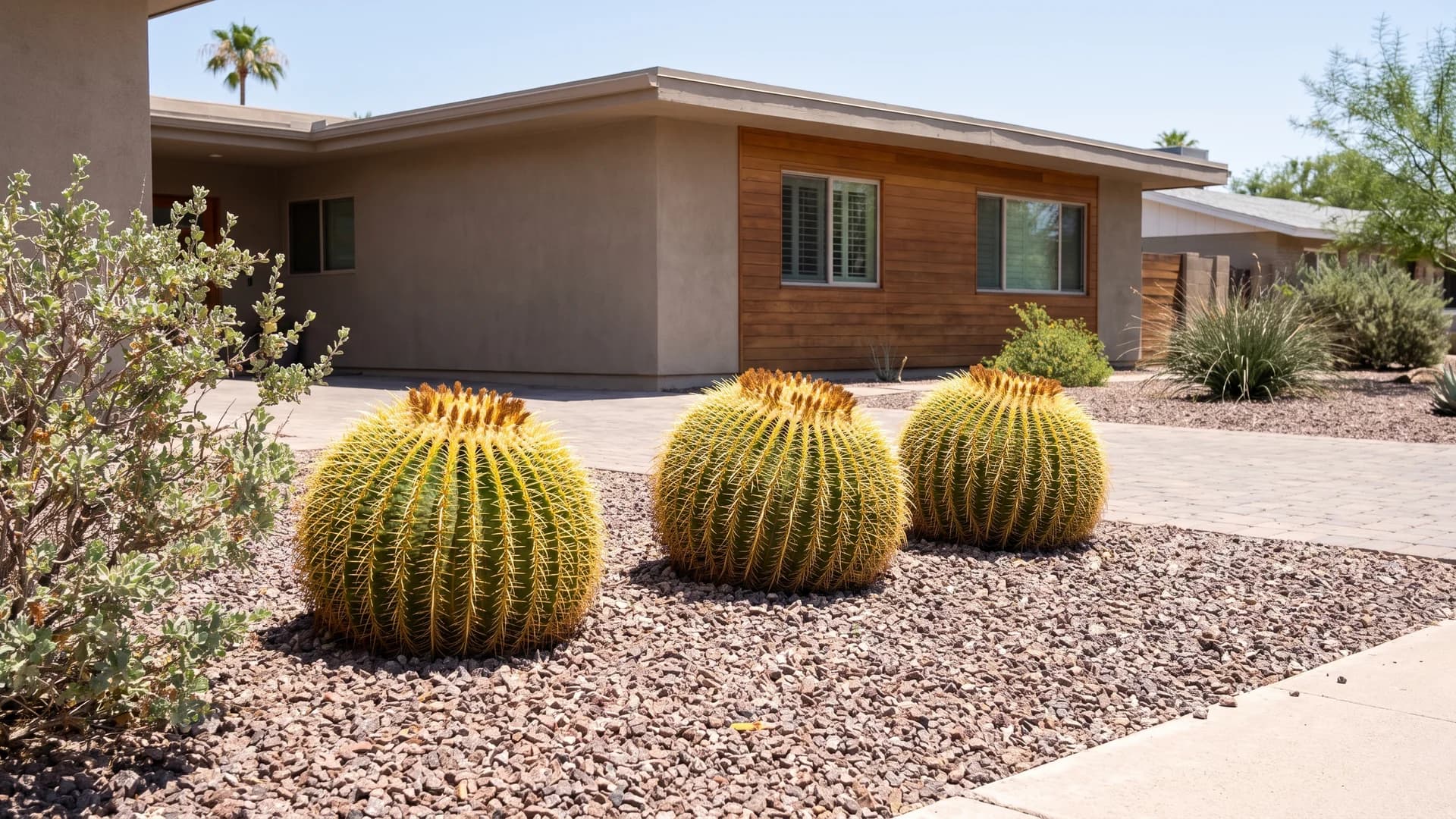
Nothing says modern desert landscaping faster than the same round form repeated three or five times down a bed. Golden barrels are zone 9 to 11 plants, and one wet winter below that will rot them from the base, so high-desert yards should swap in a hardier prickly pear. A 10-inch barrel costs $40 to $90. Set them on a slight mound so water never sits at the crown.
8. Add height with ocotillo
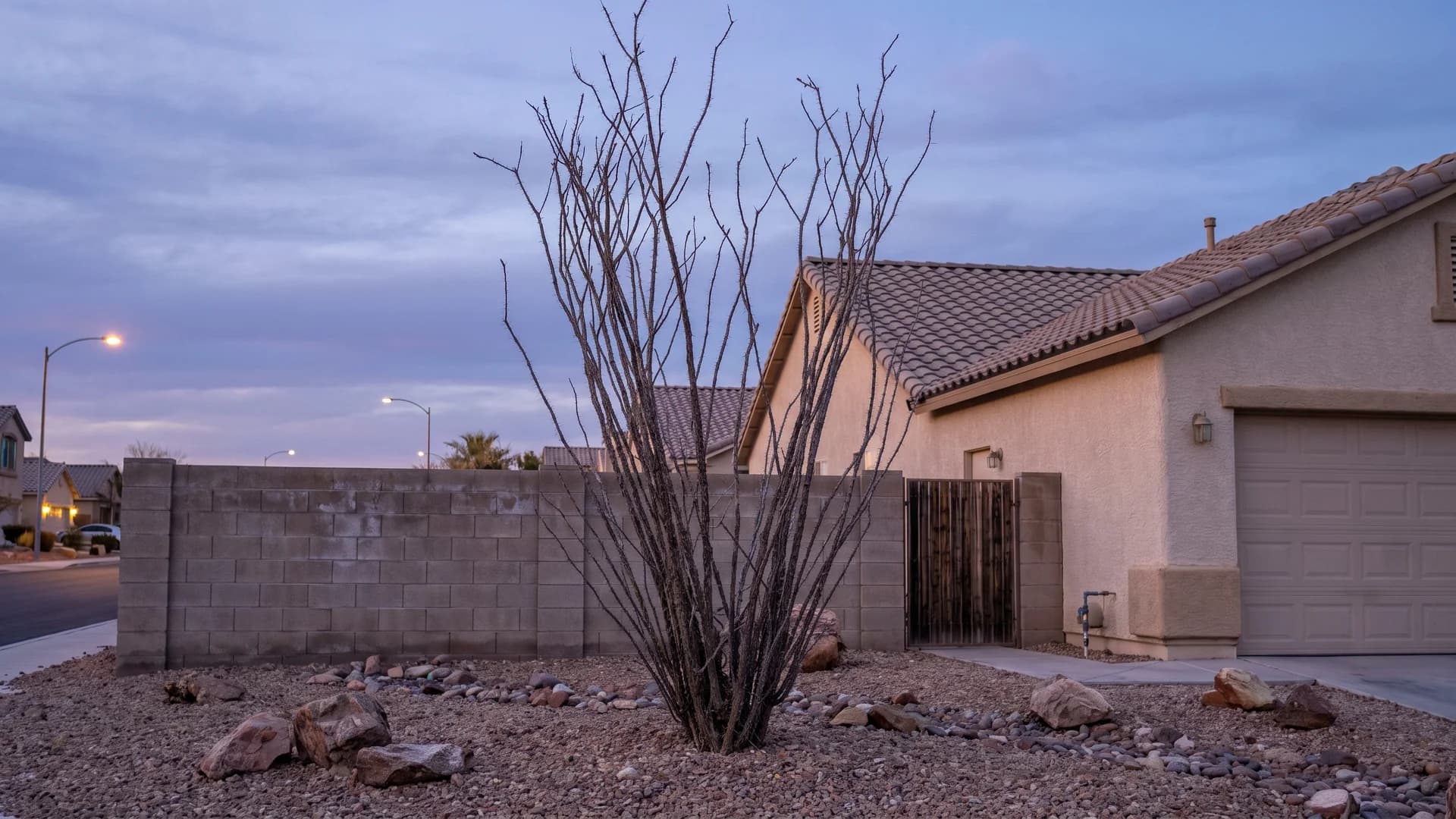
Ocotillo gives you 10 feet of vertical line without committing to a tree or its root zone, and it lights up with red tips in spring. Zones 8 to 11. Here is what the nursery tag leaves out: for much of the year it is a cluster of gray sticks, and a bare-root cane takes a full season to root. Buy a potted one at $40 to $120 if you want leaves the first summer.
9. Sow a wildflower strip for spring
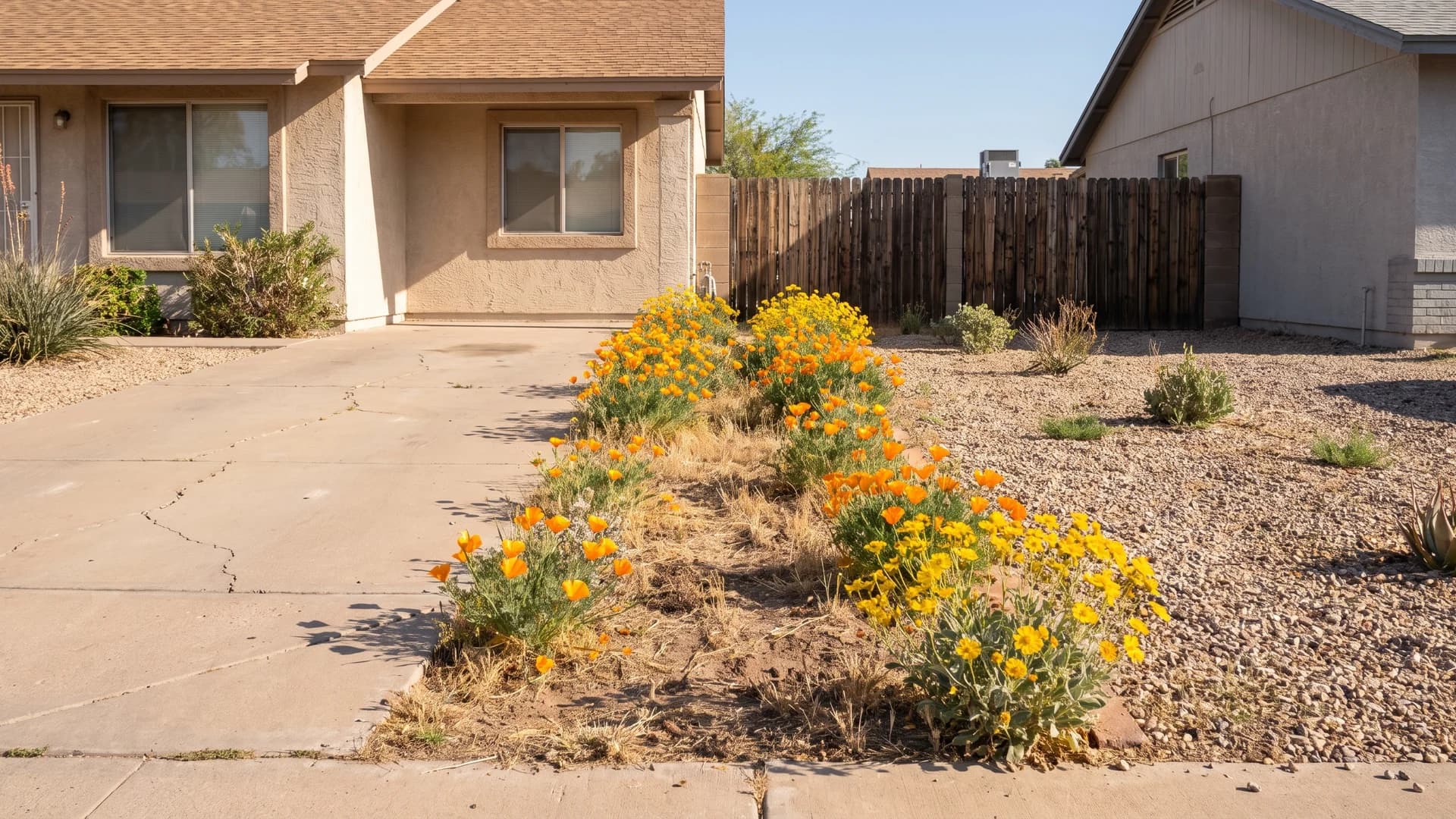
Timing is the entire trick. Sow a Southwest mix from mid-October to early December, rake it into the top half inch of soil, and water lightly until the seedlings hold. A quarter pound covers a 10-by-20 strip for under $20, which is the cheapest color in this list. Skip it if you cannot water for three weeks. Spring-sown desert seed mostly feeds ants.
10. Break up the spines with grass drifts
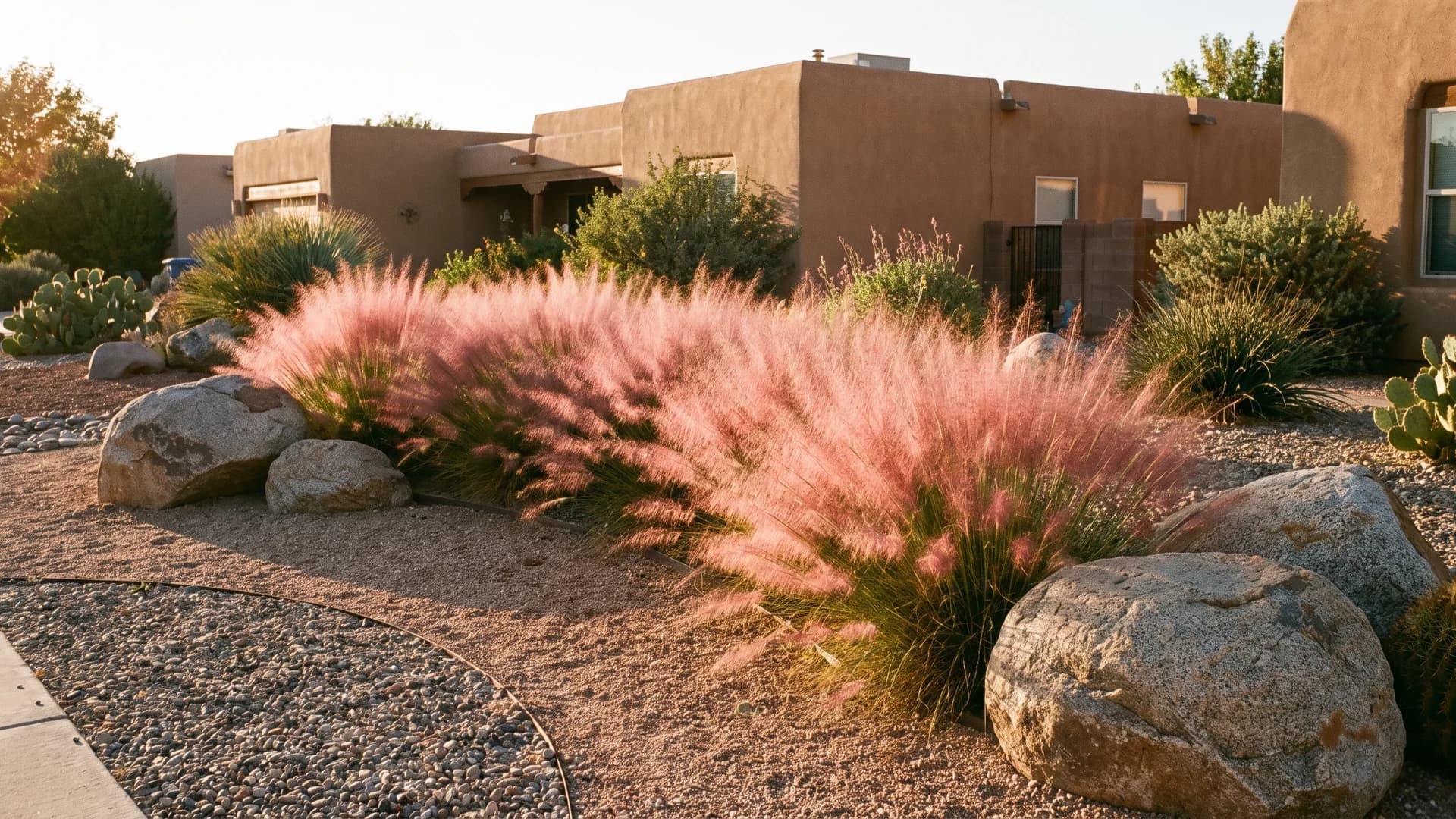
Yards built only from cactus and stone read hard. Ornamental grasses in drifts of three to five soften them without asking for water. Pink muhly holds zones 6 to 10 and turns rose-pink in October; blue grama is native across zones 3 to 10 and stays under 18 inches. Both run $10 to $18 a gallon and want one cutback in late winter. That is the whole maintenance calendar.
Desert front yard curb appeal
11. Flank the entry with a matched pair
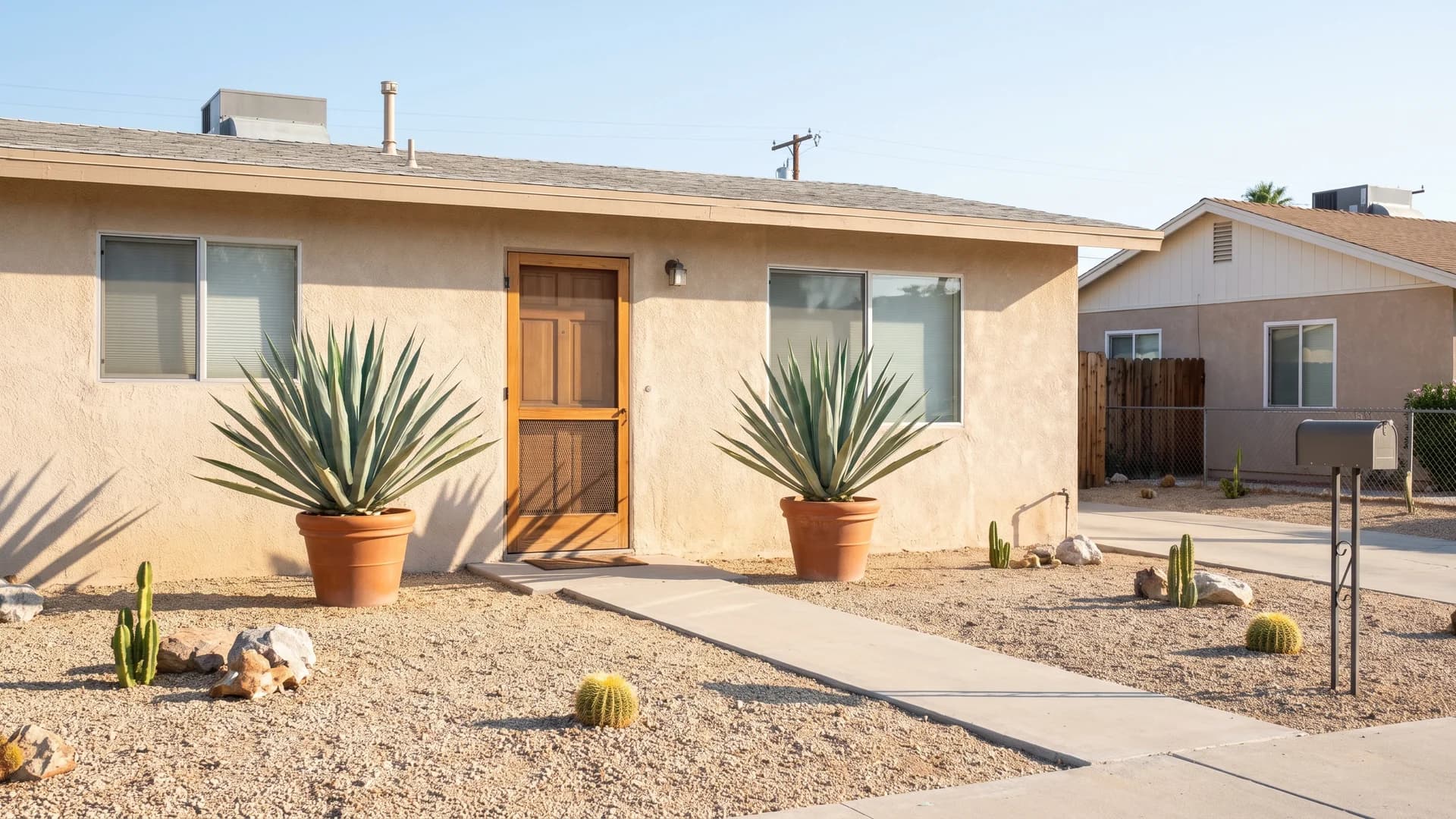
Symmetry is the cheapest formality there is. Two identical agaves, barrels, or red yuccas at the door tell the eye where to go, and the whole trick costs under $150. Hesperaloe handles zones 5 to 11 and blooms most of the summer, which makes it the safer half of the pair in a cold-snap winter. Match the containers as tightly as the plants.
12. Float pavers through the gravel
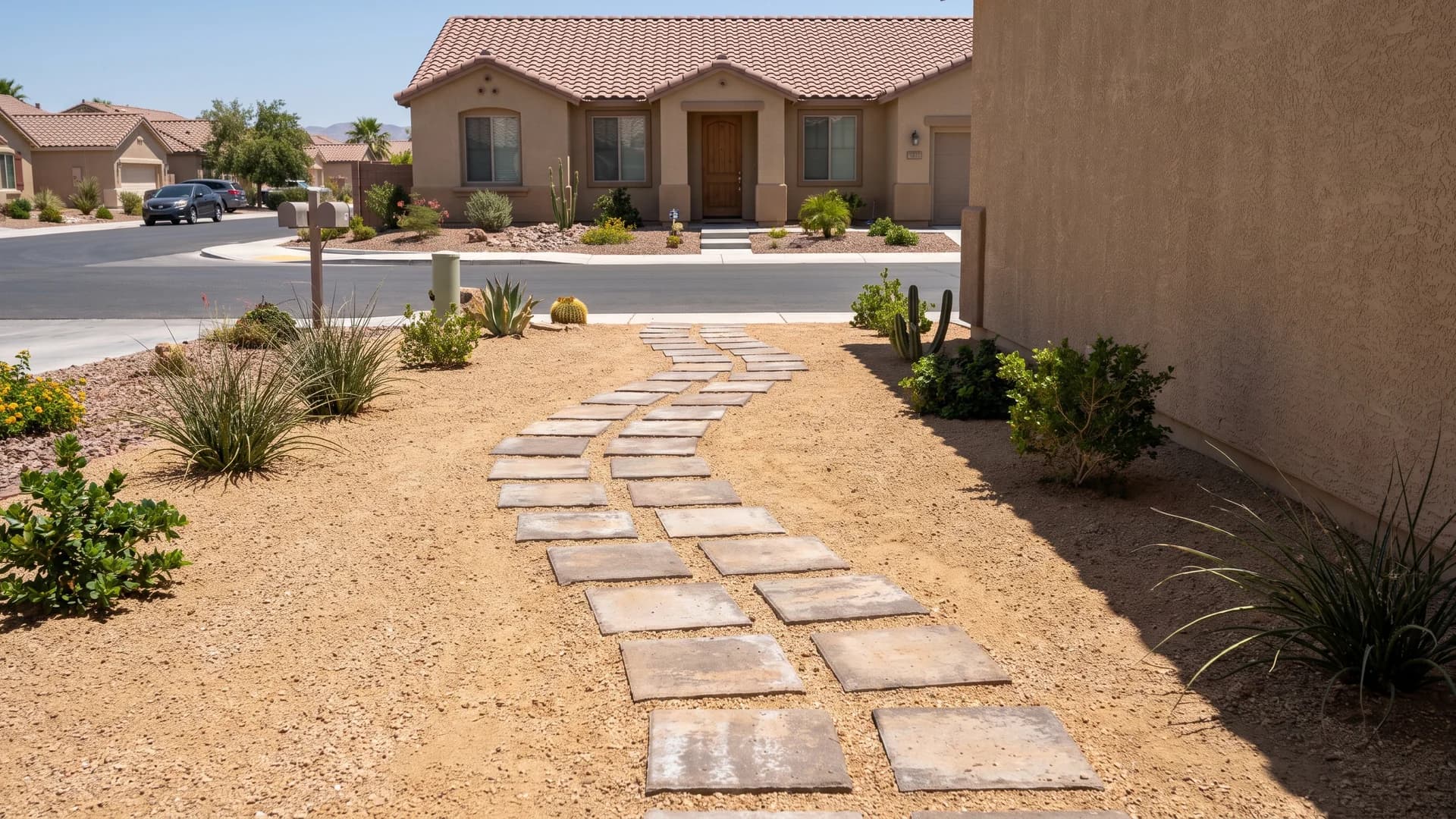
Walk the route first and drop the pavers where your feet actually land, usually 24 to 26 inches center to center. Grid spacing looks fine on paper and forces a stutter step in real life. An 18-inch concrete paver runs $4 to $8, so a 20-foot path lands around $80. Set each one an eighth of an inch below the gravel line so nothing catches a toe at night.
13. Plant one shade tree on the west side
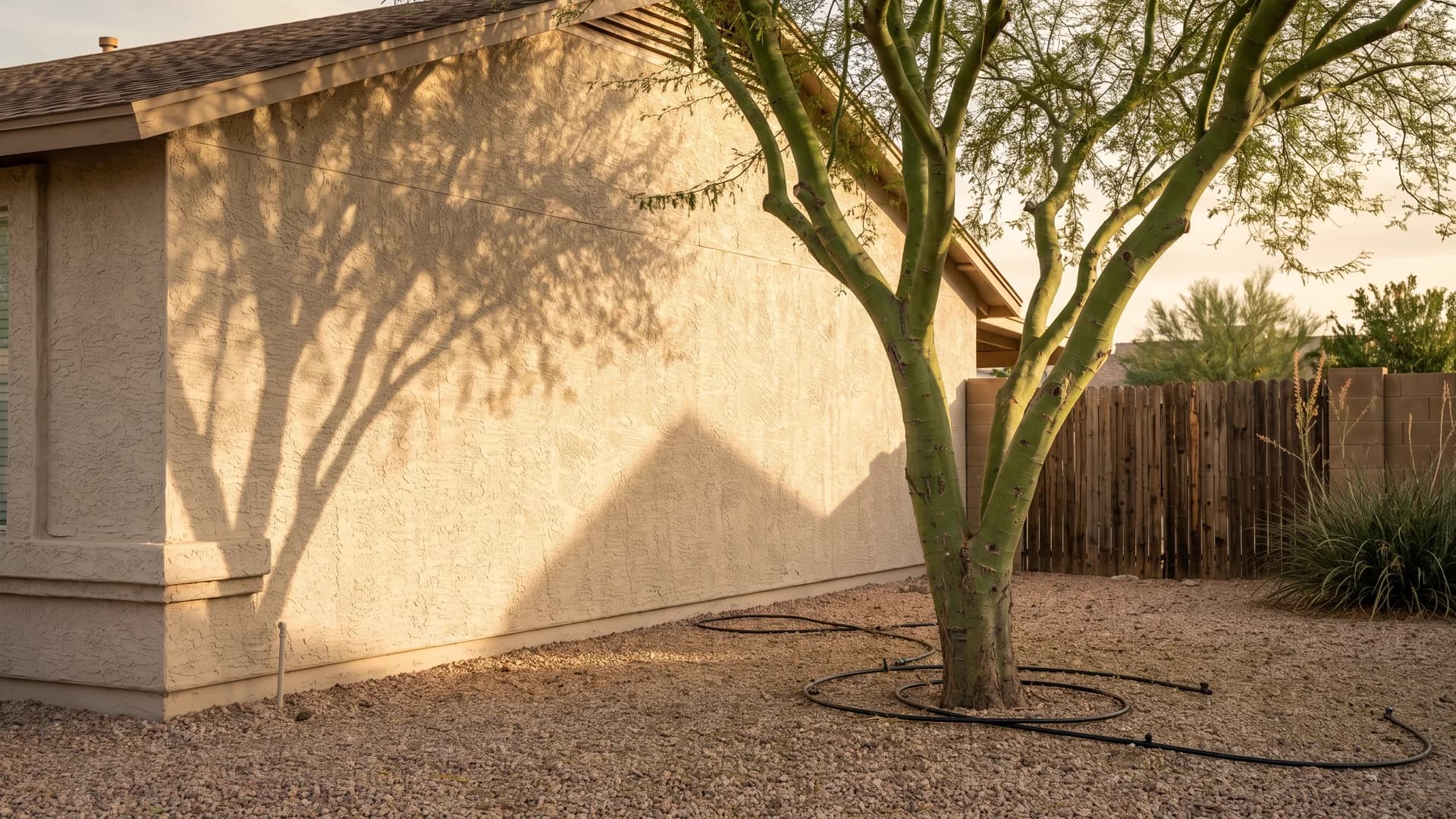
The west wall is where a desert house takes its afternoon beating, and one tree there does more for the power bill than any amount of gravel. Desert Museum palo verde is zone 8 to 11 and thornless; desert willow takes zone 7 winters and flowers all summer. A 15-gallon tree costs $80 to $150. Set it 15 feet off the foundation and run drip irrigation for the first three years.
14. Terrace a sloped front yard in low block
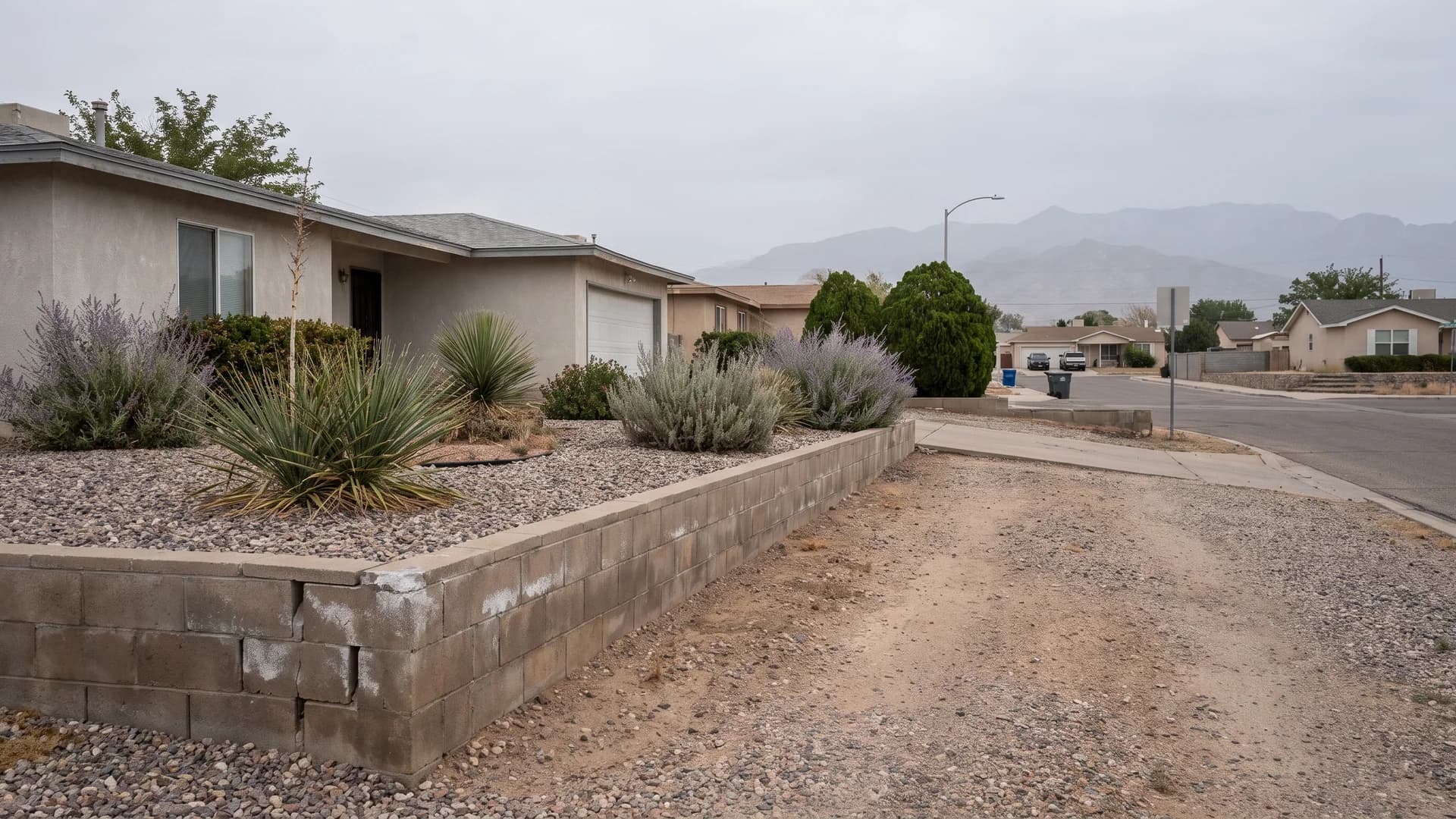
On a graded front yard, one low wall does what a truckload of gravel cannot: it stops the slope from washing into the street every August. Under 2 feet you can dry-stack block yourself for $8 to $15 a linear foot in materials. Anything taller needs drainage and usually a permit. The full sequence is in our hillside landscaping guide.
15. Match the gravel to the house
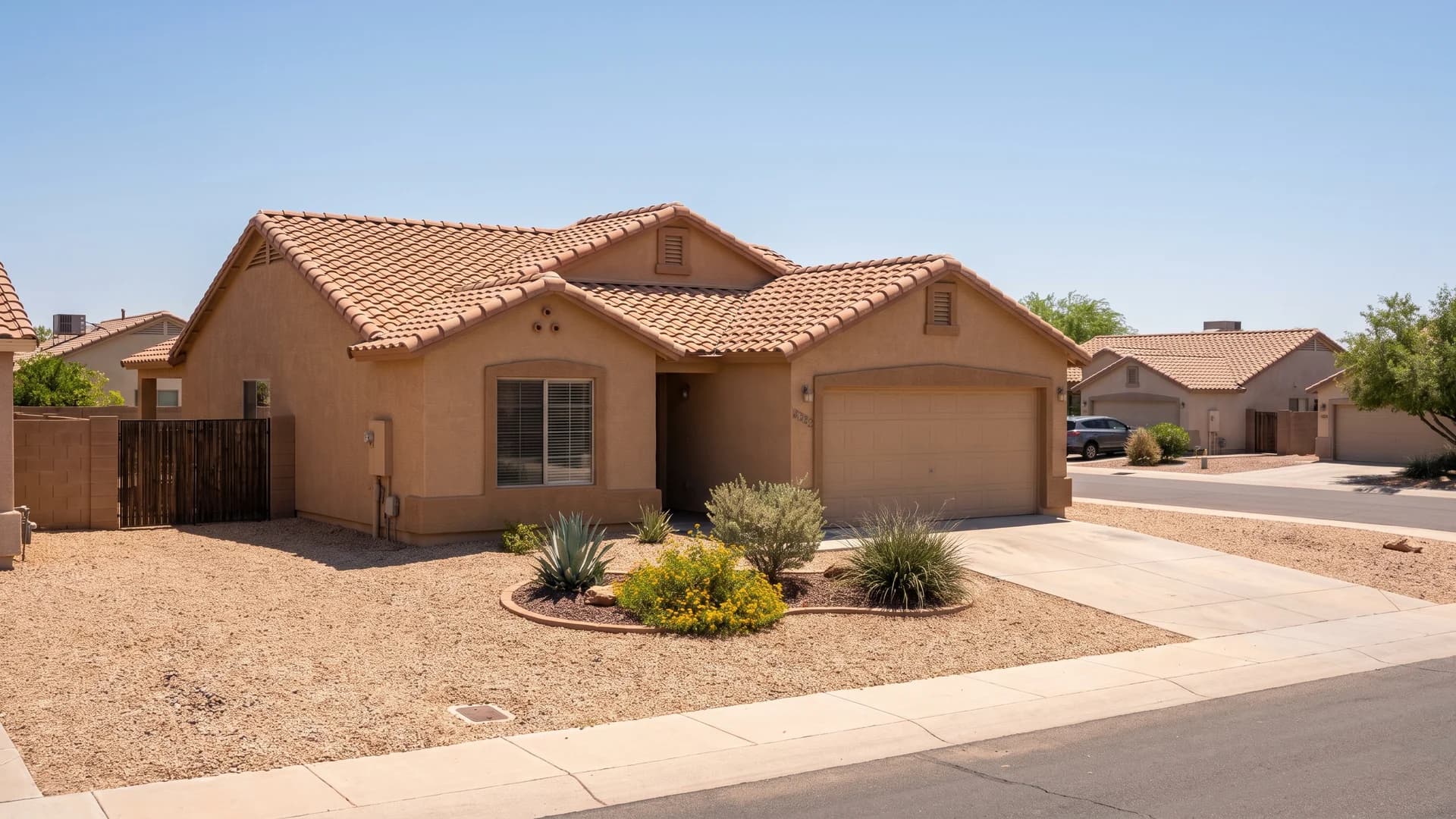
Pull the color out of the stucco or the roof tile, not out of the catalog. Rock yards will fill a sample bucket for a few dollars, and you want to see it dry at noon and wet after a hose, because most stone goes two shades darker when it rains. One warning worth the paragraph: dark lava rock against a south or west wall turns that side of the house into a radiator by three in the afternoon.
Backyard ideas for a desert lot
16. Build a gravel patio around a fire pit
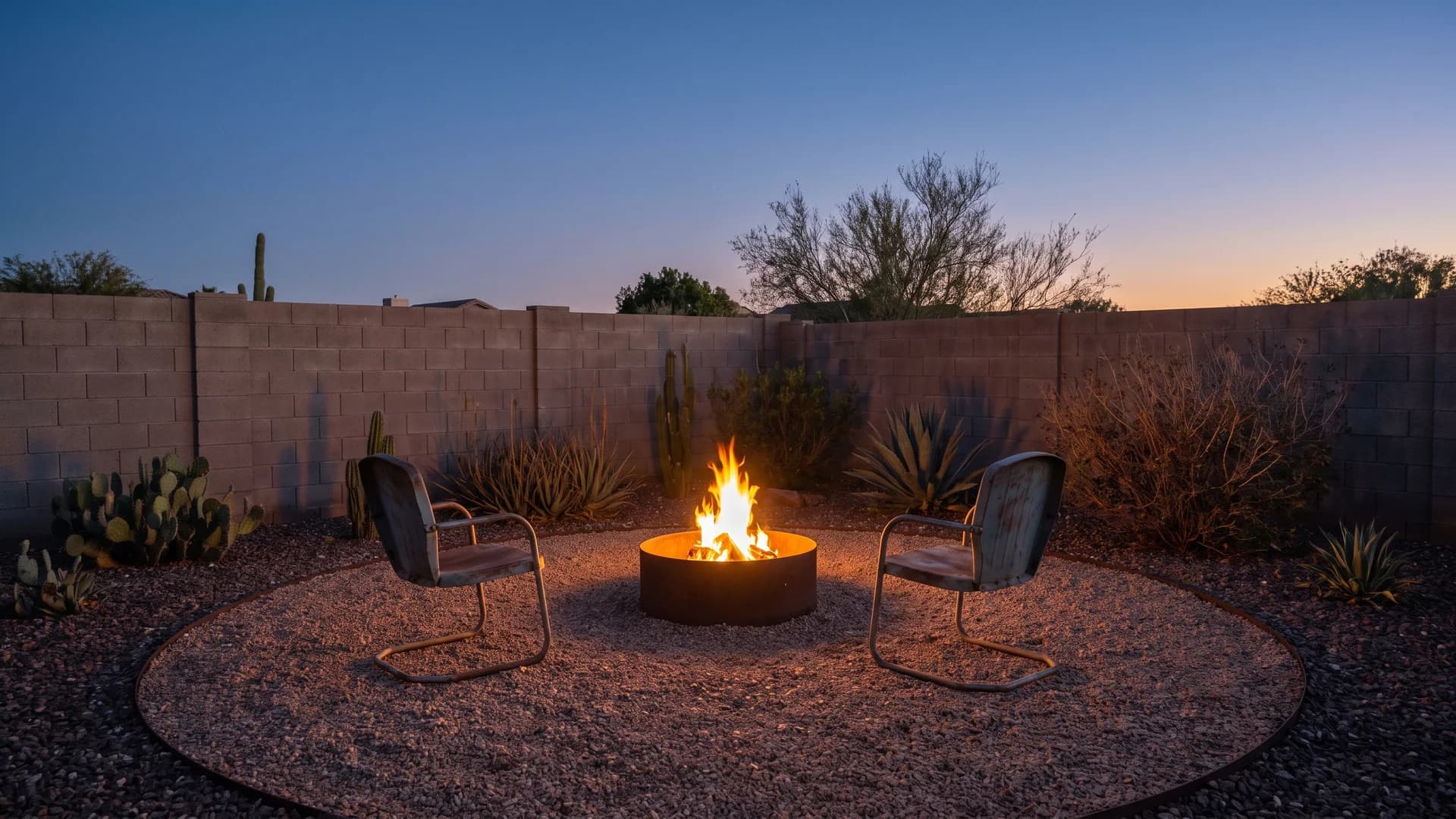
Desert nights drop 30 degrees after sunset, which is exactly when the backyard becomes usable. A 12-foot circle of crushed stone around a fire pit is fireproof ground for $150 to $300 in material, plus $150 to $400 for the pit itself. Crushed rock stays put under chair legs better than pea gravel. Check your county's burn rules first; parts of Maricopa County restrict wood fires on high-pollution days.
17. Put shade over the seating zone
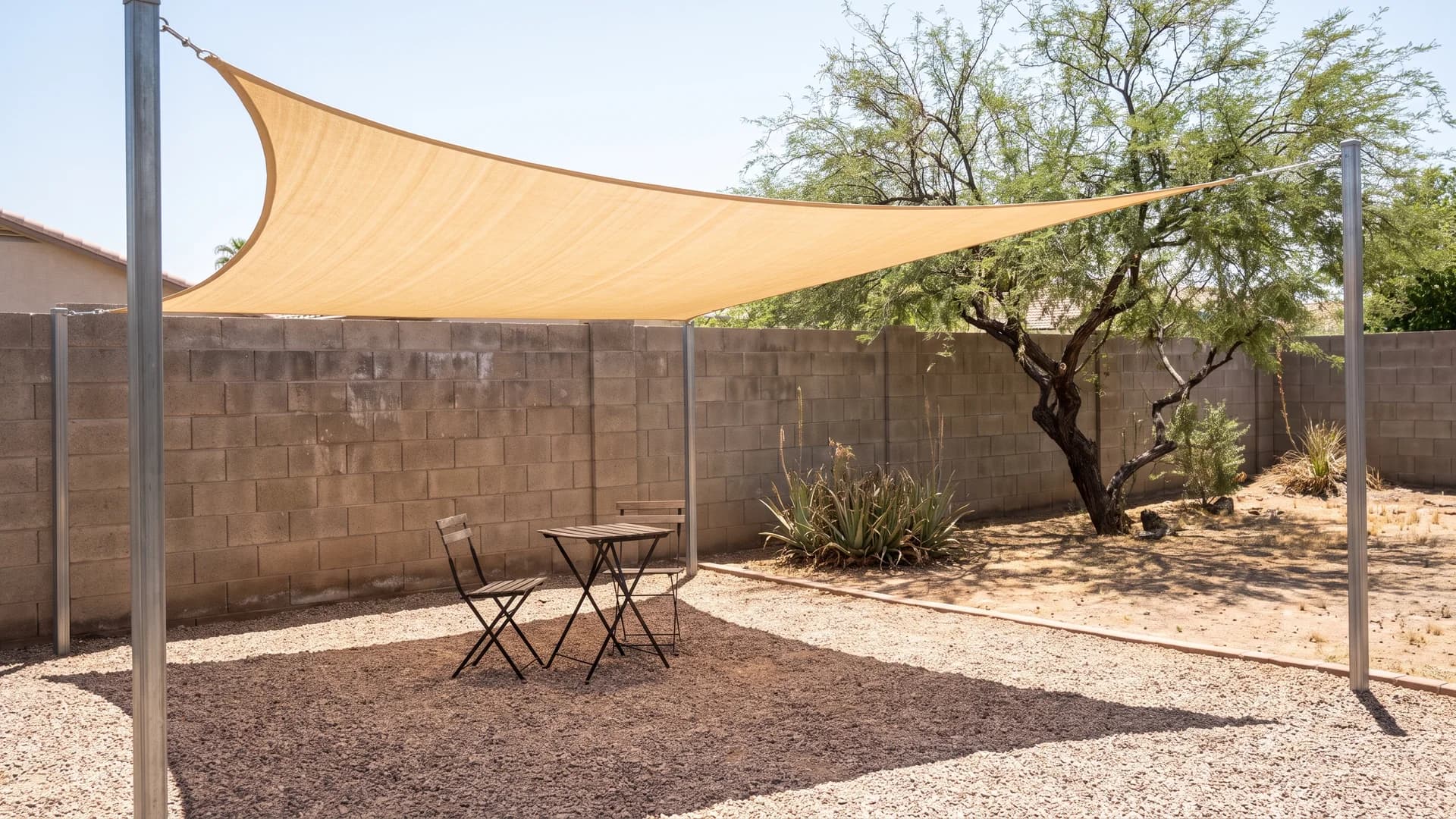
Shade decides how many months of the year the yard gets used, and in June it is the only thing that matters. A 12-by-12 sail costs $60 to $150 plus posts and hardware, and a kit pergola runs $1,200 to $4,000. Sails need real anchor points, so plan for concrete footings rather than screwing into a fence. Angle the sail so it blocks the western sun, not the noon sun.
18. Keep one small pad of turf
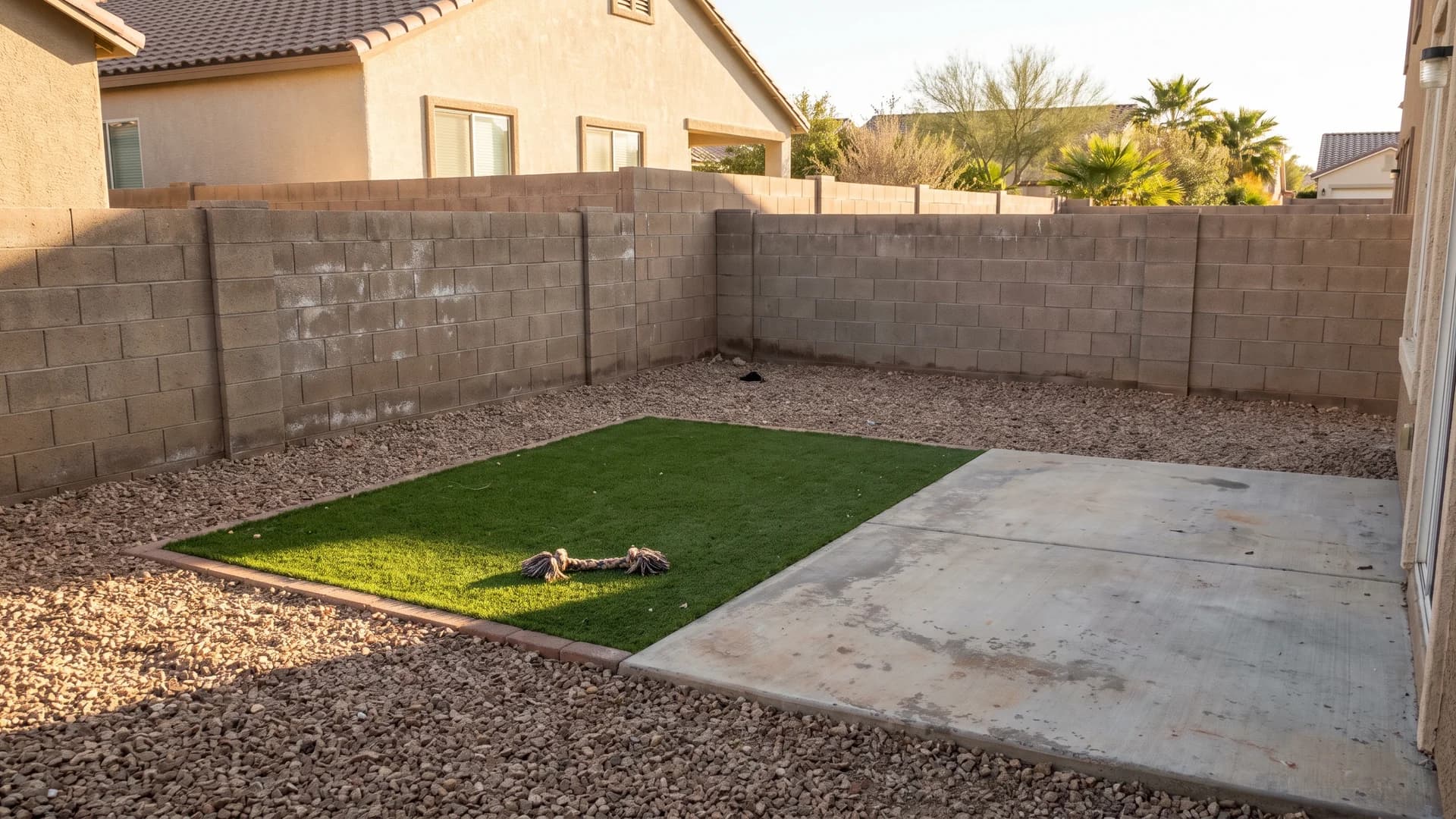
Kids and dogs want somewhere soft, and a 10-by-12 pad gives them that without a lawn's water bill. Artificial turf runs $8 to $15 a square foot installed, or $4 to $7 in materials if you build the base yourself. It also gets brutally hot: synthetic grass in full desert sun can climb well past bare skin tolerance, so put the pad where the house or a tree shades it after 2 p.m.
19. Add a fountain with a buried basin
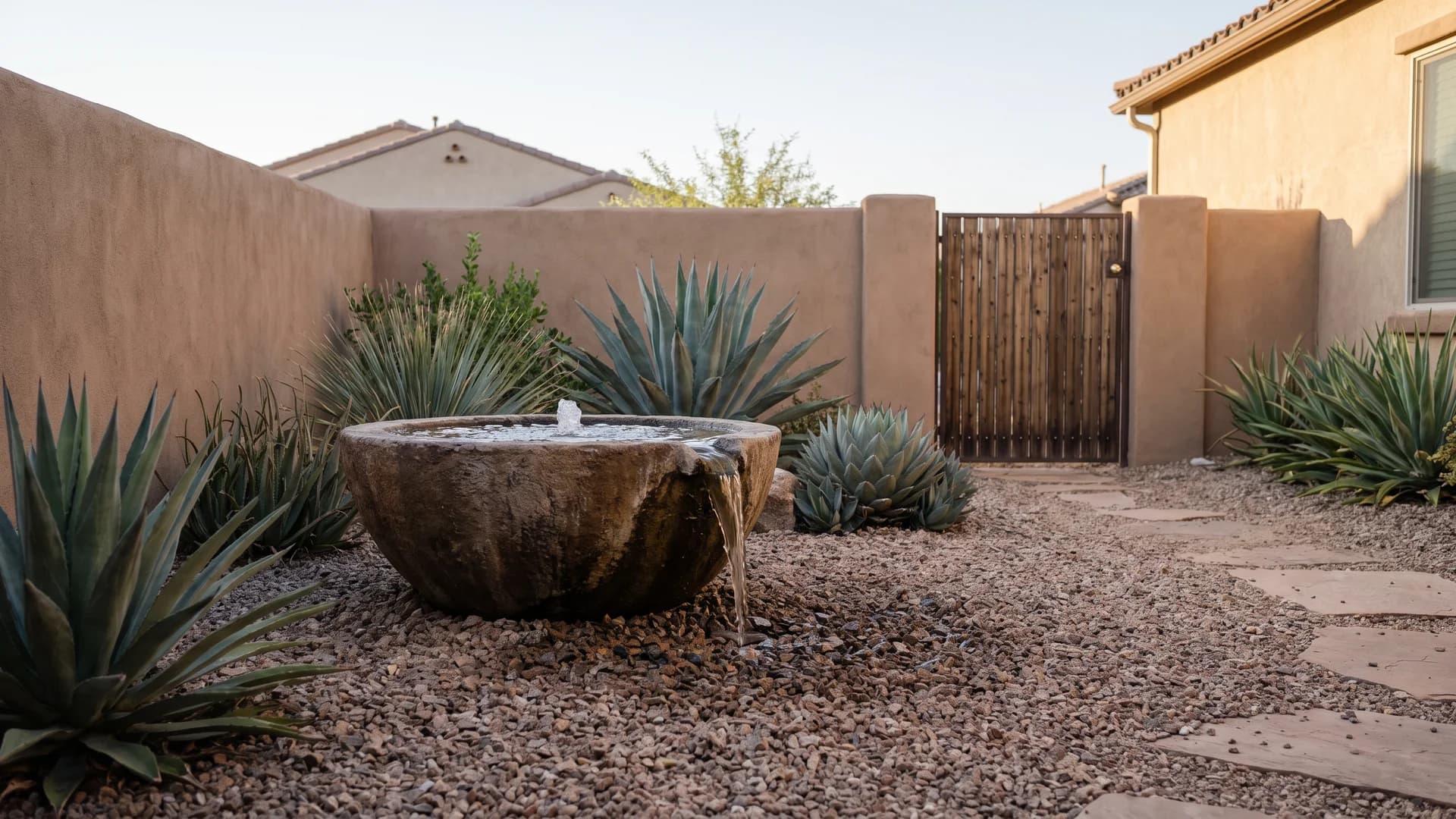
Moving water is the one sound that cancels a road, and birds will find it within a week. A disappearing fountain hides its reservoir underground, so far less evaporates than in an open bowl. Kits run $300 to $900. Top it up weekly in summer and drop in a mosquito dunk, because standing water in July does not stay charming for long.
Desert landscape lighting after dark
20. Uplight one specimen
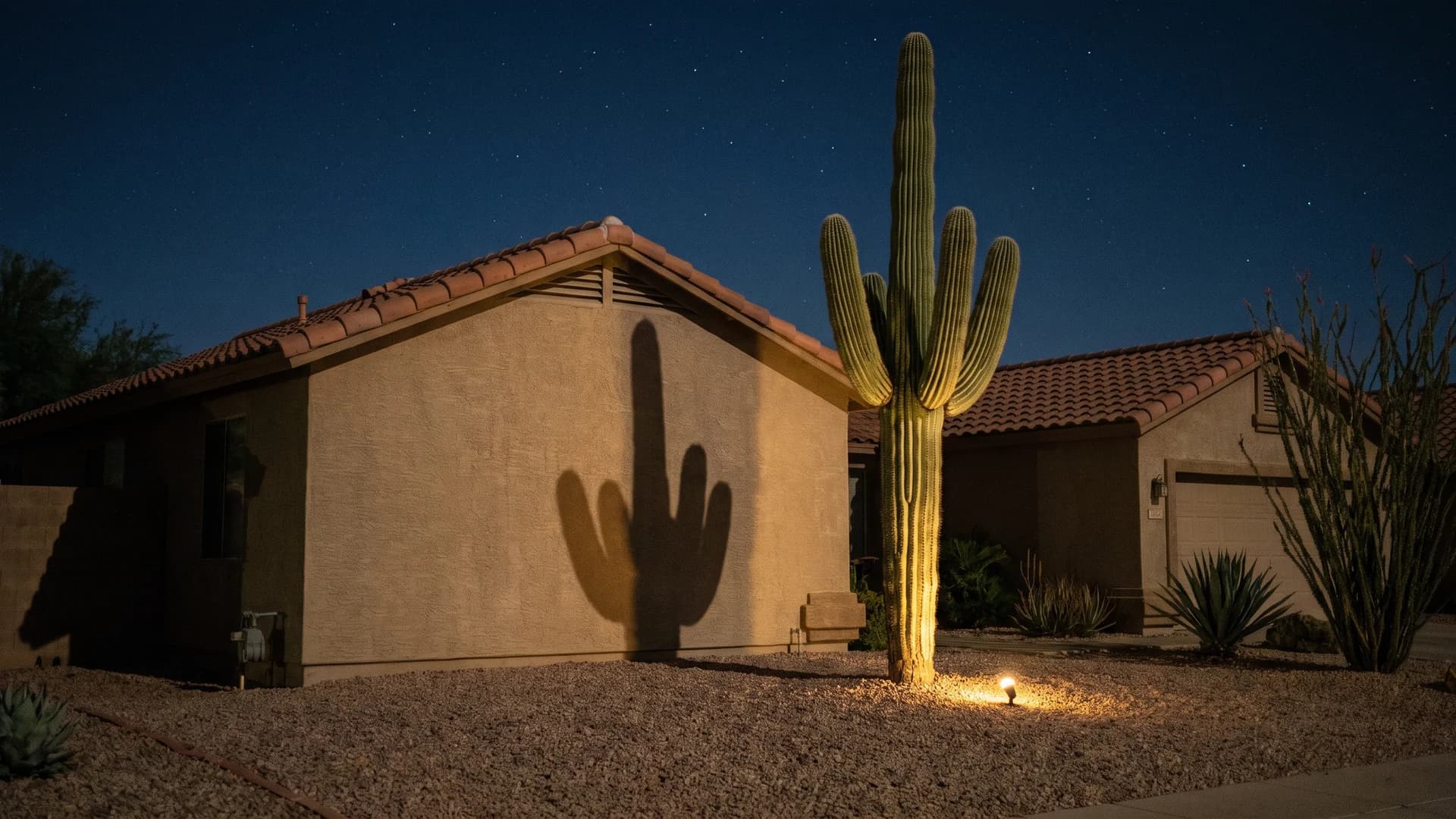
Set one warm 3-watt uplight at the base of a saguaro, ocotillo, or multi-trunk tree and its silhouette climbs the wall behind it, which turns a single plant into the entire night view. No other fixture here returns as much. Uplights cost $25 to $60 each and a 100-watt transformer $80 to $150. Aim it slightly off-center; straight-on lighting flattens everything it touches.
21. Light the path low, not runway-style
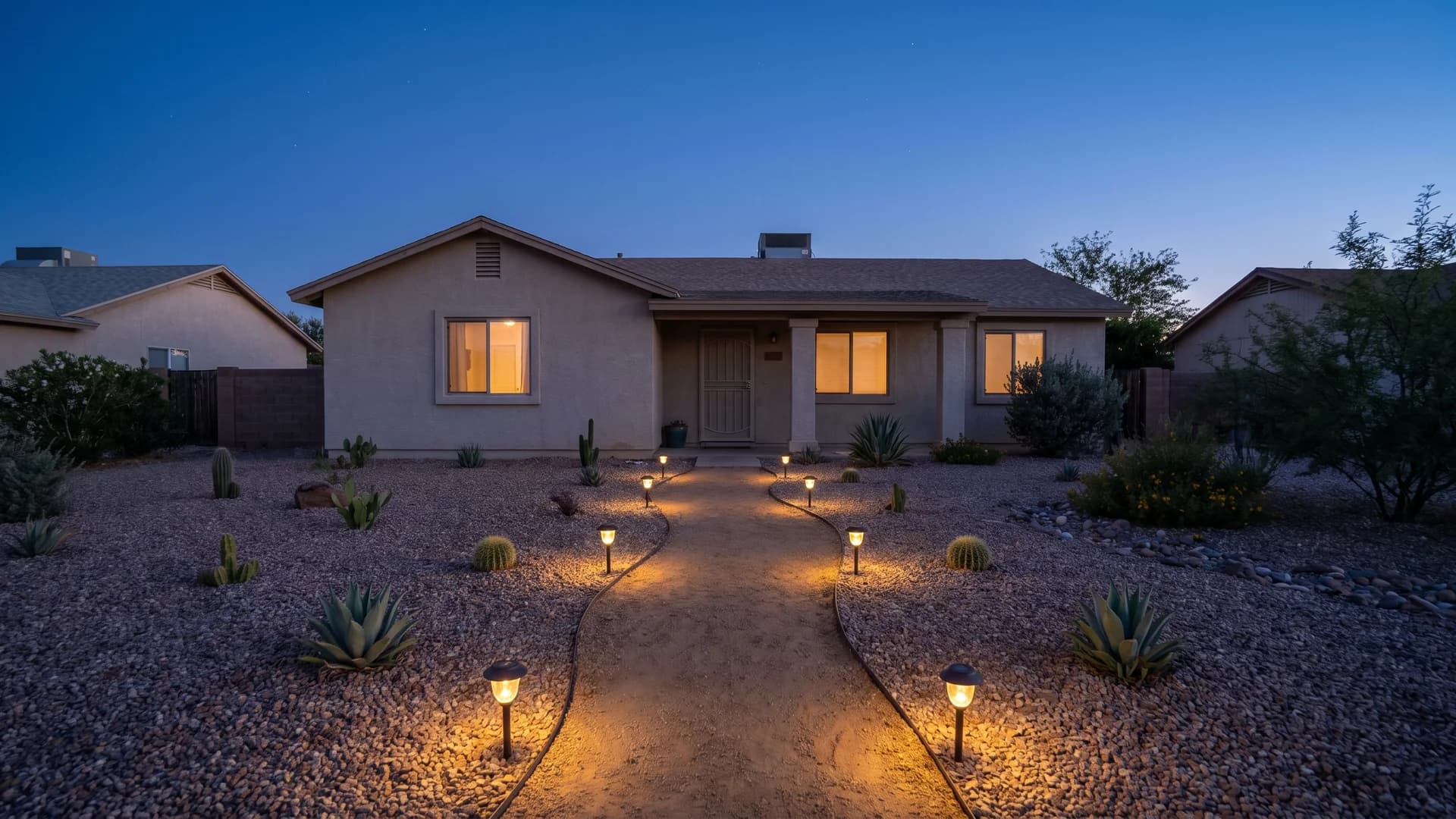
Space landscape lighting 8 to 10 feet apart and stagger the sides, so the walk reads as a path rather than an airstrip. Low-voltage fixtures on a transformer cost more up front, $25 to $50 each plus cable, and they still work in January when solar stakes have quit. Solar at $8 to $20 apiece is fine for a back path you rarely use after dark.
22. Wash the block wall
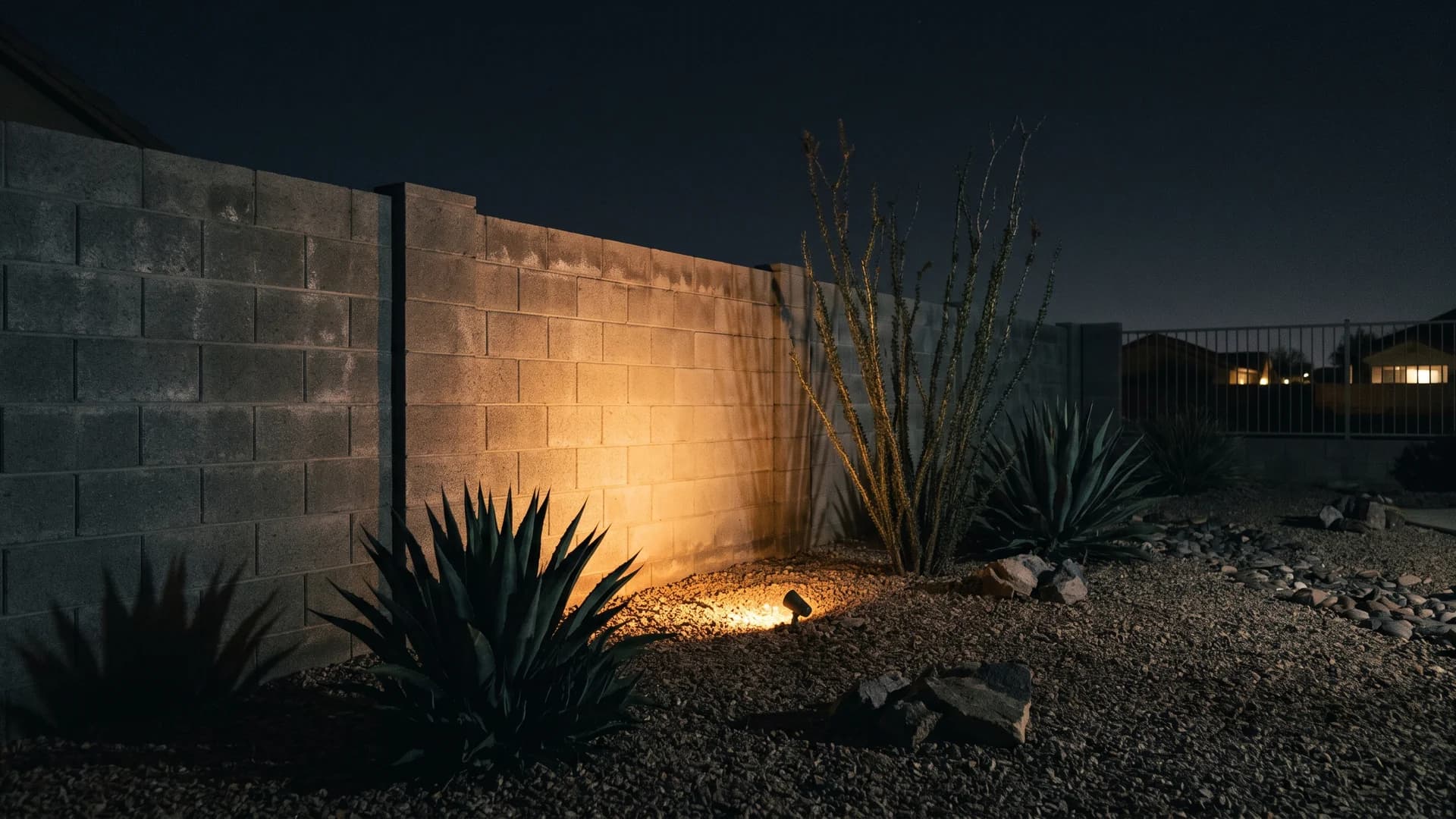
Nearly every desert yard is fenced in gray block, and at night that wall is simply a void. Two or three wide-beam fixtures set 18 inches out and aimed up convert it into a lit backdrop that the plants read against. Budget $40 to $80 a fixture. Warm bulbs at 2700K flatter tan and adobe tones; anything cooler makes block look like a loading dock.
23. Hang string lights over the patio
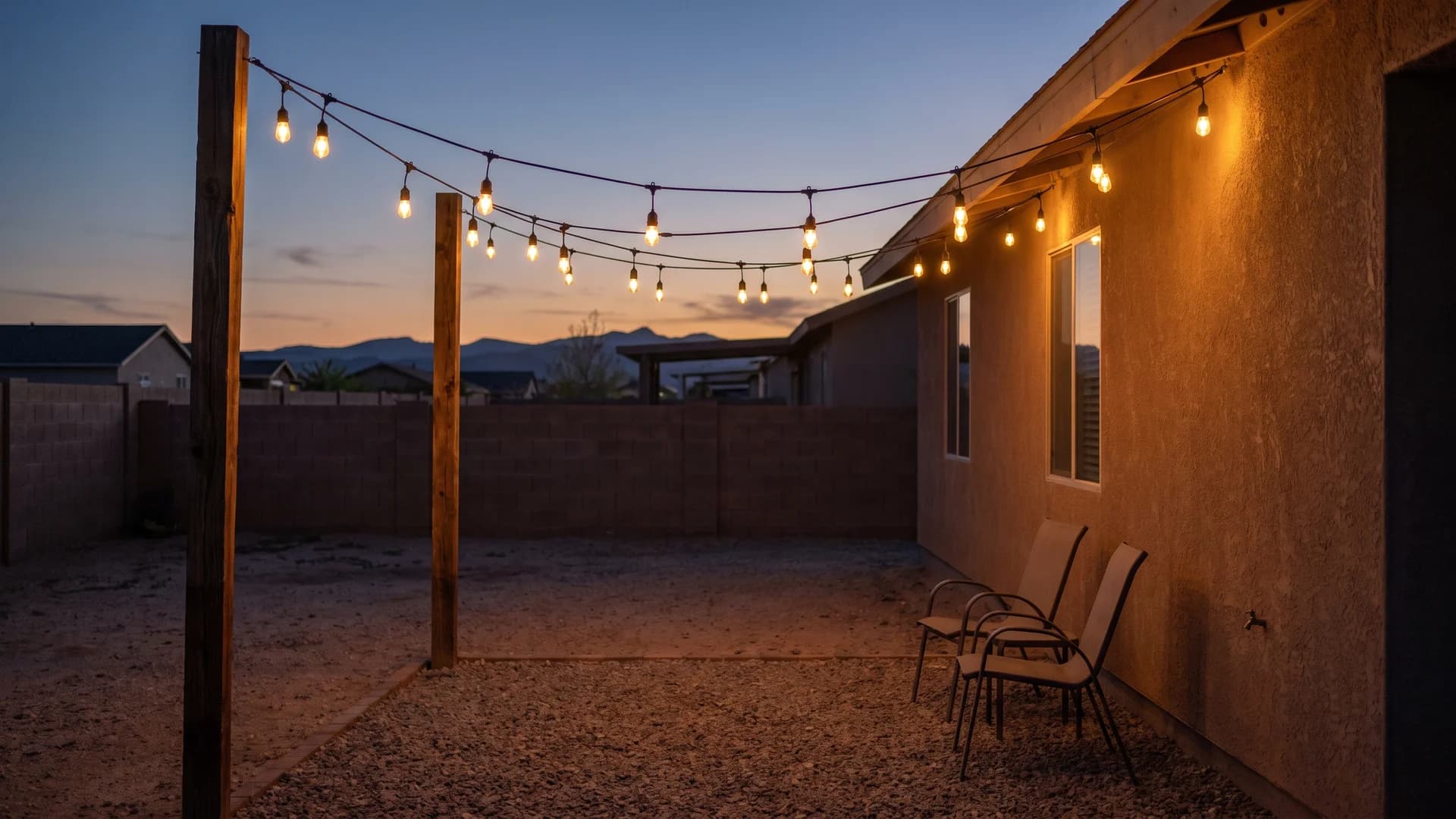
Commercial-grade string lights run $40 to $70 for a 48-foot strand and give the seating area a ceiling, which is what makes an outdoor room feel like a room. Run a steel guy wire between anchor points first and zip-tie the strand to it. Left hanging on its own cord, it sags within a month and any real wind takes it down with a monsoon gust.
Inexpensive desert landscaping ideas for small yards
24. Cluster containers instead of digging
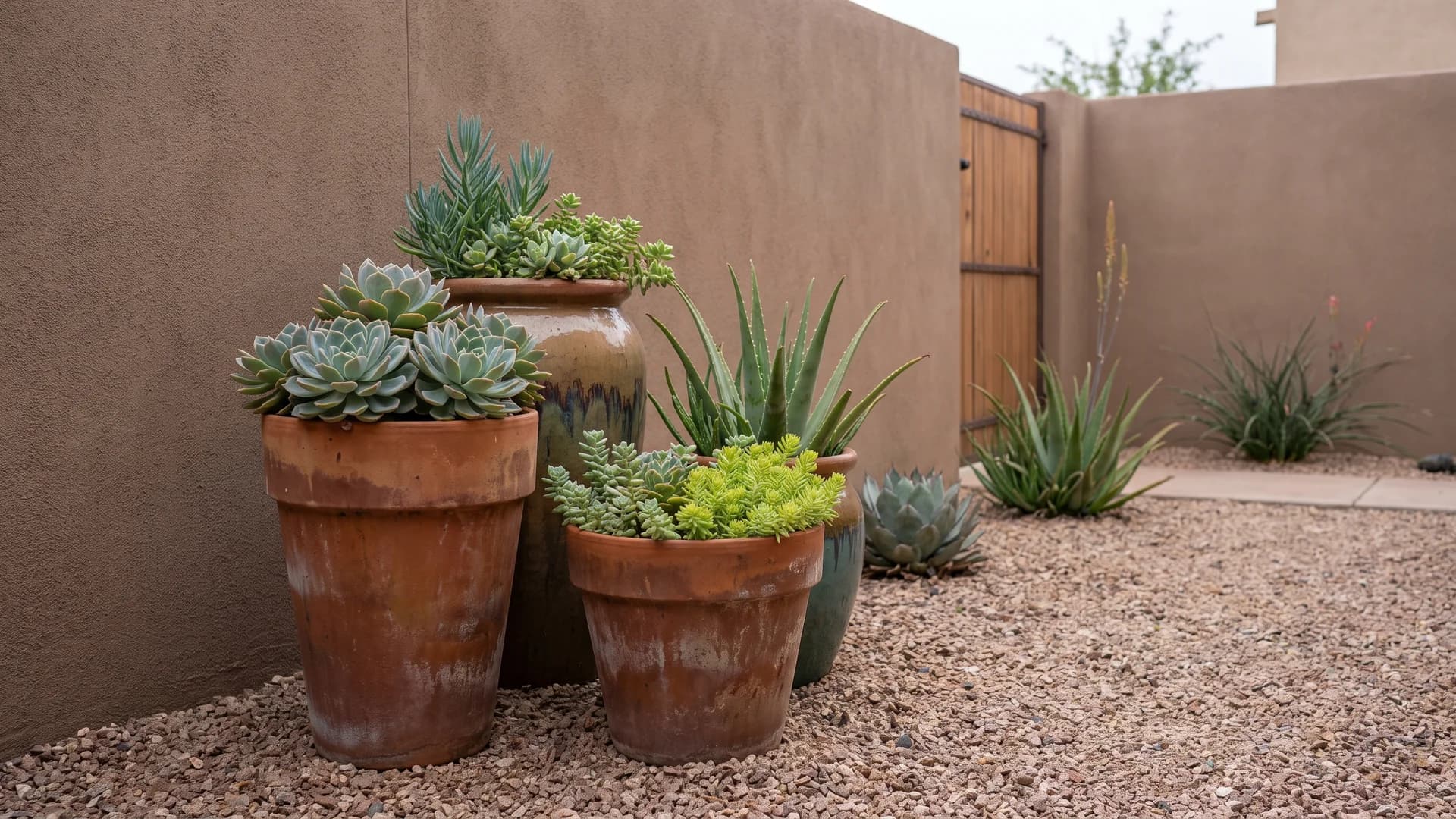
Renters, courtyards, and anyone not ready to break caliche should start here. Three pots of different heights, one plant per pot, all in the same material family. Terracotta at $25 to $60 breathes and dries fast, which suits succulents; glazed pots at $50 to $120 hold moisture longer. Skip metal containers in full sun. They cook roots at the pot wall by early July.
25. Go vertical with a succulent panel
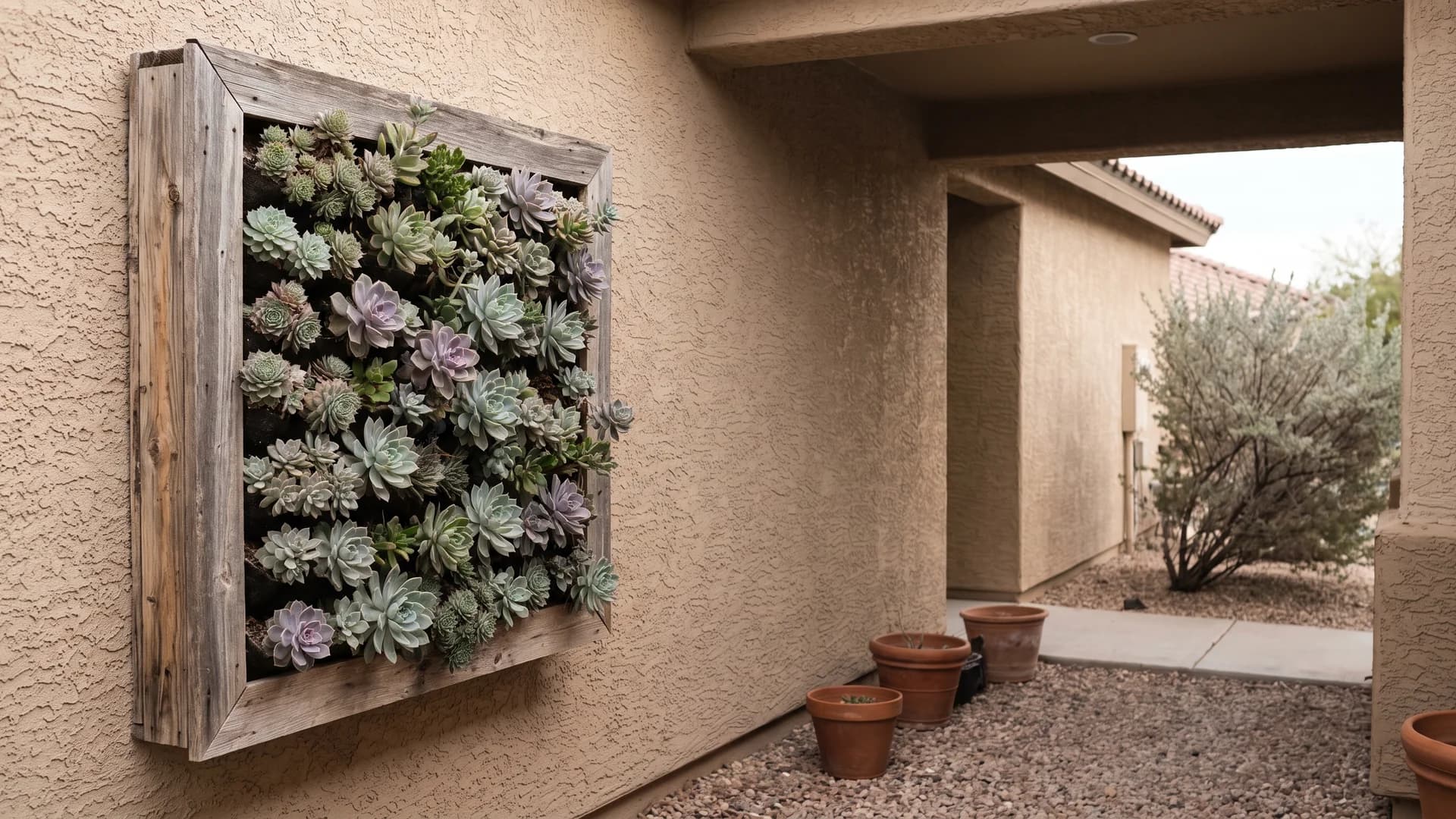
When the ground is spoken for, the wall is square footage you already own. A 2-by-3-foot planted panel costs $80 to $180 and holds 30 or more small succulents in an inch and a half of soil. Hang it on a wall that gets morning sun only. Shallow media on a west-facing wall dries out by lunch, and you will be watering by hand every single day.
26. Convert one strip at a time
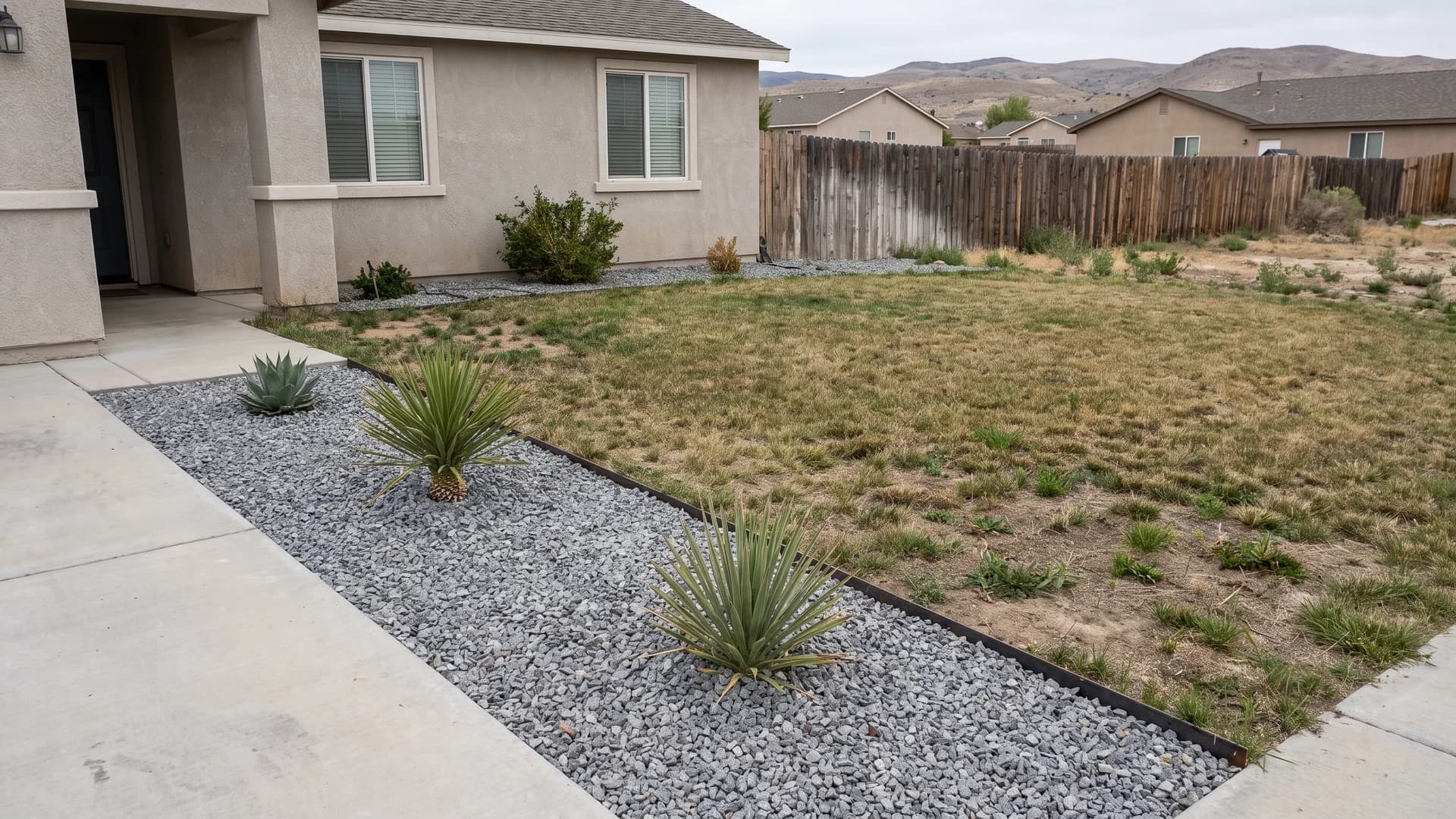
Whole-yard conversions stall on the invoice. One 4-by-20-foot strip does not: figure $150 to $250 for gravel, edging, and three plants, finished in a weekend. Start with the hell strip by the curb or the bed along the front walk, because those two are visible from the street and set the tone for the rest. Match the gravel across every phase or the yard looks patched.
27. Buy materials where the pros do, and take the rebate
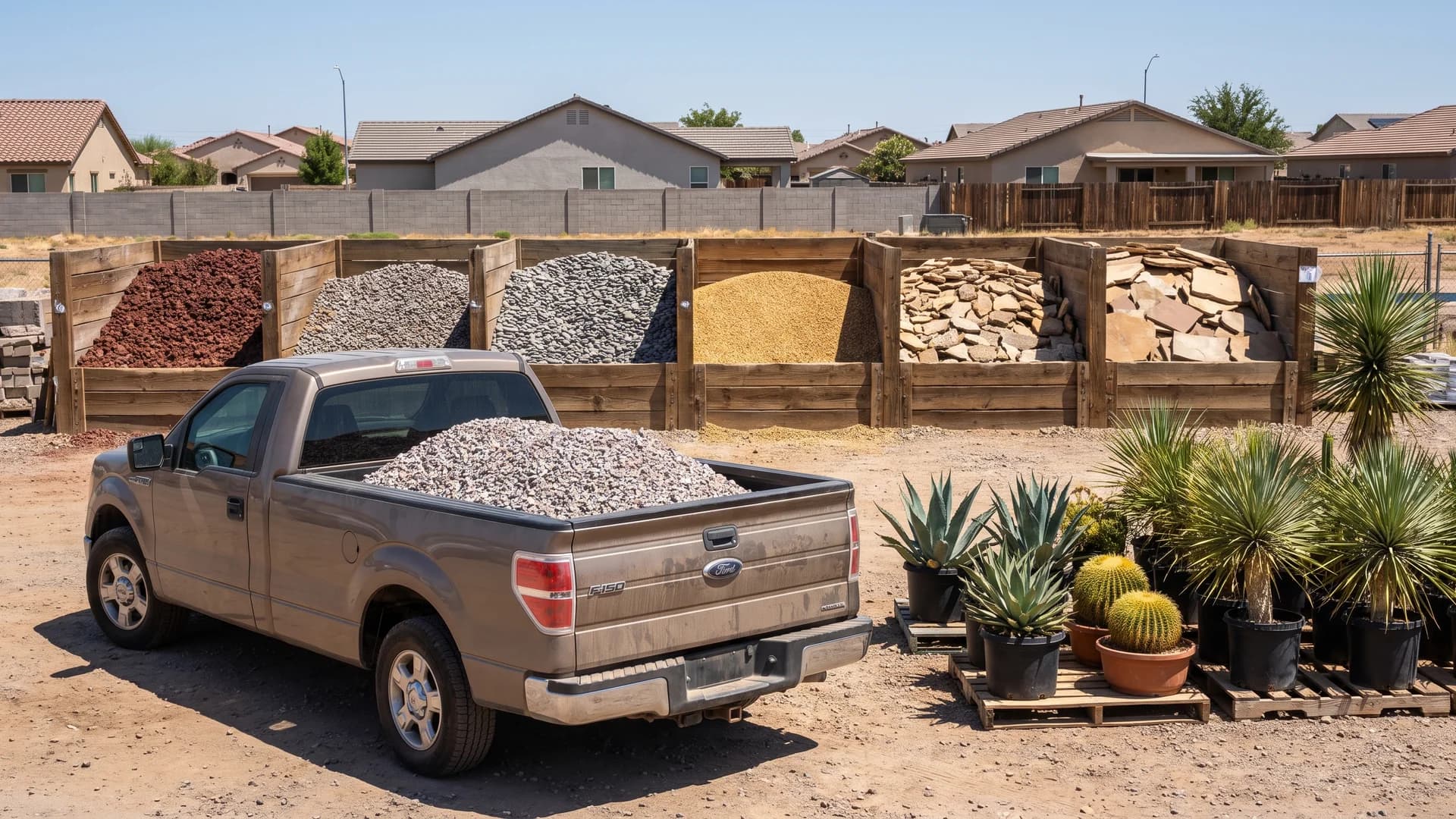
Bulk rock by the ton costs a fraction of bagged stone, and native plant society sales price 1-gallon native plants at $5 to $10. The bigger money is in removal. Southern Nevada Water Authority pays $5 per square foot for the first 10,000 square feet of grass converted, so a 1,000-square-foot lawn is $5,000 back, and Southern California's Metropolitan Water District pays $2 per square foot up to 5,000 square feet a year. Arizona runs city by city. All of them require approval before you dig.
Match the ideas to your yard
Which desert you live in changes the plant list more than the budget does.
- Sonoran, so Phoenix and Tucson at roughly zones 9a to 10a: saguaro, ocotillo, palo verde, and golden barrel all work outdoors year-round. Plan around monsoon runoff (3) and afternoon shade (13, 17).
- Mojave, so Las Vegas and Palm Springs around zone 9a: hotter and drier still, with almost no summer rain. Lean on drought-tolerant plants with drip (13) and take the rebate in 27, which is the most generous in the country.
- High desert, so Albuquerque, Reno, and much of Utah and Colorado at zones 6 to 7b: skip the golden barrels and tender agaves. Blue grama (10), Agave parryi (6), and desert willow (13) take real winters.
- Small courtyard or a rental: 24, 25, and 26, none of which need a contractor or a permit.
- Tightest budget: 9, 12, and 26 total under $400 and change how the yard reads from the street.
- Cutting upkeep to near zero across the whole front: the front-of-house sequence in our low maintenance front yard landscaping guide pairs with 1, 5, and 15 here.
Two things to avoid. Bare gravel with no plants in it, sometimes called zeroscape, is not xeriscaping, and appraisers and buyers read it as a yard nobody finished. And black plastic sheeting under stone fails within about three years, trapping silt on top where weeds root happily; woven landscape fabric or nothing at all is the better call. If you want to test a palette before committing to eight tons of anything, run the photo through AI xeriscape design and compare styles on your own yard first.
FAQ
How do you desert landscape a yard?
Work in this order: remove the lawn (after your rebate is approved), grade so water runs away from the house, place the big elements first, then fill the ground. Big elements means trees, boulders, and any wall or patio. Plants and gravel come last because both are easy to move on paper and expensive to move once delivered. Most yards get built in phases over two or three seasons, which is normal and cheaper.
What plants are good for a desert landscape?
Match the plant to your winter low, not to the region's reputation. Reliable choices across most of the Southwest include Agave parryi (zones 5 to 10), red yucca (5 to 11), blue grama grass (3 to 10), and desert willow (zone 7 and up). Golden barrel cactus, saguaro, and Agave americana need zone 8 to 9 and warmer. Check your zone on the USDA Plant Hardiness Zone Map before you buy anything expensive.
What is desert landscaping called?
The design approach is called xeriscaping, a term coined by Denver Water in 1981 for landscaping built around low water use. It does not mean no plants. The gravel-only version, often nicknamed zeroscape, is a different thing and a worse one: it raises surface temperatures and adds nothing a buyer will pay for.
How much does it cost to convert a yard to desert landscaping?
Materials for a DIY conversion generally land between $1.50 and $4 per square foot, so a 1,000-square-foot front yard runs roughly $1,500 to $4,000 including gravel, edging, plants, and drip. Contractor installs commonly run $6 to $15 a square foot. Turf rebates can cover a large share of that, and in Southern Nevada's case they can exceed it.
How do I landscape a desert front yard versus a backyard?
The front yard is a view, so it wants symmetry at the entry, one shade tree, and a clean gravel line to the sidewalk (ideas 11 to 15). The backyard is a room, so it wants shade, seating, and something to look at after dark (16 to 23). The mistake is treating both like display space and ending up with a backyard nobody sits in.
What is the rule of 3 in landscaping?
Group plants and objects in odd numbers, most often threes, because the eye reads an odd group as one composition and an even one as a pair to compare. It applies to boulders, barrel cactus, and grasses alike. The exception is a deliberate matched pair flanking a door or gate, where the symmetry is the point.