32 River Rock Landscaping Ideas That Stay Low-Maintenance
River rock is the material you buy once and then edge properly. These 32 ideas cover beds, borders, paths, drainage, and planting pairings, with the depths, stone sizes, and costs you need to order material, plus an honest look at year five.
The strip along the foundation is bare dirt, the downspout has cut a trench through the lawn, and mulch floats out of the front bed every time it rains hard. Stone fixes all three at once, which is why so many river rock landscaping ideas start as a repair job and end up as the best-looking part of the yard.
The 32 ideas below are grouped by what they solve: beds and borders, paths, drainage, planting pairings, color and size, then features. Each one carries a depth, a stone size, or a cost, because a gallery with no numbers in it can't get you to the yard. There's also a section on what river rock gets wrong, which the pages selling installation tend to leave out.
One figure worth writing down before you order anything: a ton of river rock covers roughly 100 square feet at 2 inches deep, or about 70 at 3 inches. The gravel calculator runs that math from your bed dimensions. Every image here is an AI-generated design concept built from an ordinary yard photo, the same kind of render AI landscape design makes from a picture of yours.
Size and color, decided before you shop
Two choices set how the whole thing looks, and both get made at the supplier rather than in the yard.
| Stone size | Where it belongs |
|---|---|
| 3/8 in (pea size) | Paths, seating pads, narrow borders |
| 1 to 2 in | Beds, tree rings, foundation strips |
| 2 to 4 in | Downspout aprons, stream bottoms |
| 4 in and up | Slopes, water edges, placed accents |
Color does the styling. Gray and blue-gray read modern against dark siding. Tan and brown are the safe, warm option that never fights brick or cedar. White is the brightest and the fussiest, since it shows every leaf and mud splash. Black gives the sharpest contrast and holds the most heat.
Depth follows use: 2 inches is decorative coverage, 3 inches is where weed suppression actually holds, and 4 inches or more belongs in a channel where water needs voids to move through.
Beds, borders, and edging
1. Run a clean band between lawn and bed
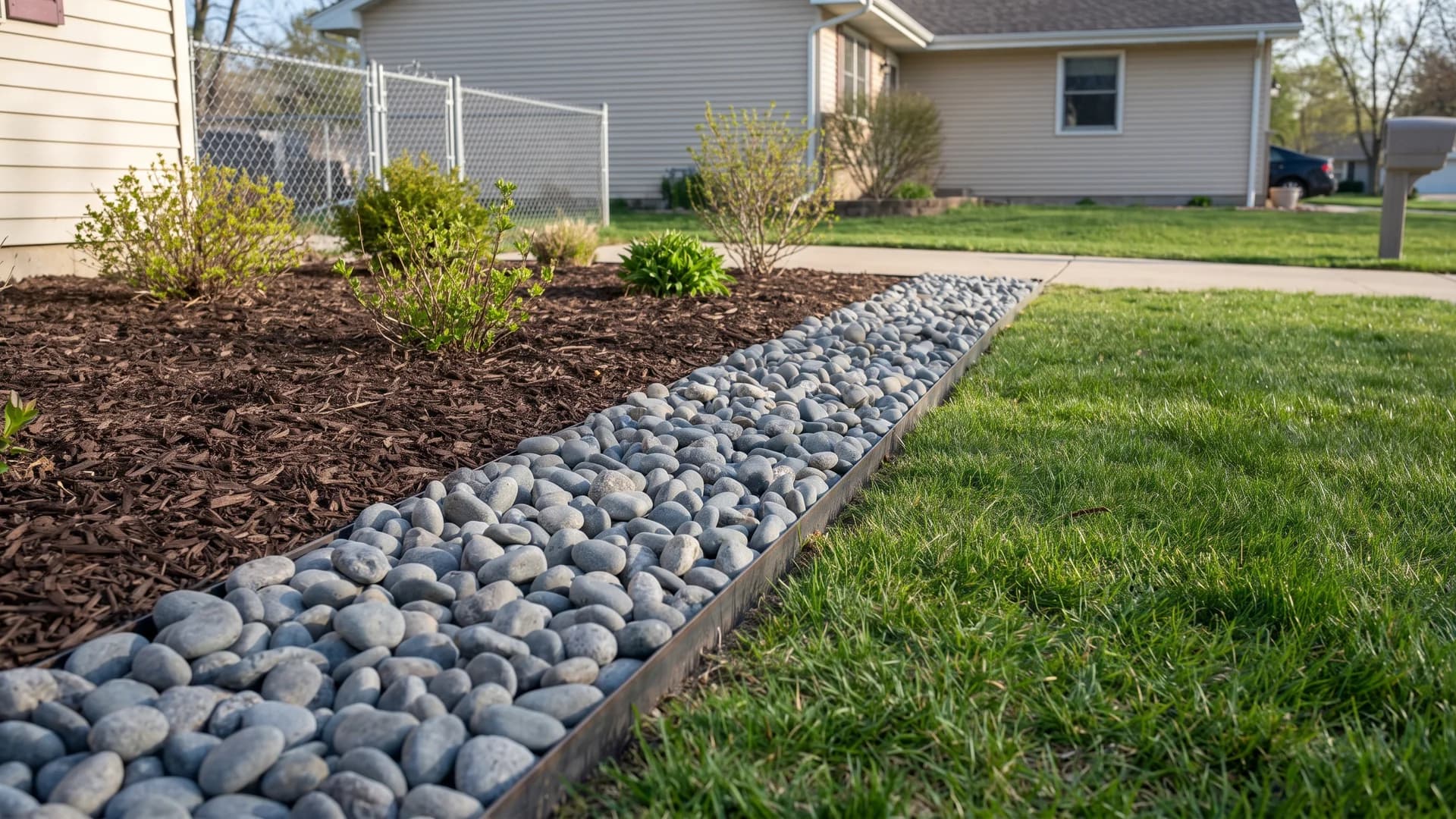
A 10-inch band of 1-to-2-inch stone along the front of a bed does what three separate products claim to: it stops mulch washing onto the grass, gives the mower wheel a firm place to ride, and turns a ragged boundary into a drawn line. Steel or aluminum landscape edging on the lawn side keeps it from creeping. Figure a ton per 100 linear feet.
2. Split the bed: rock outside, mulch inside
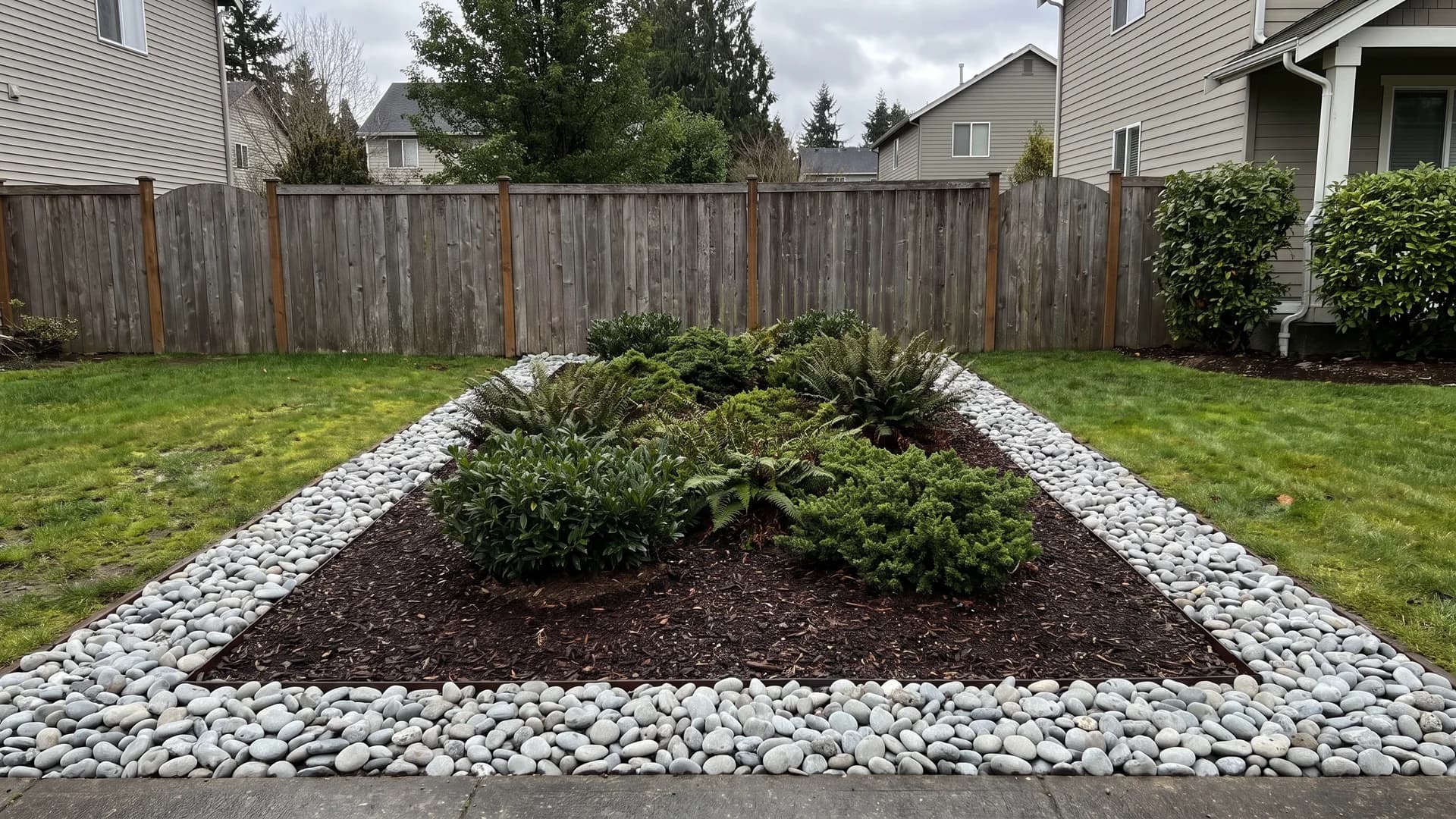
Rock and mulch get argued about like you have to pick one. Put stone on the outer 12 inches where the trimmer runs and rain splashes, keep bark inside where the roots are, and each material sits where it performs. Plants still get the organic matter, the visible edge stays sharp all season, and every spring you're topping up a third of the bed instead of the whole thing.
3. Lay a splash strip along the foundation
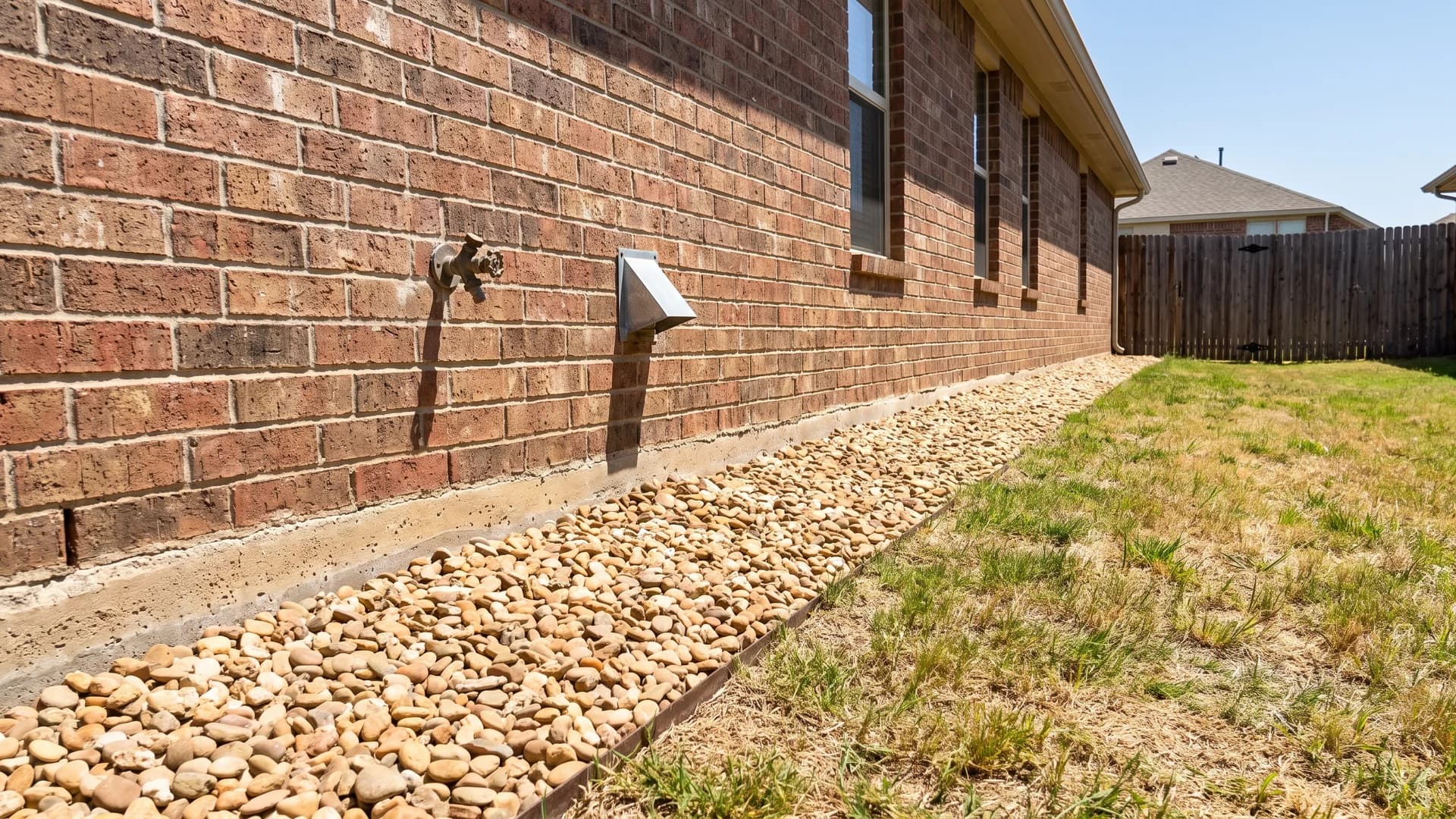
The 18 inches against the house is where siding gets stained and nothing wants to grow. A strip of 1-inch stone, graded to fall away from the wall, breaks the splash and dries out fast between storms. Keep the finished rock level at least 6 inches below the siding so nothing wicks upward, and leave fabric off the wall face, where it traps the moisture you're trying to shed.
4. Collar a tree, shallow and wide
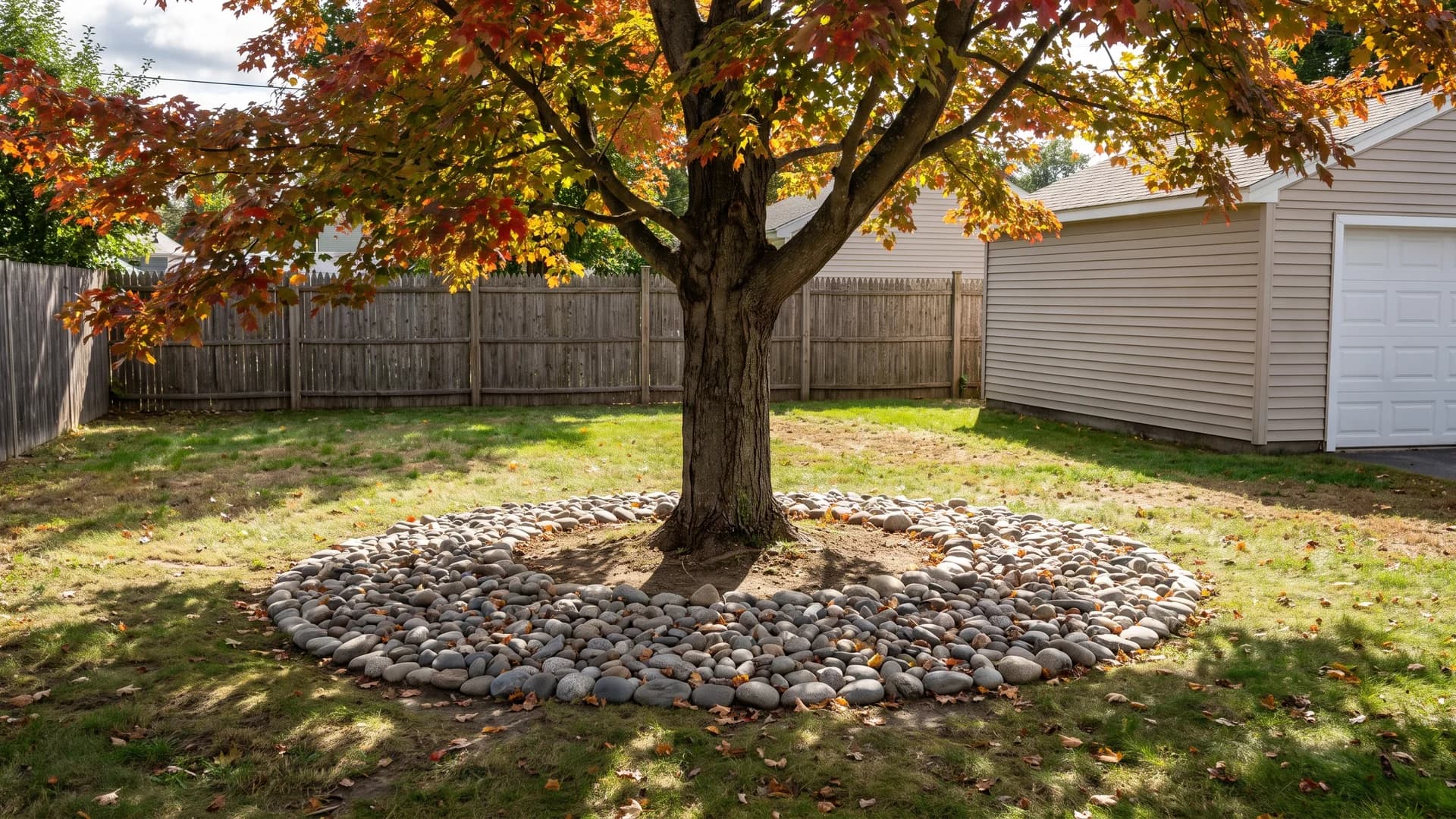
Grass gives up under a mature canopy, and a stone collar is the honest answer to the bald ring. Keep it 2 inches deep and pull the rock a hand's width back from the bark, because stone piled against a trunk holds moisture where trunks rot. A 6-foot circle takes about half a ton. Leave the fabric out here so roots keep their air exchange, and accept a few weeds as the trade.
5. Set perennials into stone instead of bark
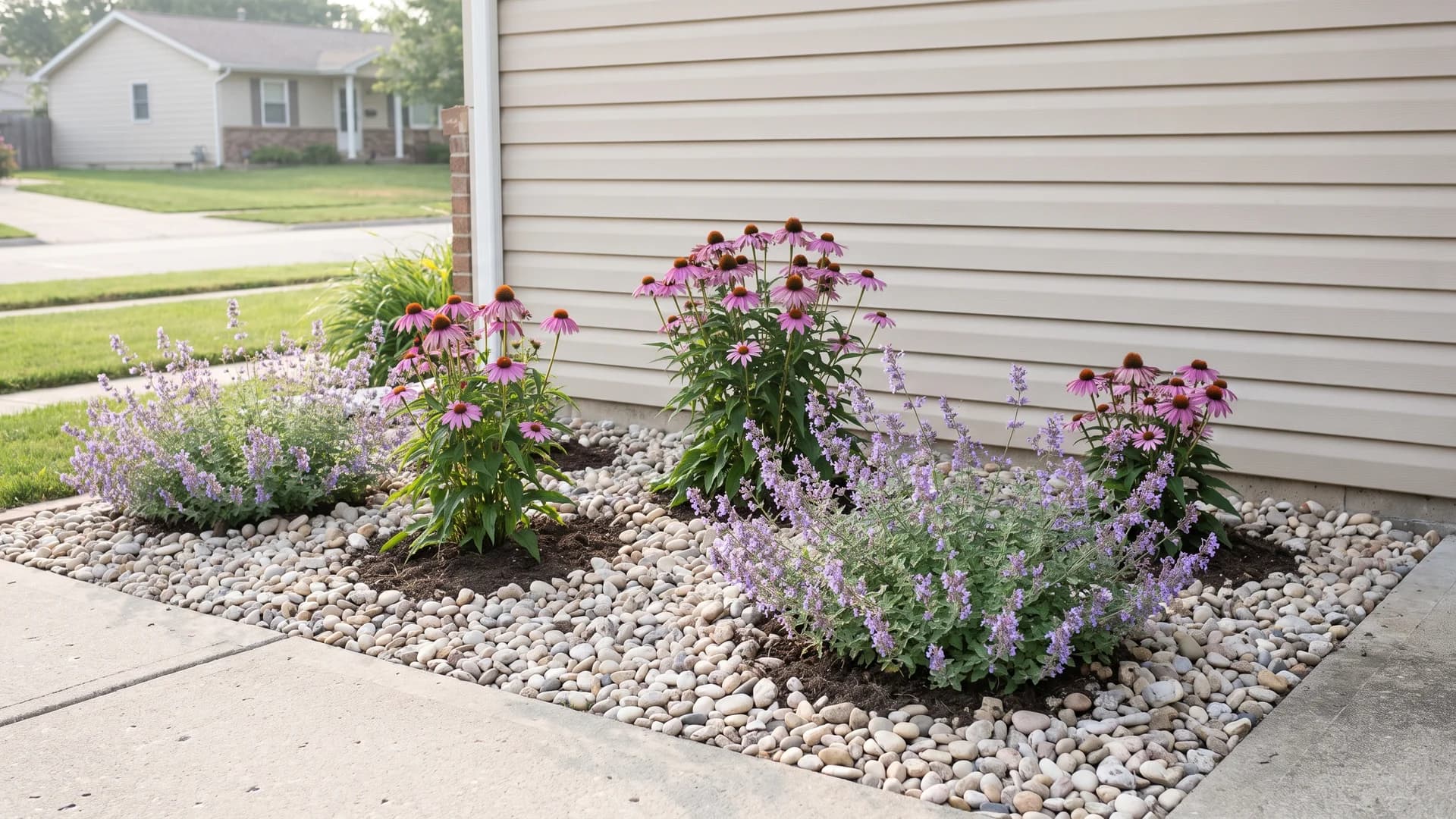
Perennials mulched in stone look sharper year-round and never need a spring refill. It works when the plants can take reflected heat: coneflower (zones 3 to 9), catmint (3 to 8), and daylily (3 to 9) all shrug it off. Cut an X in the fabric per plant, fold the flaps under, and leave 4 inches of clear soil at each crown so stems aren't sitting buried in rock.
6. Fill the gap behind a raised bed
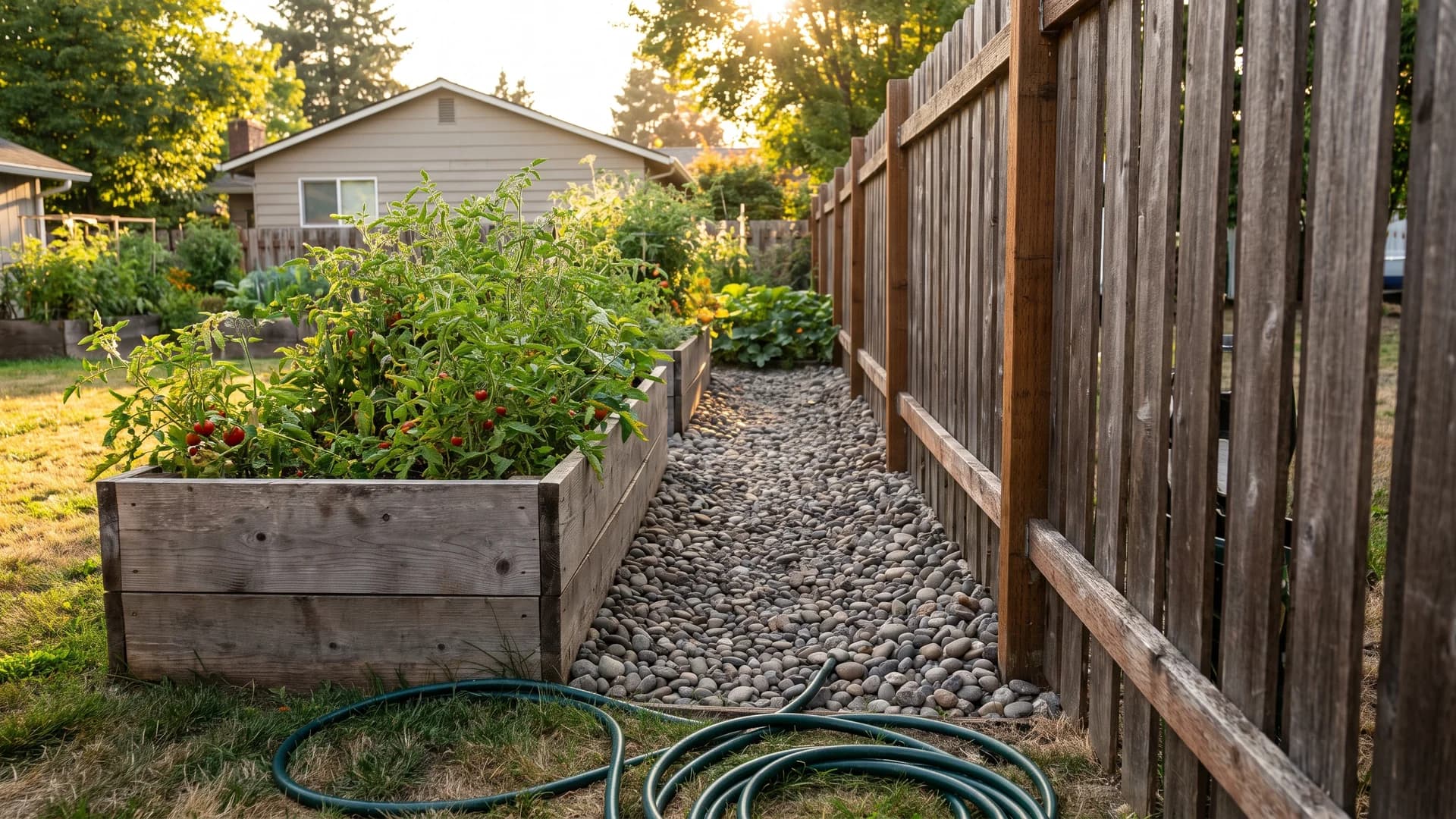
That 8-to-14-inch canyon between a raised bed and the fence collects leaves and grows things you'd rather not identify. Stone fills it permanently. Use 3/4-inch rock so it stays put when you sweep, run it right up to the fence posts, and lay a scrap of fabric first, since nothing is ever going to weed that gap again. Roughly $40 of material for a 20-foot run.
7. Build an apron at the mailbox
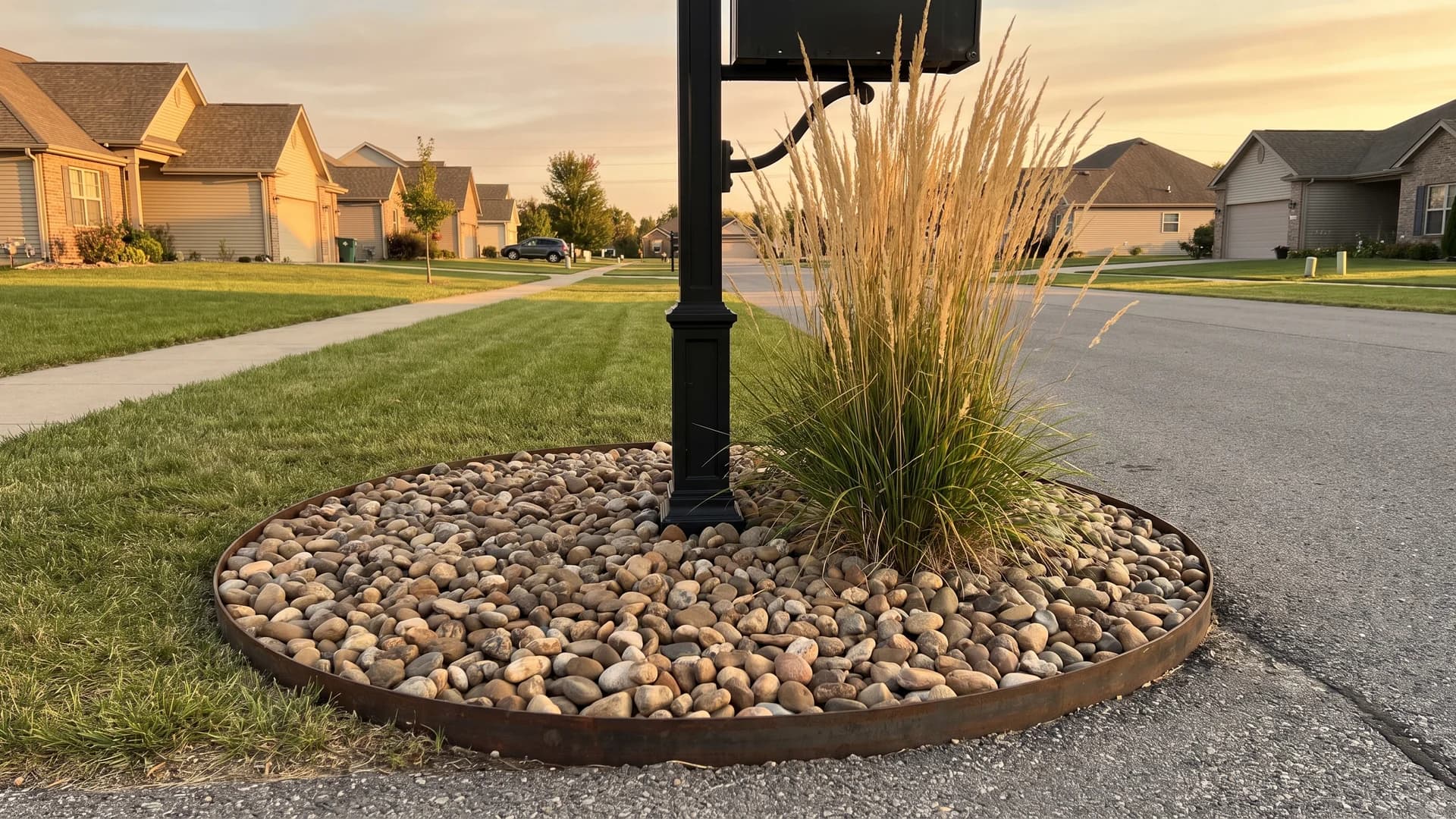
Four feet of stone around the mailbox post costs under $60 and ends the trimming ritual for good. Edge the circle, dish the center slightly so the post sits in a shallow bowl rather than on a mound, and add one grass clump for height. It's the smallest project in this list and the one that buys the most curb appeal per dollar, since the mailbox stands closest to the street.
Paths, patios, and seating
8. Pour a pea gravel path
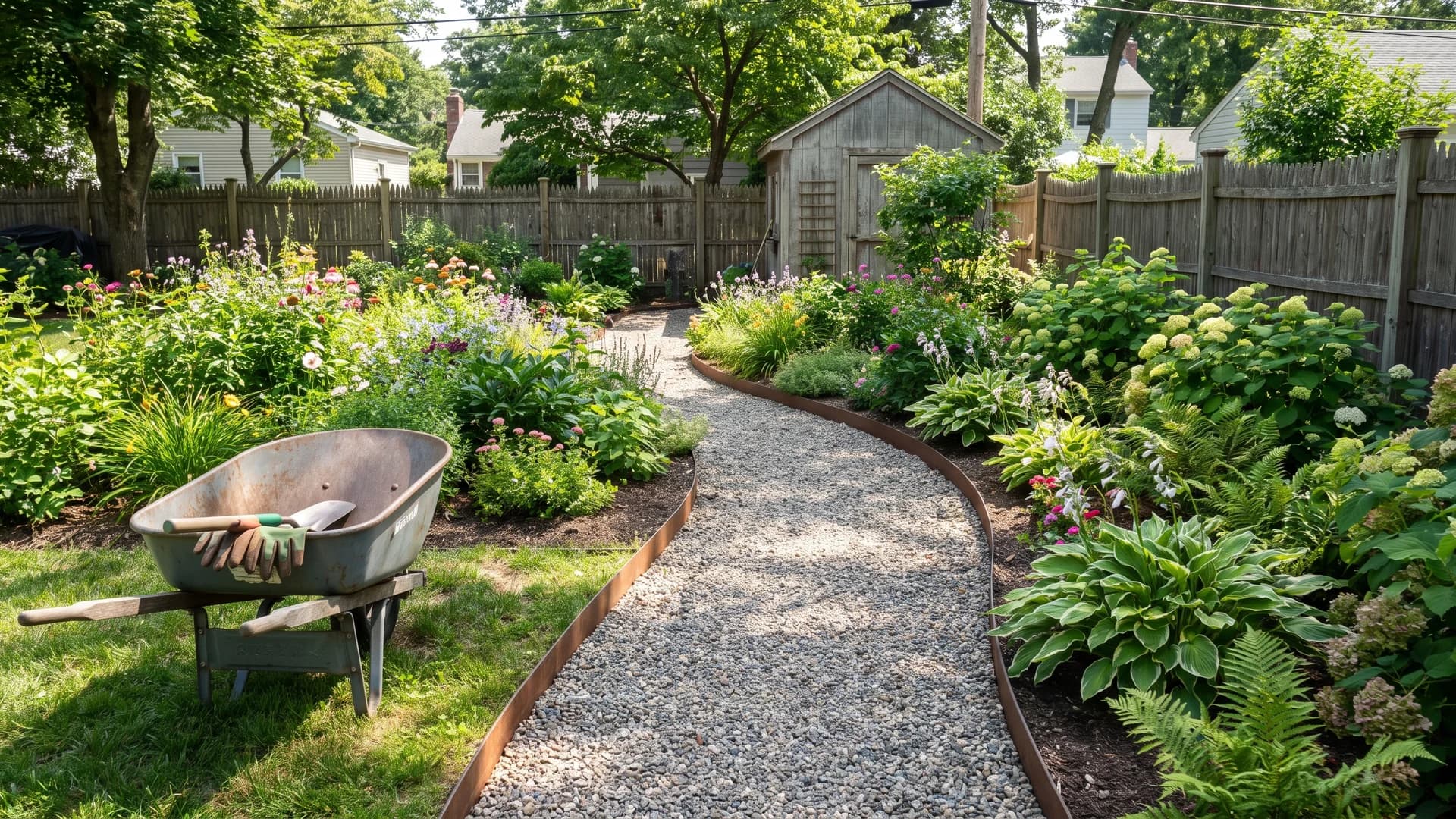
Nothing walkable costs less. A 3-foot path in 3/8-inch gravel runs about $1.50 a square foot in material, drains instantly, and goes in with a rake in an afternoon. Hold 2 inches over fabric and edge both sides, or loose round stone migrates into the lawn by August. On any slope, switch to angular gravel; round rock rolls underfoot.
9. Float stepping stones in a rock field
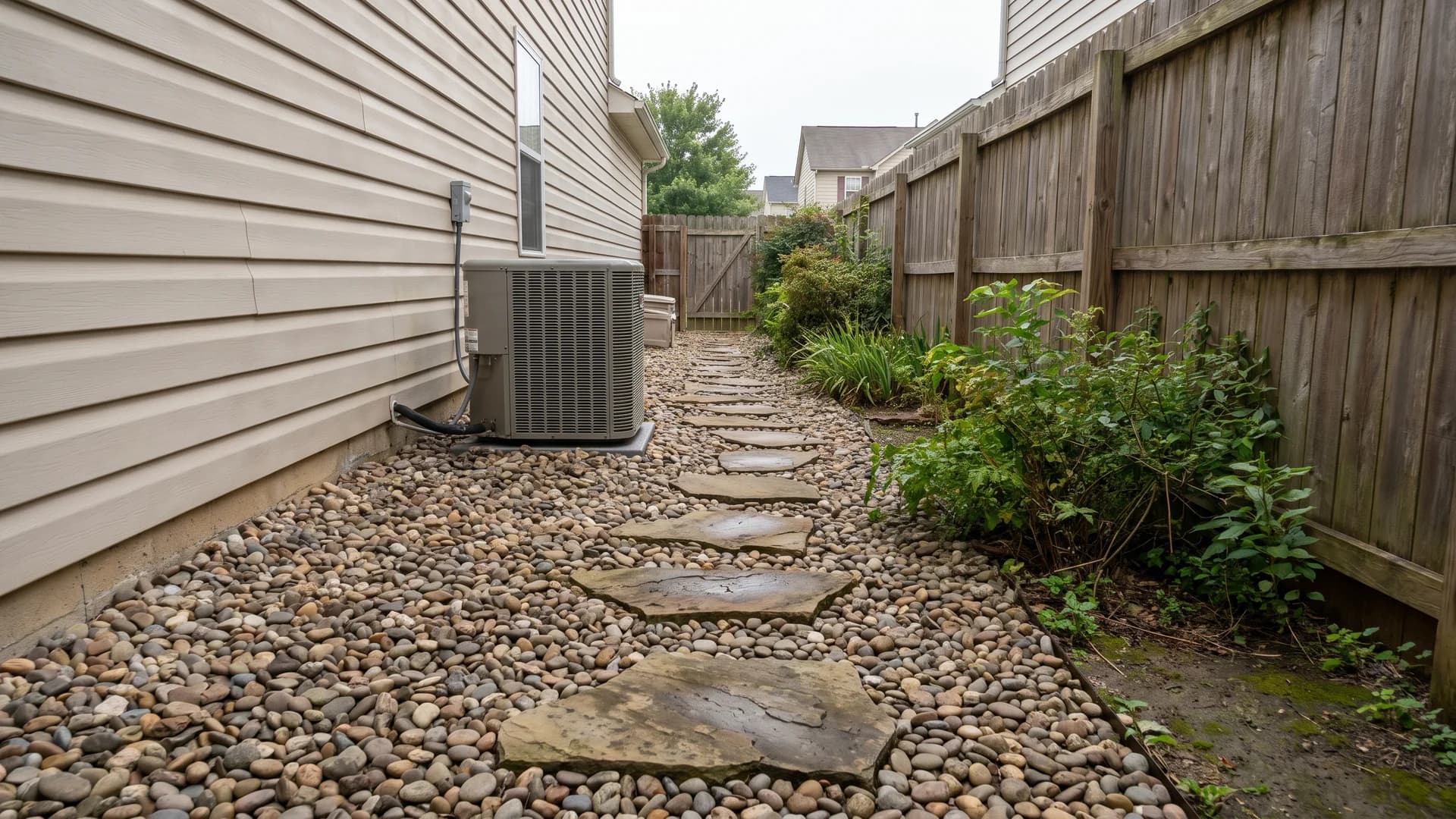
Steppers set into 1-inch river rock give you a real walking line without pouring anything. Space them 24 inches center to center, which matches an average stride, and set each one flush so the mower and your ankles both survive. Flagstone runs $15 to $30 a piece. The rock around them hides the settling that always shows up in the first year.
10. Alternate rock and paver bands
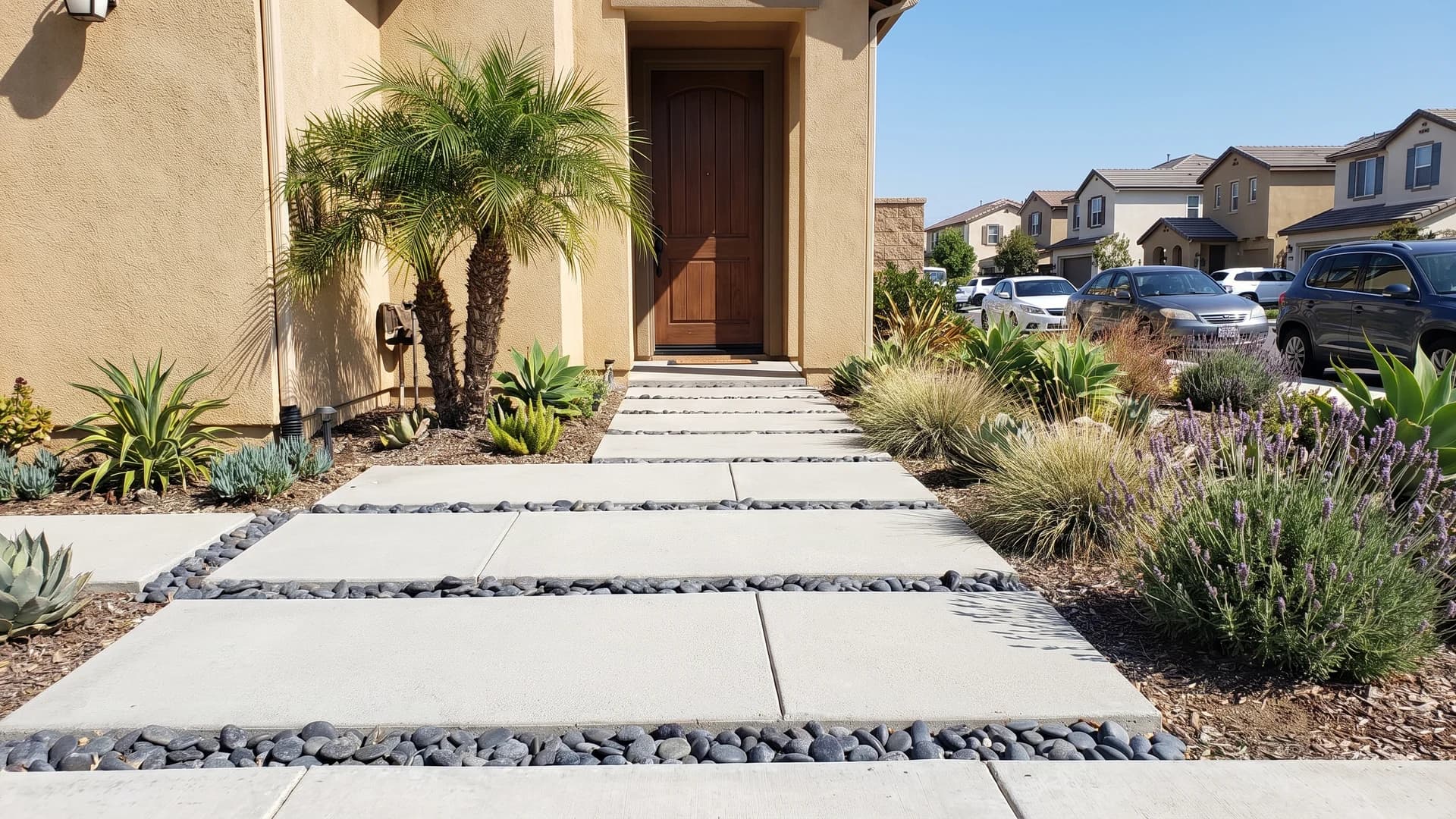
Alternating strips make a front walk look drawn rather than poured: a row of large-format pavers, then a 6-inch band of dark stone, repeating to the door. The bands drain runoff sideways instead of down the length of the walk, and they forgive cuts that aren't perfect. Budget $6 to $10 a square foot installed for the pavers; the paver calculator sizes the order.
11. Press pebbles into a concrete slab
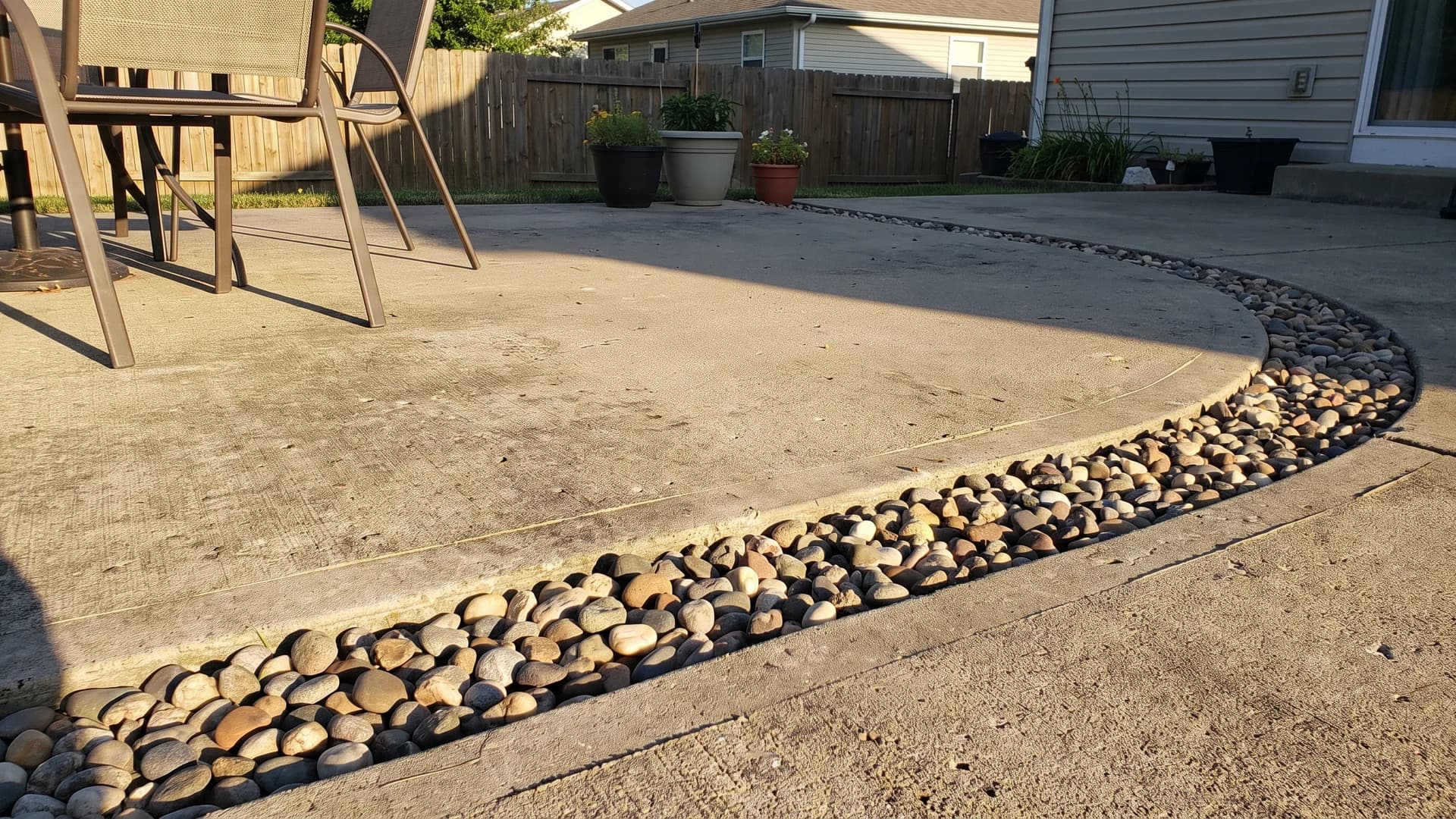
Pebble inlay is the one river rock use that's genuinely permanent. Small stone pressed into wet concrete, either along the slab border or as a band through the middle, gives a plain pour texture and a reason to look down. It's a same-day decision, though. Once the concrete goes off, the pattern is what you have, so mark the layout before the truck arrives.
12. Compact a gravel seating pad
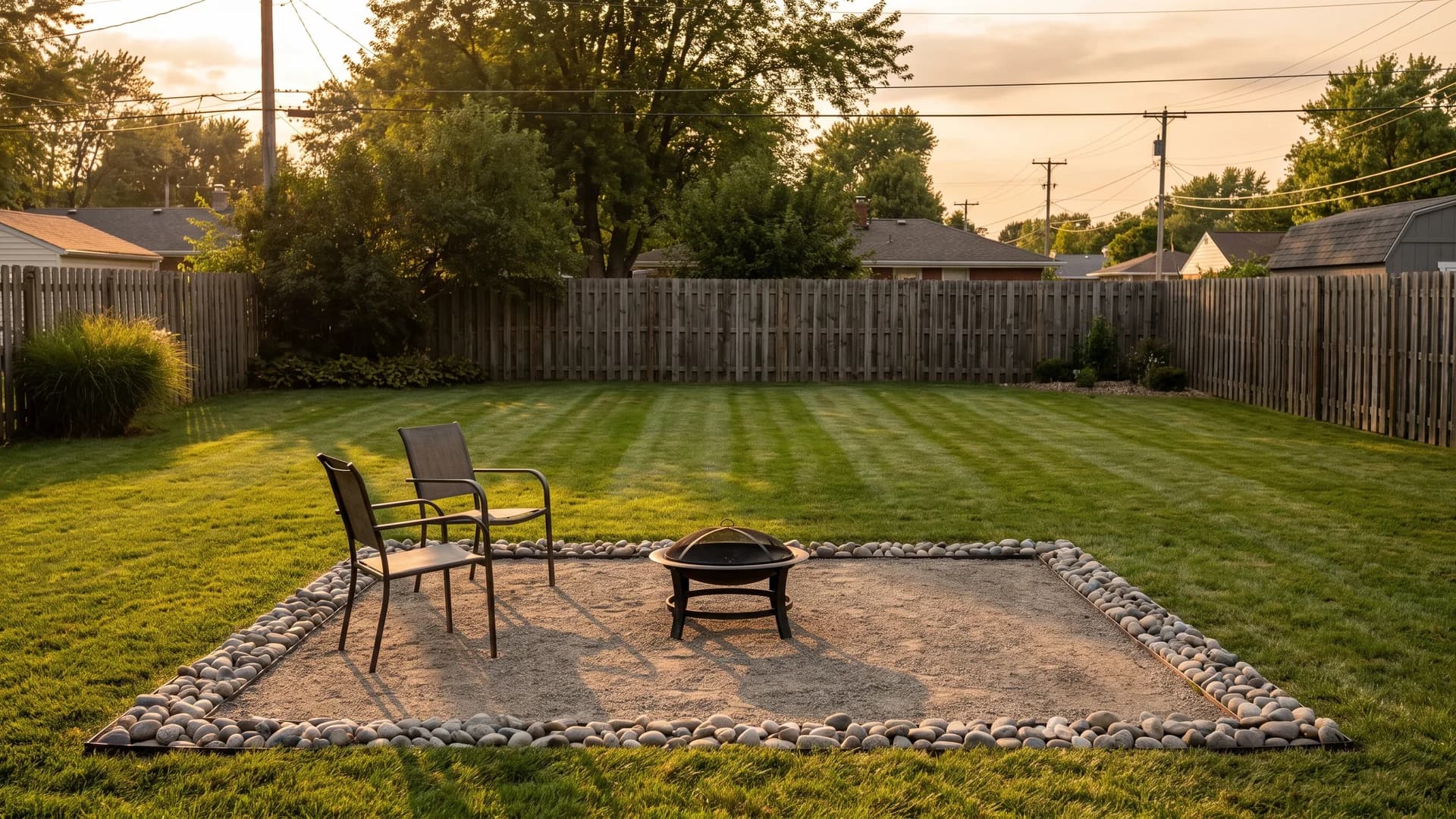
Compacted 3/8-inch gravel holds a bistro set or a fire pit for around $250 of material on a 10-by-10 pad. Lay it in two lifts and tamp each one, because a single 4-inch dump stays spongy and chair legs sink into it. Angular crushed gravel locks tighter underfoot than rounded stone, so save the river rock for the border and let it frame the pad.
13. Turn the side yard into a runner
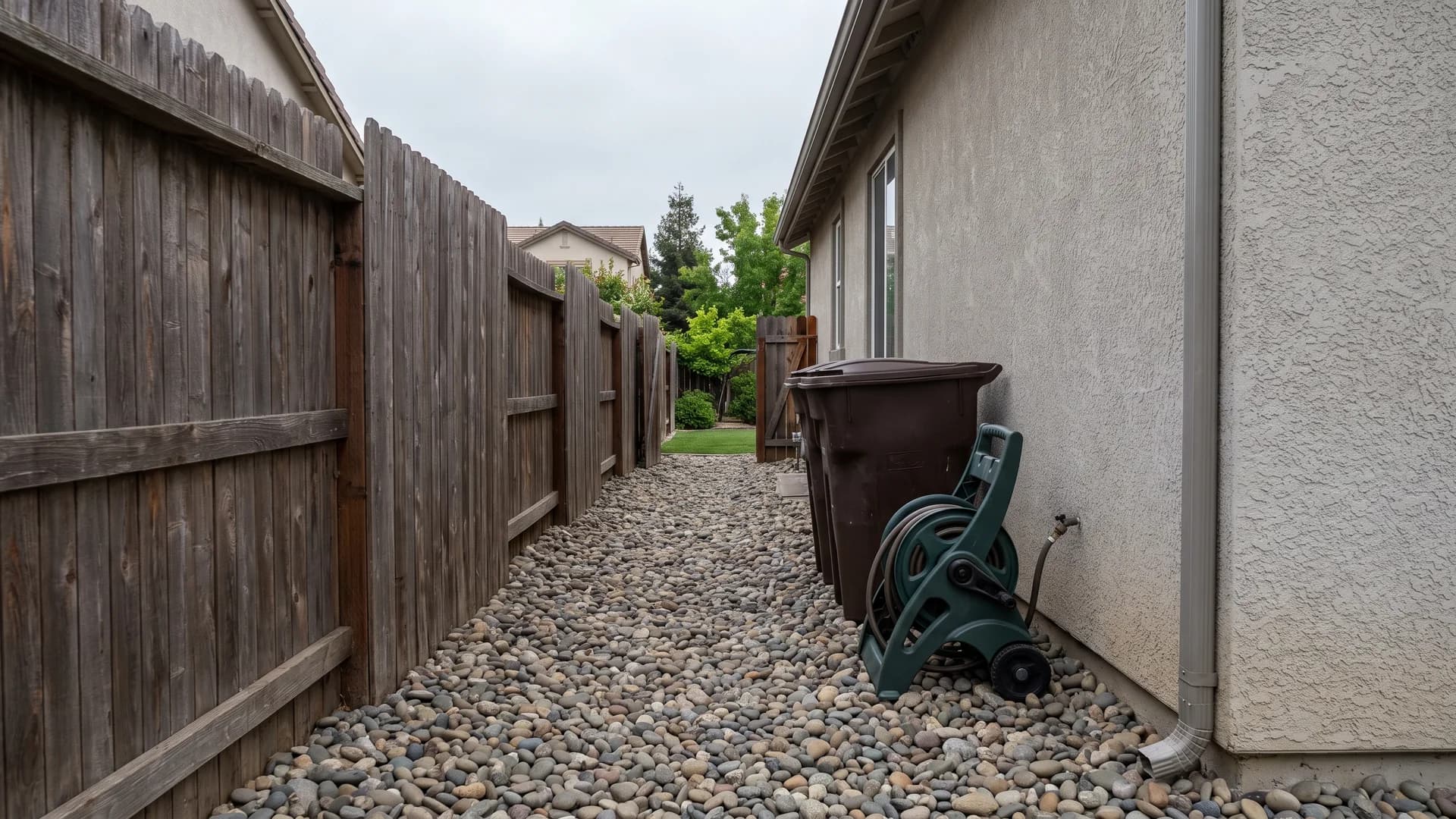
Nobody has a plan for the 4-foot strip between house and fence: no sun, no traffic, no attention. A full-width run of 3/4-inch stone over fabric turns it into a dry service corridor for hose reels, bins, and the ladder. Grade it to drain toward the back of the lot, and drop a line of stepping stones down the middle if you regularly carry anything heavy through.
Drainage and problem spots
14. Build a splash apron under every downspout
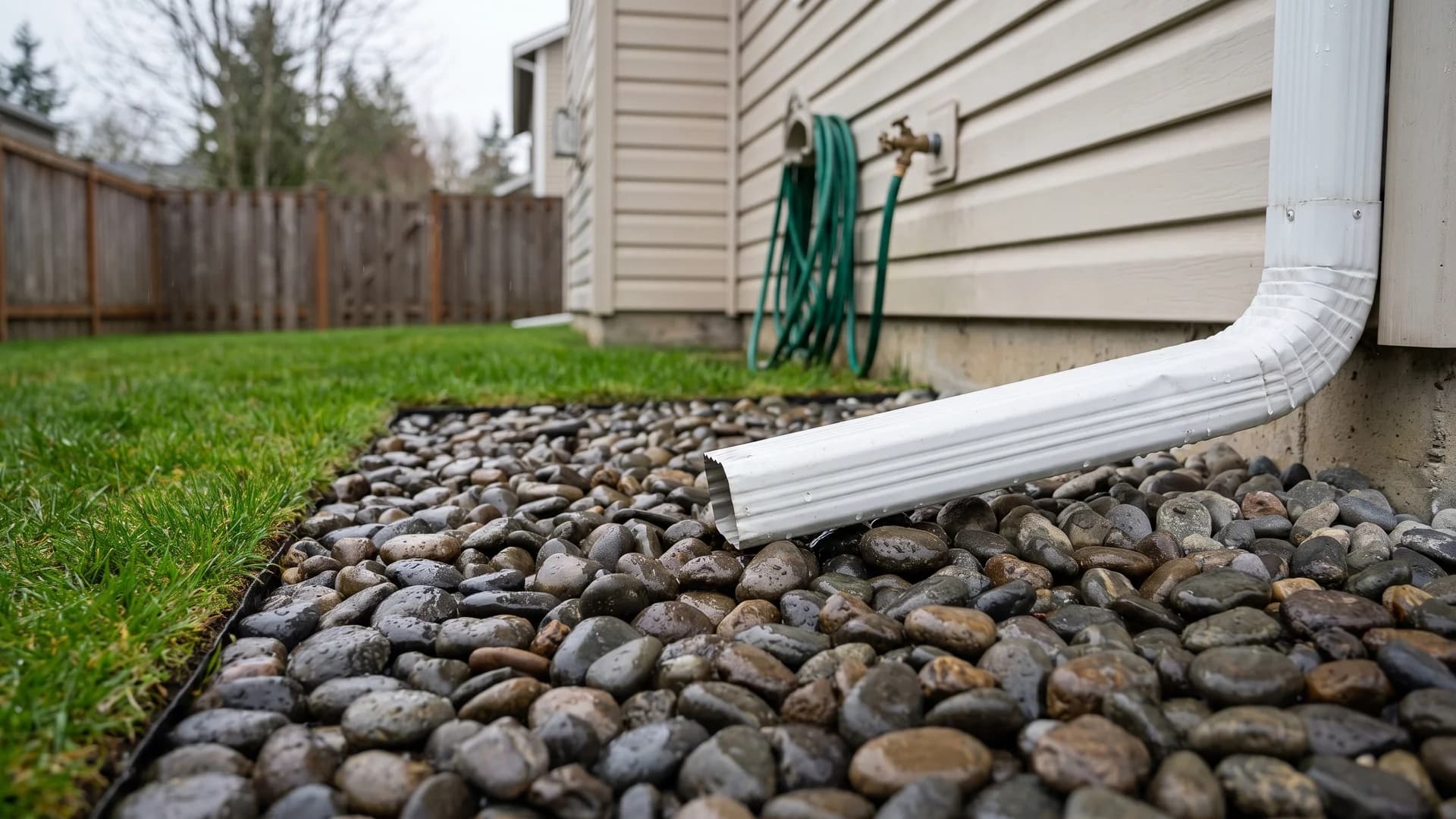
This is the highest-value idea in the post and the cheapest. A 3-by-4-foot bed of 2-to-4-inch stone under the downspout kills both the trench in the lawn and the mud line up the siding. Dig out 4 inches, line it, and let the extension discharge onto the rock. Stone size matters here: pea gravel washes out of position in the first real storm.
15. Lay a dry stream across the lawn
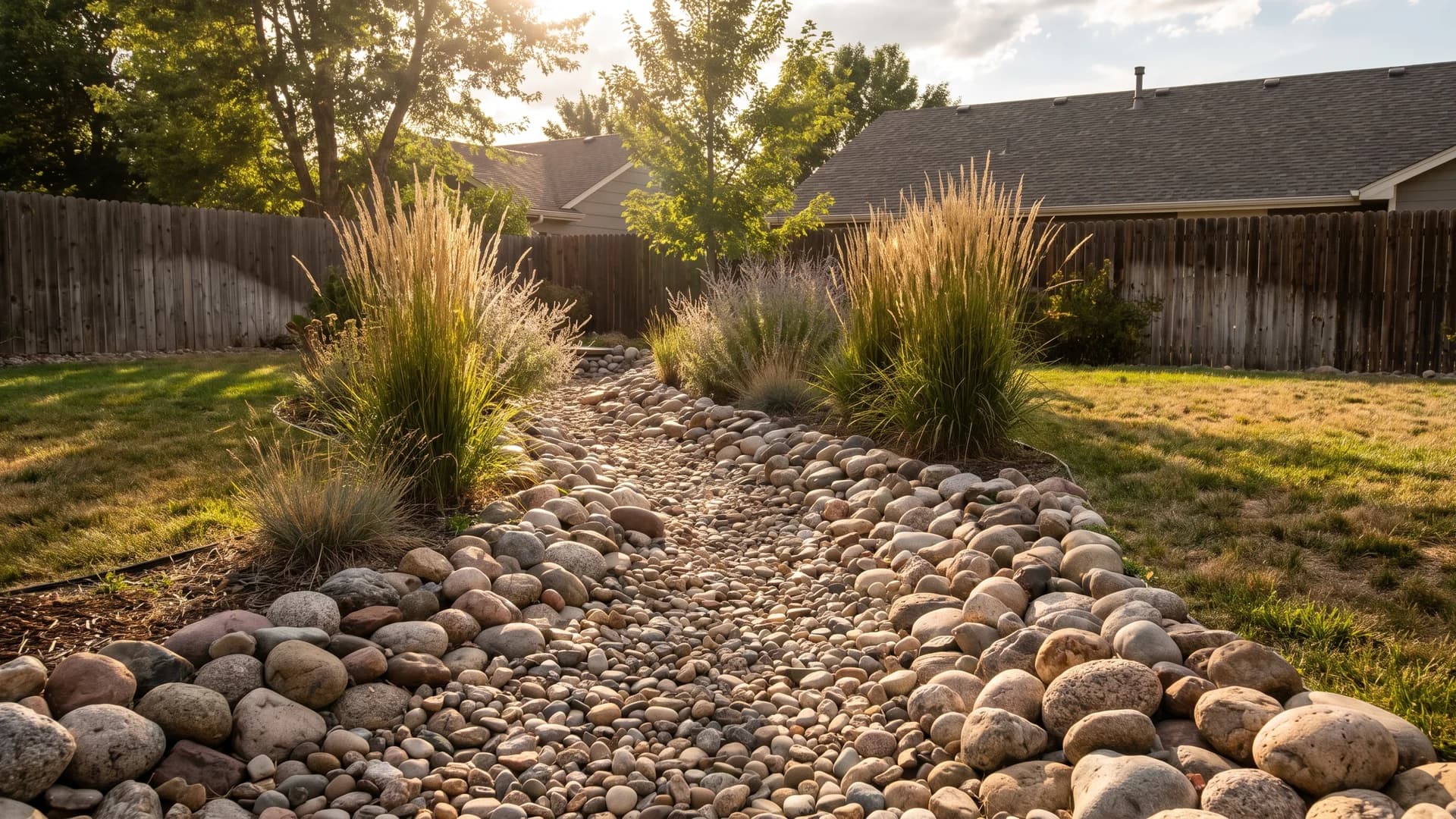
Even bone dry, a curving run of mixed river rock reads as a stream and gives a flat lawn the one thing it lacks, a line that moves through it. Grade the stone from pea size down the middle to 6-inch cobbles at the banks so it looks deposited rather than poured. Keep the bends lazy, since sharp corners read as a trench.
16. Wind a stone ribbon through a bed
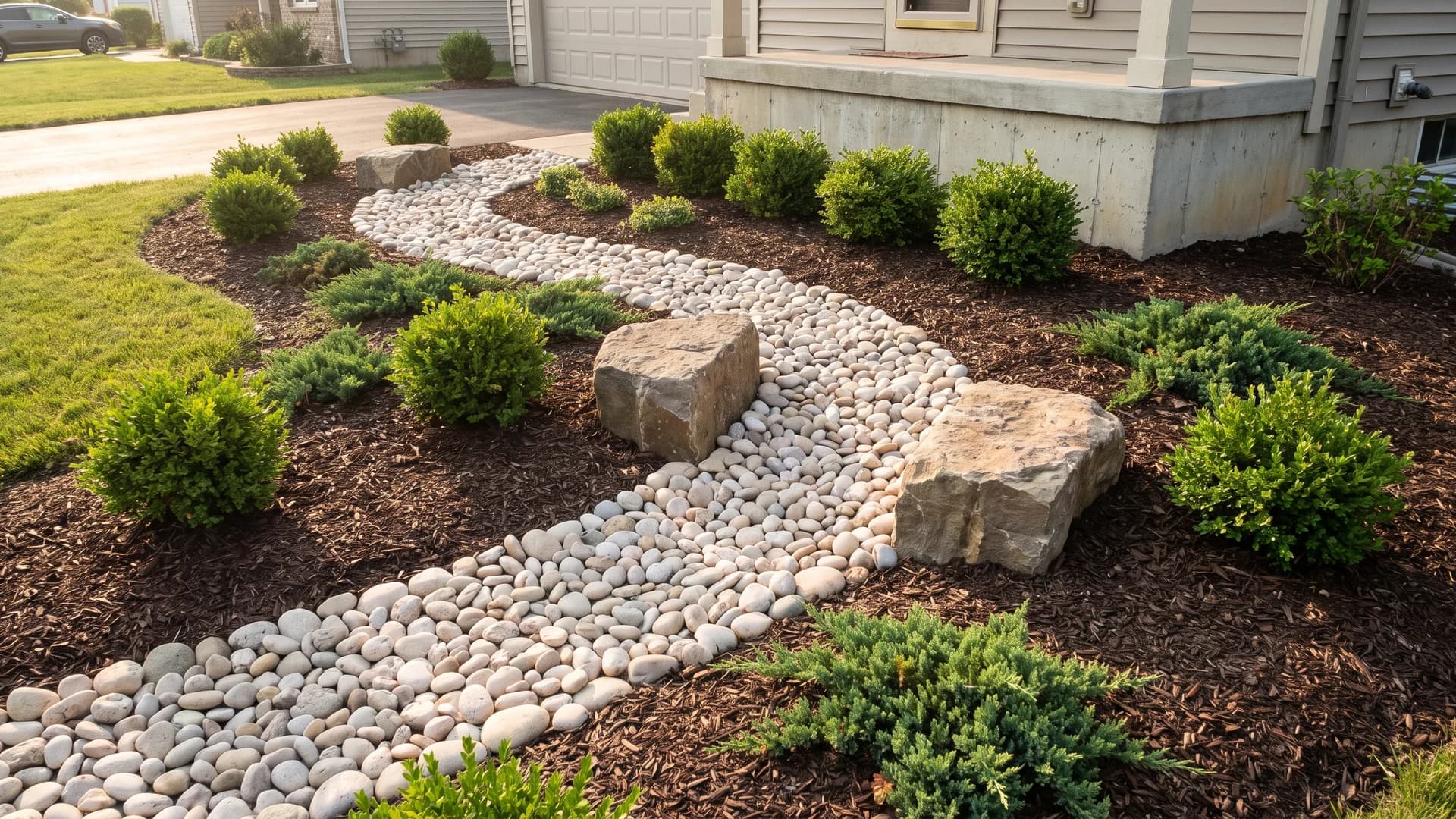
Same move, smaller, and contained inside a bed instead of crossing open lawn. A 10-foot ribbon of pale stone winding between shrubs, with two or three larger rocks set where it turns, gives a flat planting a focal point and some depth for about $70 in material.
17. Hold a bank with larger stone
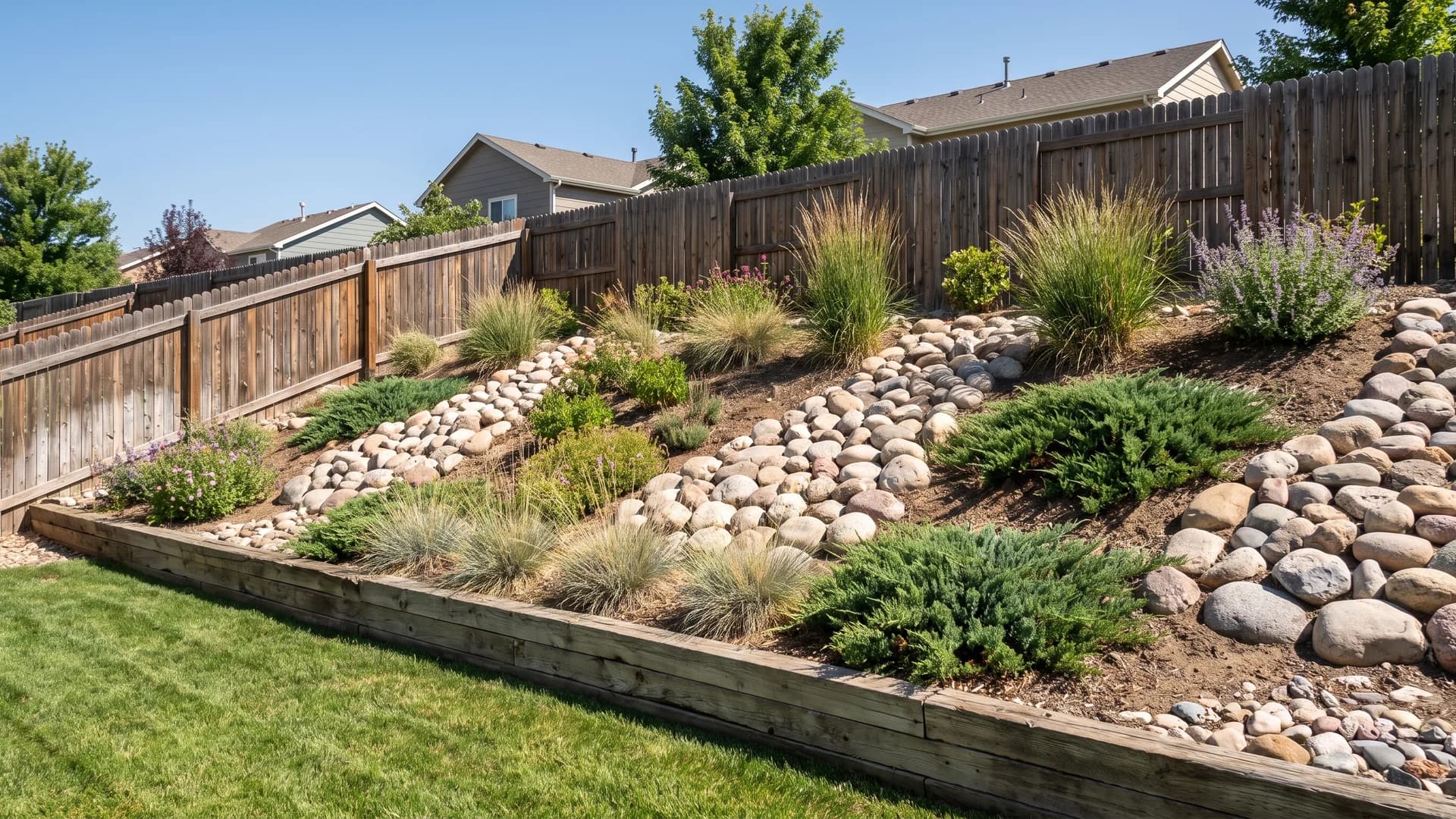
On a real slope, small rock is a liability. It walks downhill with every heavy rain and ends up in the lawn, in the gutter, and under the mower. Use 4-inch and larger cobbles set into the grade with plantings between them to bind the soil, and put a header of edging or timber at the base to catch whatever still moves. Our hillside landscaping guide works through the full budget sequence on a bank like this.
18. Fill the low spot that keeps drowning
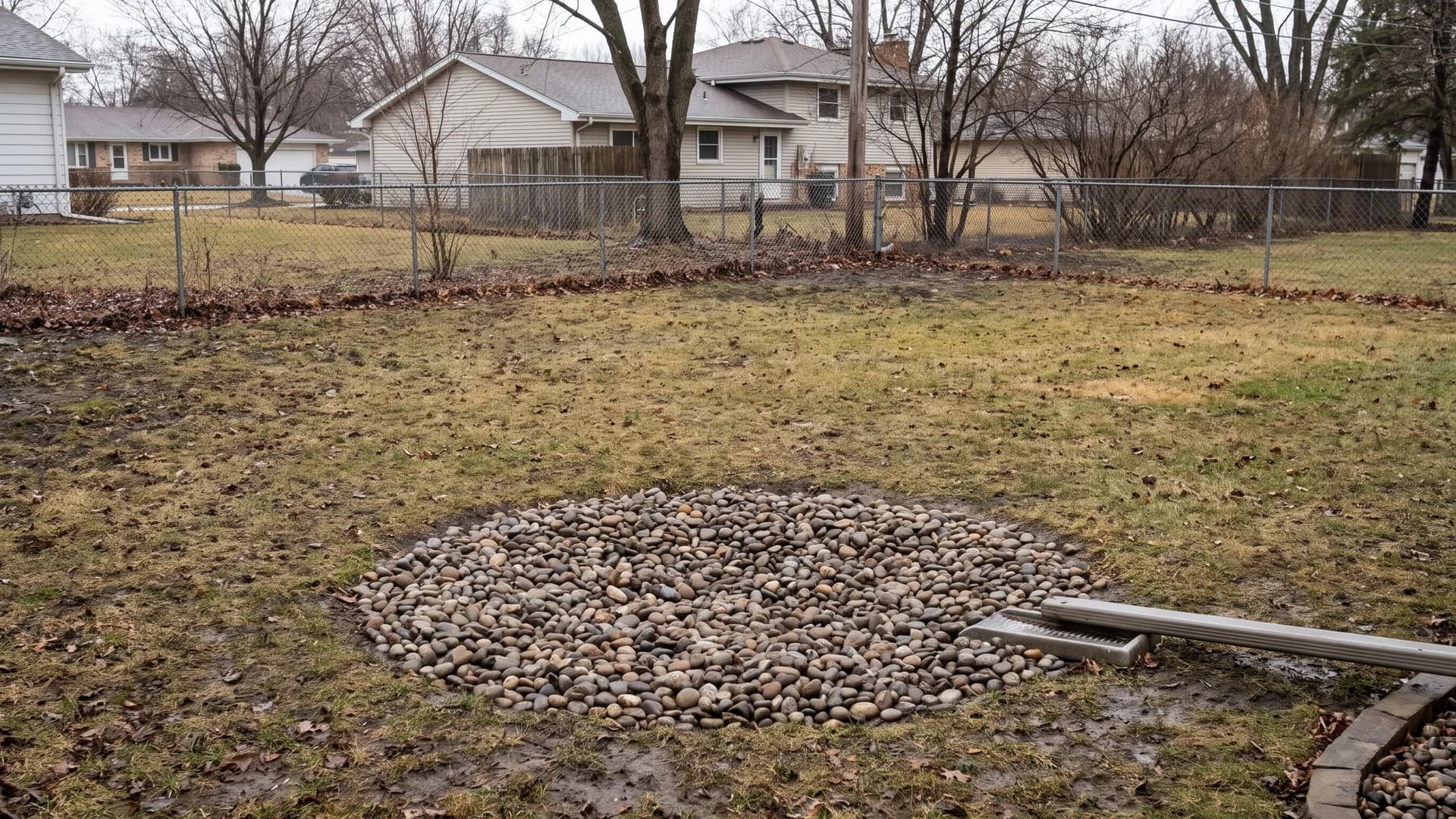
Where the grass dies out every spring in the same 6-foot patch, stone is a more honest fix than another bag of seed. Excavate the dish, set 4 inches of 1-to-2-inch rock into it, and the bald spot becomes a feature that drains within hours. If water stands for days rather than hours, that's a grading problem and a french drain job, and rock laid on top won't touch it.
Plants that belong in stone
19. Plant ornamental grasses in gray stone
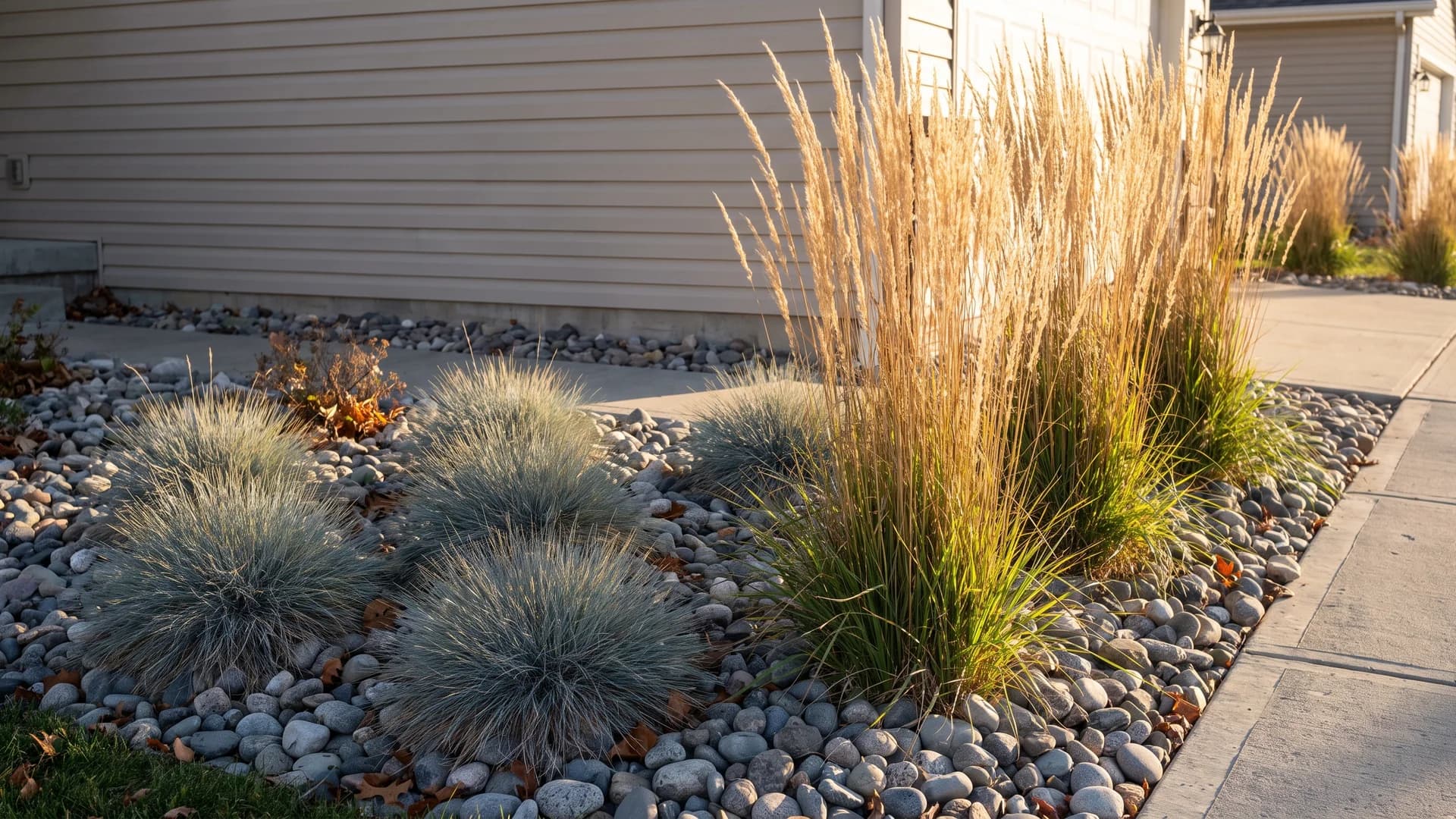
Gray stone under grass foliage is the highest-contrast, lowest-effort pairing available. Feather reed grass (zones 4 to 9) stands upright through winter, blue fescue (4 to 8) holds a tight silver mound, and both want the fast drainage a rock bed already provides. Plant 30 inches apart, cut back once in late winter, and that's the year's maintenance. Around $12 to $18 a plant.
20. Build a succulent bed for dry zones
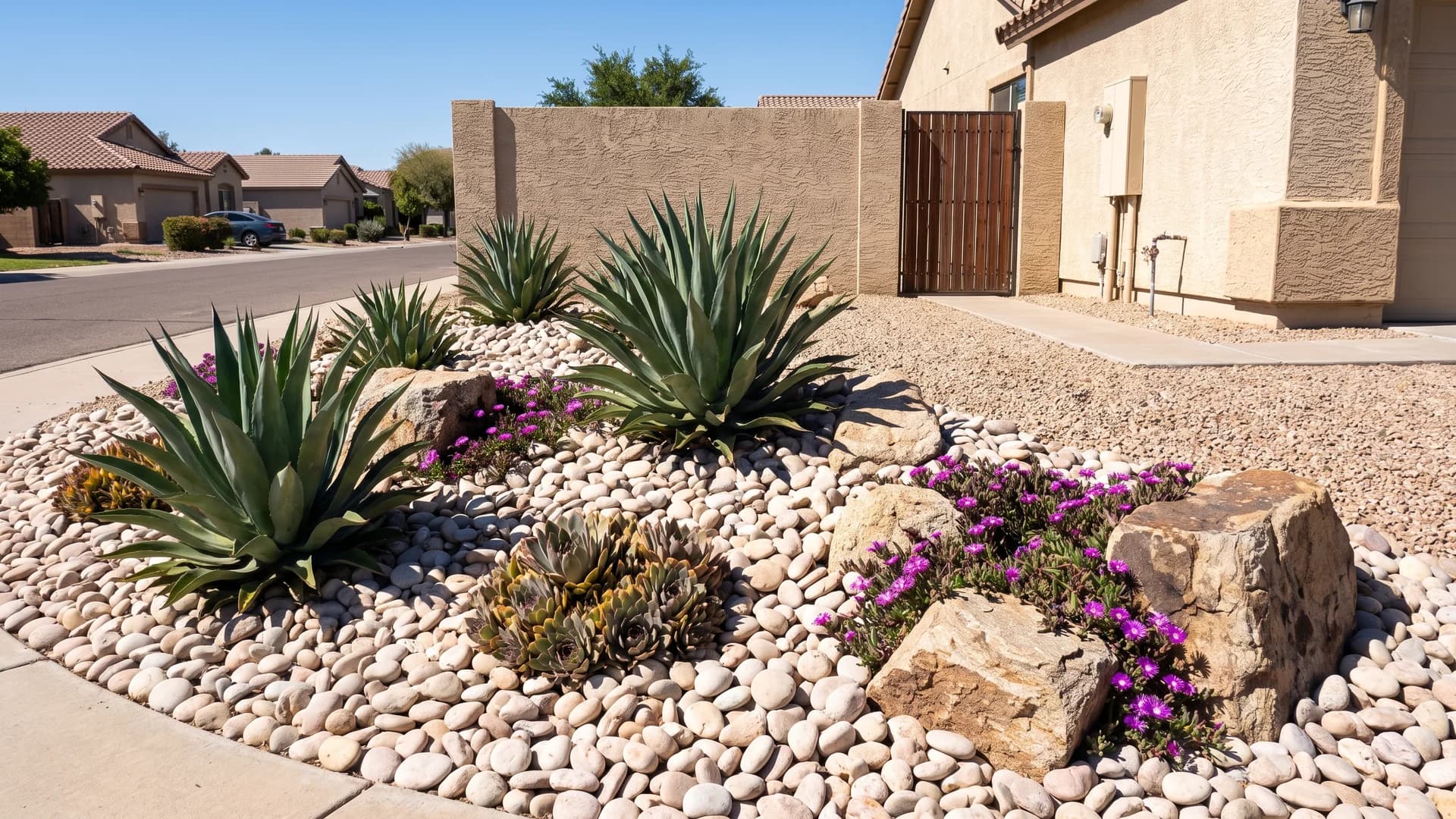
In zones 8 to 11, a mounded bed of pale rock holding agave, hens-and-chicks, and ice plant comes close to a permanent installation. Mound the soil first so water leaves fast, face it with your larger stones, and plant into the pockets between them. This is xeriscaping at its simplest, and it's the first thing AI xeriscape design sketches on a sun-baked yard.
21. Pair lavender with tan rock
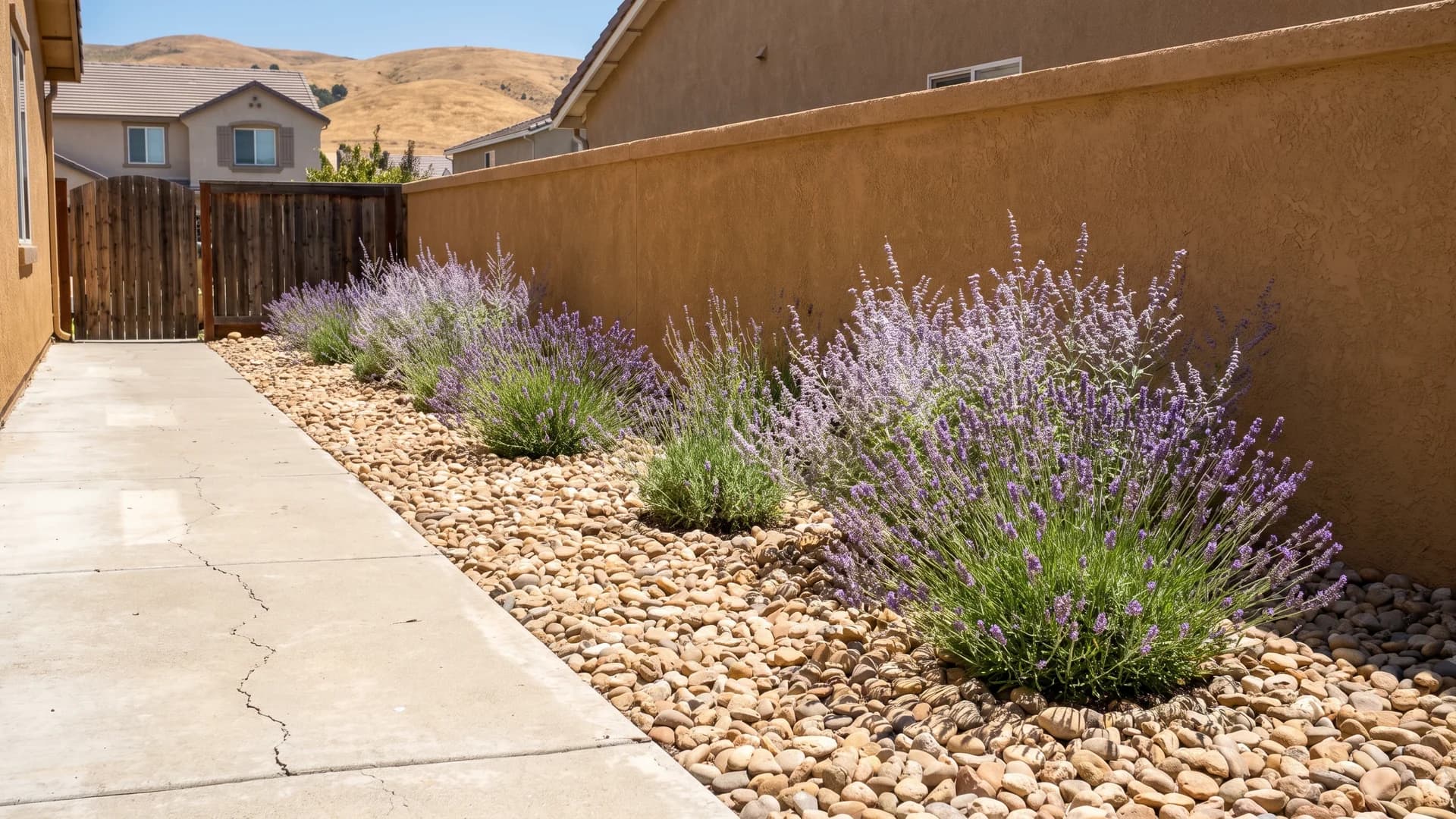
Warm stone under silver foliage is one of the few combinations that looks better in August than in May. Lavender (zones 5 to 9) and Russian sage (4 to 9) both want lean soil and sharp drainage, which is exactly what 3 inches of tan rock over a gritty base gives them. Keep the crowns clear of stone, since damp material packed against lavender is how most of it dies.
22. Use dark stone in a shade bed
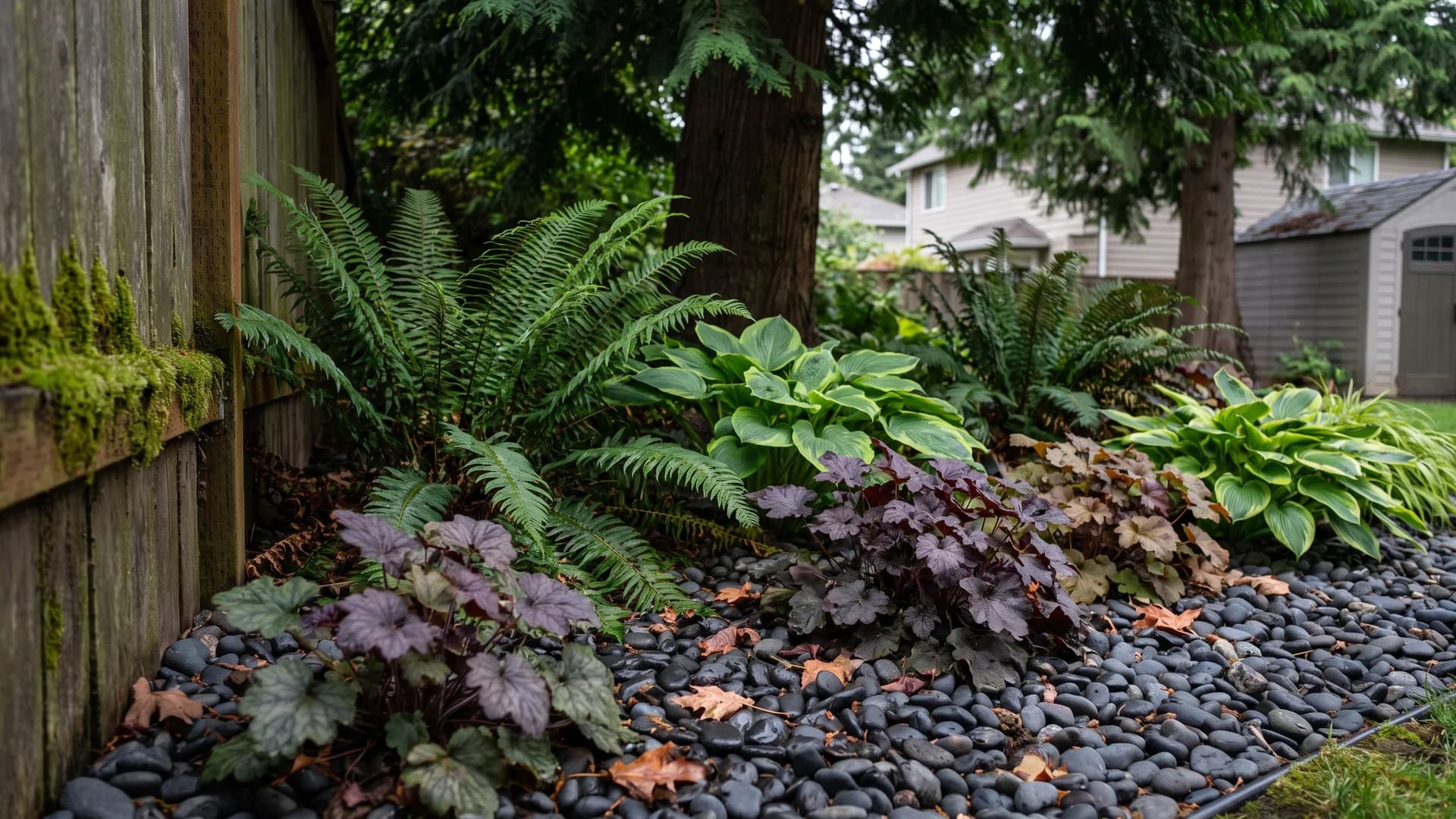
Stone is not a desert-only material. Dark gray or charcoal rock under ferns, hostas (zones 3 to 9), and heuchera reads like a woodland floor and runs cooler than any pale gravel would. The one caution is leaf fall, since shade beds usually sit under trees. Plan on a blower pass twice a year or the stone vanishes under a layer of compost.
23. Let groundcover spill over the edge
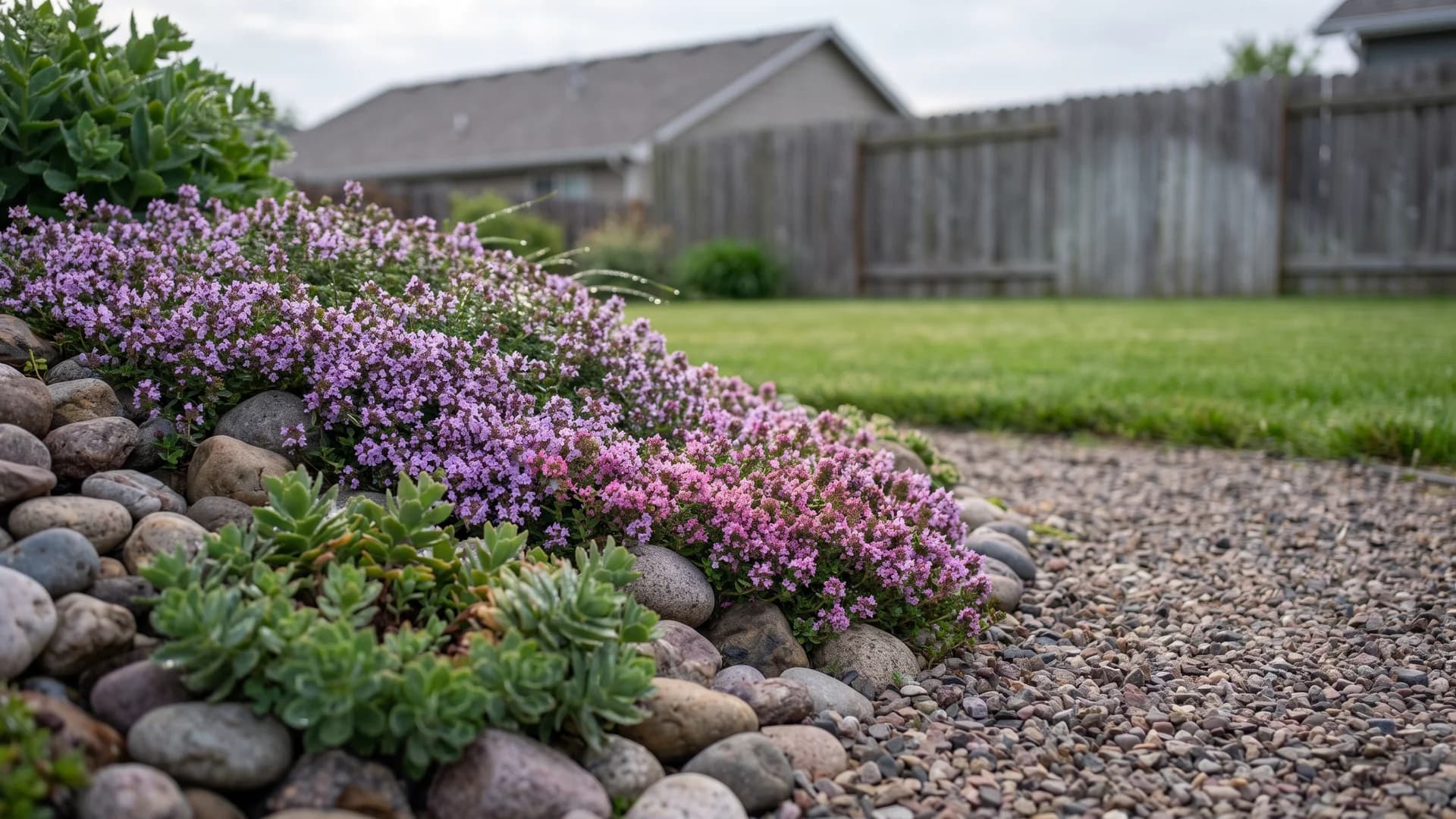
Hard boundaries between planting and rock read like a hospital floor. Creeping thyme (zones 4 to 9), sedum (3 to 9), and blue star creeper soften the line by growing out over the stone within a season or two, and they take light foot traffic better than turf. Plant them right at the rock edge rather than back in the bed, and they'll do the blending themselves.
Color, size, and texture
24. Go white for the brightest bed
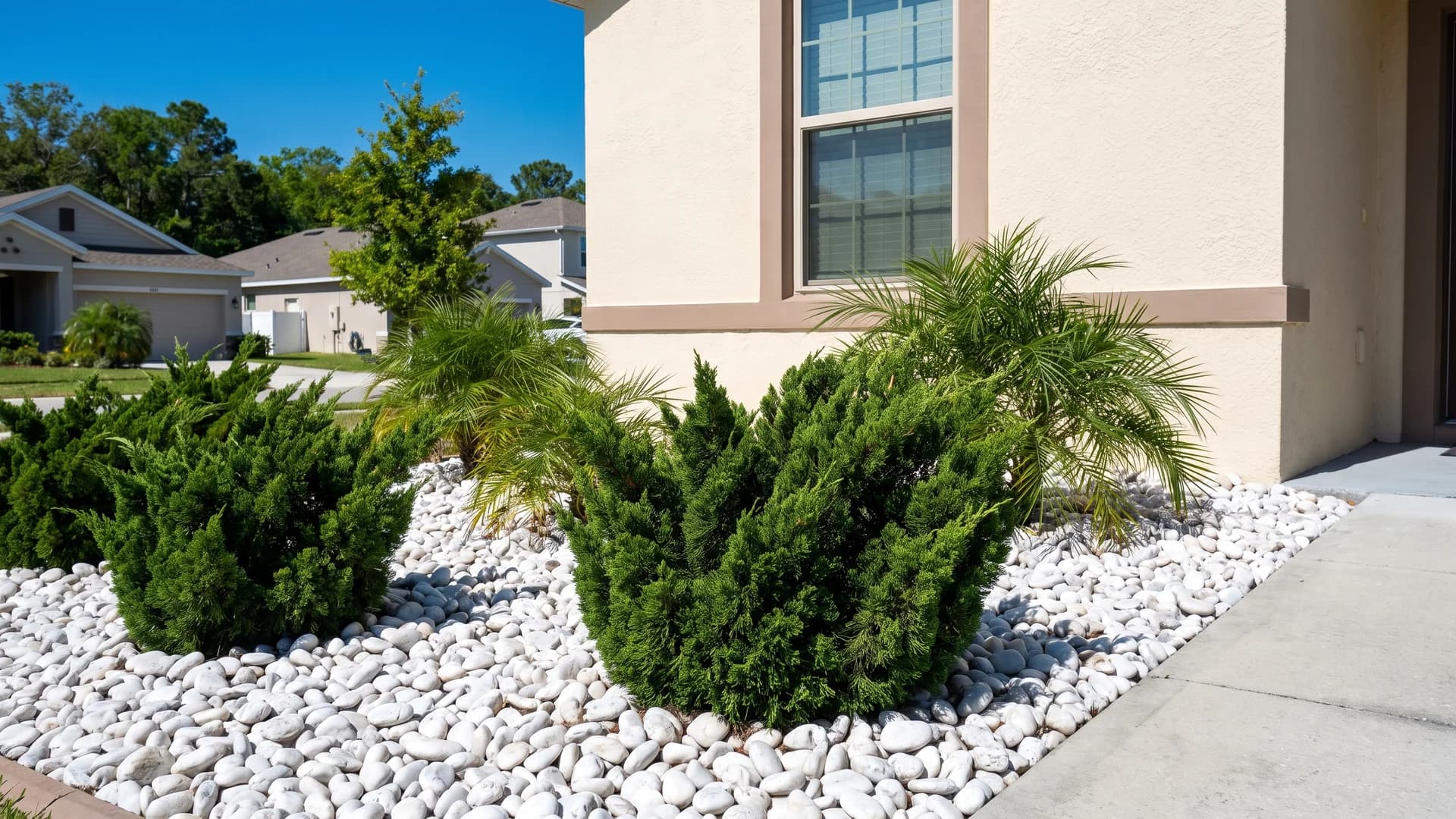
White river rock bounces light into dim corners and makes dark foliage pop harder than any other color will. The trade is real: white shows every leaf, algae streak, and mud splash, so it belongs under evergreens and away from downspouts rather than beneath a deciduous tree. Plan on a hose rinse once a year, and expect to refresh the top layer around year five.
25. Use black stone against light siding
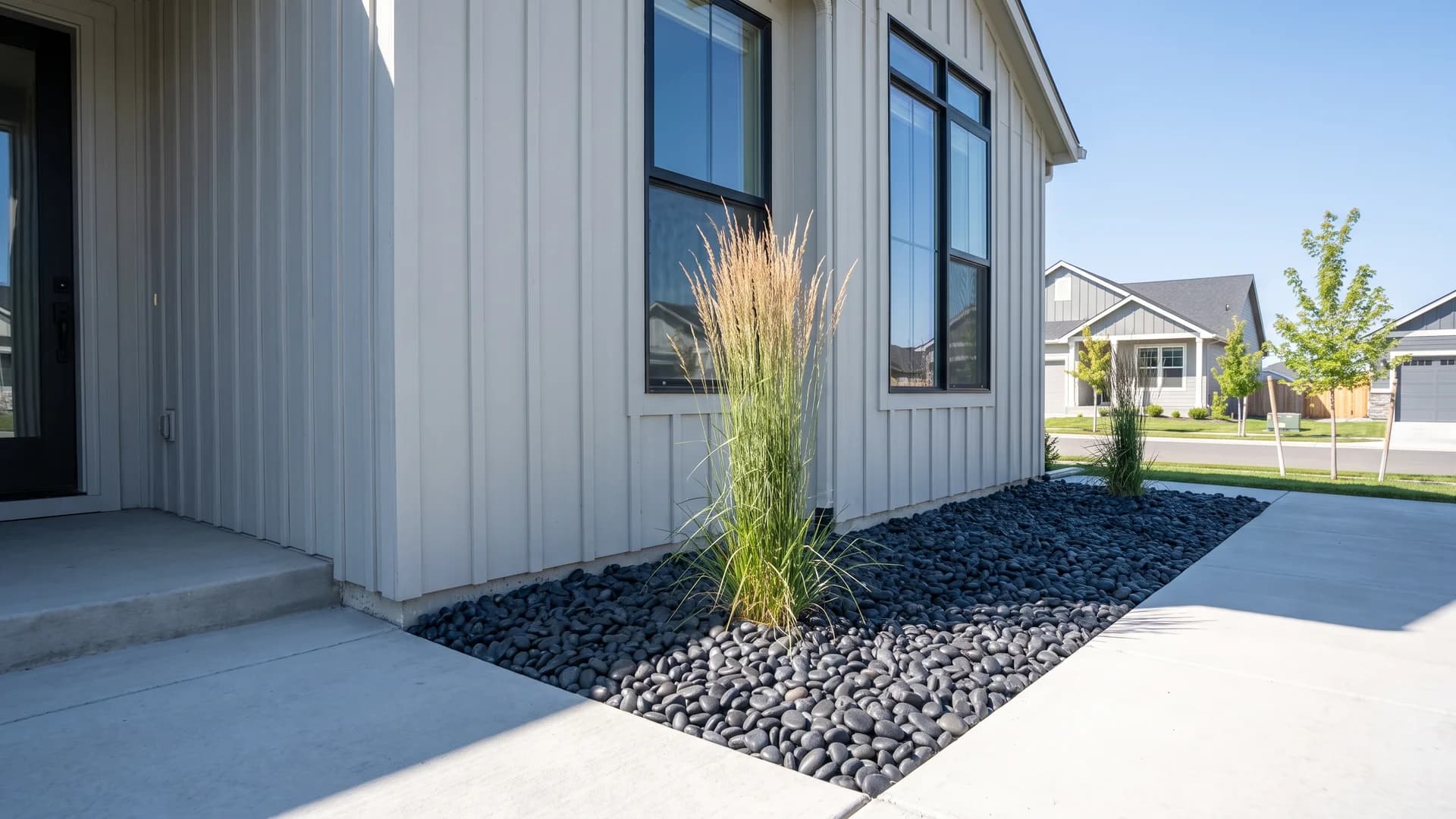
Black Mexican beach pebble against white or pale gray siding is the sharpest contrast stone can give you, which is why it turns up on nearly every modern build. It also costs the most, often $200 to $400 a ton for graded polished stone, and it runs hot. Keep it out of beds holding tender plants, and off the south wall in a hot climate.
26. Stay brown for a traditional look
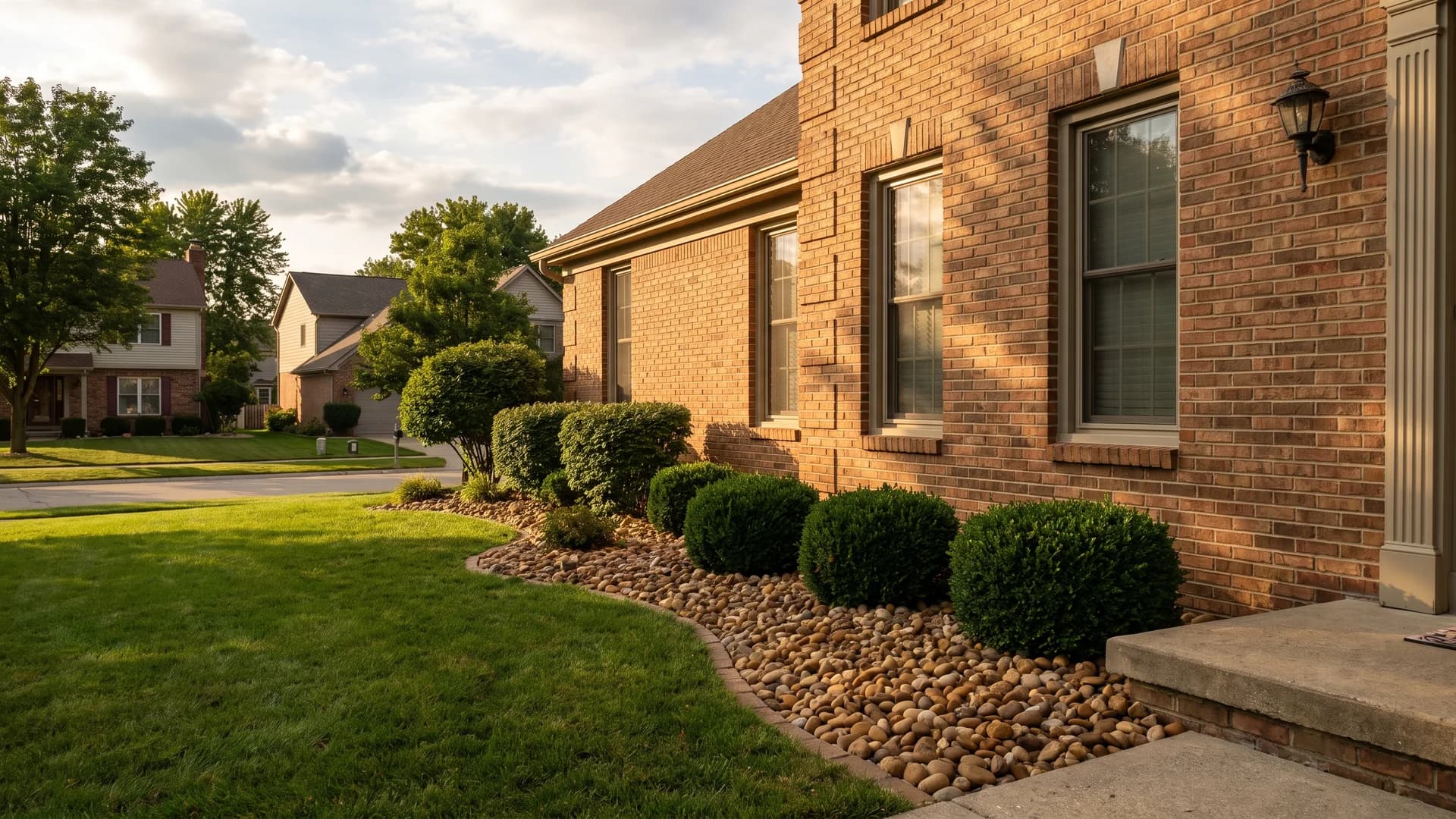
Brown and tan is the safe answer, and safe is underrated on a house you might sell. Warm stone hides dust, sits comfortably against brick and cedar, and doesn't date the way a stark color choice can. It also reads softer beside green lawn than gray does, which starts to matter once the bed is big enough to be a field rather than a stripe.
27. Mix sizes so the bed has texture
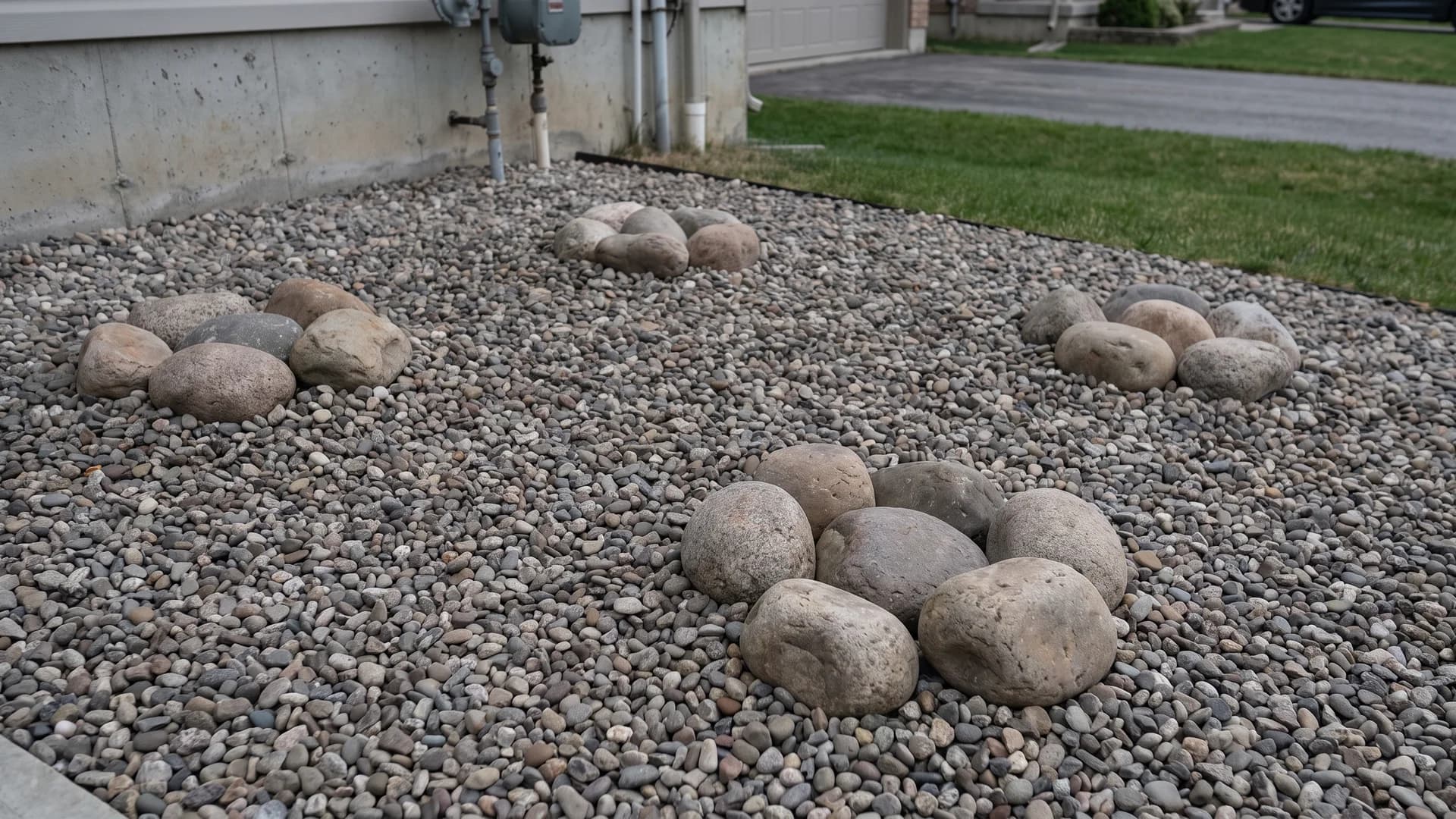
One uniform size looks like it came off a truck, because it did. Lay a base of 3/4-inch stone, then scatter a dozen 4-to-6-inch rocks across it in odd-numbered groups, pressing each one into the base instead of leaving it perched on top. The upgrade costs almost nothing and it's the fastest way to make a stone bed look designed rather than delivered.
28. Set boulders as the sculpture
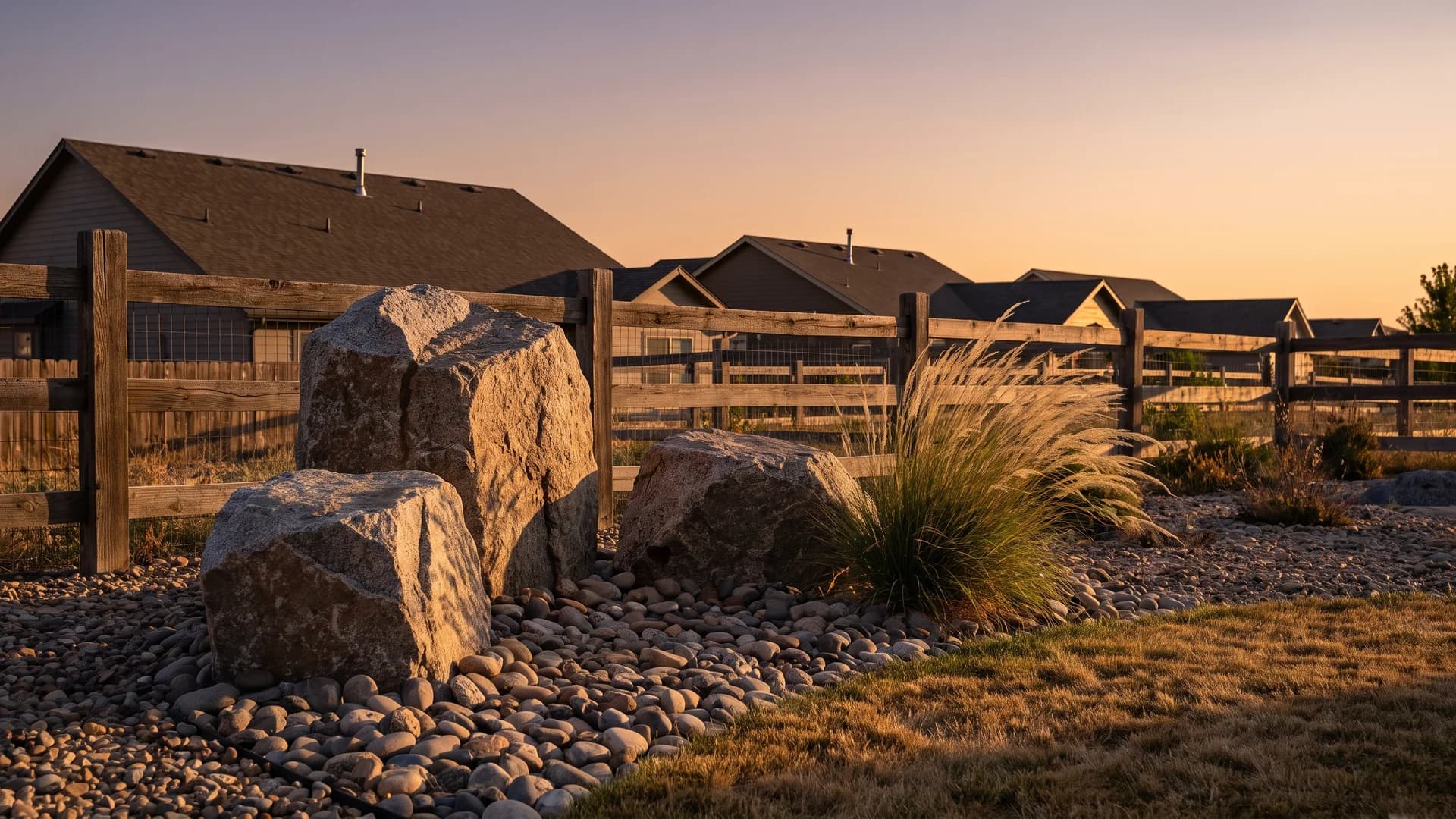
Two or three boulders in a rock field give the eye somewhere to land. Bury each one about a third deep so it sits like geology instead of delivery, vary the sizes, and never space them evenly. Landscape boulders run $100 to $300 apiece delivered depending on weight, and the real cost is the skid steer or the four strong friends who move them.
Features and finishing touches
29. Bed a bubbler in stone
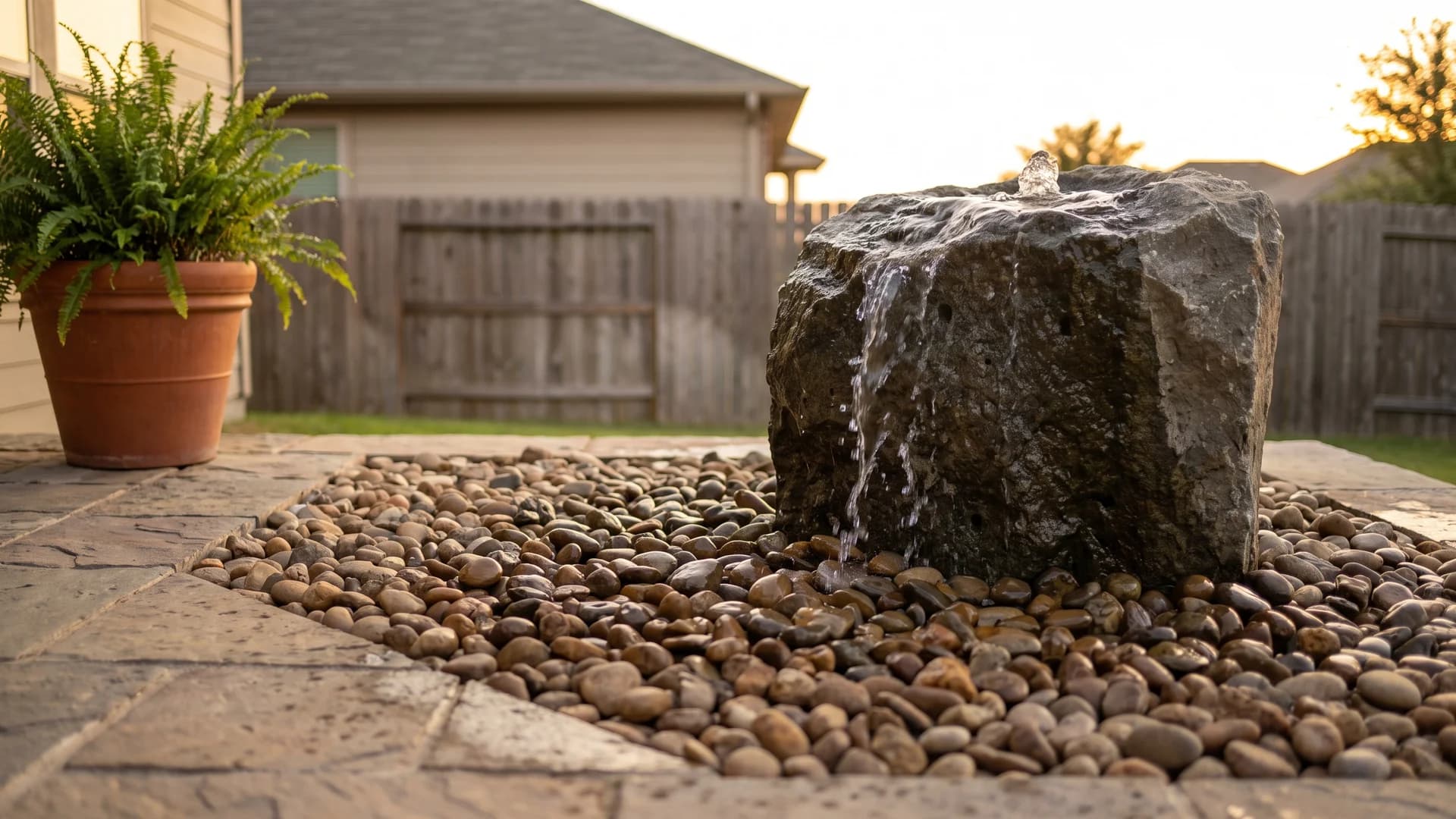
Pot bubblers and drilled-stone fountains are the least demanding water feature you can own: no open pond, no fish, no algae season. The rock hides the basin lid and every bit of plumbing, and the sound carries roughly 15 feet. Kits run $200 to $600, and a covered reservoir means topping it up weekly rather than daily in July.
30. Edge a pond or pool in matched stone
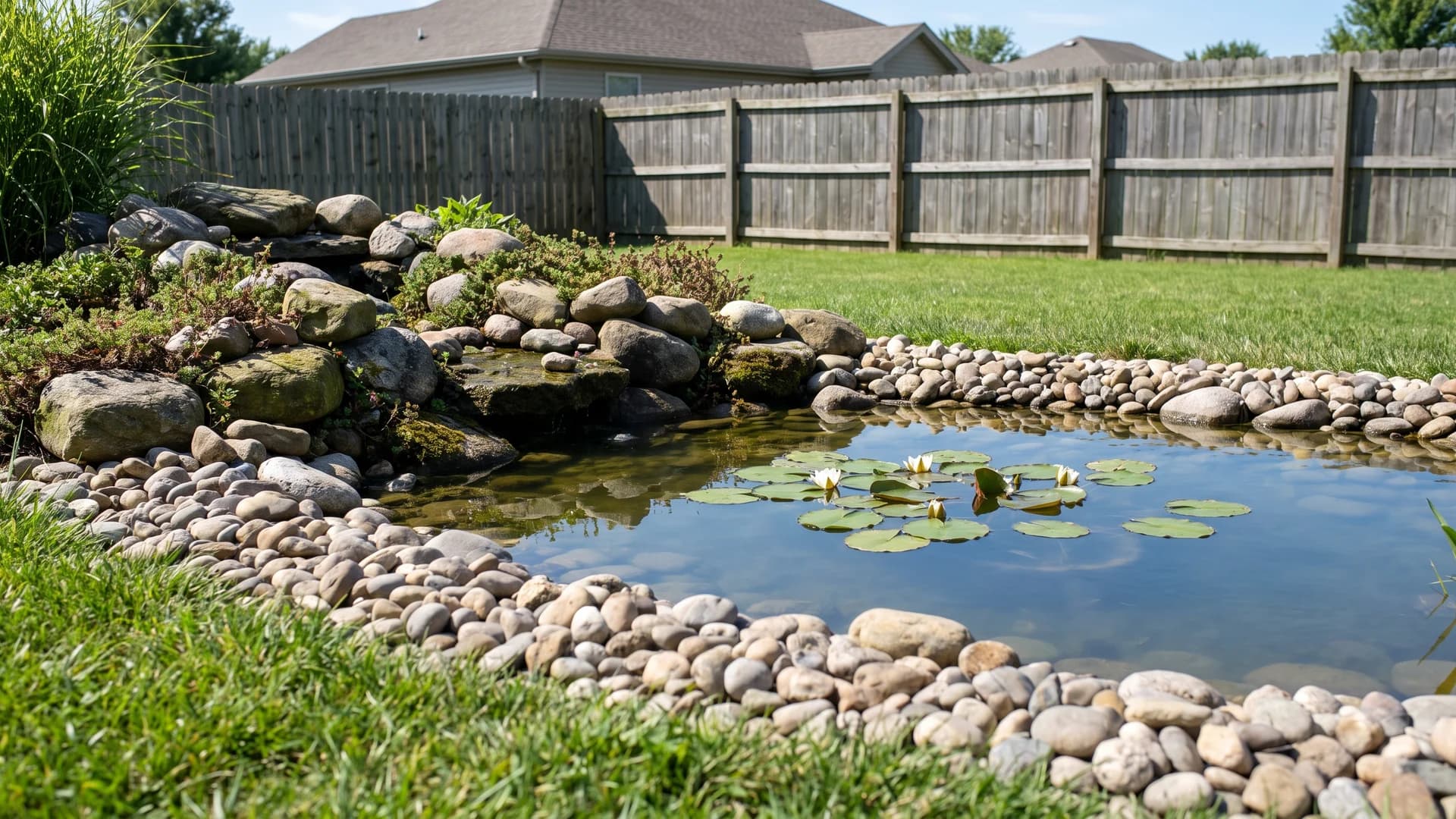
Matched river rock hides the liner, or the coping shadow, wherever hardscape meets water and the transition would otherwise look abrupt. Use 1-to-2-inch stone at the waterline with larger cobbles stacked behind it. Around a swimming pool, keep loose rock well back from the deck, because stone that travels underfoot into the water becomes a pump problem. The full treatment is in our pool landscaping ideas.
31. Rake a gravel square in a quiet corner
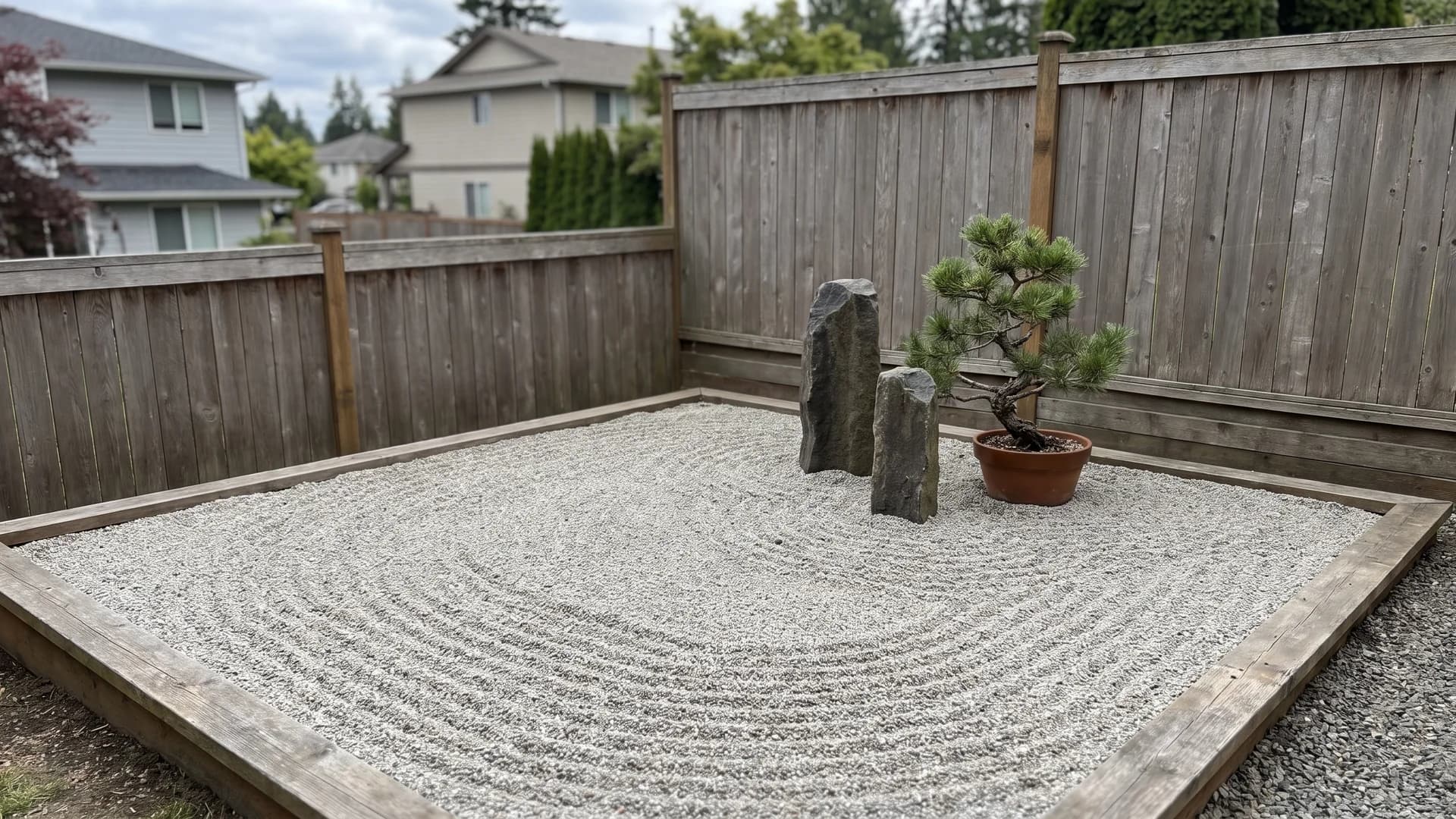
Eight feet square of fine gravel raked in lines, two upright stones, one dwarf pine. That's the entire idea, and the emptiness is what makes it work; every object you resist adding improves it. Fines rake cleanly where rounded stone will not, so use crushed gravel for the field and keep the river rock for the placed accents.
32. Floor the fire pit area in stone
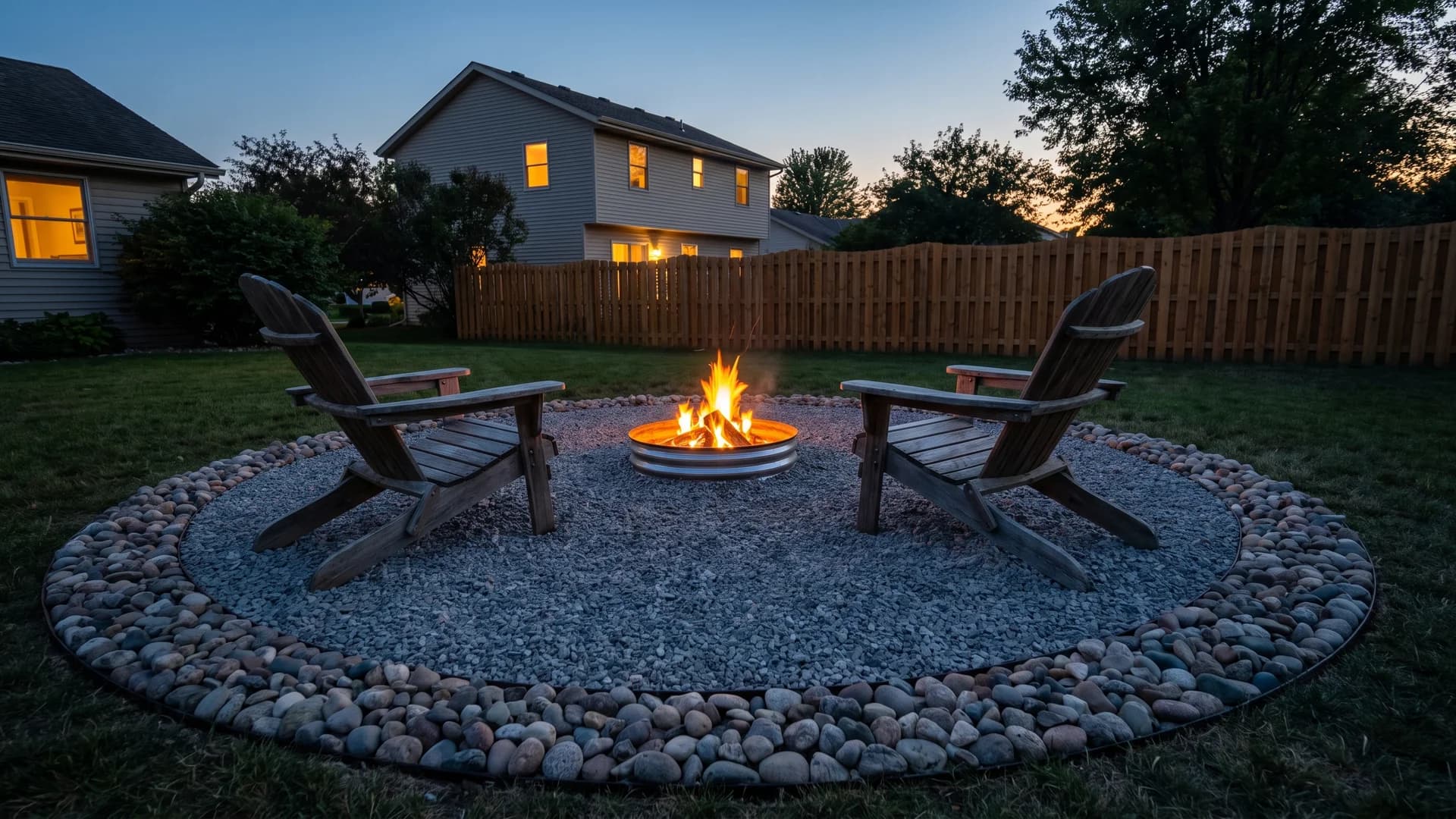
Fire burns grass and chars decking, so give the pit a floor that doesn't care. A 12-foot circle costs about $180 in material: crushed stone under the chairs where it compacts, river rock in the outer band where nothing gets dragged across it. Keep the pit 10 feet from the house and any overhang, and check local burn rules before you build seating around it.
What river rock gets wrong
Nothing this permanent is neutral. Stone holds and radiates heat, which stresses shallow-rooted plants above it and warms a south-facing wall you'd rather keep cool. Leaf litter is the daily annoyance: leaves blow in, wedge between stones, and raking drags the rock out along with them, so a blower on a low setting ends up being the only tool that works.
Then there's year five. Rock sinks into soil, fabric shreds at the seams, and the organic debris that collected on the surface turns into a seedbed, so weeds start growing on top of the stone rather than under it. Removal is genuinely miserable, a shovel-and-wheelbarrow job with no shortcut and no machine that helps. On slopes, small rock keeps migrating downhill. None of that rules river rock out. It means putting it where those traits don't matter, and edging it properly so it stays where you put it. For lava rock, crushed granite, flagstone, and the rest of the material range, our rock landscaping ideas guide covers the lot.
Match the idea to your yard
- Water is the problem: start at 14, then 18, and add 15 only if the run has somewhere to go.
- Smallest budget: 7, 13, and 27 all land under $100 and finish in a weekend.
- Front of the house: 1, 3, 7, and 10. For the version that covers every stone type, see our front yard rock playbook.
- Hot and dry: 20, 21, and 26 hold up where lawn won't.
- Shade under trees: 4 and 22, and skip 24, because white shows everything a tree drops.
- A real slope: 17 first, and read the hillside guide before you order a single ton.
- Renting or undecided: 9 and 27 are reversible in an afternoon.
FAQ
What are the disadvantages of river rock landscaping?
It holds heat, it's hard to remove, and it collects leaf litter that becomes a weed seedbed on top of the stone within a few years. Rock also sinks into soil over time, so a bed laid at 3 inches looks thin by year five and wants a top-up. On slopes, smaller stone migrates downhill with every heavy rain.
What should I put under river rock?
Woven commercial-grade landscape fabric in decorative beds, overlapped 6 inches at the seams, pinned every 2 feet, with edging at every boundary before the stone goes down. In a drainage application, use a permeable fabric over a compacted base instead. Around tree roots and in self-sowing gravel gardens, skip fabric entirely and let a thicker layer of stone do the weed control.
How deep does river rock need to be?
Two inches is decorative coverage, 3 inches is where weed suppression actually holds, and 4 inches or more belongs in a drainage channel where water needs void space to move through. Paths stay at 2 inches so the surface remains firm underfoot. Go deeper on a path and you're wading rather than walking.
What size river rock is best for landscaping?
One-to-two-inch stone is the default for beds, tree rings, and foundation strips. Drop to 3/8-inch pea size for paths and seating areas that need a firm surface. Move up to 2-to-4-inch under downspouts and along stream bottoms where water moves, and 4-inch and larger on slopes or as placed accents.
How much river rock do I need, and what does it cost?
One ton covers roughly 100 square feet at 2 inches deep, or about 70 square feet at 3 inches. Bulk gray and tan stone runs $80 to $150 a ton delivered, while polished black and specialty colors reach $400. Length times width times depth in feet, divided by 27, gives you cubic yards, and delivery is often the line item people forget to price.
How do you clean river rock landscaping?
Blow leaves off with a leaf blower on a low setting rather than raking, which drags stone out with the debris. Once a year, a hose with a jet nozzle, or a pressure washer on a wide fan, rinses dust and algae off light-colored rock. For stone that's sunk into soil, a bed rake and a screen will recover most of it, though topping up with a fresh half ton is usually faster.
Does river rock look good for landscaping?
It does when it has a job and a hard edge. River rock reads as design when it's contained by real edging, sized for its use, and broken up by planting so the bed isn't an unbroken field. It reads as neglect when it's a thin, unedged layer over bare soil, which is what most of the bad examples have in common.