21 Gravel Patio Ideas With the Right Gravel and Depth for Each
Pea gravel with steel edging, flagstone and gravel mixes, fire pit circles, planted gravel gardens and fixes for side yards and slopes. Each idea names the gravel and depth, with a current cost table.
A patch of worn lawn by the back door is where most patios start, and pouring concrete over it is a big, permanent decision. Gravel isn't. You can lay it yourself over two weekends, change the shape later, and spend a few hundred dollars instead of a few thousand. The gravel patio ideas below cover the whole range, from a simple pea gravel square with steel edging to fire pit circles, flagstone and gravel mixes, and planted gravel gardens.
There are 21 ideas, grouped by what they're built around. Each one names the gravel to use and how deep to lay it, because the wrong stone at the wrong depth is why most gravel patios end up as a rolling, weedy mess. Further down you'll find a cost and depth table with current prices.
Every image here is an AI-generated design concept, not a client project. It's the same kind of render AI patio design makes from a photo of your own yard.
Which gravel to use for a patio
Before the ideas, one decision shapes all of them: the stone. Here's one ordinary backyard corner, then the same spot as three AI concepts, each with a different surface.
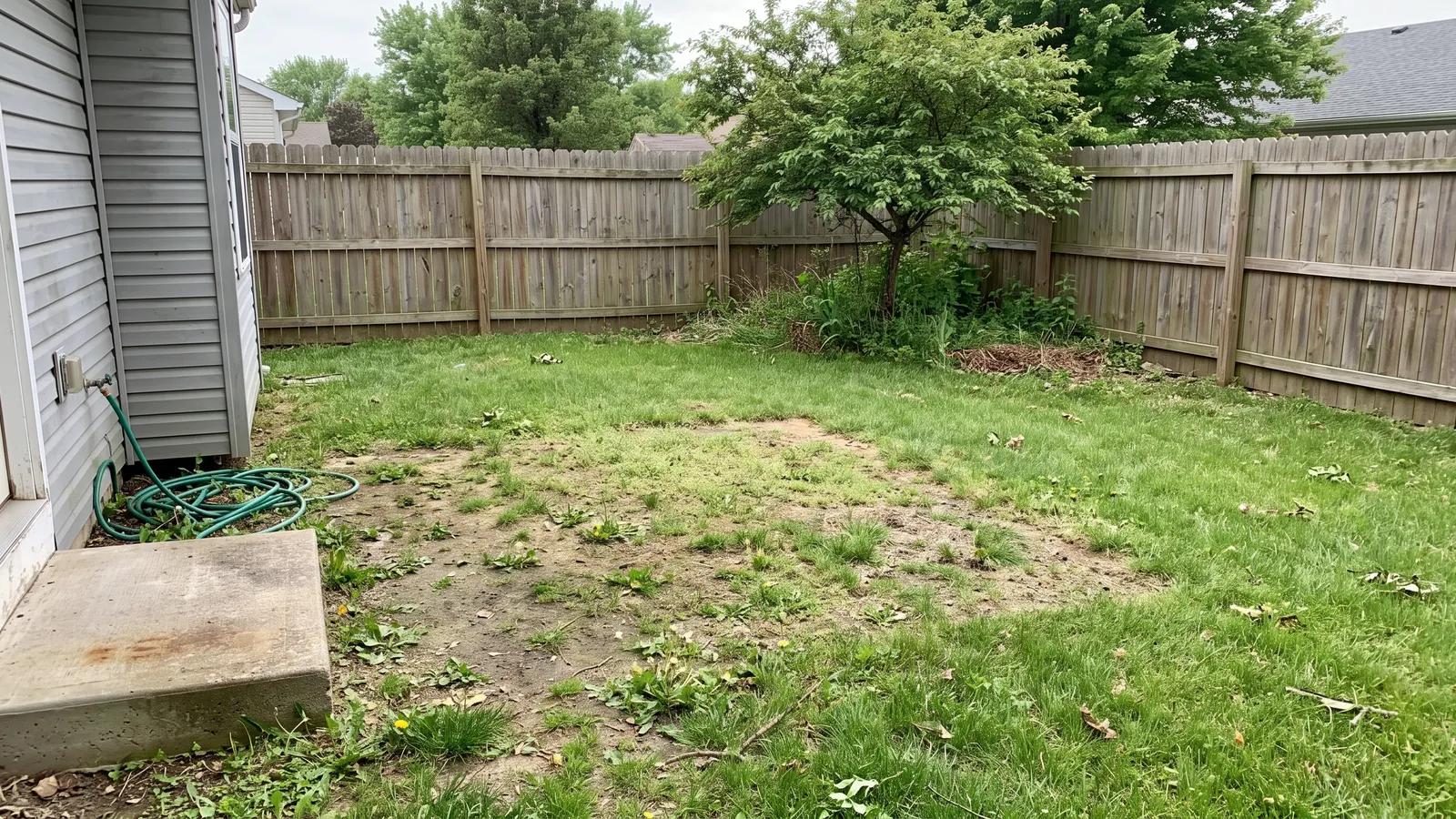
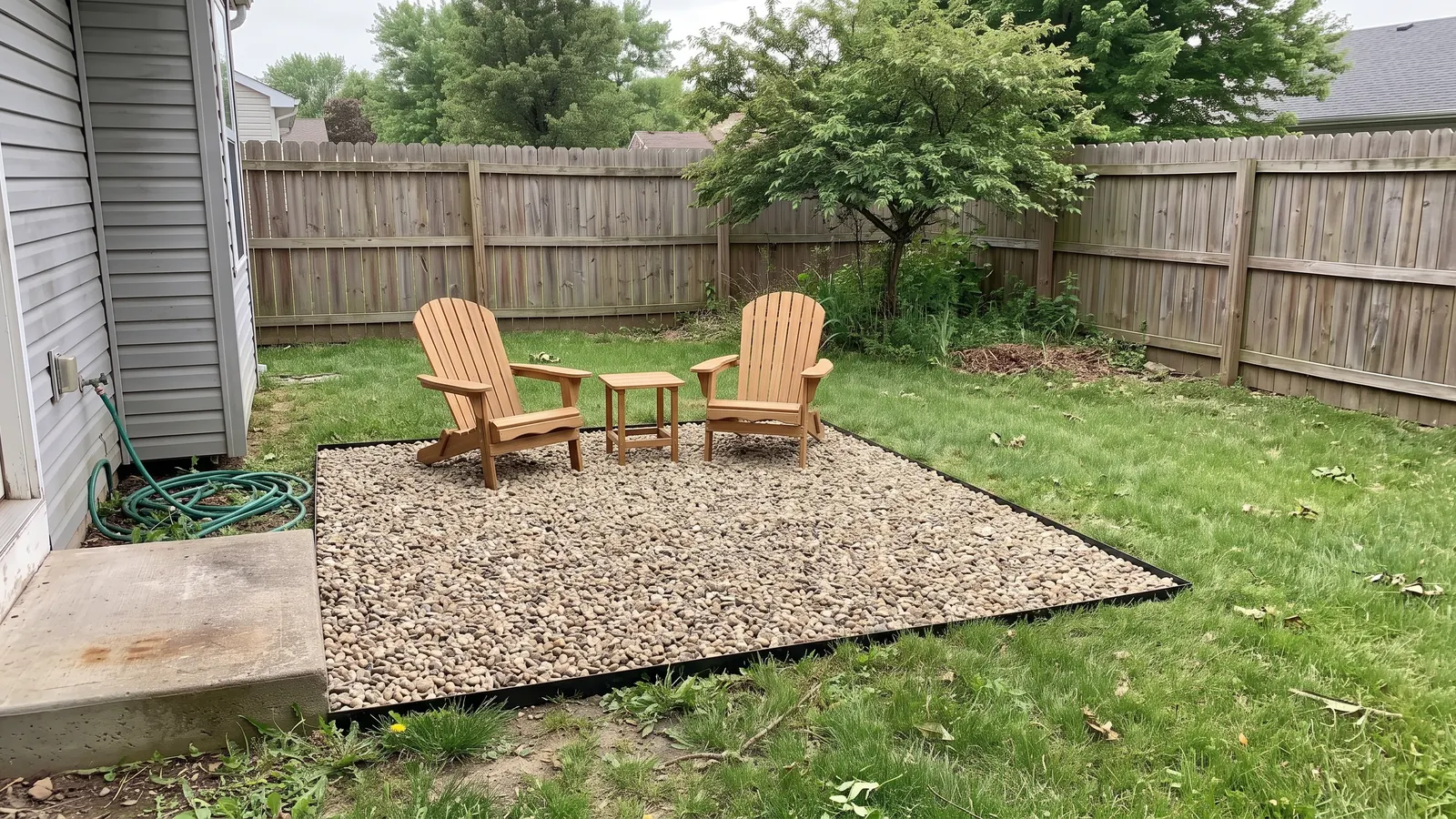
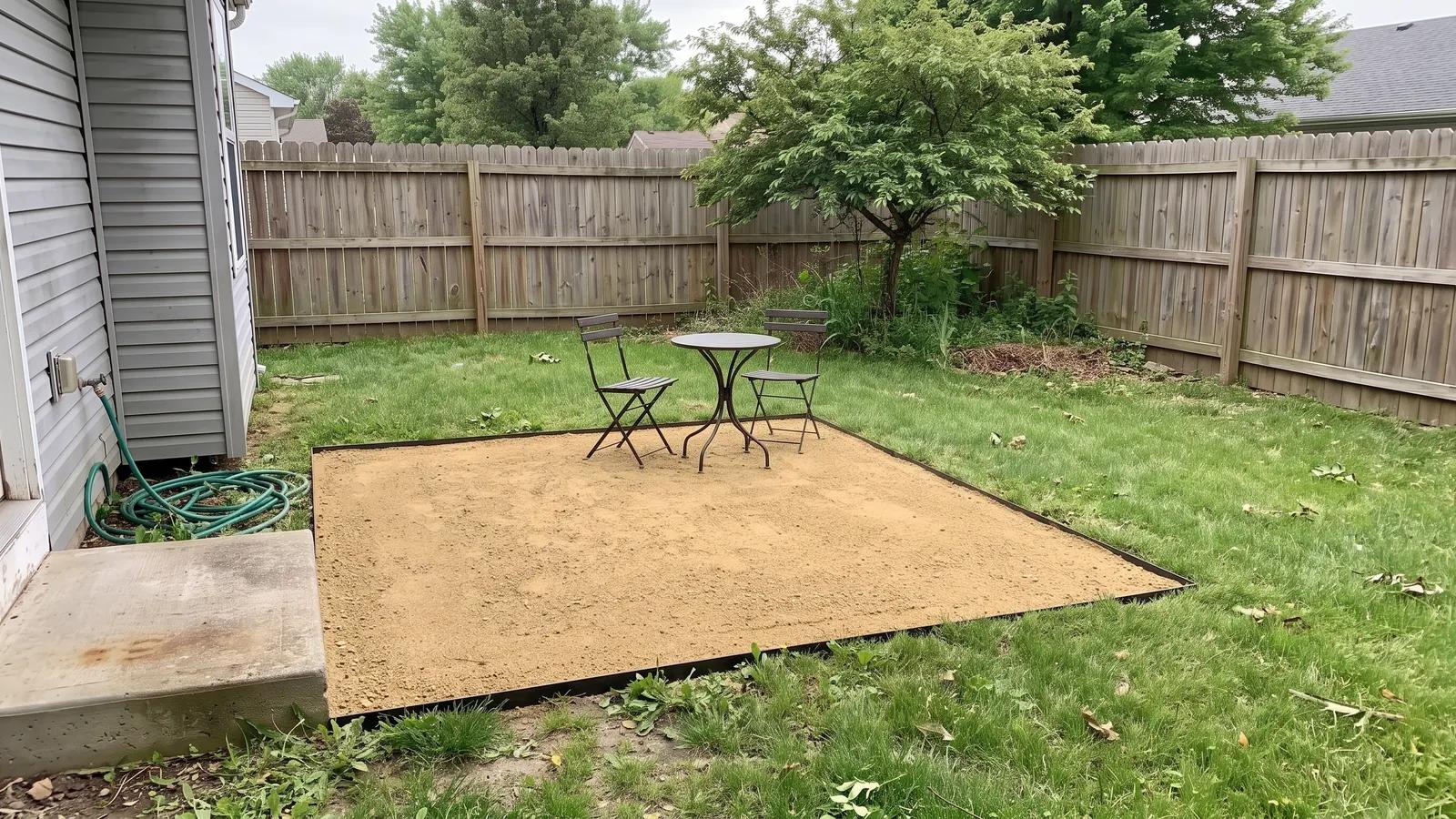
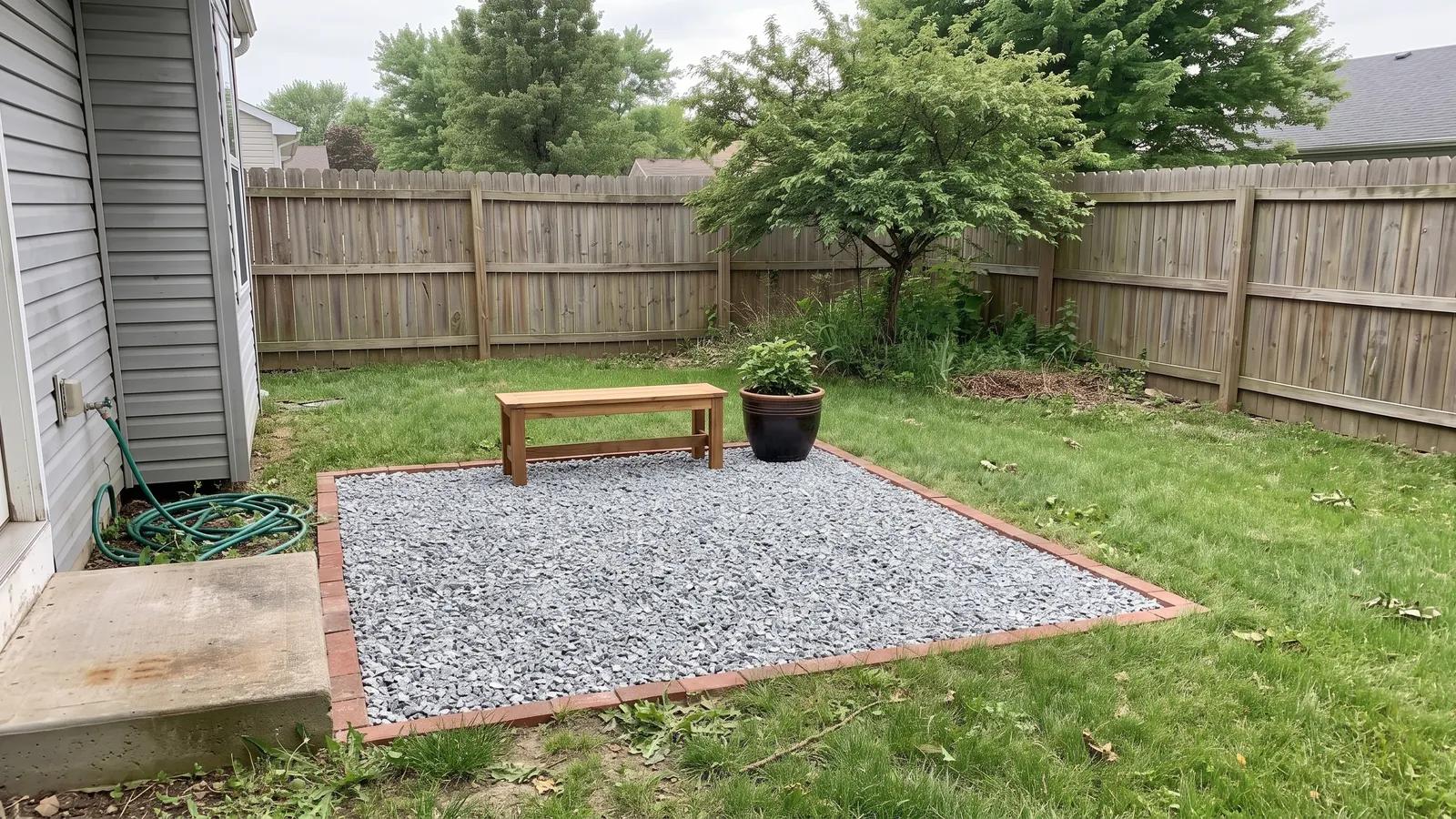
They look similar in a photo, but they feel very different underfoot:
| Gravel | Size | Underfoot | Lay it | Best for | Bulk price |
|---|---|---|---|---|---|
| Pea gravel | About 3/8 in, smooth and round | Soft, shifts and rolls | 2 to 3 in over a 2 in crushed base | Lounge chairs, fire pits, a relaxed look | $30 to $55 per ton |
| Crushed stone (3/8 in, or with fines) | Small, angular | Locks together, firmer | 2 to 3 in over a 2 in crushed base | Dining tables, furniture with thin legs | $30 to $38 per ton (limestone) |
| Decomposed granite | 1/4 in and finer, sandy | Packs almost solid | 2 to 3 in, compacted in layers | Dry climates, a smooth "floor" | $40 to $100 per cu yd natural, $100 to $225 stabilized |
| River rock | 1 in and larger | Hard to walk on | Borders only | Edges and drainage strips | $45 to $130 per ton |
The short version: pea gravel is the classic and the cheapest to make look good, but chairs sink into it and it migrates. If you'll mostly sit and eat, angular crushed stone or stabilized decomposed granite gives you a firmer floor. Keep bigger rock for the edges; our river rock landscaping ideas show where it works better.
Classic gravel patios
1. Pea gravel with steel edging
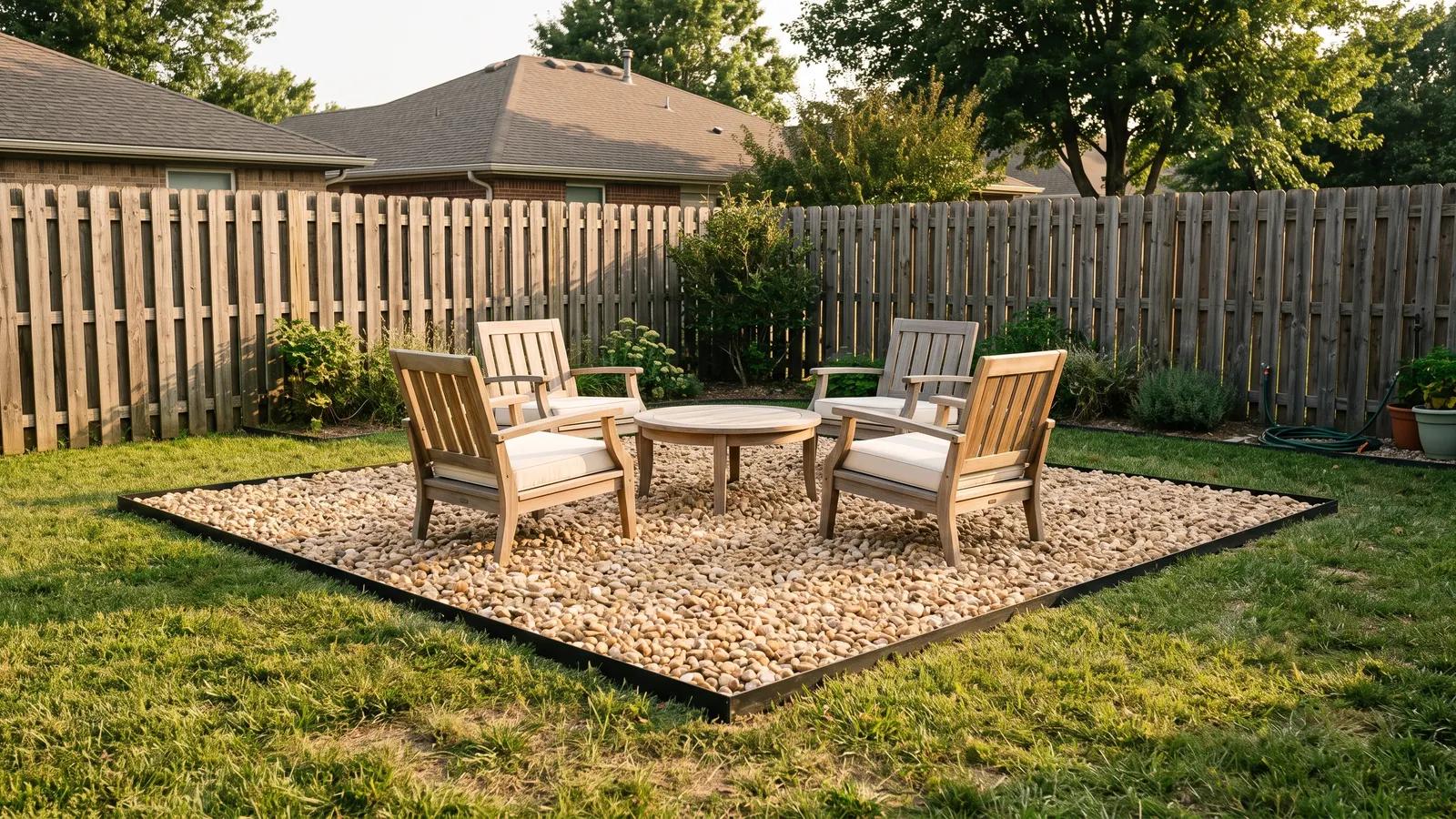
Most pea gravel patio ideas come back to this one, and the edging does most of the work. Thin steel edging disappears visually, holds a crisp line against the lawn, and stops pea gravel from drifting into the grass. Set it about 1/2 inch above the finished gravel, as Lowe's recommends, so stones don't spill over. Use 2 to 3 inches of pea gravel on a tamped 2-inch crushed base with landscape fabric between them.
2. A brick border around pea gravel
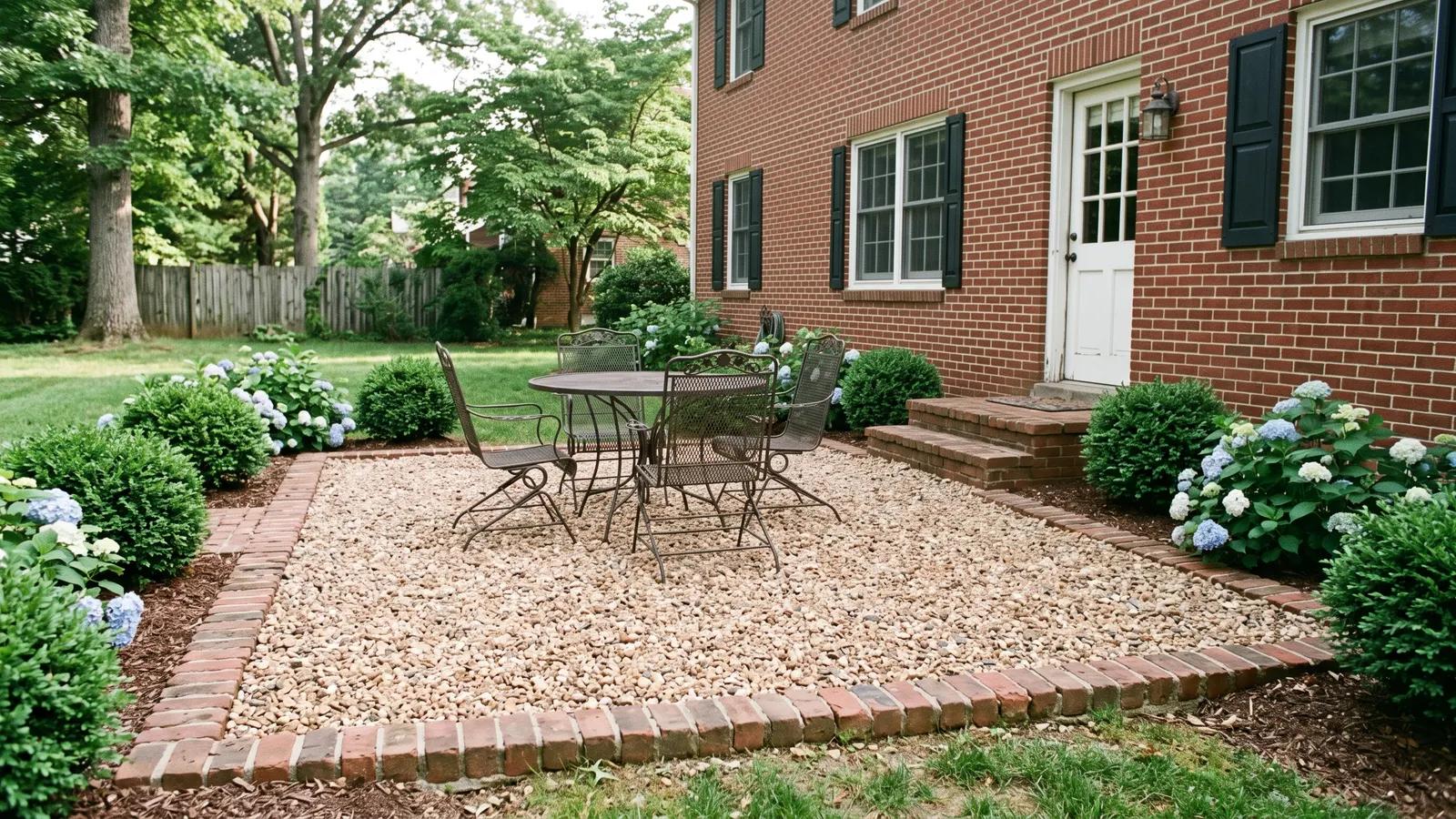
Old brick set on end in a row (a soldier course) gives a gravel patio a finished, traditional look that suits a brick or colonial house. Salvaged brick is often cheap or free on local marketplace listings. Bed the bricks in a trench on compacted base so frost doesn't heave them, and keep the gravel a little below the brick tops. Boxwood or hydrangeas planted outside the border soften the line.
3. Timber edging on a budget
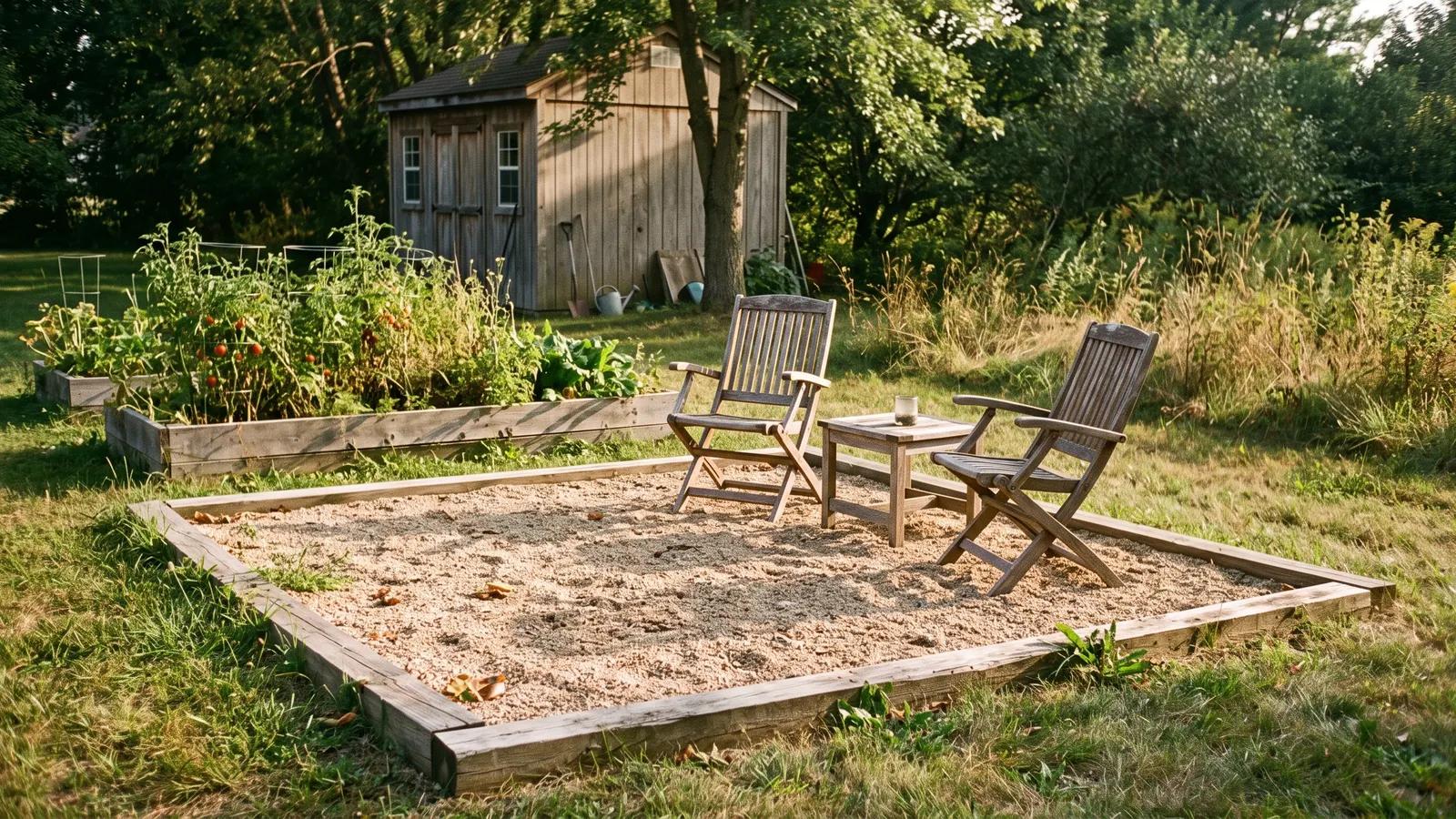
If the budget is close to zero, frame the patio with untreated cedar or ground-contact treated timbers laid flat and staked in place. Light tan crushed gravel inside packs down better than pea gravel, so folding chairs stay level. Wood edging won't last as long as steel or brick (expect to replace untreated cedar in several years), but it's the fastest border to install and easy to change.
4. Black gravel for a modern patio
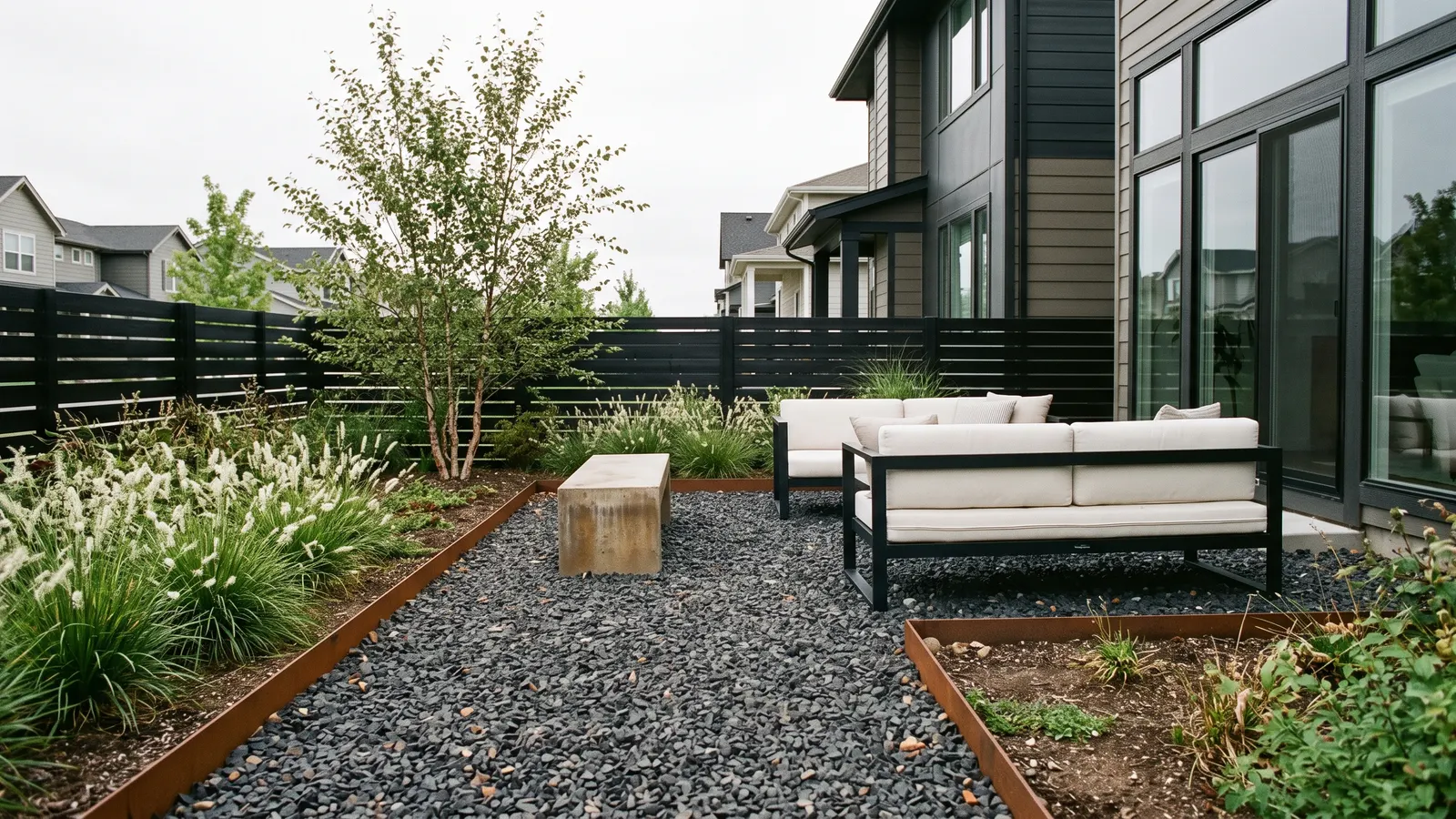
Dark angular gravel with rust-colored Corten steel edges reads clean and contemporary next to newer houses. Pair it with a few large, simple pieces: a concrete bench, a low sofa, one multi-stem tree. Two cautions. Black stone gets hot in full sun, so it suits shadier yards or cooler climates. And leaves show clearly on it, so plan on a leaf blower in fall.
5. Decomposed granite in dry climates
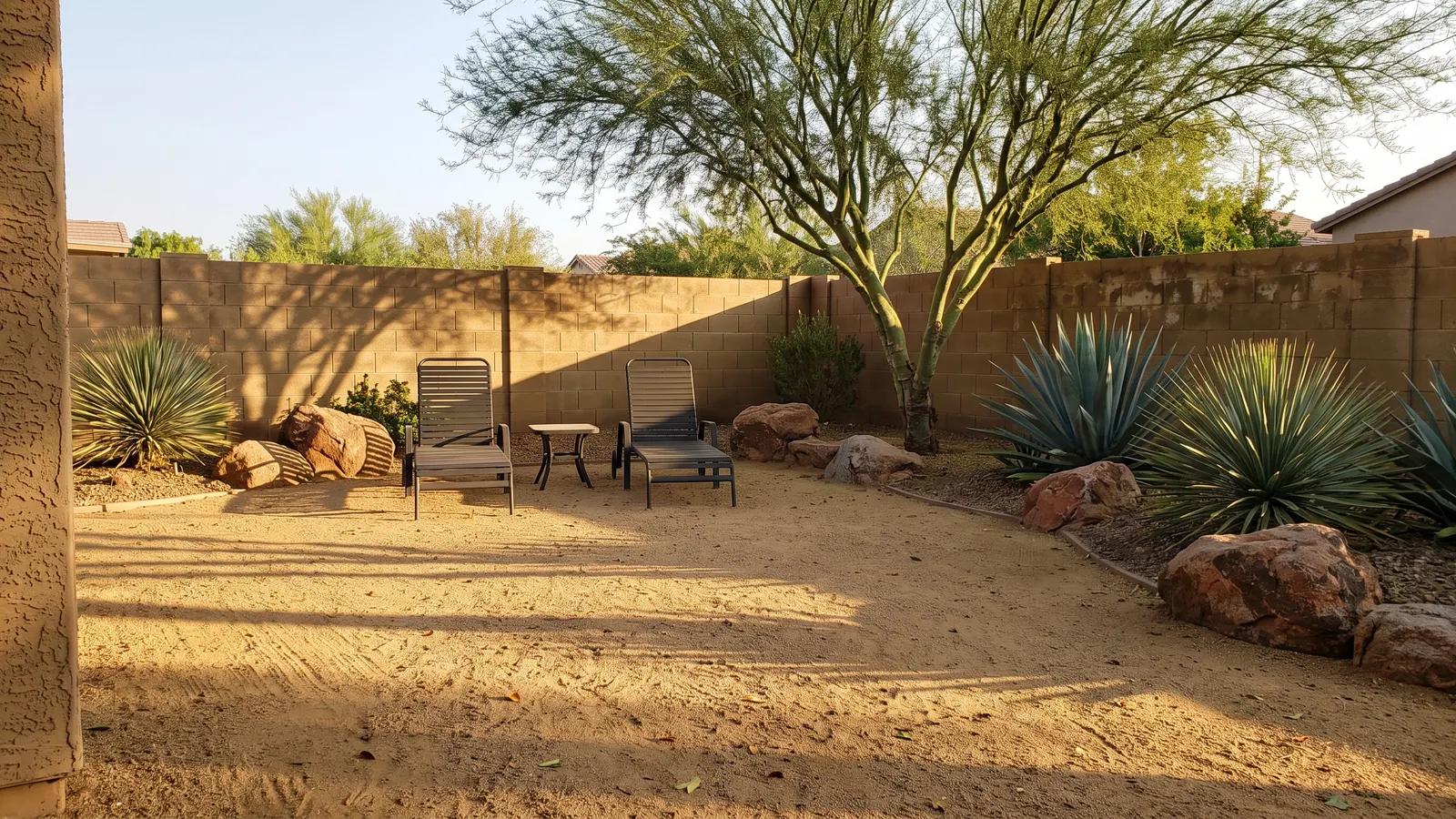
In the Southwest, decomposed granite is the default for good reasons. It compacts into a firm, even floor, matches desert planting, and drains fast after a monsoon storm. HomeGuide notes pea gravel holds more heat in hot, arid climates. Stabilized DG, which has a binder mixed in, costs $100 to $225 per cubic yard against $40 to $100 for natural, and it's worth it for a patio because it resists washing out and tracking indoors.
Gravel with pavers or stepping stones
6. Flagstone set in gravel
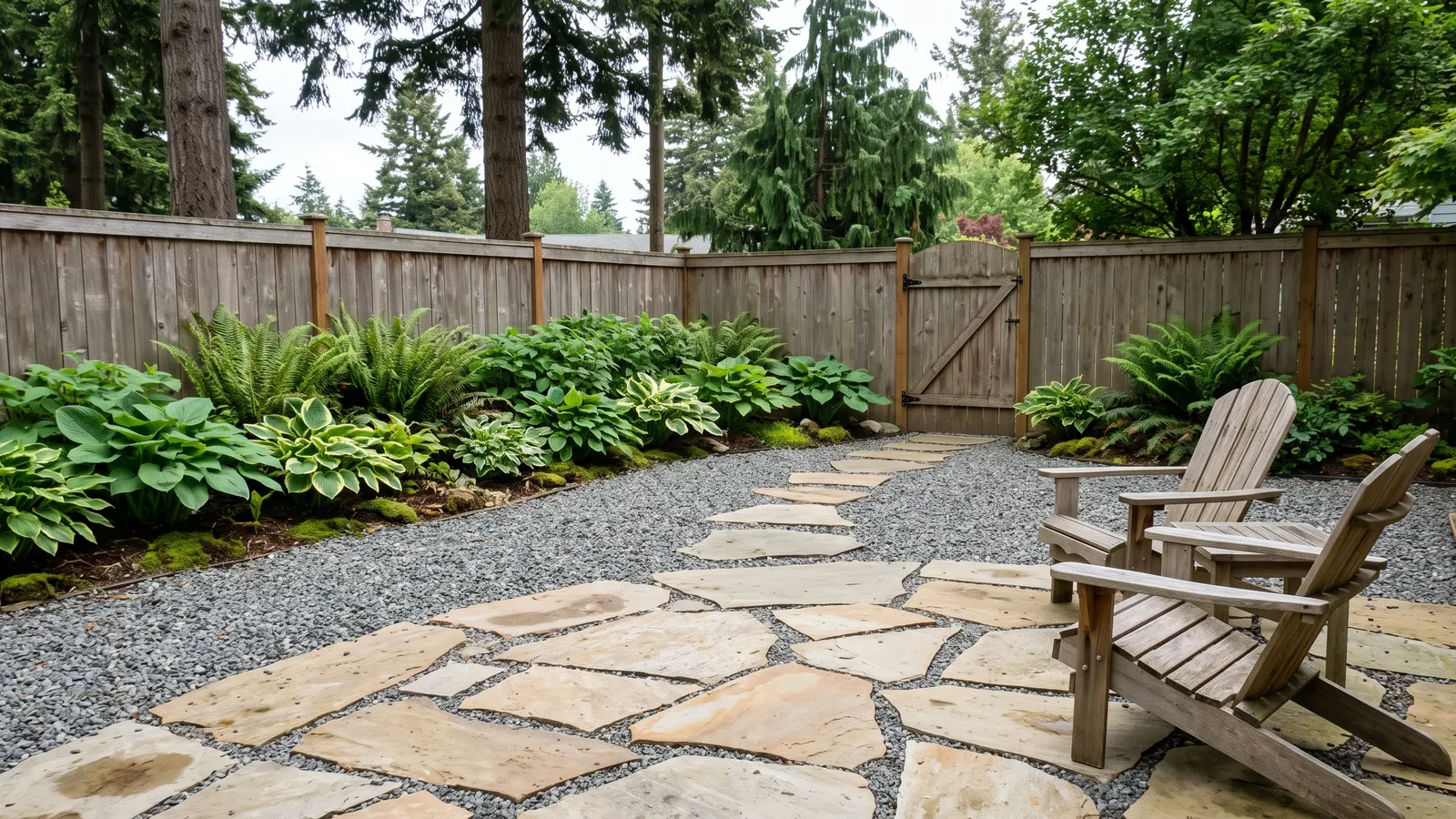
Large flagstones give chairs a solid footing, and gravel in the gaps costs far less than mortar. The look is informal and it drains well. Set each stone on the compacted base so its top sits just above the gravel, and keep gaps under about 4 inches so you aren't stepping between stones. A line of single stones continuing out of the patio makes a path to the gate or garden for very little extra.
7. Square pavers with gravel joints
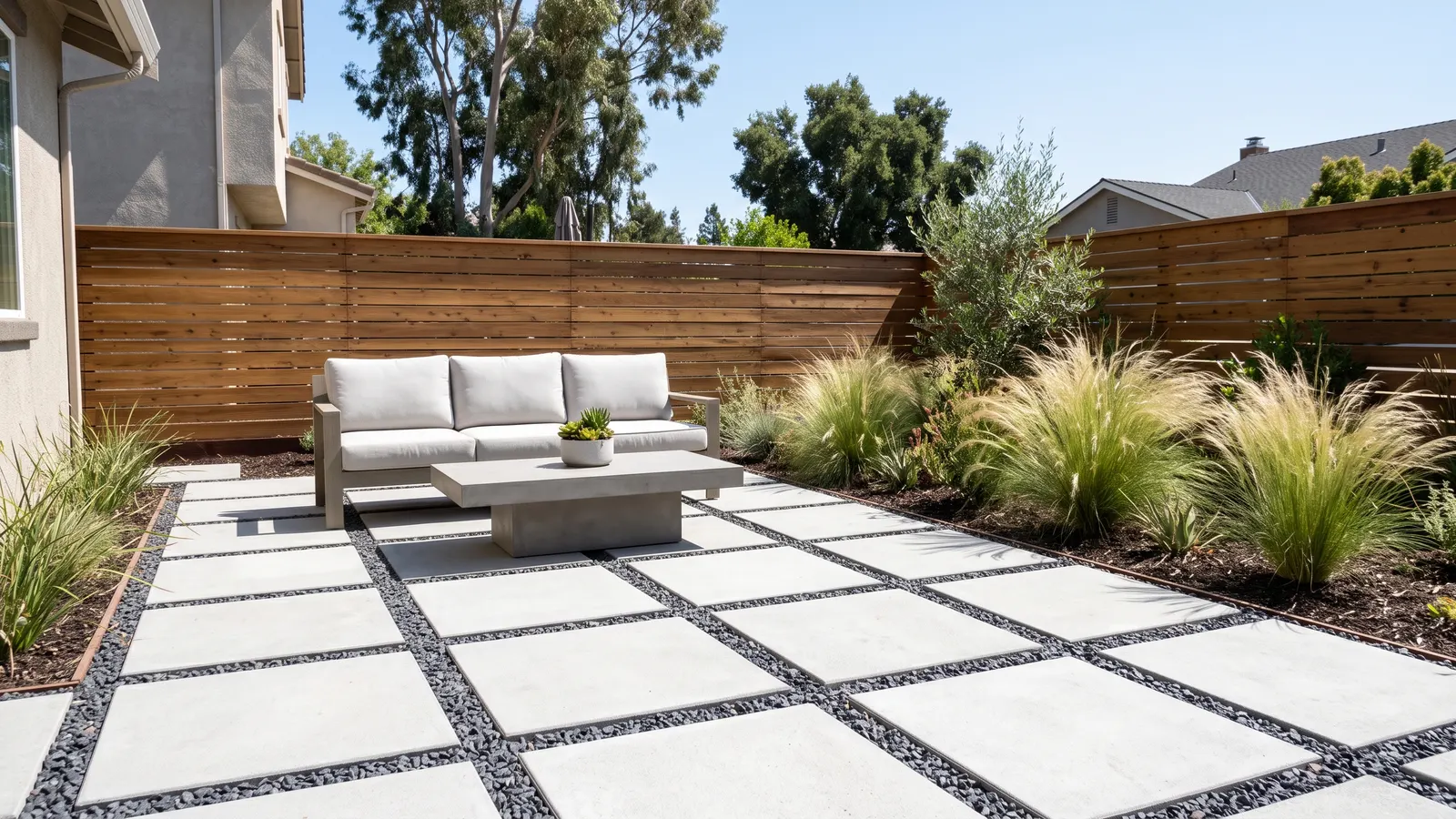
Two-foot concrete pavers in a grid with dark gravel joints are a modern take on the same idea. You buy fewer pavers than for a solid patio, and the wide joints let rain soak in. The grid only looks good if it's precise, so use a string line and spacers. Charcoal gravel in 4-inch joints against light pavers gives the strongest contrast.
8. Extend a small slab with gravel
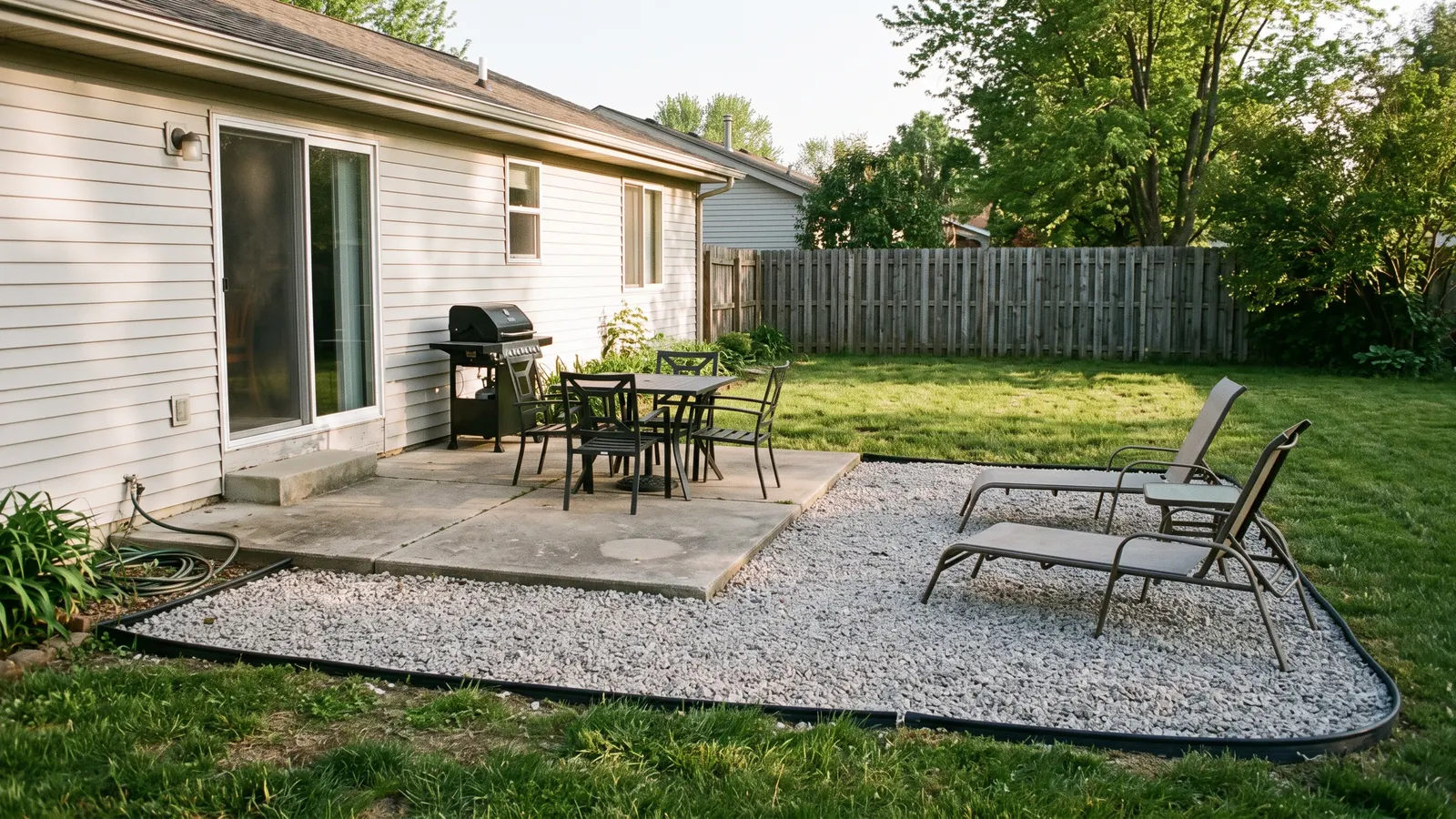
Many houses come with a concrete pad that's too small for a table and a grill. Rather than tearing it out, run gravel off one side to double the usable space. Keep the grill and dining set on the concrete and put lounge chairs on the gravel. Match the gravel's top to the slab height, and use steel or plastic edging on the lawn side.
9. A round gravel patio in the lawn
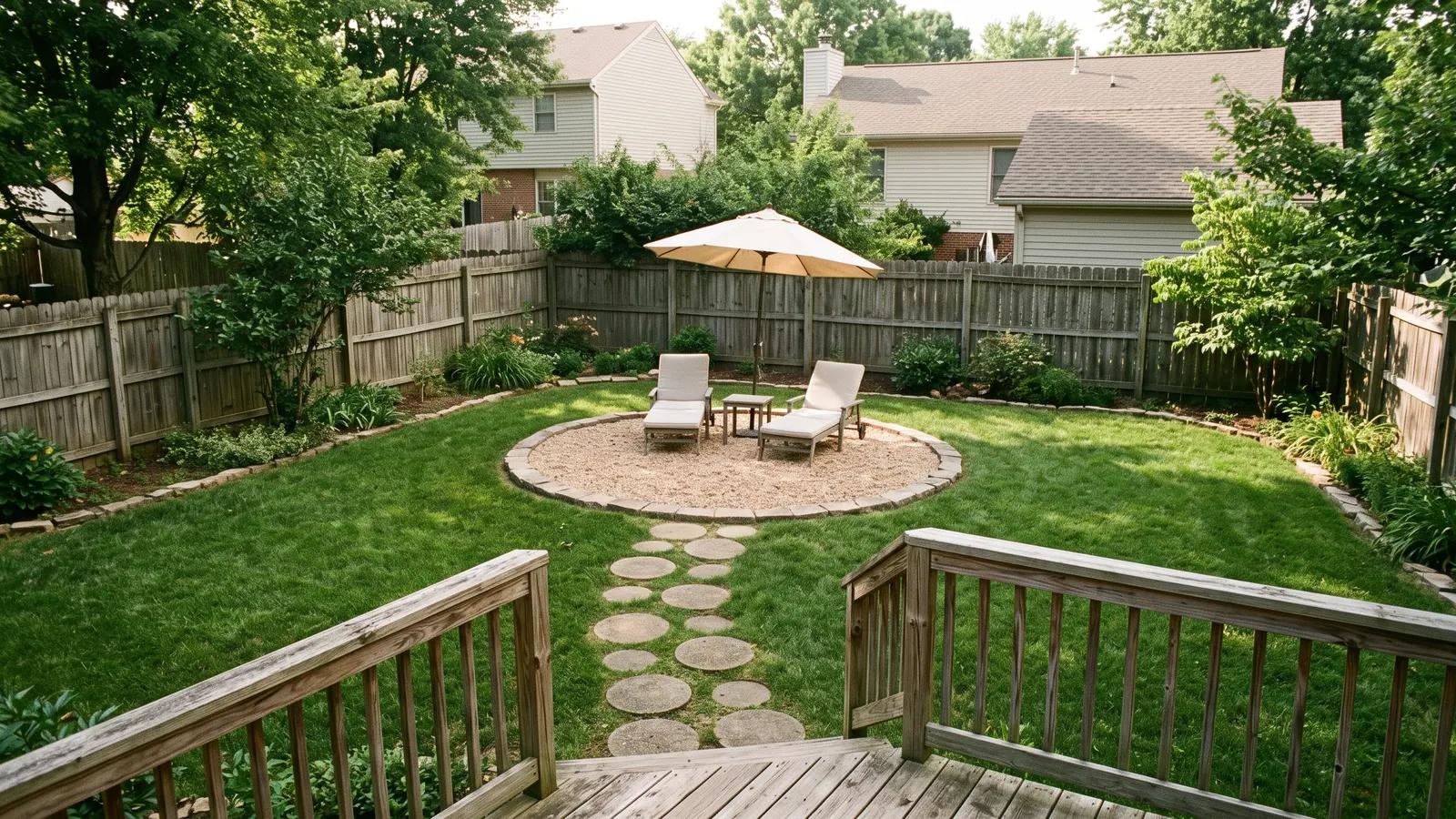
A circle in the middle of the yard feels like a destination in a way a patio against the house doesn't. To mark a clean circle, tie a string to a center stake and spray-paint the line. Flexible plastic or aluminum edging bends to a curve far more easily than steel. A path of round stepping stones through the grass connects it back to the house.
Fire, light and shade
10. A fire pit circle on gravel
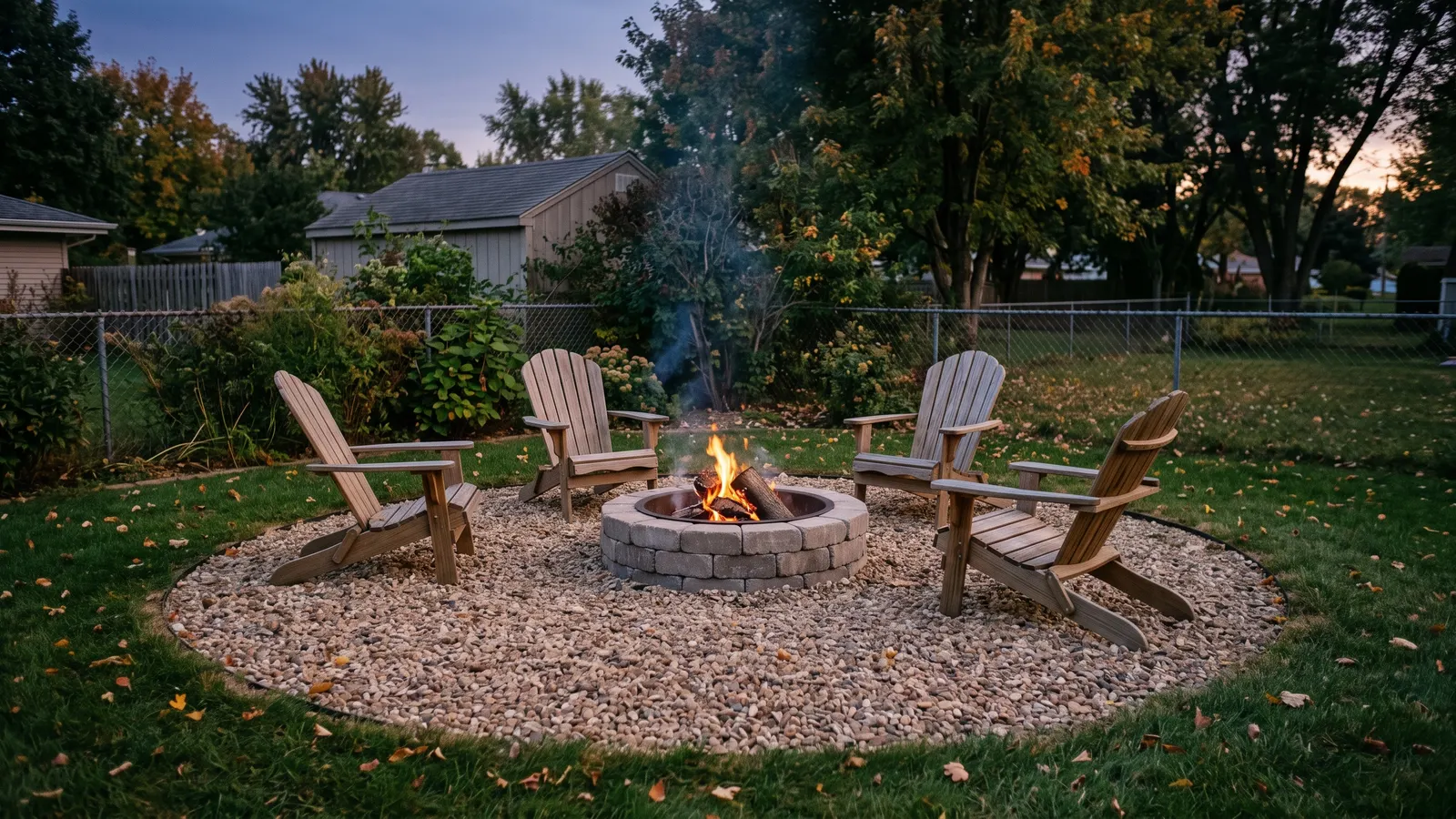
Gravel is one of the best surfaces to put under a fire pit: it doesn't burn, a stray ember can't scorch it, and it costs a fraction of pavers. Make the circle at least 12 to 14 feet across so chairs sit back from the heat. Clearance rules vary by town, commonly 10 feet from the house and sometimes 25 or more, so check yours. Our fire pit cost guide prices the pit itself, and these fire pit layouts show more ways to arrange the seating.
11. A bistro corner under string lights
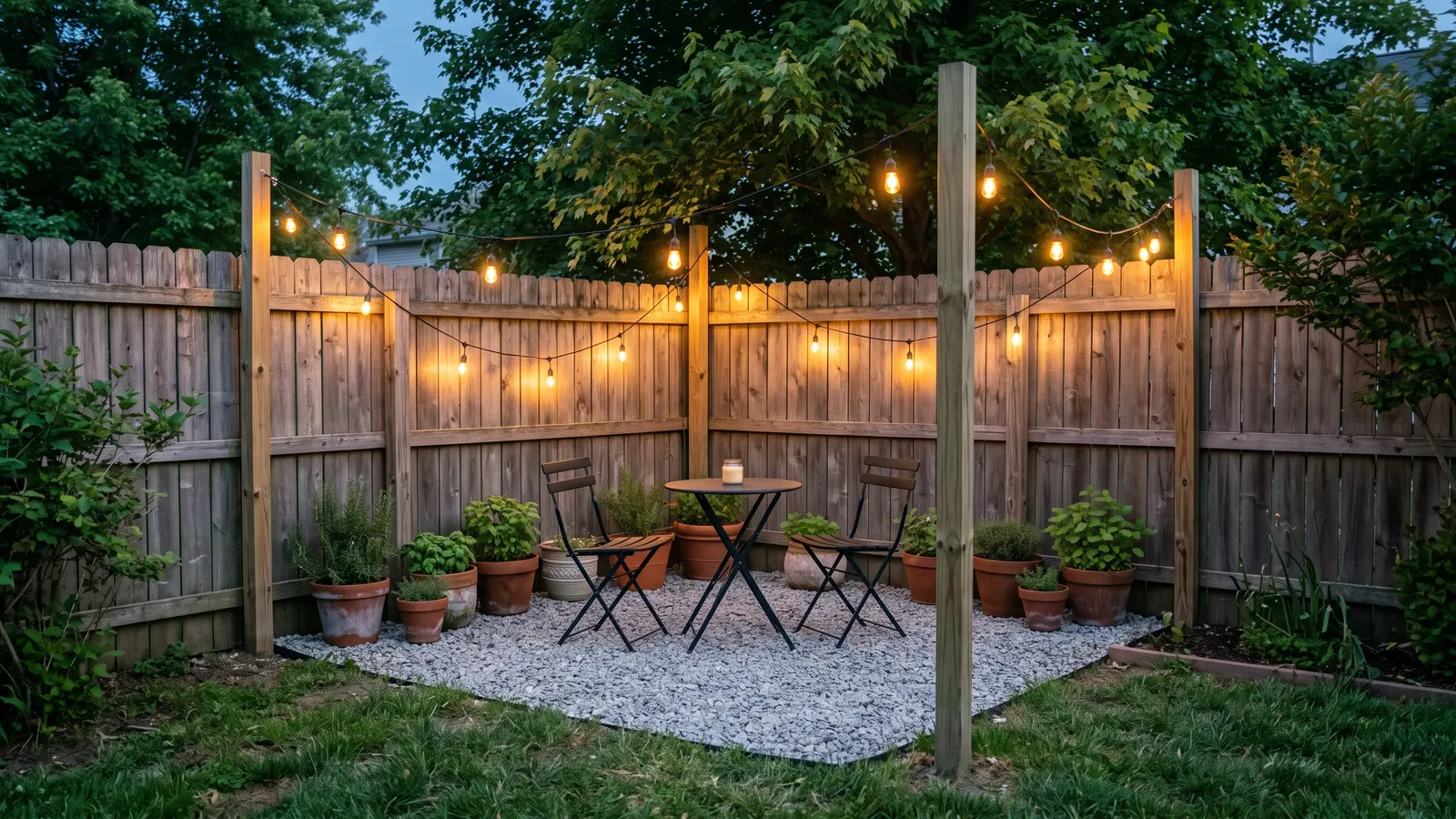
A gravel patio doesn't have to be big. An 8-by-8-foot corner holds a bistro table and two chairs, needs about 0.6 cubic yards of gravel at 3 inches, and takes an afternoon. String lights zigzagged between the fence and two posts make it feel like a room at night. Use outdoor-rated lights with a plug-in timer.
12. Low lights along the edge
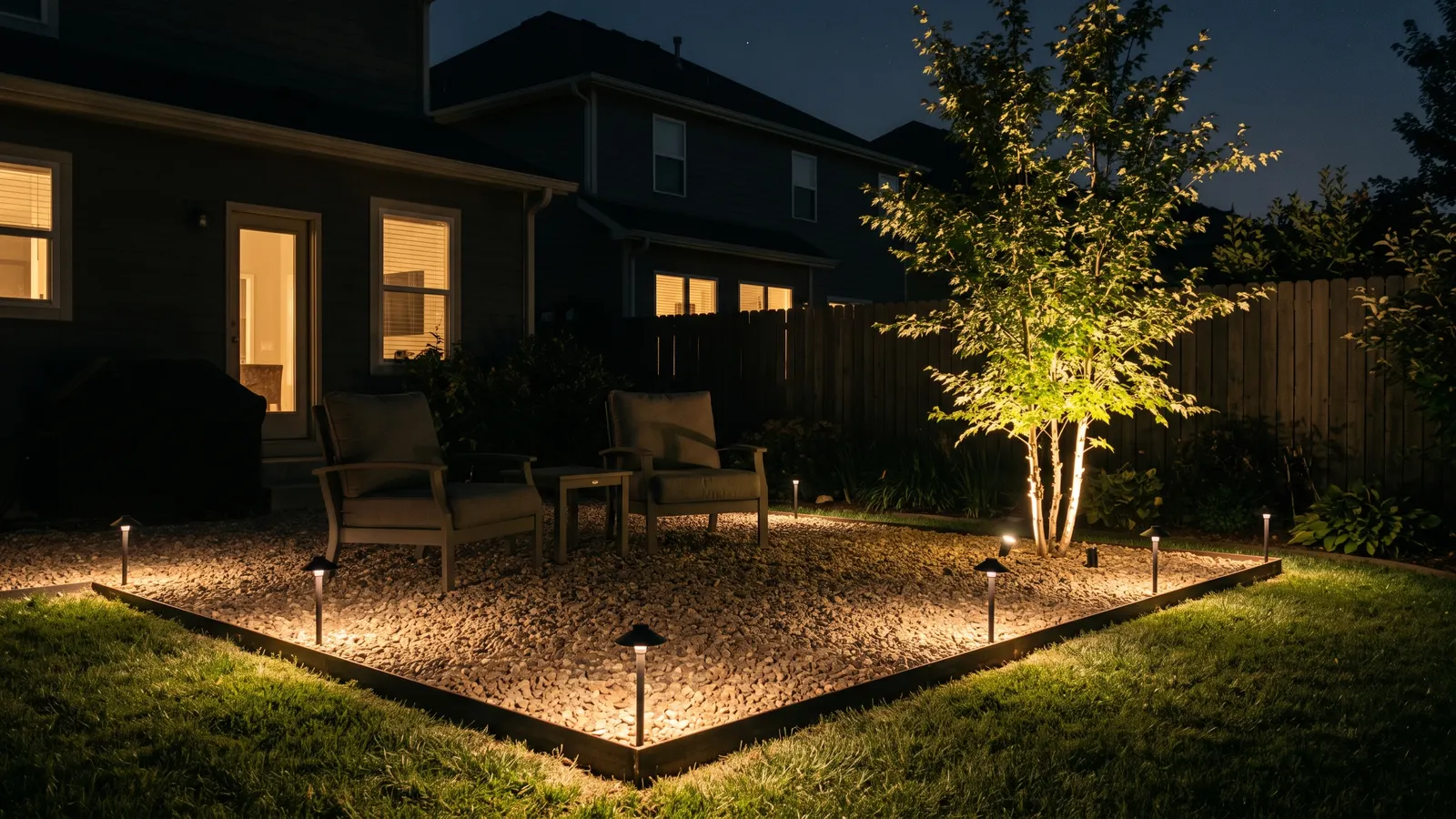
Low path lights along the edging show where the gravel ends after dark, which matters more on gravel than on pavers because the edge is harder to see. Solar stakes are the cheapest option. A low-voltage kit with a transformer gives brighter, more even light. Run the cable in a shallow trench under the gravel before you spread the final layer, not after.
13. Under a pergola
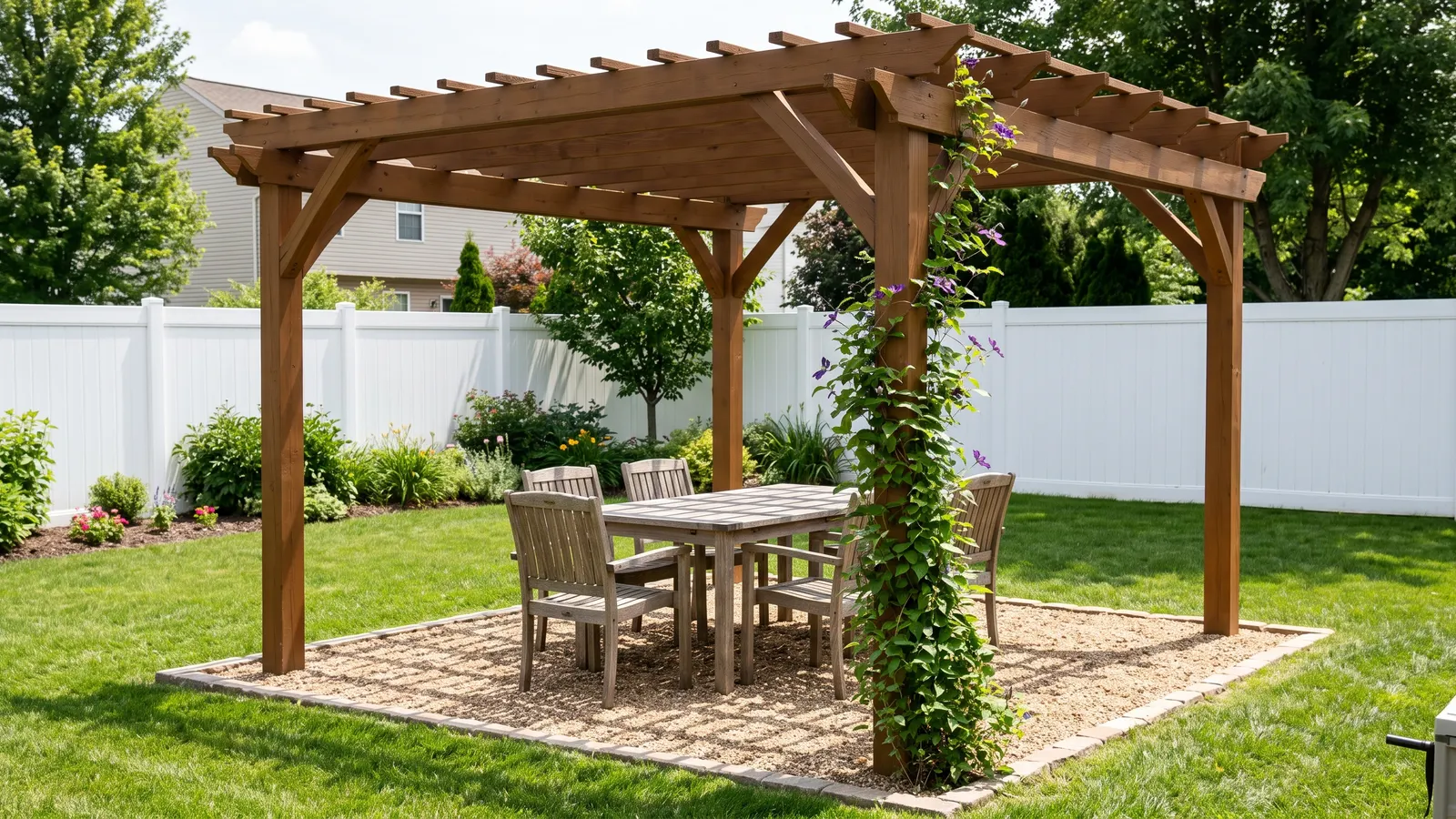
A pergola gives a gravel patio walls and a ceiling, and shade for the afternoon. Set the posts in concrete footings before you lay the base and gravel so the posts look like they belong. If you'll put a dining table under it, use crushed stone instead of pea gravel, or chairs will sink every time someone scoots back.
14. Under a big shade tree
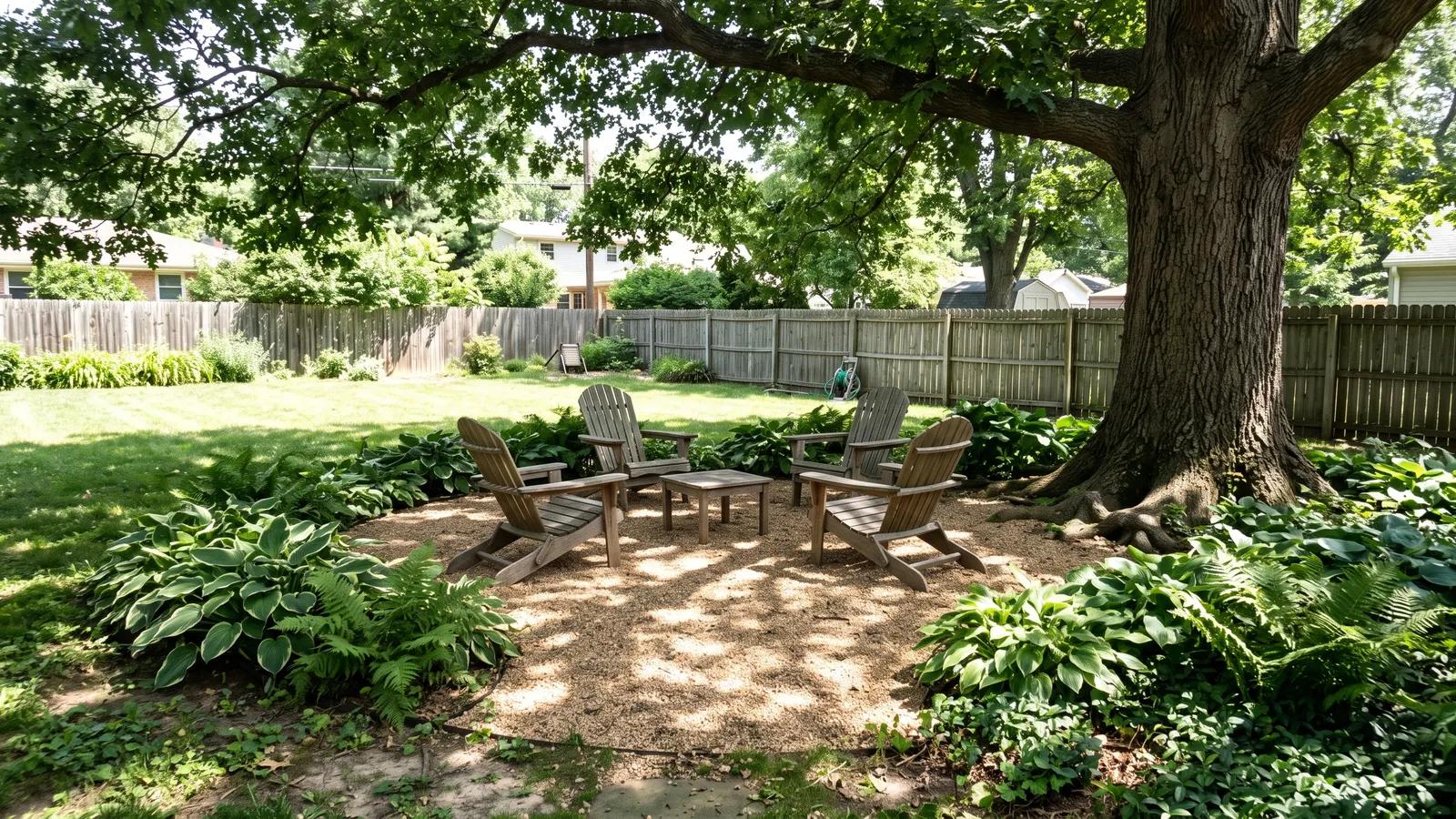
Grass rarely survives under a big oak or maple, and the bare dirt is usually the coolest spot in the yard in July. Gravel solves both. Skip digging near the trunk: cutting roots can hurt the tree, so build up a thin 2-inch layer over fabric instead. Hostas and ferns around the edge like the same shade.
Planting and garden style
15. Thyme and lavender in the gravel
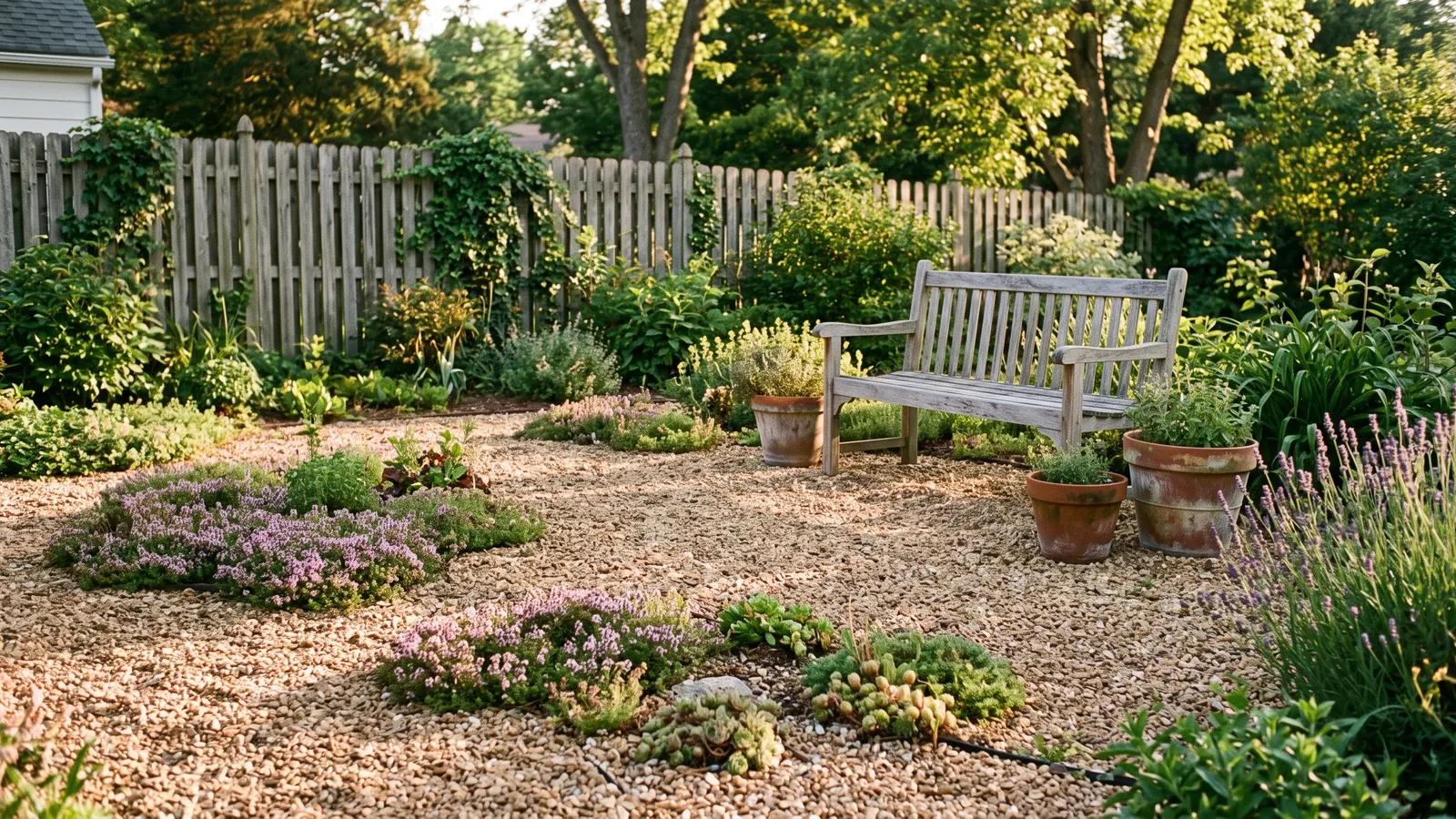
Leave some planting pockets free of fabric at the edges and plant low, tough perennials straight into the gravel. Creeping thyme (USDA zones 4 to 9) handles light foot traffic and smells good when stepped on. English lavender (zones 5 to 9) and small sedums like the sharp drainage. The result looks like a cottage gravel garden and needs no mowing.
16. A kitchen garden courtyard
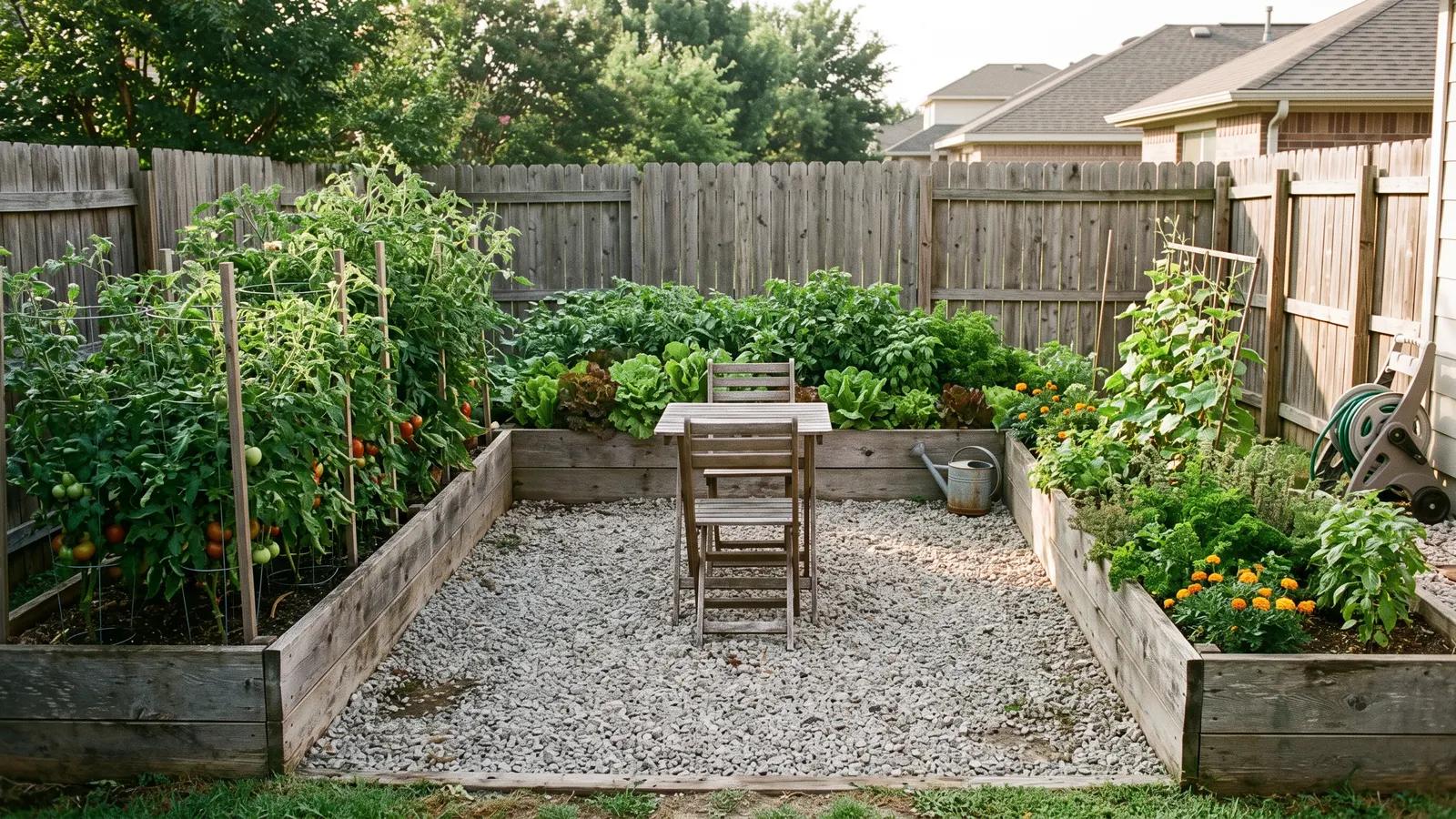
Surround a gravel square with raised beds and you get a patio and a vegetable garden in one. The gravel stays tidy when you're kneeling at the beds and doesn't turn to mud after watering. Leave at least 3 feet between beds so a wheelbarrow fits. Put the table in the middle so you can pick tomatoes from your chair.
17. A Japanese-style gravel seating area
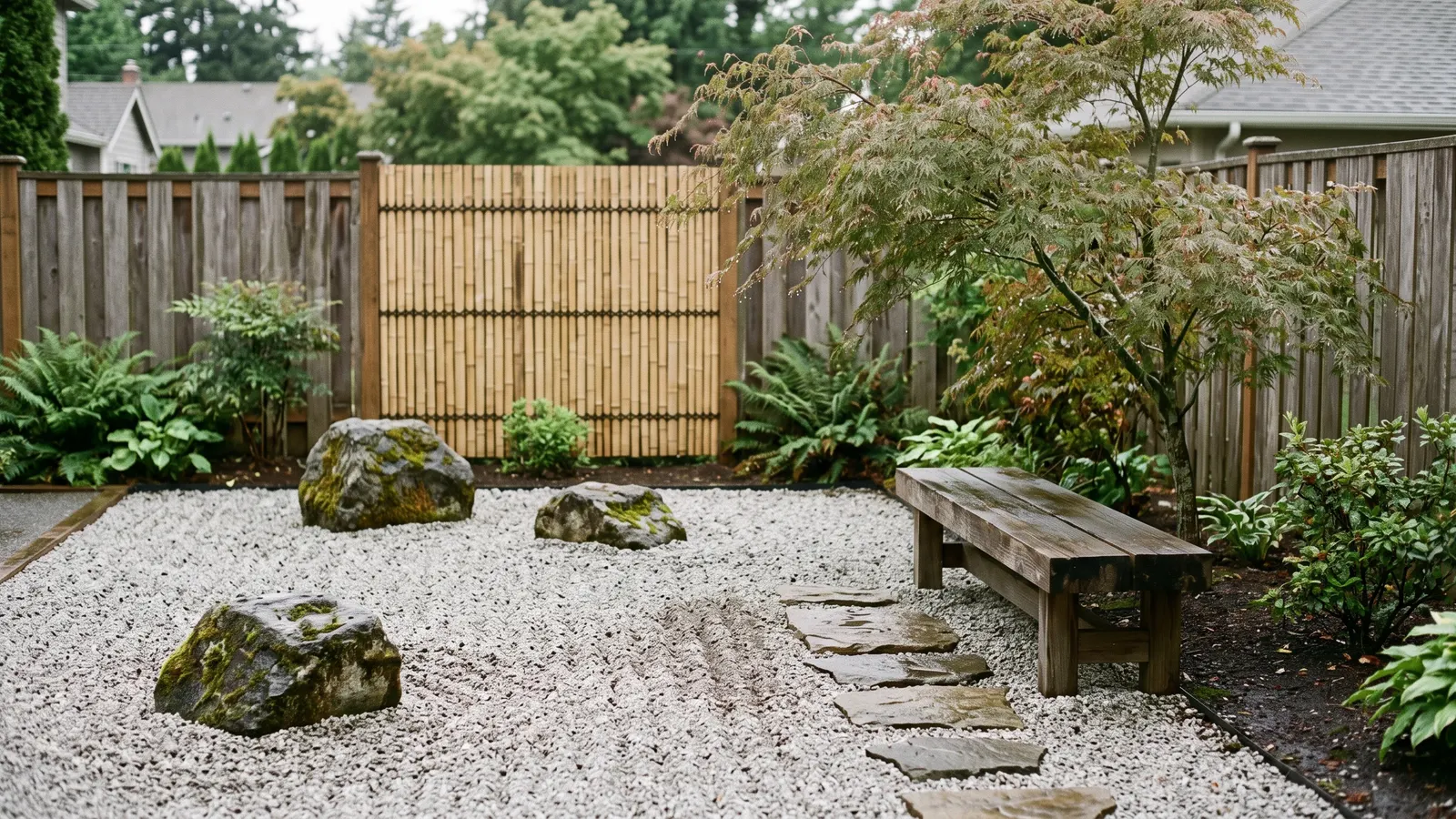
Pale gray crushed granite raked in straight lines, a few boulders and a Japanese maple turn a quiet corner into a place to sit with coffee. Use angular gravel (it holds raked lines better than round pea gravel) and keep the planting sparse. A bamboo screen hides a plain fence. It's a small zen garden with a bench added.
18. Mediterranean gravel with potted olives
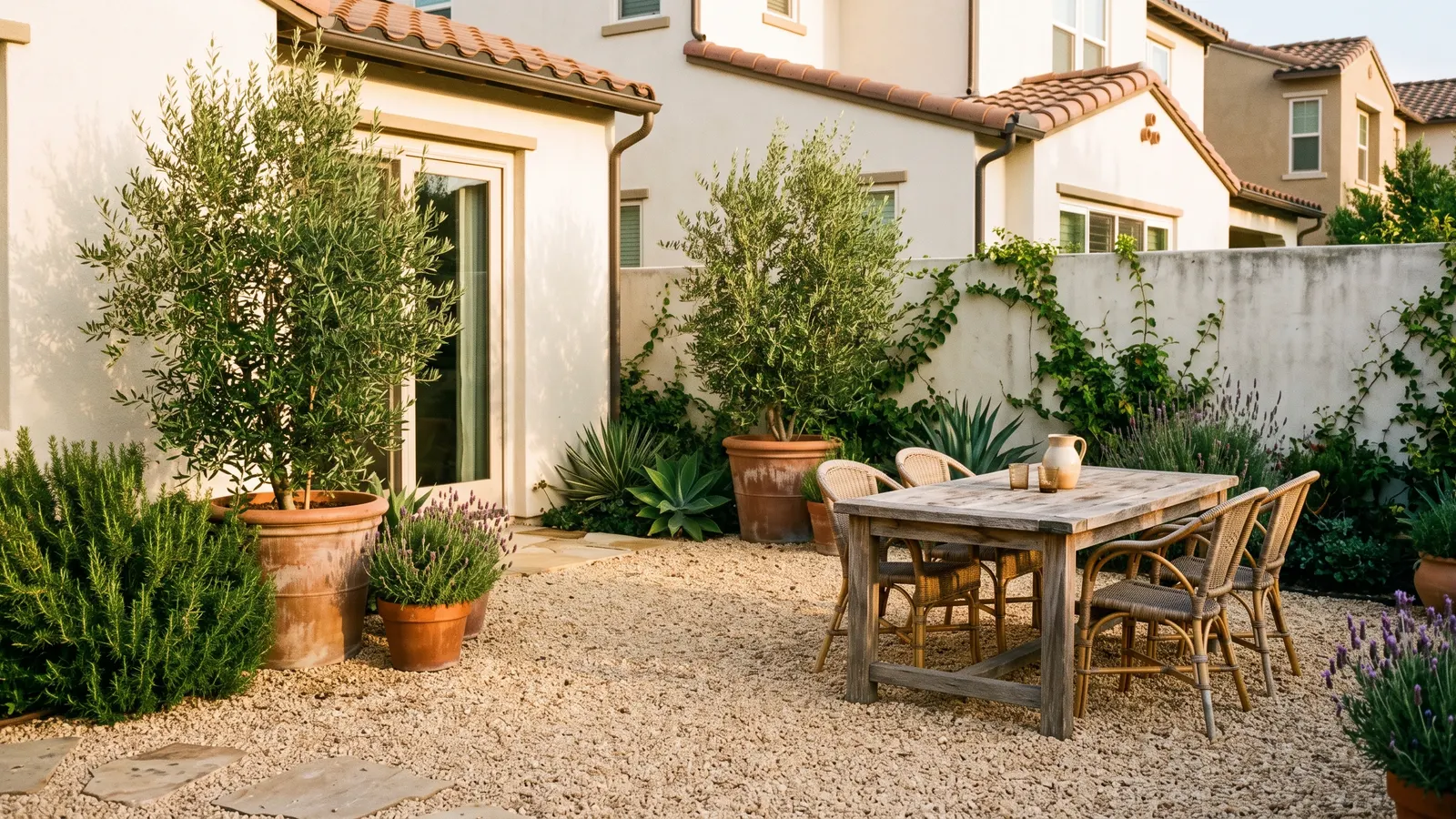
Warm cream gravel, terracotta pots and silvery plants make the Mediterranean look easy to copy. Olive trees are hardy in roughly zones 8 to 10, so in colder areas keep them in pots you can move into a garage for winter. Rosemary and lavender in the gravel nearby fill in the scent. A weathered wood table looks better here than anything shiny.
Awkward spots and big gatherings
19. A narrow side yard
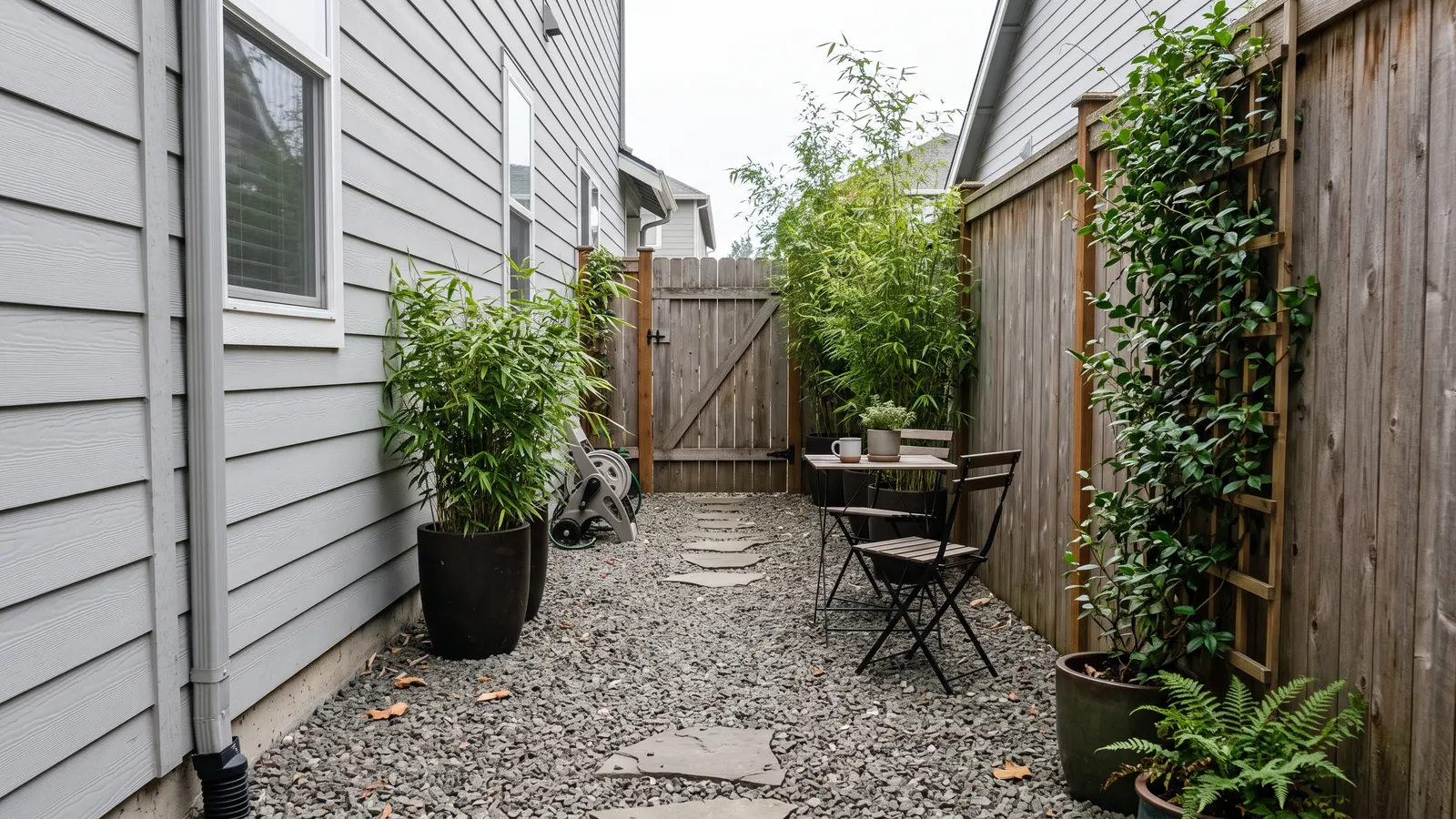
Side yards are often a wasted strip of mud and trash cans. At 8 feet wide, gravel turns one into a sitting spot with two slim chairs. Climbing vines on a trellis and tall planters use the vertical space the ground doesn't have. Make sure the gravel slopes away from the house wall so rain doesn't pool against the foundation.
20. A level terrace on a slope
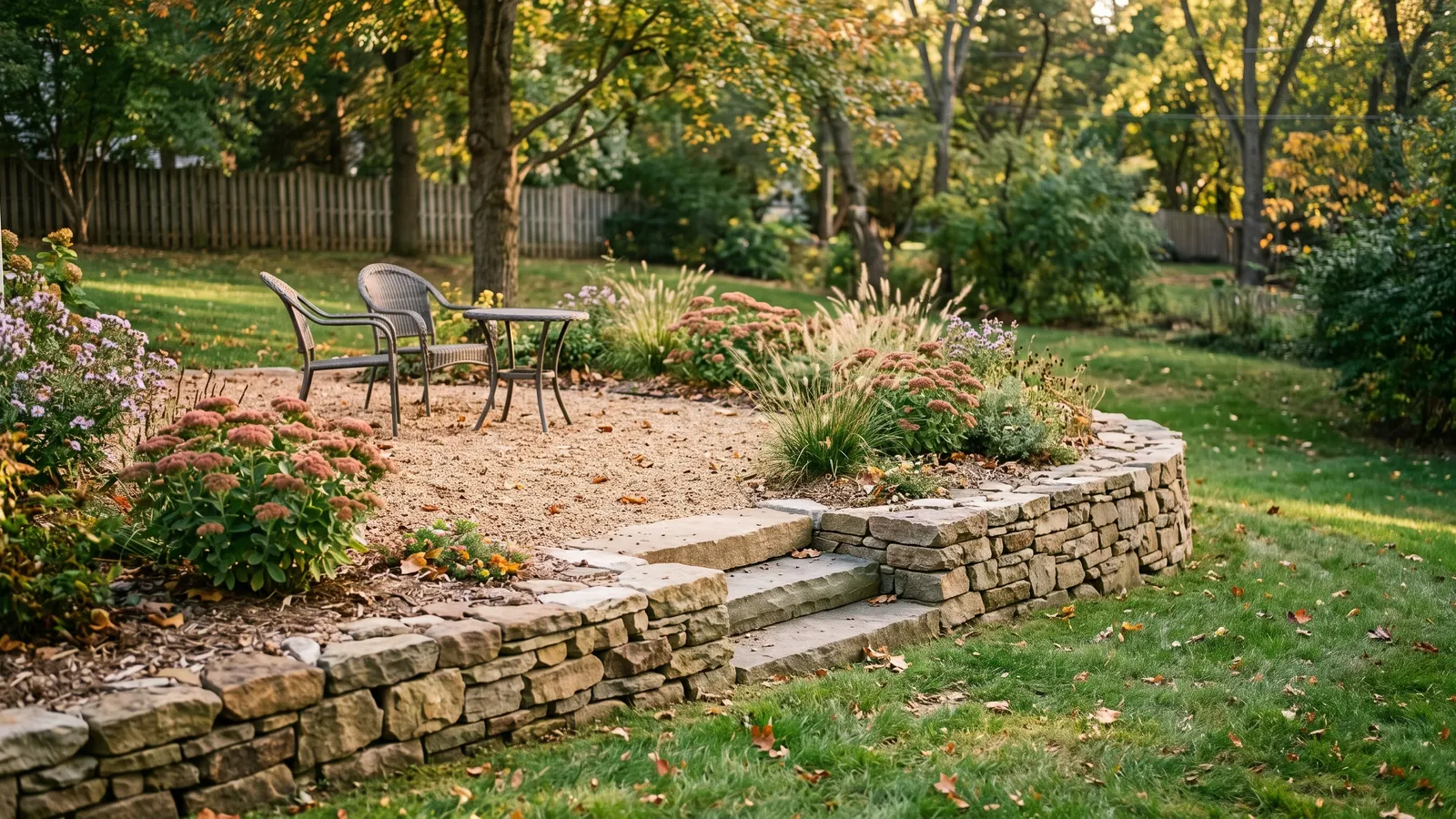
On a gentle slope, cut into the high side and hold the low side with a short dry-stacked stone wall to make a flat gravel terrace. Under the IRC model code, retaining walls over 4 feet need a permit, and many towns are stricter, so a wall of 2 feet or less is the comfortable DIY range. Gravel drains freely, which helps keep water pressure off the wall. Our rock landscaping ideas cover more ways to work stone into a slope.
21. A long dining table on crushed gravel
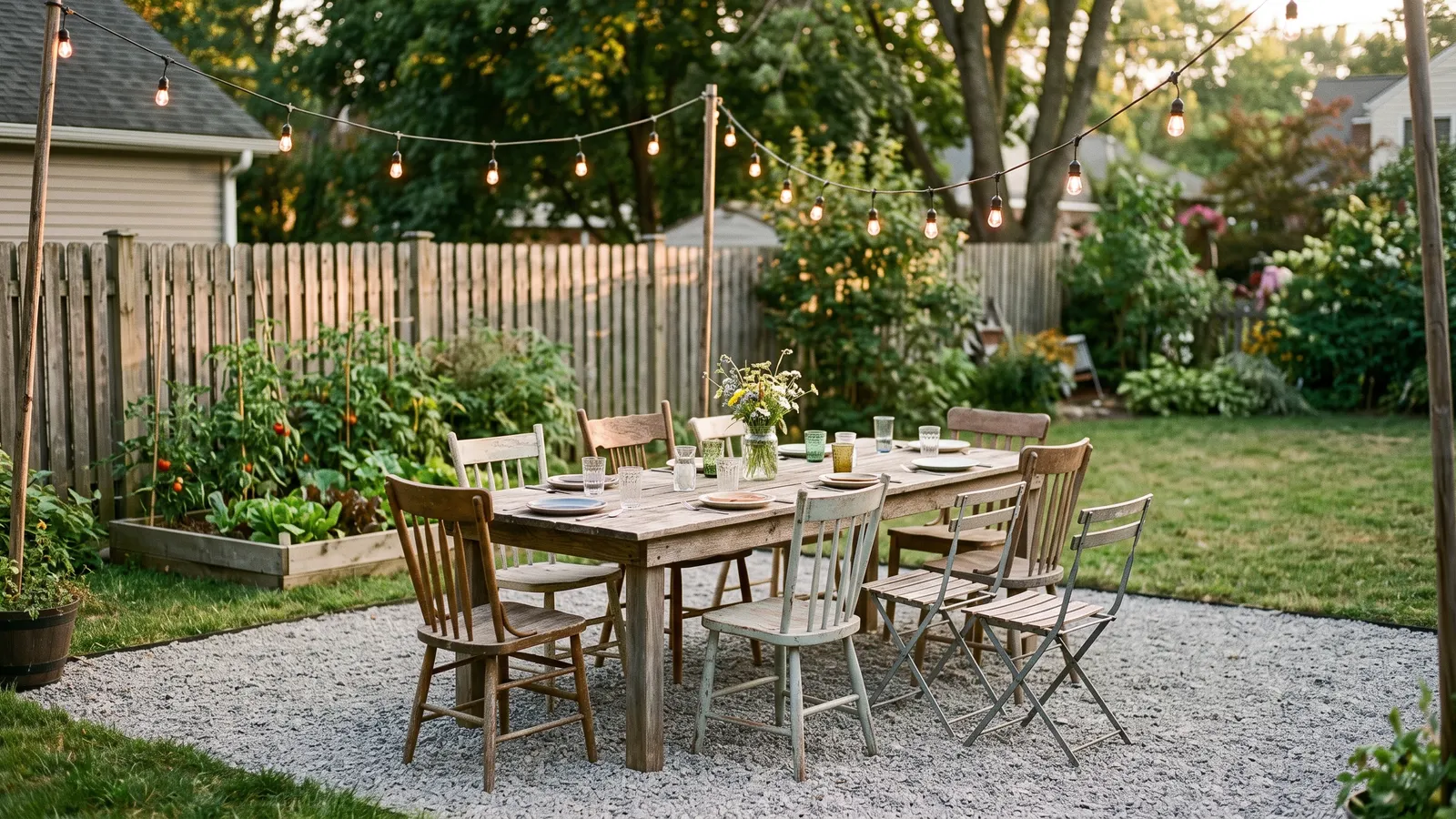
For a table that seats eight, the surface matters more than the size. Crushed stone with fines, compacted in two lifts with a plate compactor, gets firm enough that chair legs don't dig in. Plan about 3 feet of clearance around the table so people can push back. Bulb lights on posts overhead finish it for summer dinners.
Gravel patio cost and depth
Gravel is the cheapest patio surface there is. Angi puts it at $1 to $4 per square foot, and Homewyse estimated $1.85 to $3.39 per square foot to install pea gravel in May 2026. Those figures mostly cover the stone and spreading. Edging, base and fabric add to them, and a pro will charge for digging out the turf.
| Item | Typical cost |
|---|---|
| Pea gravel, bulk | $30 to $55 per ton, $45 to $80 per cu yd |
| Crushed limestone, bulk | $30 to $38 per ton |
| Delivery | $10 to $25 per ton, often free over 5 tons nearby |
| Pea gravel spread, installed | $0.85 to $2.80 per sq ft |
| 20 x 20 ft pea gravel patio, installed | $500 to $1,250 |
| Concrete curb edging, installed | $5 to $18 per linear ft |
| Patio permit, where required | $50 to $200 |
Sources: HomeGuide pea gravel and gravel price guides, Angi, Homewyse, checked October 2026.
The build that lasts follows the Lowe's spec:
- Dig out about 4 inches (RB Materials suggests up to 6 inches for larger patios) and slope the area slightly away from the house.
- Tamp the soil, then install edging that will sit about 1/2 inch above the finished gravel.
- Lay landscape fabric, then 2 inches of 3/4-inch crushed rock with fines. Mist and tamp it.
- Spread 2 to 3 inches of top gravel. Less than 2 inches and the fabric shows through; more than 3 and it's tiring to walk on.
To turn your patio's size into cubic yards or tons, use the gravel calculator. A 10 by 12 foot patio at 3 inches of pea gravel needs about 1.1 cubic yards, plus roughly 0.75 cubic yards of base.
How to choose
- Smallest budget: pea gravel with timber edging (3) or a bistro corner (11).
- You'll eat out there: crushed stone (21), flagstone in gravel (6) or a slab extension (8). Skip pea gravel under dining chairs.
- Hot, dry climate: decomposed granite (5) or Mediterranean gravel (18). Avoid black gravel in full sun.
- Shade or bare dirt: under the tree (14) or a Japanese-style corner (17).
- Awkward space: side yard (19) or the slope terrace (20).
Gravel patio designs that look right in a gallery can clash with your siding and lawn. Try two or three versions on a picture of your own yard before you order a truckload.
FAQ
How deep should a gravel patio be? Plan on about 4 inches total: a 2-inch compacted base of crushed rock and 2 to 3 inches of top gravel. Less than 2 inches of top gravel lets the landscape fabric show, and more than 3 inches makes it hard to walk on. Larger patios on soft or sandy soil benefit from digging closer to 6 inches.
Is pea gravel good for a patio? Yes, for lounging and fire pits. It's cheap, drains well and looks relaxed. The downsides are that it shifts underfoot, chair legs sink into it, and it travels into the lawn and the house. Good edging and a compacted base help. For dining areas, angular crushed stone or stabilized decomposed granite is firmer.
What is the best gravel for a patio? It depends on how you'll use it. Pea gravel is the softest and most popular, crushed stone with fines packs down firmest for furniture, and stabilized decomposed granite gives the smoothest surface in dry climates. Large river rock is too uneven to walk on and belongs on borders.
Do I need landscape fabric under a gravel patio? It's strongly recommended. Fabric keeps the gravel from sinking into the soil and slows weeds, though some will still sprout in the gravel from windblown seed. Skip it only in planting pockets where you want thyme or sedum to root.
How do you keep gravel from spreading? Install edging that sits about 1/2 inch above the gravel, and don't overfill: 2 to 3 inches is plenty. Angular gravel stays put better than round pea gravel. A coarse doormat or a paver landing at the house door stops pebbles from coming inside on shoes.
Can I see a gravel patio on my own yard before building it? Yes. With OutdoorBrite you upload a photo of the spot, pick a style, and get realistic concepts in under a minute, so you can compare pea gravel, flagstone or decomposed granite on your real yard before you buy anything.
Sources: Lowe's: Create a DIY Pea Gravel Patio, RB Materials: budget-friendly gravel patio ideas, HomeGuide: pea gravel cost, HomeGuide: gravel prices, HomeGuide: decomposed granite cost, Angi: patio cost, Homewyse: cost to install pea gravel, NC State Extension: Thymus serpyllum, Lavandula angustifolia and Olea europaea, all checked October 20, 2026