21 Privacy Plants for Fast-Growing Hedges and Screens
Fast-growing hedges, narrow trees for small yards, shade-tolerant evergreens, flowering shrubs and container screens, with zones, sizes and growth rates from extension services.
The neighbor's new deck looks straight into your kitchen, or the house behind you has a second-floor window aimed at your patio. A 6-foot fence does nothing about a view from a second-floor window. Plants keep growing past the fence line, which is why privacy plants are usually the better answer for a view that comes from above, as long as you pick one that fits your zone and the width of your planting strip.
This list covers 21 of them, from hedges that put on 3 to 4 feet a year to pencil-thin columns for a 3-foot side yard, shade-tolerant evergreens, flowering shrubs, and quick fixes in planters and on trellises. Every size, zone and growth rate below comes from university extension services and botanical gardens, not nursery tags, and the comparison table and zone shortlist near the end put it all in one place.
The photos are AI design concepts made with OutdoorBrite, so you can see how each plant reads on an ordinary lot.
How to choose privacy plants
Four questions narrow the list fast:
- What's your hardiness zone? Find it on the USDA map, then cross off anything outside it. A hardiness zone is about winter lows, so a plant rated to zone 7 can die in a zone 5 winter.
- How wide is the planting strip? This rules out more plants than anything else. Green Giant arborvitae spreads 12 to 18 feet; Sky Pencil holly stays 1 to 3 feet wide. Measure from the fence or lot line to where the lawn has to start.
- Do you need privacy in January? Evergreens screen all year. Deciduous shrubs and grasses are thinner or bare from late fall to spring, which is fine for a pool or patio you only use in summer.
- How much sun does the line get? Most fast screens want 6 or more hours of direct sun. For shade under big trees, look at yews, plum yew and Limelight hydrangea.
One decision people skip: a single-species row or a mixed screen. A row of one plant looks tidy, but if disease takes out three in the middle you're left with a gap that takes years to fill. University of Maryland Extension recommends mixing species for that reason, and it holds up better through droughts and pests.
Here's one ordinary property line, then the same line planted both ways:
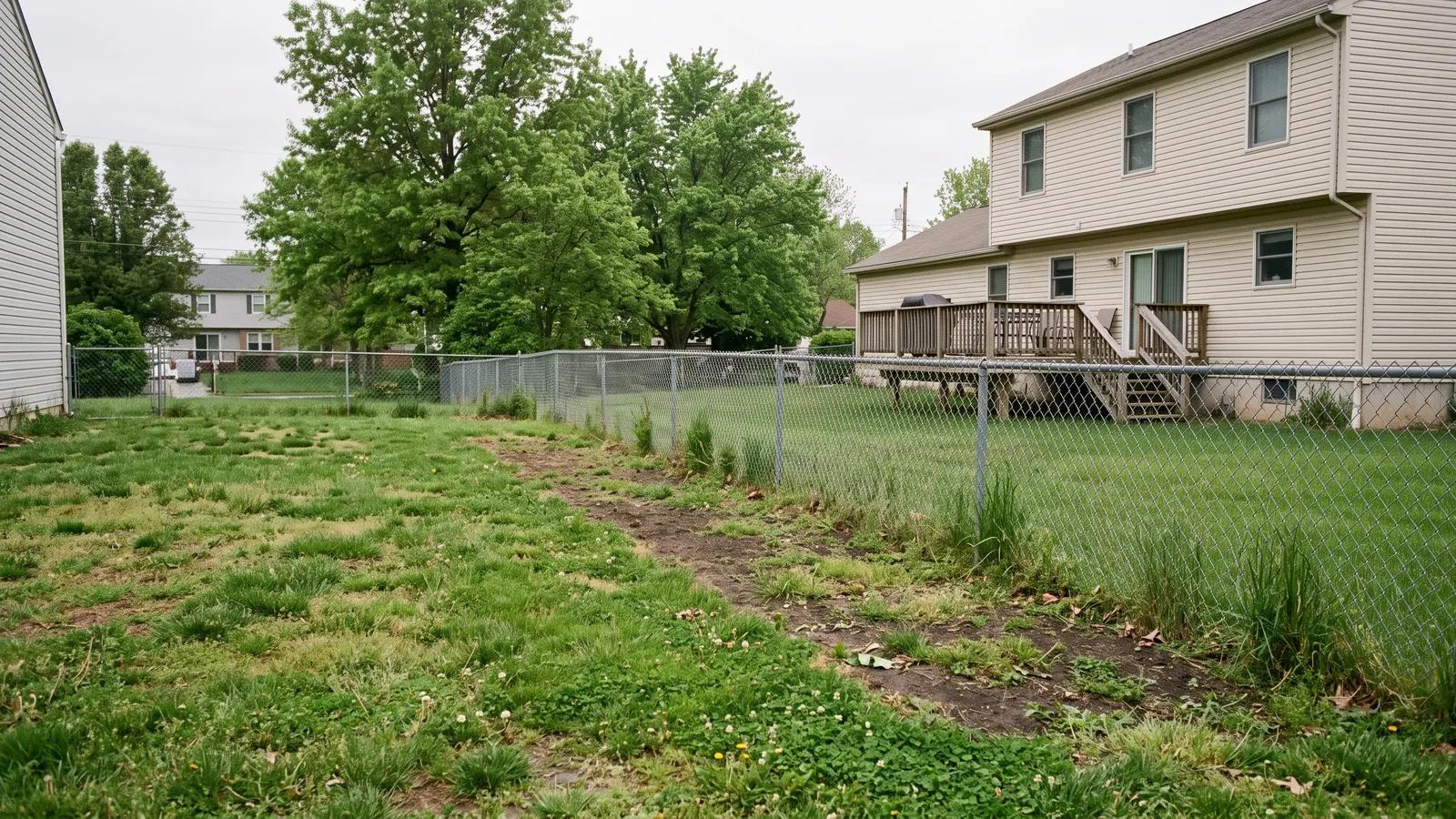
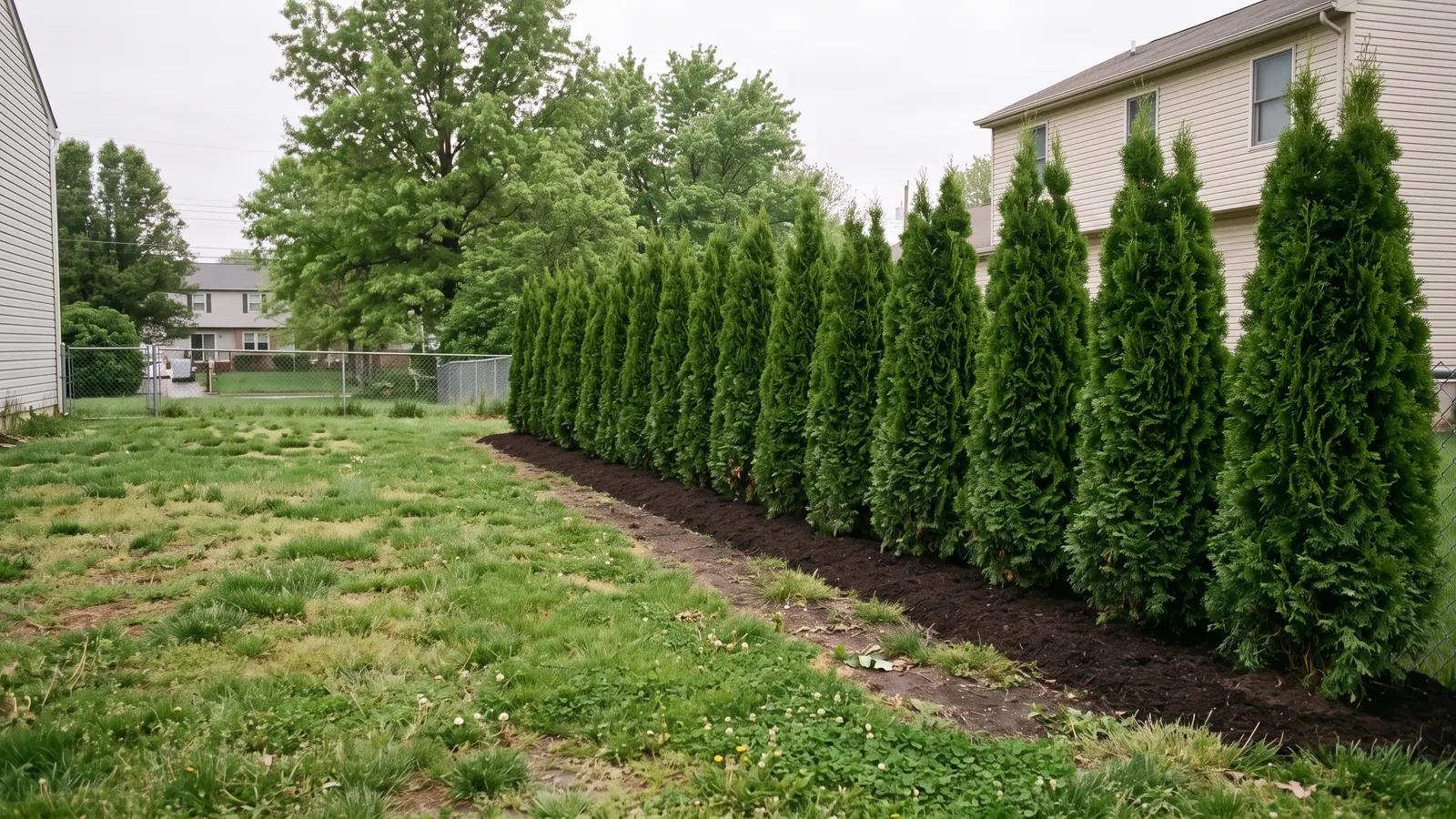
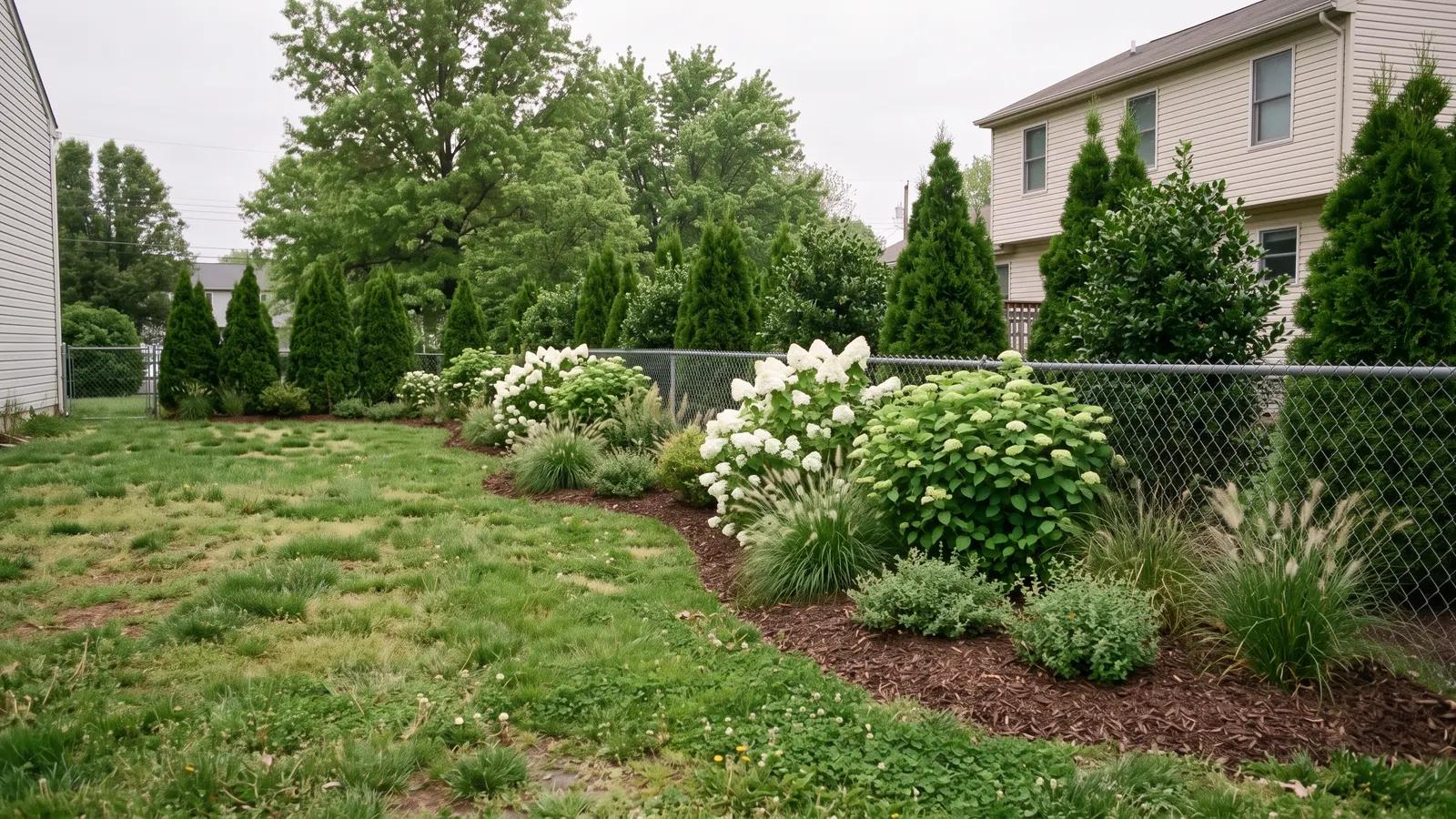
The single row needs a strip about as wide as one tree. The mixed bed needs more room, usually 8 to 12 feet deep, but it looks like a garden instead of a wall and losing one plant barely shows.
Fast-growing hedges
1. Green Giant arborvitae
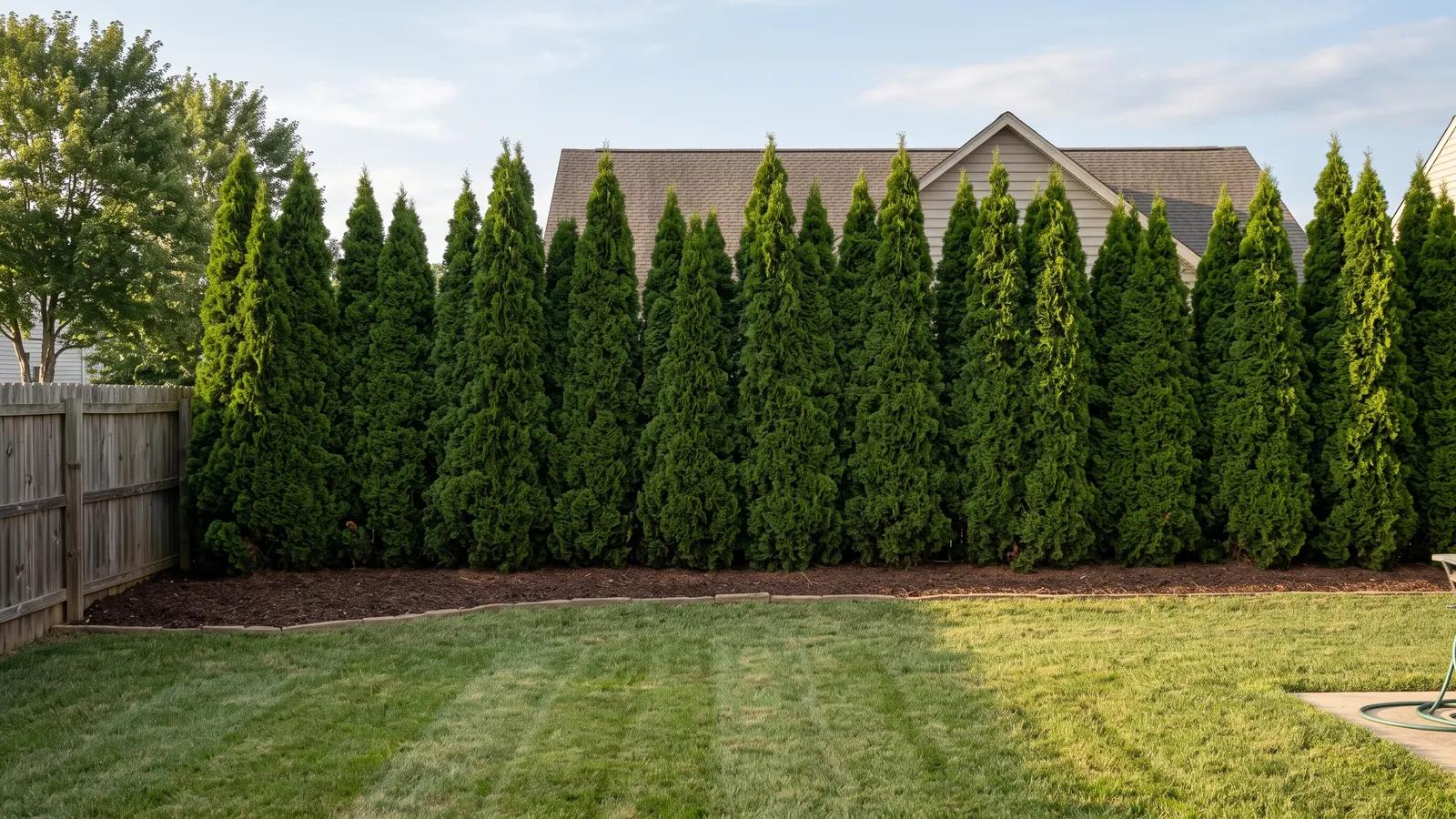
This is the plant most people mean when they ask for the fastest privacy tree. NC State Extension puts its growth at 3 to 4 feet a year in good conditions, on its way to 40 to 60 feet tall and 12 to 18 feet wide. It grows in zones 5 to 8, in full sun to part shade, and holds its dark green color through winter. The width is the catch: give it a strip at least 10 feet deep, or plan on shearing it.
2. Leyland cypress
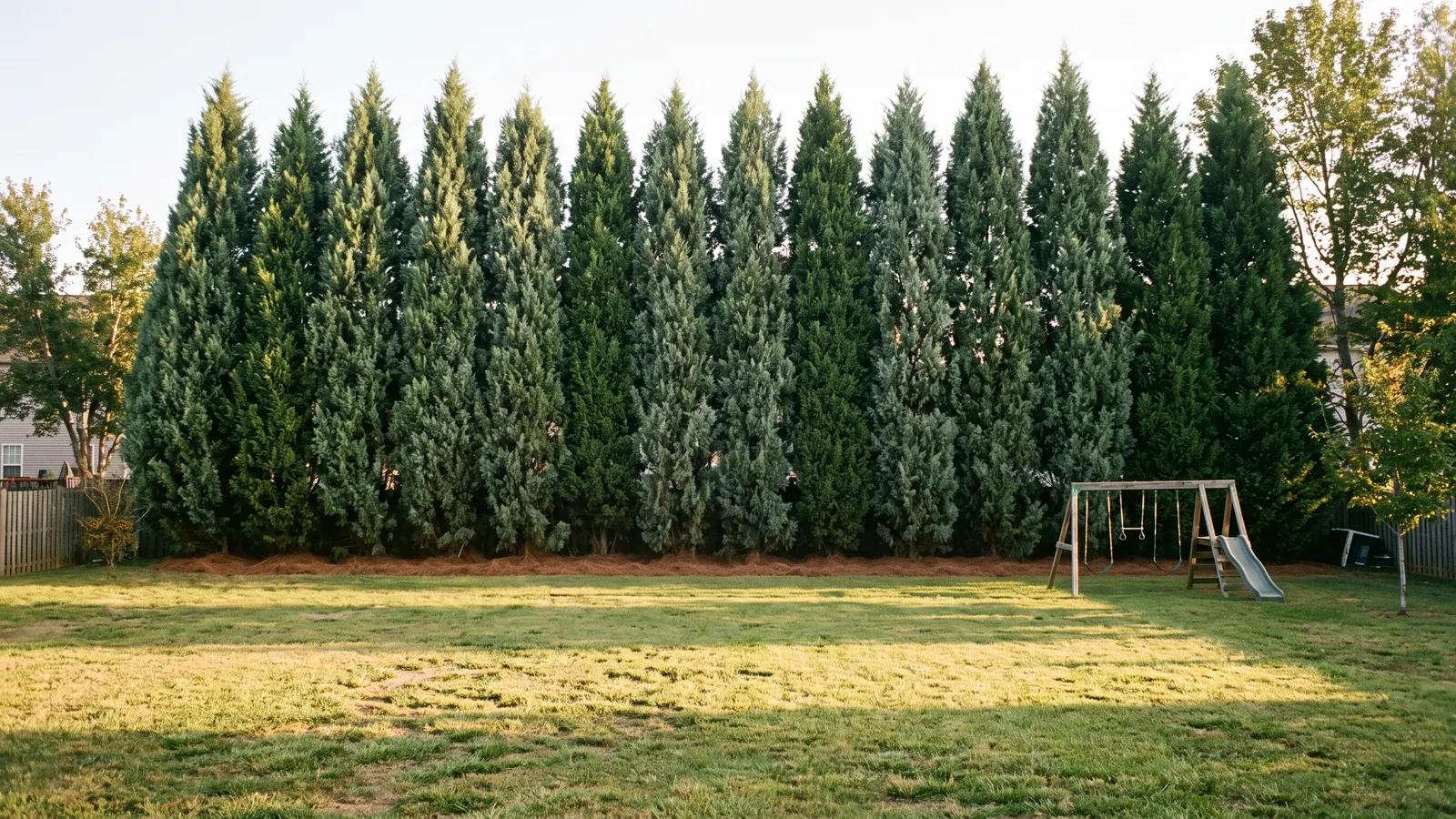
Leyland cypress matches Green Giant for speed, about 3 to 4 feet a year when young according to Clemson Extension, and gets bigger: 60 to 70 feet tall in zones 6 to 10. It's a good fit for a large lot with full sun. Clemson flags a canker disease that kills branches back to the trunk, plus bagworms, and UGA Extension recommends spacing trees at least 10 to 15 feet apart for airflow. On a small lot, it outgrows the space.
3. Skip laurel
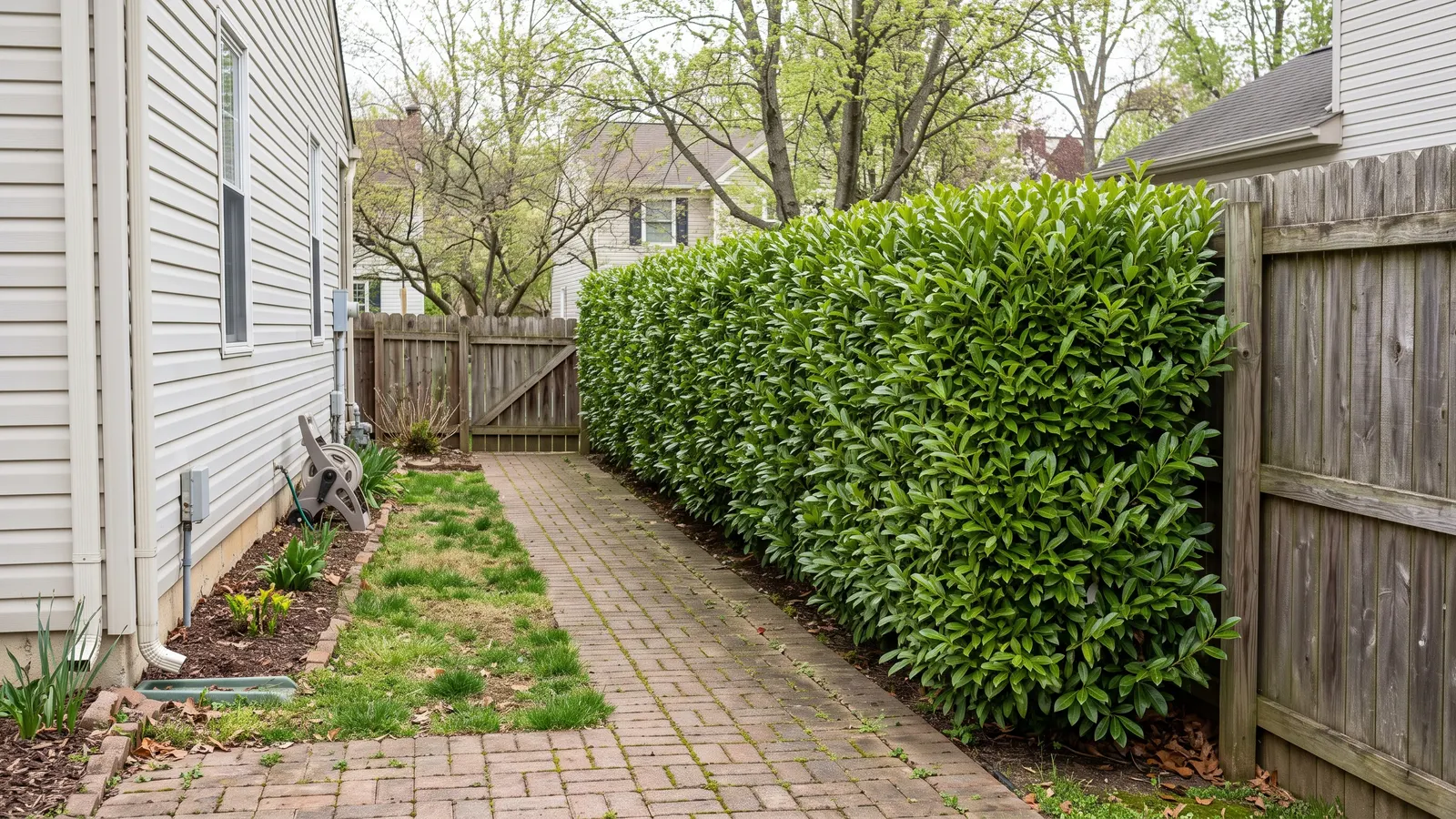
If you want a hedge you can keep at 8 feet with a shear, skip laurel is easier to manage than the conifers. It reaches 10 to 15 feet tall but only 5 to 7 feet wide, grows at a medium rate, and keeps glossy evergreen leaves in zones 5b to 9. It handles full sun to fairly deep shade, which most fast conifers don't, and UMD Extension rates it deer resistant.
4. Wax myrtle
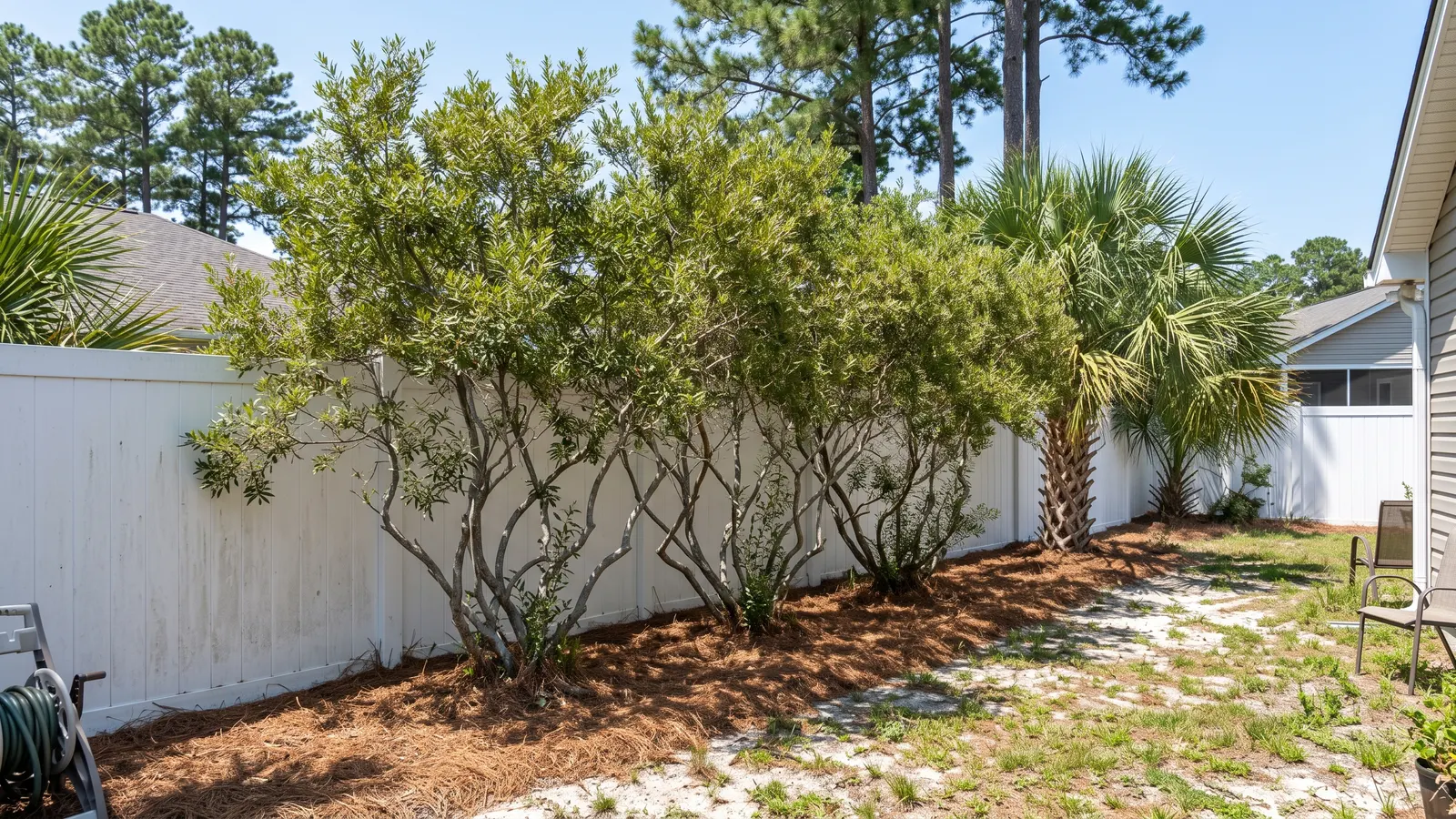
Wax myrtle is a native Southern choice for zones 7 to 11 that grows fast and tolerates salt spray, sandy soil and wet spots. Left alone it becomes a multi-stemmed small tree, 20 to 25 feet tall and 8 to 10 feet wide, with a looser look than arborvitae. One caution from NC State: the aromatic leaves are flammable, so keep it out of the zone right around the house if you live where wildfires happen.
5. Nellie R. Stevens holly
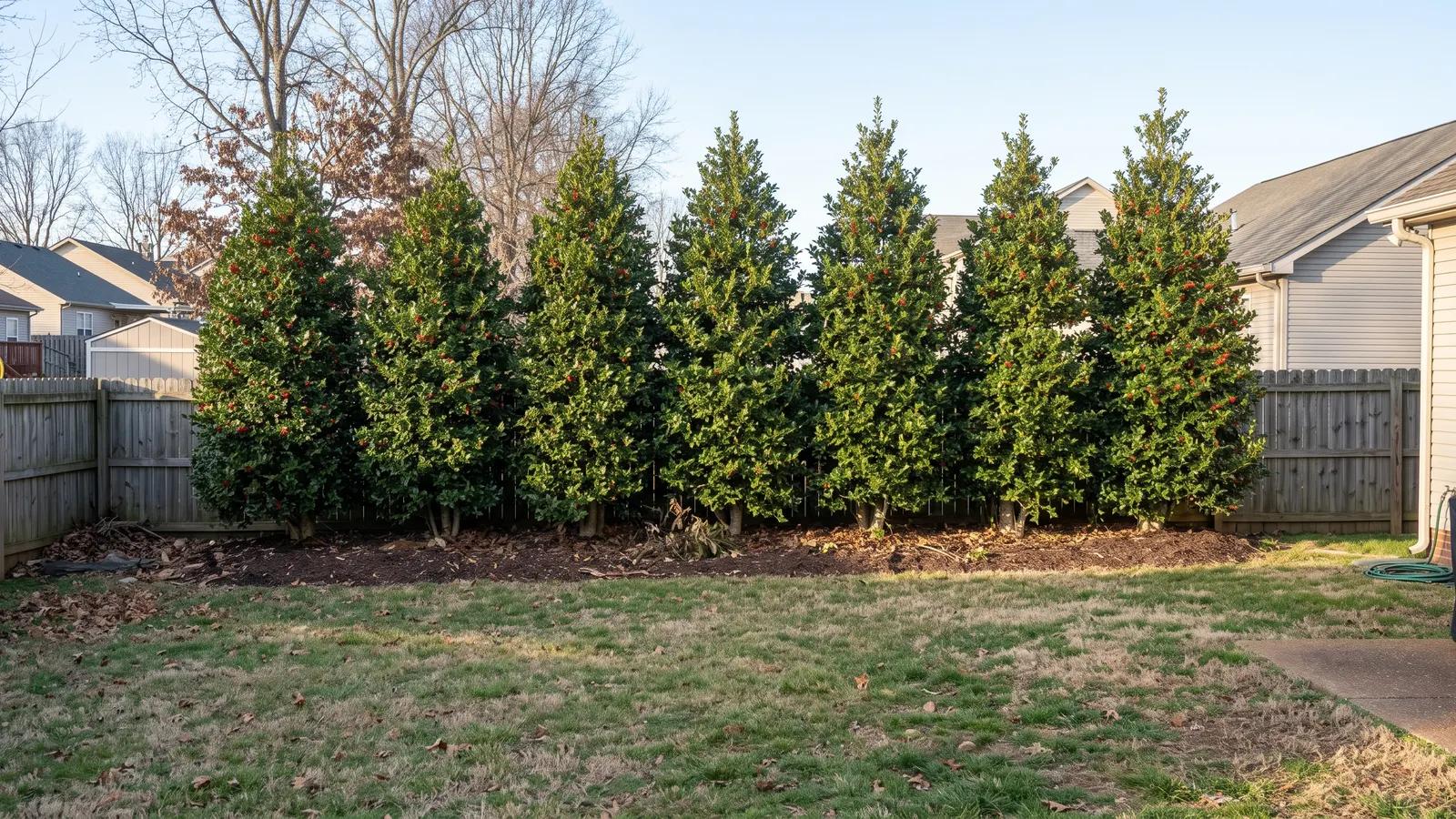
A pyramidal holly that grows quickly for a holly, with glossy spiny leaves and red berries in winter. NC State lists it at 15 to 30 feet tall and 8 to 25 feet wide in zones 6 to 9, in full sun to part shade. It stays leafy down to the ground, so it screens a seated view well, and the spines discourage anyone cutting through. Birds eat the berries.
Narrow trees for small yards
6. Emerald arborvitae
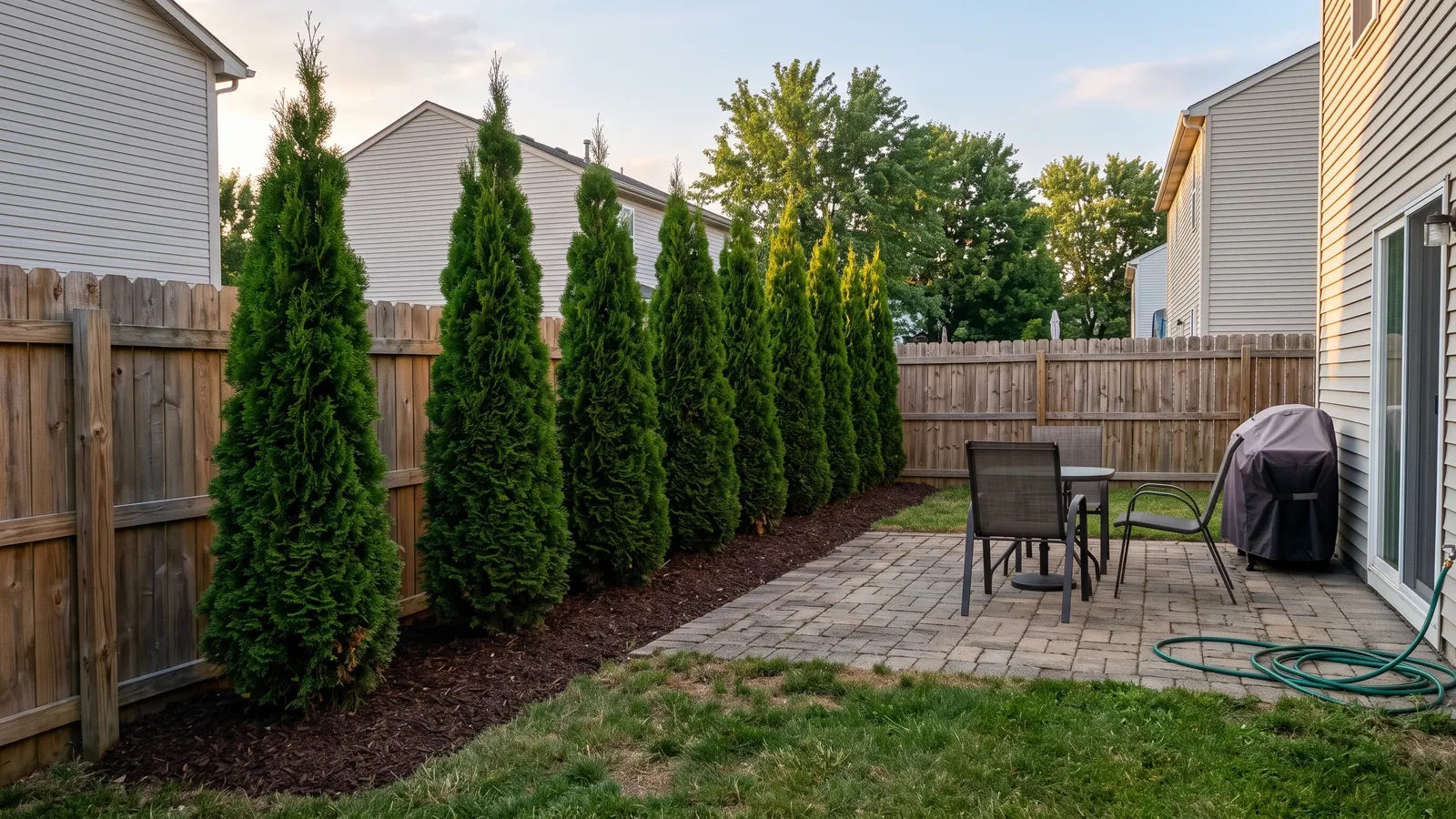
Also sold as 'Smaragd' or 'Emerald Green', this is the small-yard version of arborvitae. The Missouri Botanical Garden lists it at 12 to 14 feet tall and only 3 to 4 feet wide, hardy all the way down to zone 2 and up to zone 7. The trade-off is speed: American arborvitae is a slow grower, so buy plants close to the height you need. It tolerates clay and wet sites better than most evergreens here.
7. Taylor juniper
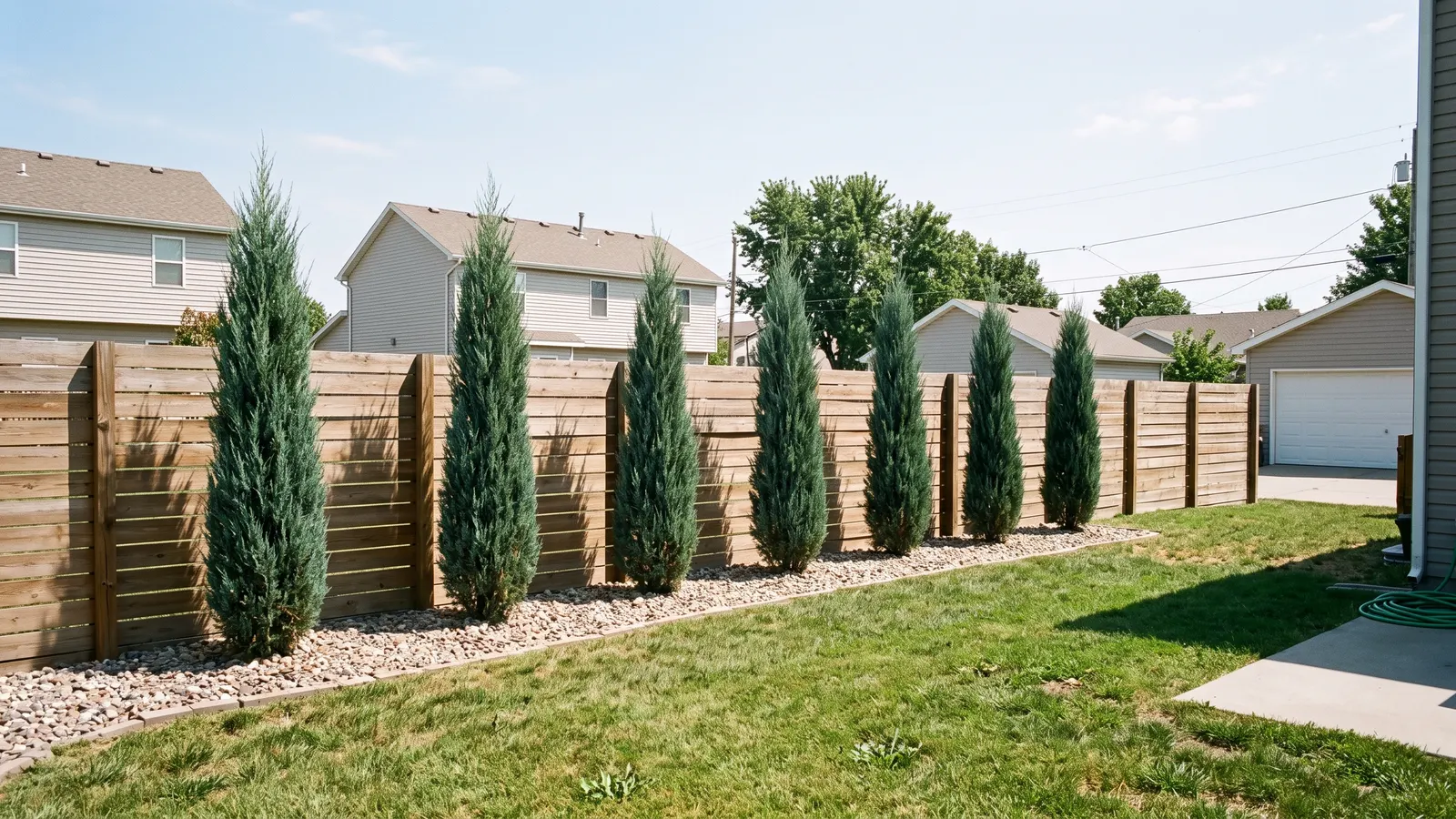
A columnar form of the native eastern red cedar, 'Taylor' grows 20 to 25 feet tall and just 3 to 4 feet wide, per NC State. NC State notes it tolerates drought and poor soil in zones 4 to 9, which makes it a good pick for dry, exposed lots where arborvitae struggles. It wants full sun. The blue-green foliage reads a little lighter than arborvitae, and deer usually leave it alone.
8. Italian cypress
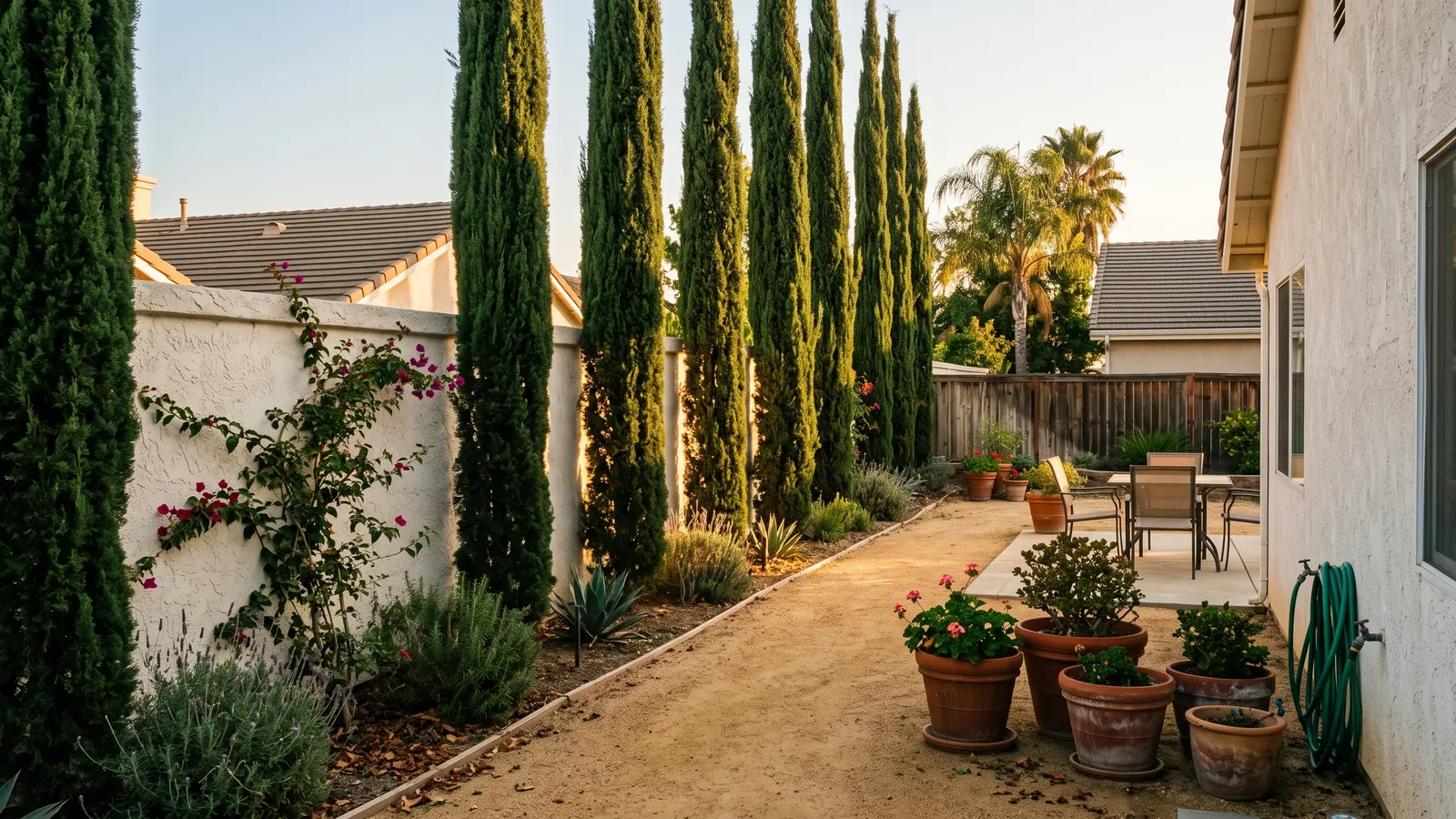
For warm, dry climates (zones 7 to 10), Italian cypress gives you height with almost no width: 40 to 70 feet tall and 3 to 6 feet wide at maturity, according to NC State. It needs full sun and good drainage and grows at a medium rate. Plant it where its height matters, like blocking a two-story house behind you, because at 3 feet wide each tree only screens a narrow slice until the row fills in.
9. Sky Pencil holly
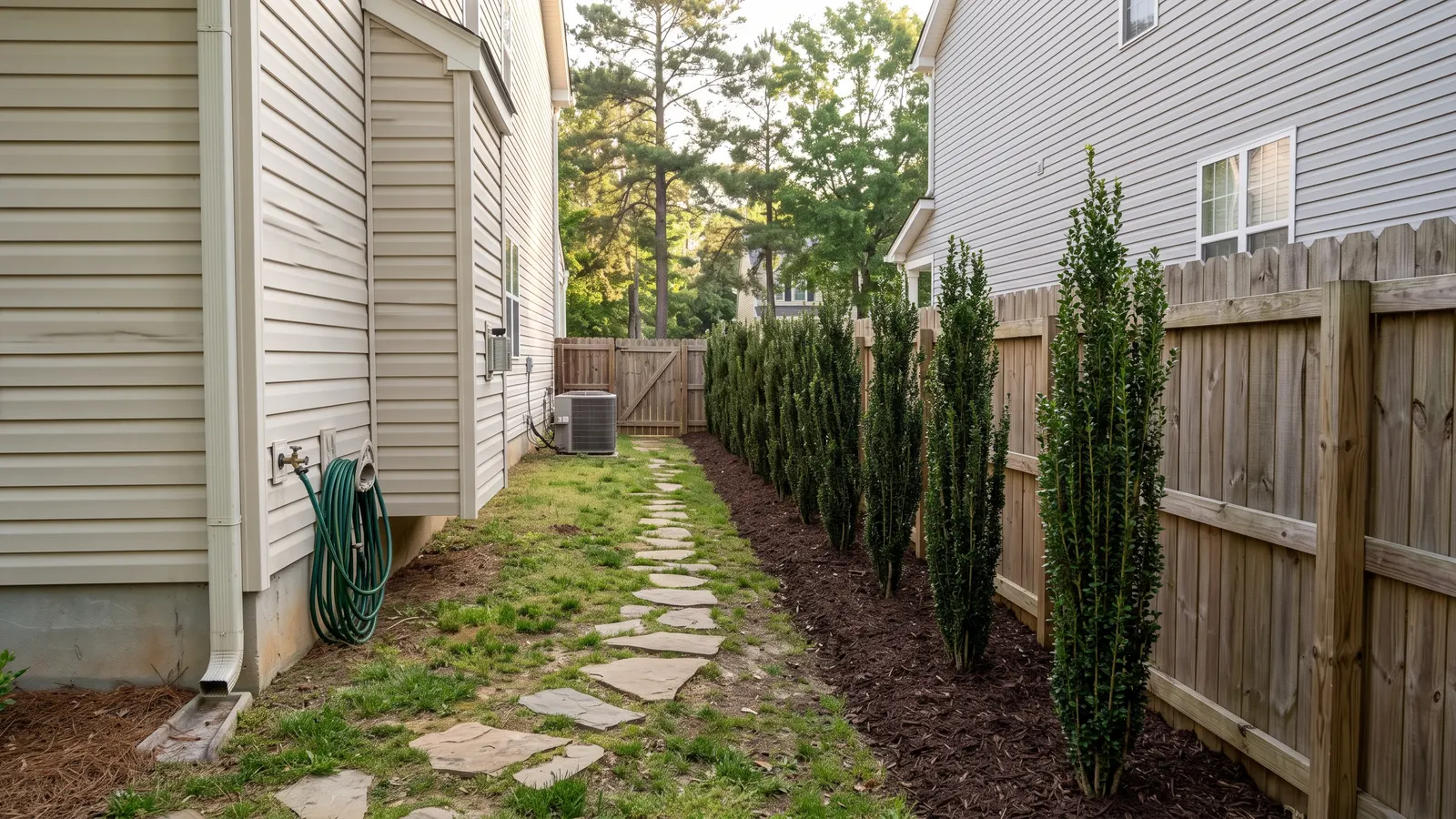
When the strip is barely wider than a walkway, Sky Pencil is one of the few evergreens that fits. NC State puts it at 4 to 10 feet tall and 1 to 3 feet wide, in zones 5 to 8. It grows slowly, so treat it as a plant you buy at size rather than wait on. It suits side yards and spots between windows, and it also does well in large containers on a patio.
Evergreen shrubs for shade and year-round cover
10. Hicks yew
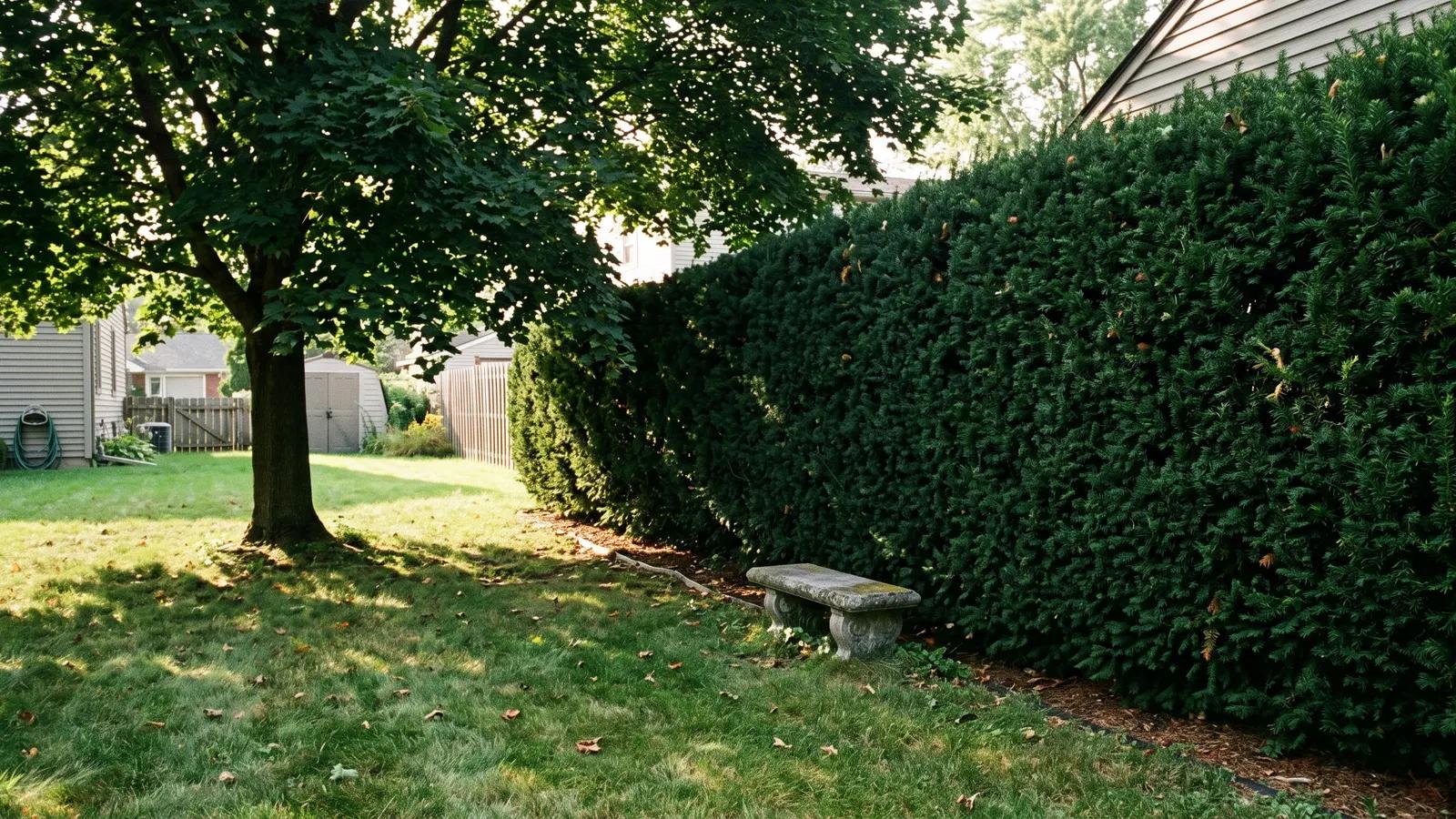
Yews are the classic answer for a shaded property line in the North. 'Hicksii' grows 12 to 20 feet tall and 8 to 12 feet wide in zones 4 to 7, according to the Missouri Botanical Garden, and takes shearing into a formal wall well. Two warnings: it won't tolerate wet soil, and NC State rates yews as highly poisonous, so think twice where dogs or small children play. Growth is slow.
11. Japanese plum yew
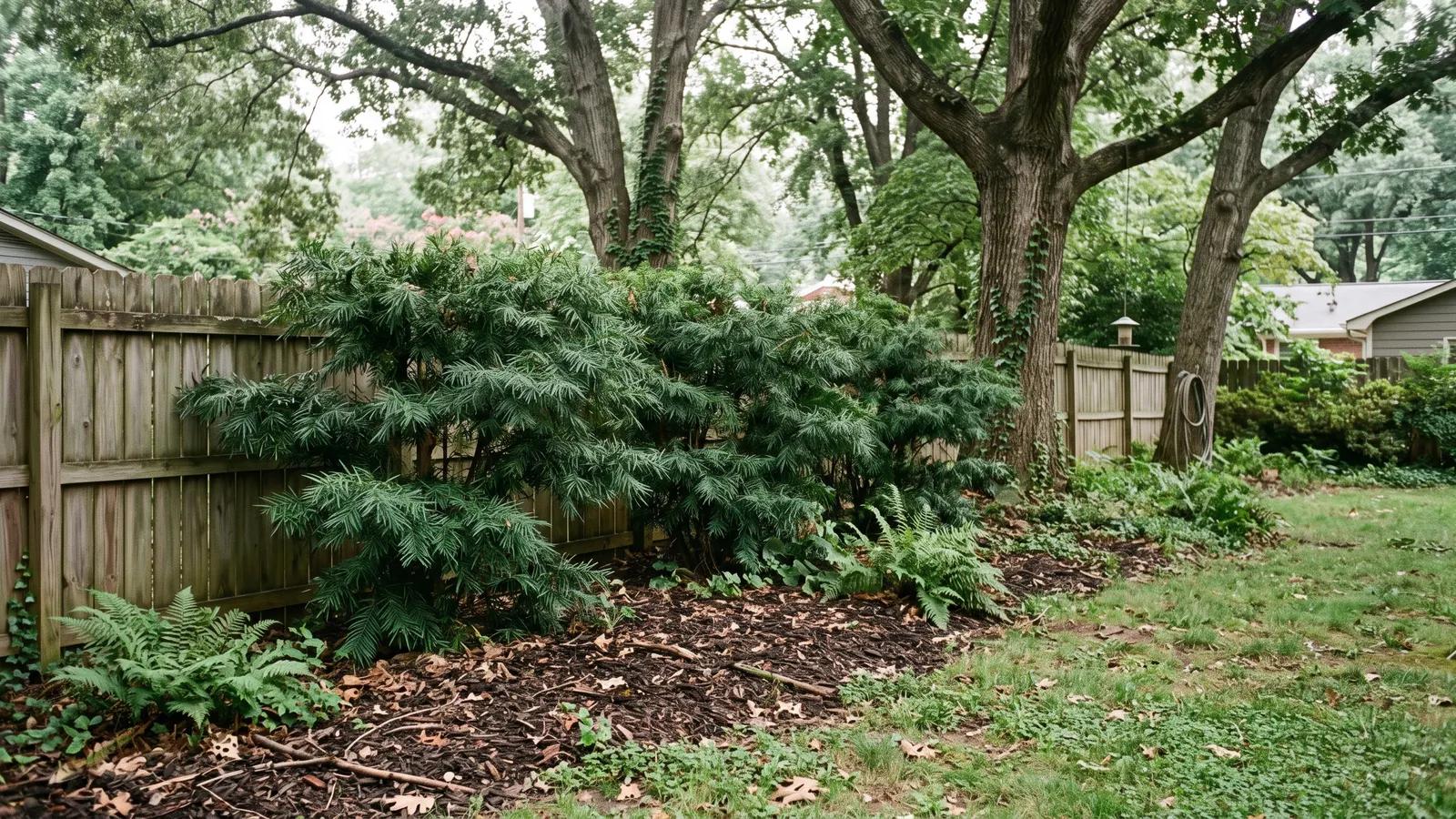
Plum yew does the yew job in the South, where true yews suffer in heat and humidity. NC State lists it at 5 to 10 feet tall and 5 to 14 feet wide in zones 6 to 9, growing slowly in shade to part sun. It's deer resistant, which matters if deer strip your other evergreens. Use it as a mid-height layer under trees rather than a tall wall. Our shade garden ideas cover what grows beneath it.
12. Inkberry holly
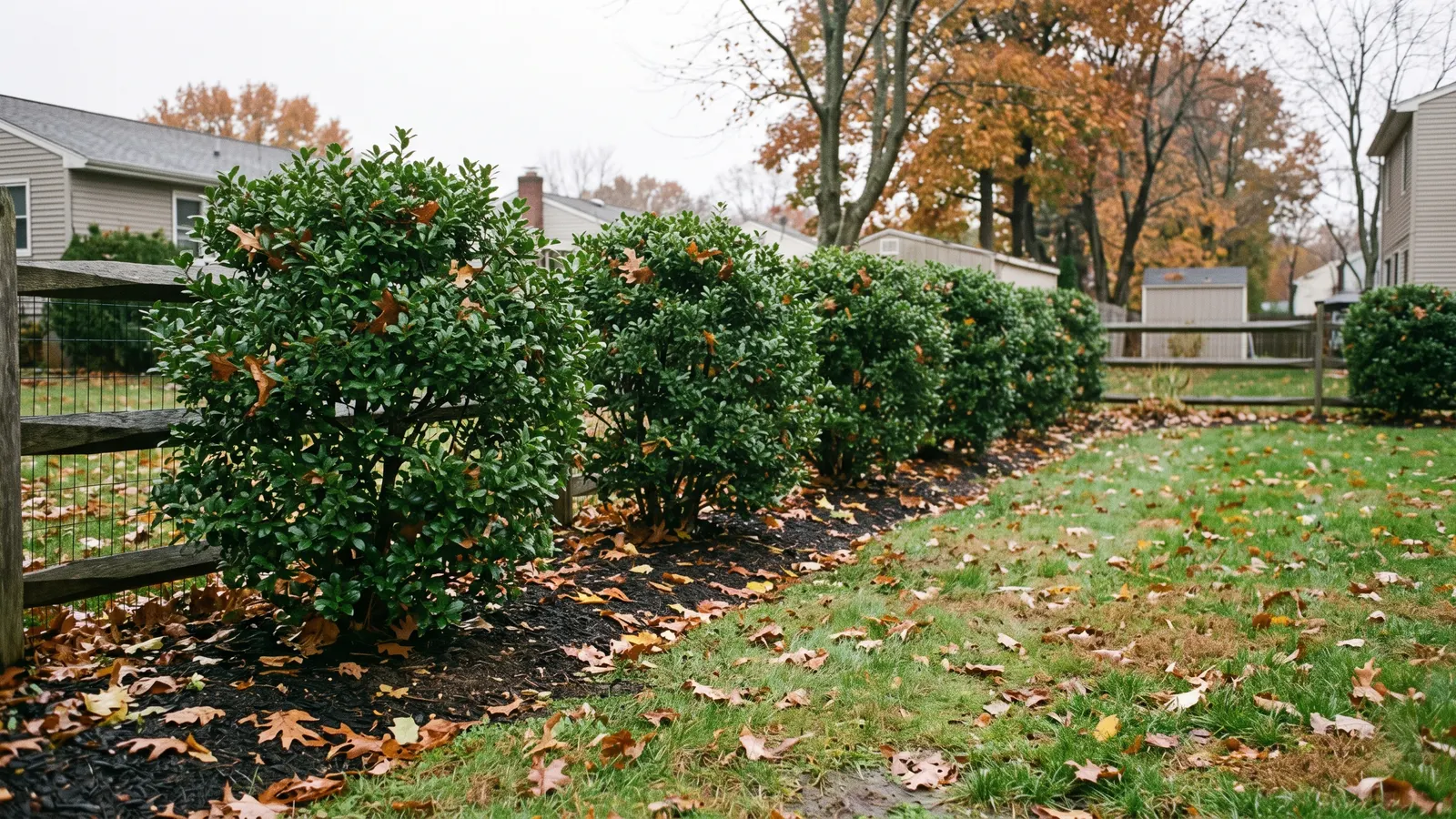
Inkberry is a native evergreen with small glossy leaves and an unusually wide range, zones 4 to 11 per NC State. It stays 5 to 10 feet tall and 5 to 8 feet wide and tolerates wet soil, so it works in the soggy corner where boxwood and yew rot. It's a good fit for a screen at patio height. It grows slowly and needs little pruning; if you keep it as a clipped hedge, NC State suggests trimming in early spring just before new growth starts.
13. Podocarpus
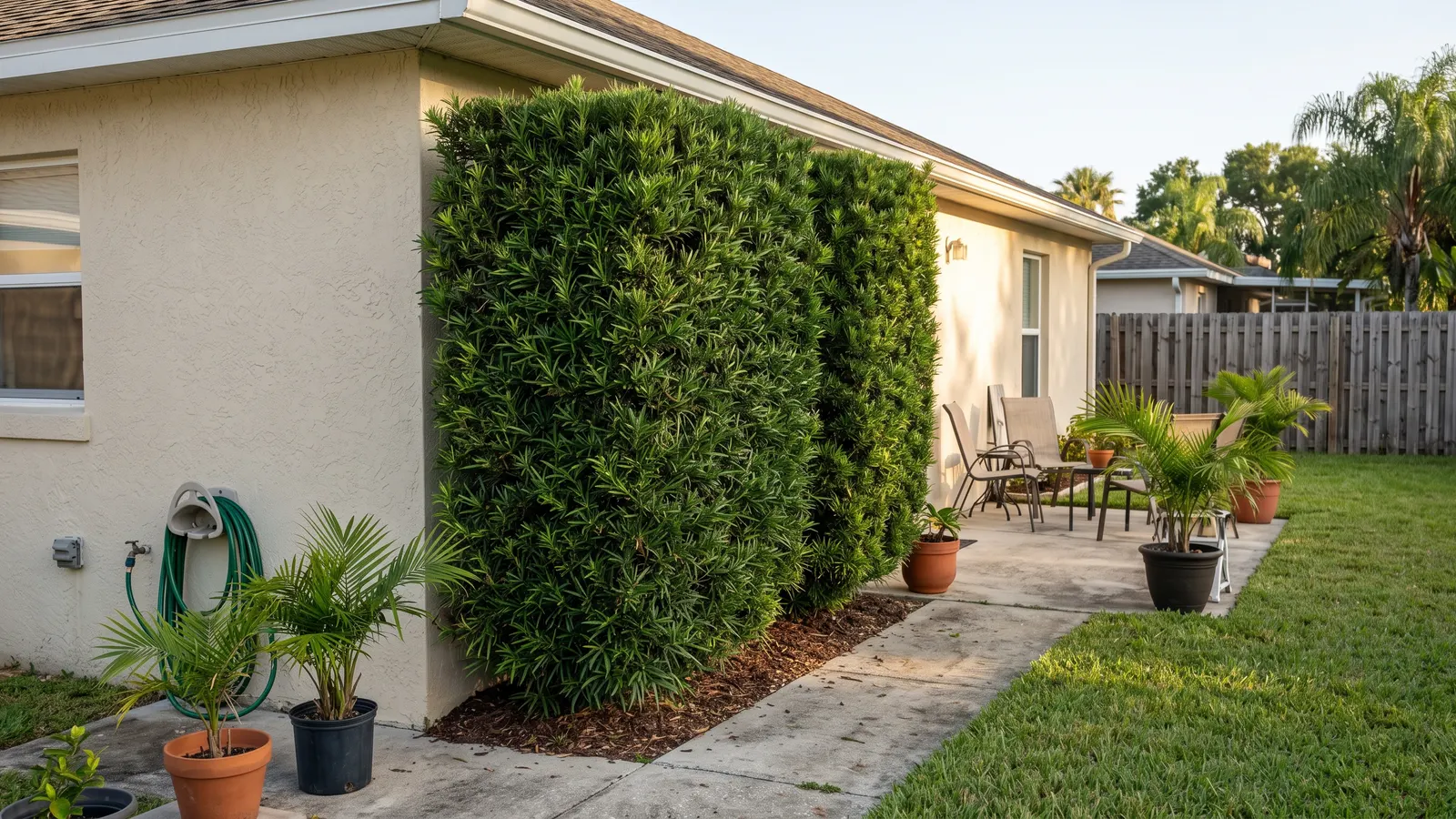
Across the Gulf Coast and Florida, podocarpus is the go-to tall, narrow evergreen hedge. NC State lists it at 15 to 50 feet tall but only 6 to 8 feet wide, in zones 7 to 9, in sun or part shade. Kept sheared, it holds a slim 8- to 12-foot wall for years. It grows slowly, so expect a few seasons before a row of small plants closes up.
Flowering screens
14. Limelight hydrangea
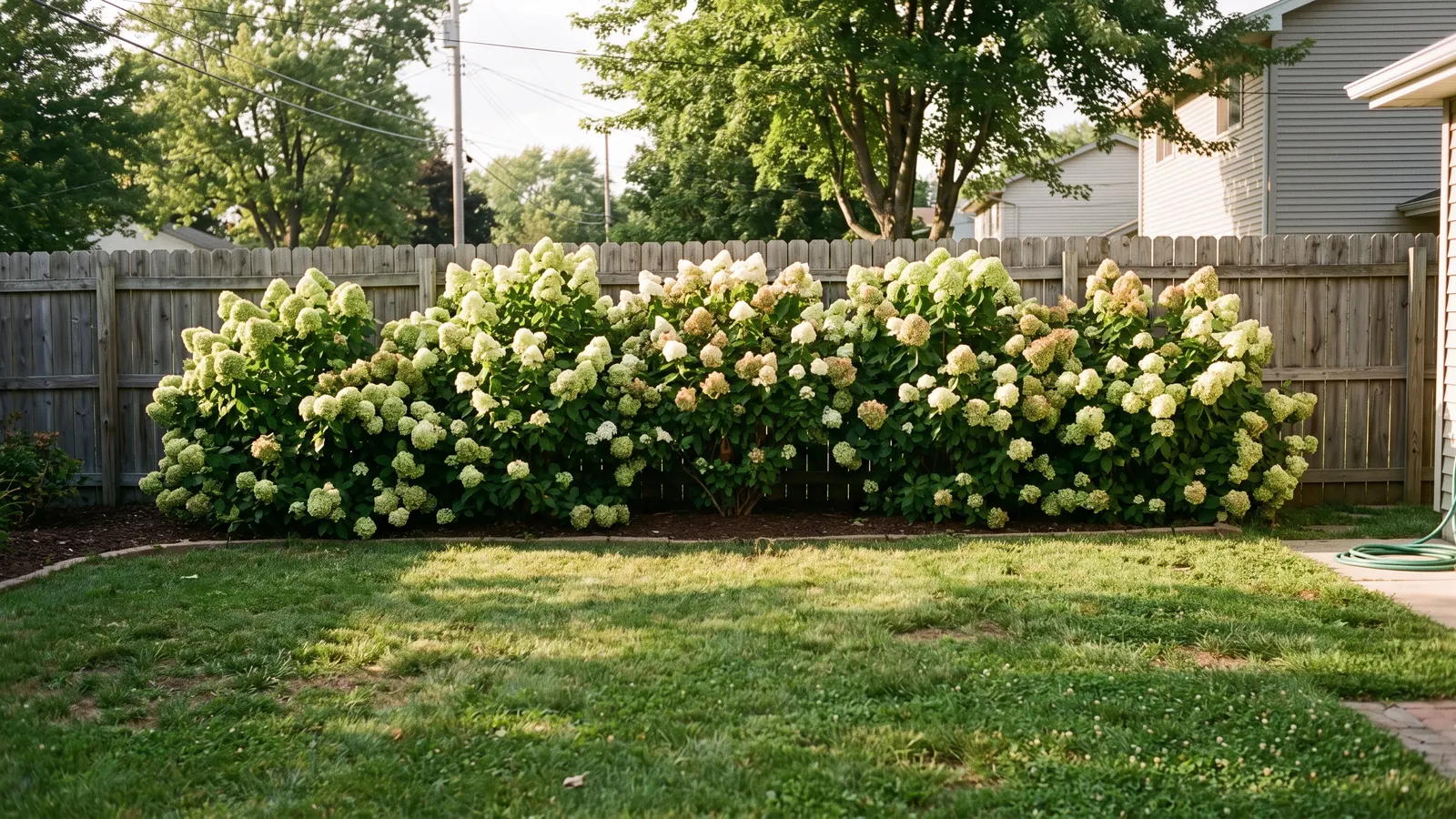
For summer privacy with flowers, Limelight panicle hydrangea is hard to beat. It grows 6 to 8 feet tall and wide in zones 3 to 9 (NC State), blooms from midsummer into fall, and takes sun or light shade. Unlike bigleaf hydrangeas, it blooms on new wood, so a hard cut in late winter won't cost you flowers. It drops its leaves in fall, so pair it with an evergreen if you need winter cover.
15. Arrowwood viburnum
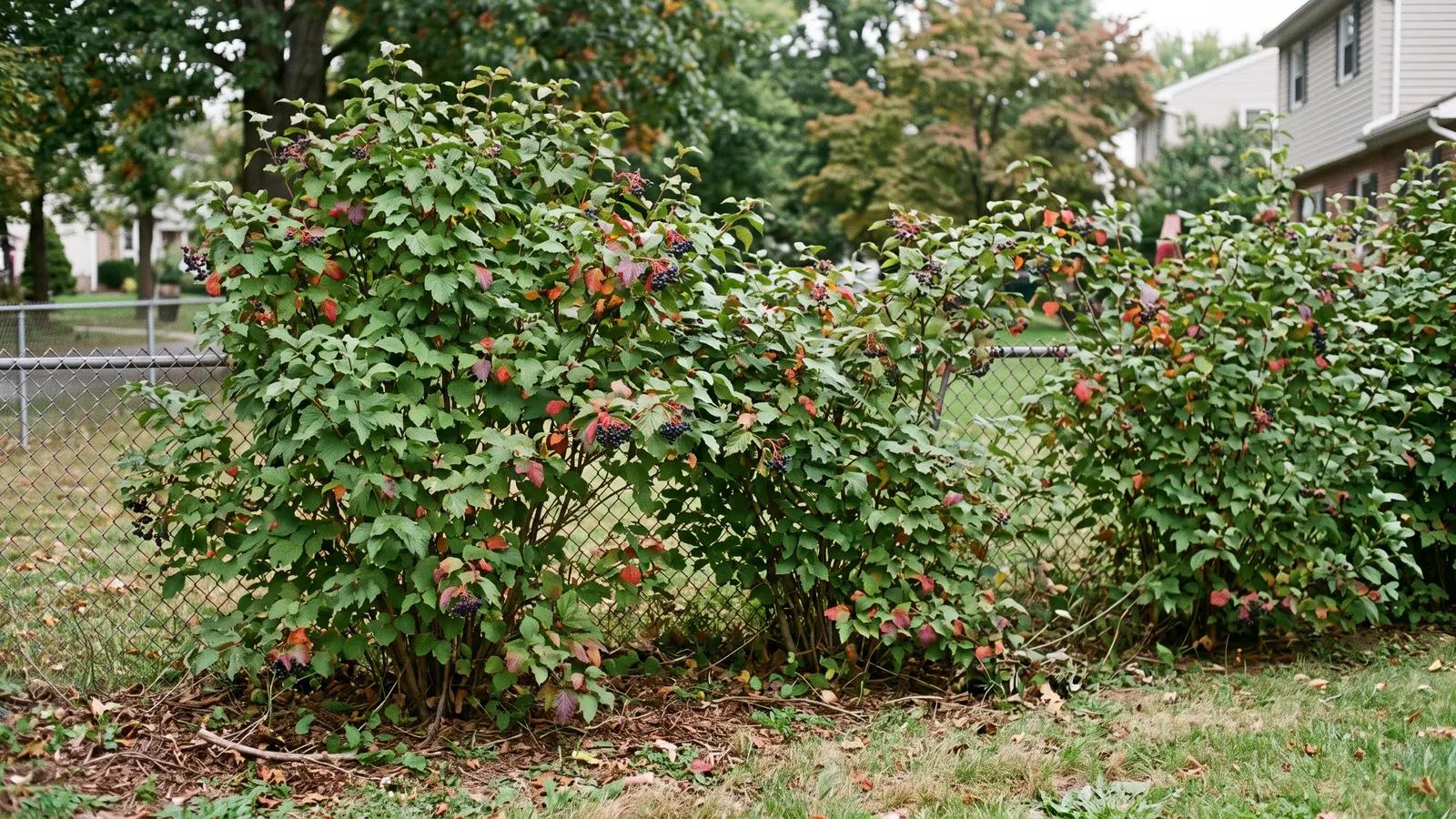
A tough native shrub for zones 2 to 8, arrowwood viburnum reaches 5 to 10 feet tall and 6 to 10 feet wide, per NC State. It has domed white flowers in late spring, dark blue berries for birds, and good fall color. Plant more than one, since NC State notes it needs a second genetic strain nearby to set fruit. It handles clay, occasionally wet soil and part shade. As a deciduous shrub it screens May through October, which makes it a strong middle layer in a mixed screen.
16. Common lilac
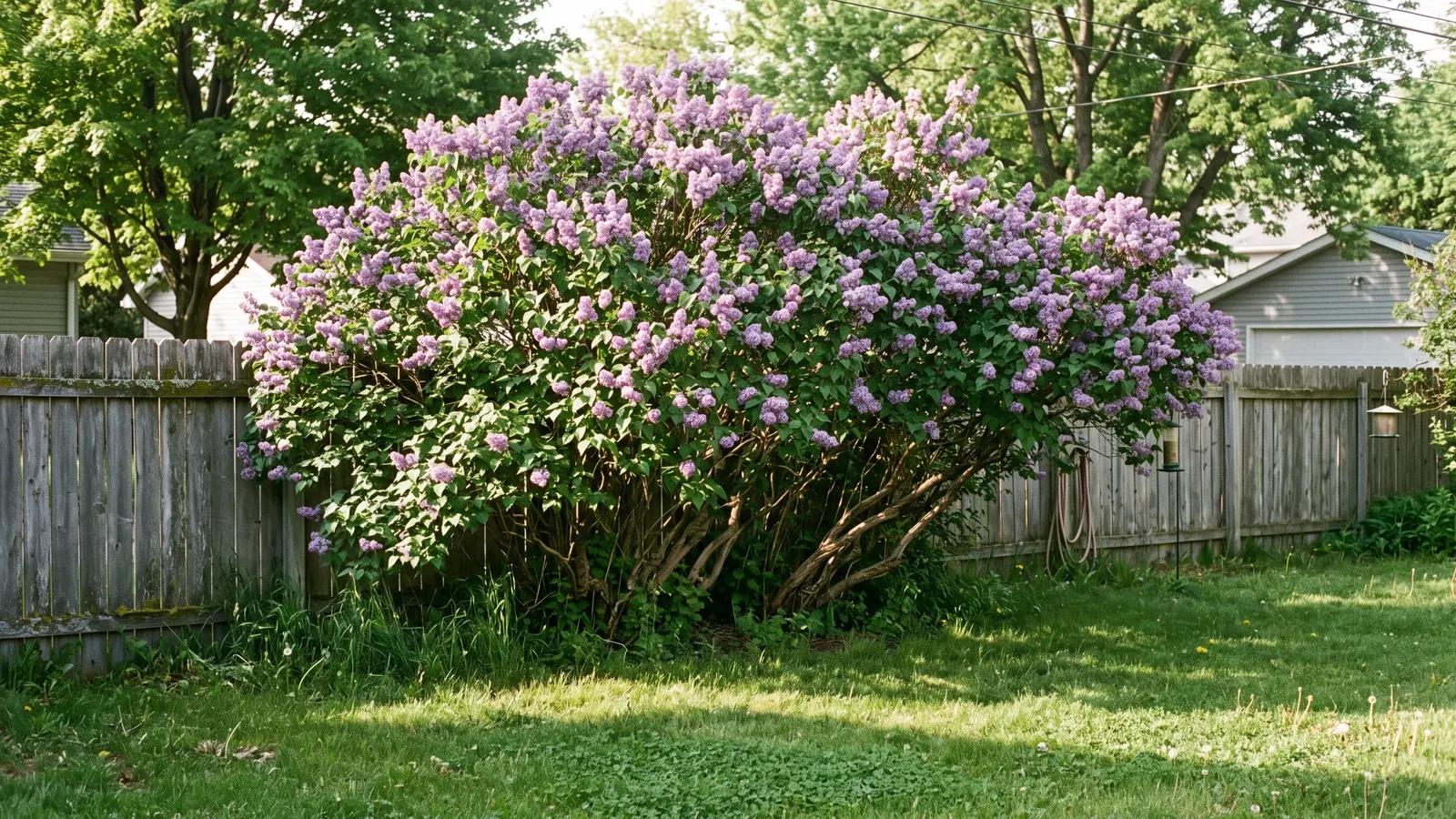
In cold climates (zones 3 to 7), an old lilac hedge is still one of the best-smelling ways to block a view. NC State lists it at 8 to 16 feet tall and 6 to 12 feet wide, growing at a medium rate in full sun. Be realistic about it: the bloom lasts a couple of weeks in late spring, the stems get leggy, and powdery mildew often coats the leaves by late summer. It works best with something evergreen in front.
17. Oleander
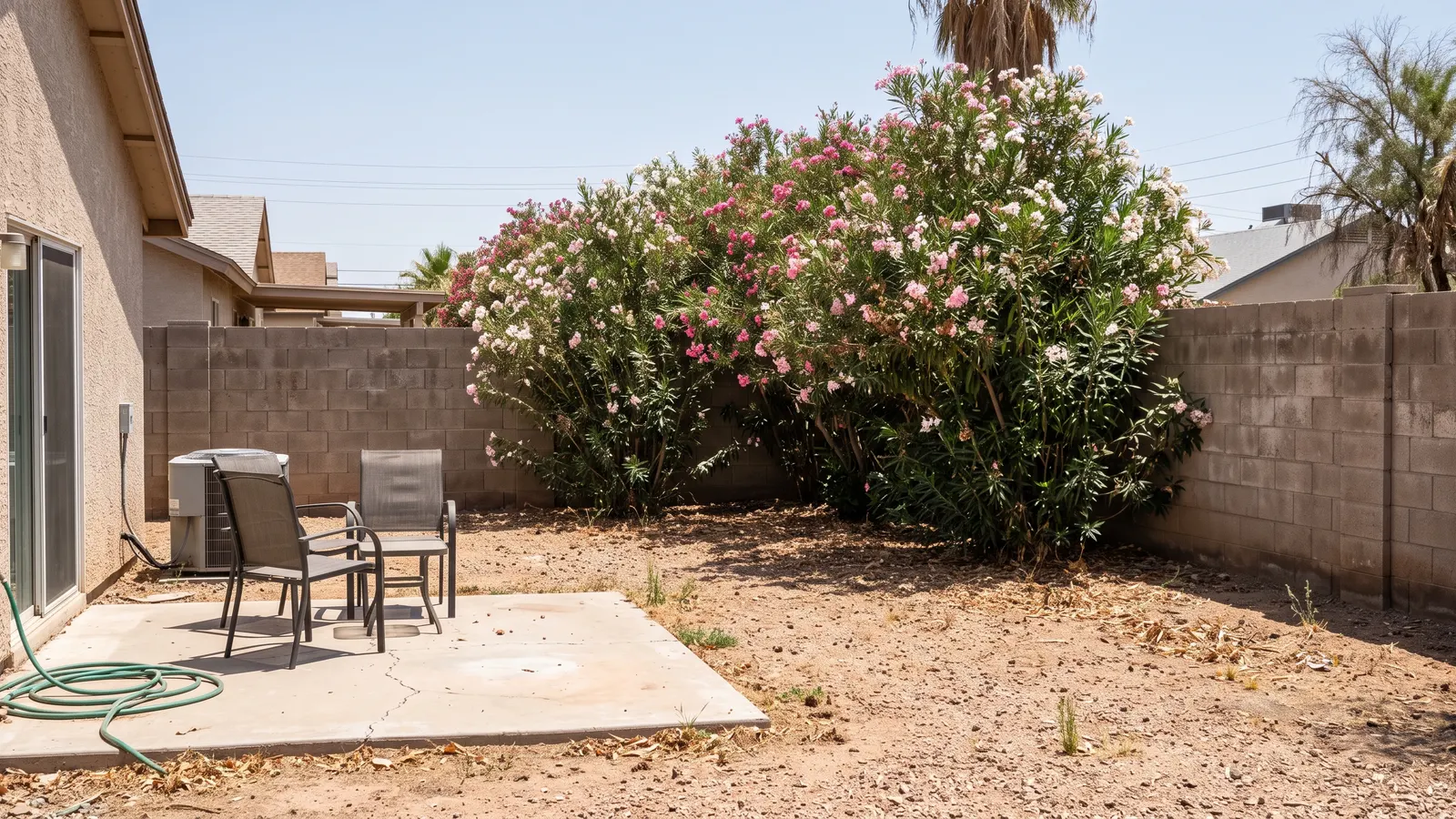
Oleander is the flowering screen of the desert Southwest and Gulf Coast, fast-growing and evergreen in zones 8 to 10, 5 to nearly 20 feet tall and 6 to 10 feet wide (NC State). It handles heat, drought and reflected light off walls. It's also highly poisonous: every part, and even smoke from burning it. Skip it if children or pets use the yard, and never burn the clippings.
Container privacy and quick fixes
18. Clumping bamboo in planters
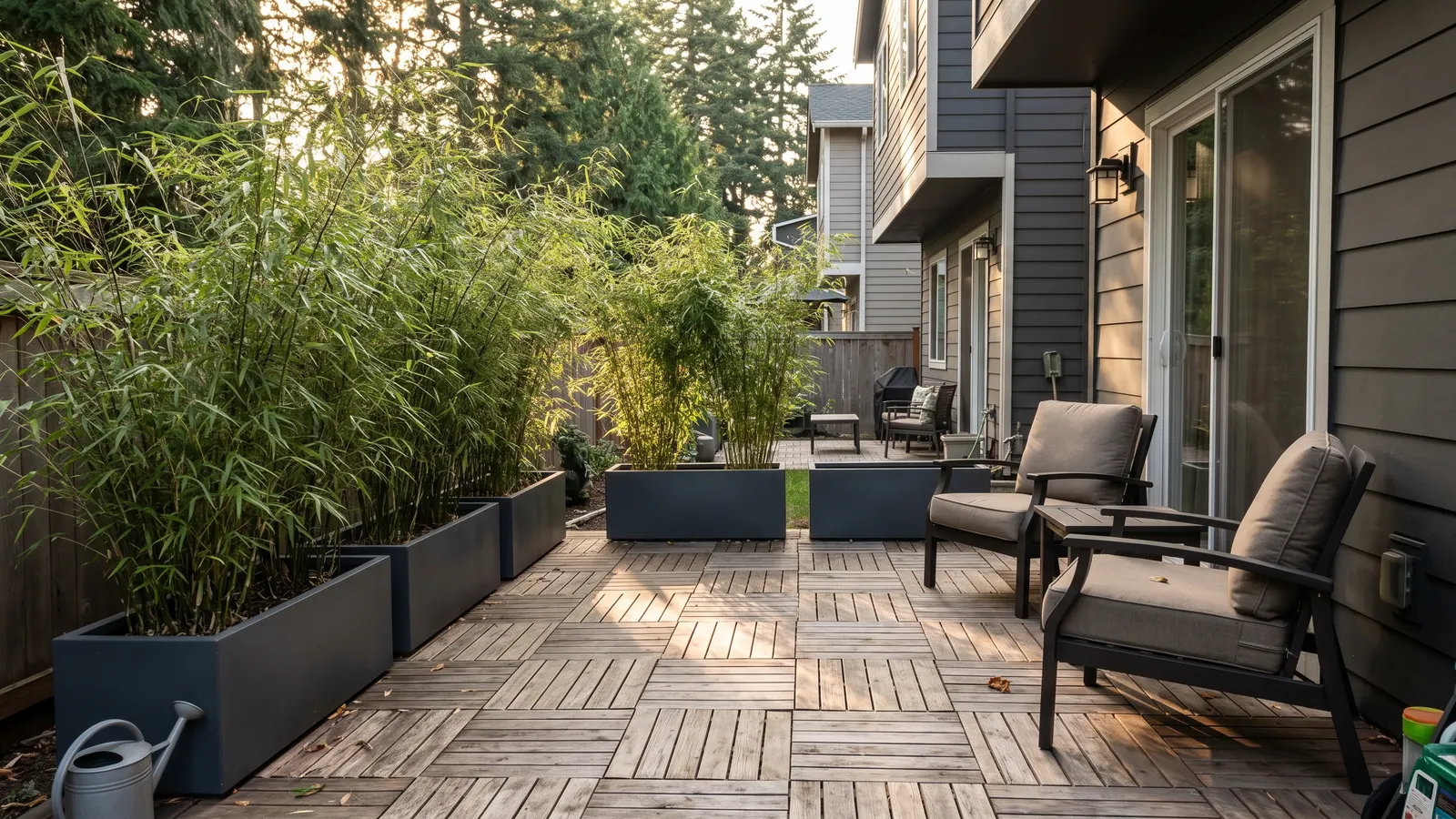
Bamboo has a bad name because running types spread under fences, and UMD Extension lists bamboo among the invasive screens to avoid. Clumping Fargesia is different. 'Green Panda' grows quickly to 6 to 10 feet tall in zones 5 to 8, and NC State notes clumping bamboos aren't invasive like the runners. In long planters it screens a patio or balcony without the risk of canes coming up in the neighbor's lawn.
19. Switchgrass
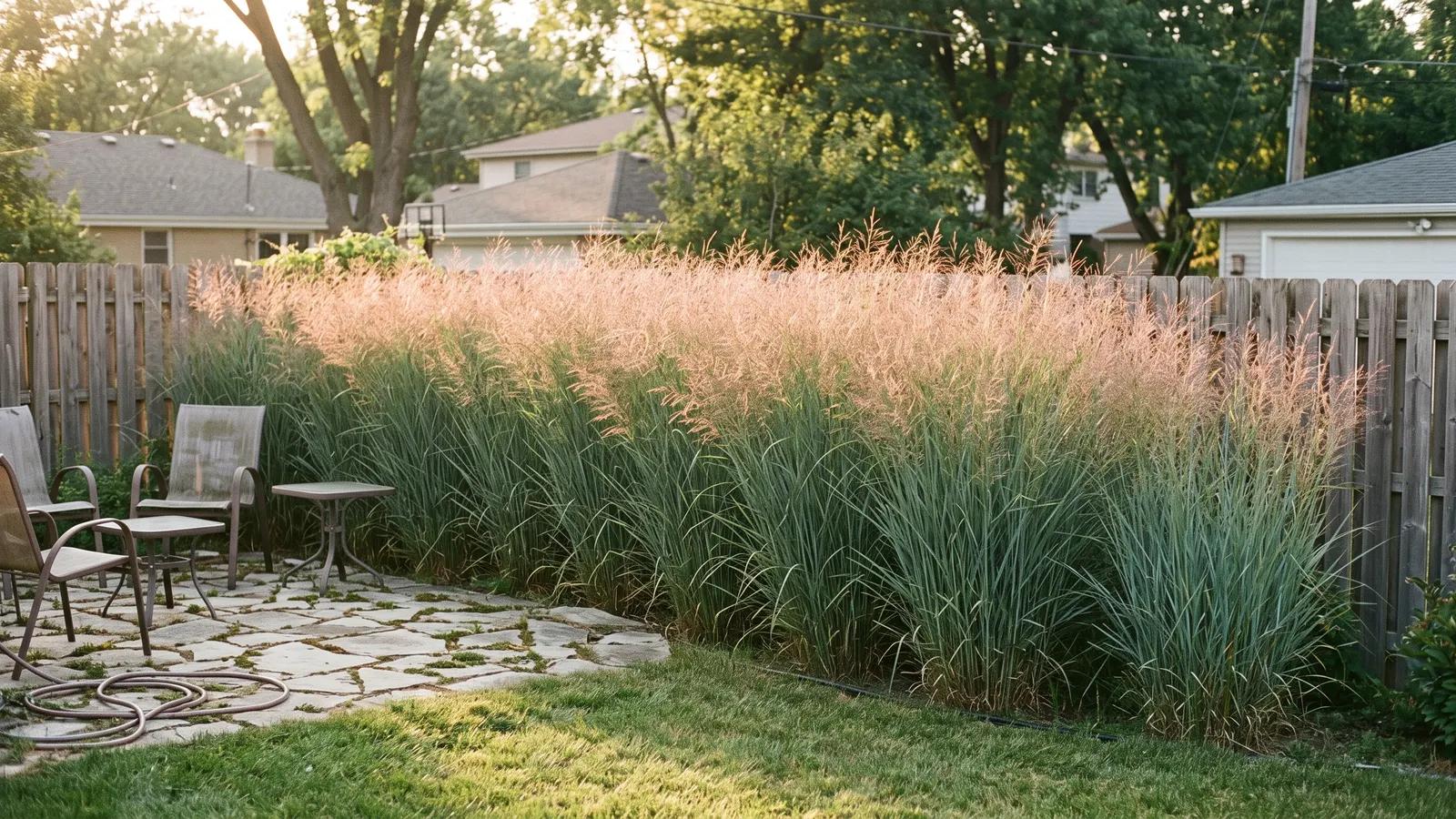
A native grass for zones 5 to 9 that reaches 3 to 7 feet tall and 2 to 3 feet wide, per NC State. It's tall enough by midsummer to screen a seated view, and NC State notes it provides cover year round and resists deer and drought. It works in a bed or a large container. Cultivars such as 'Northwind' and 'Shenandoah' differ in height and color, so check the tag before you buy.
20. Coral honeysuckle on a trellis
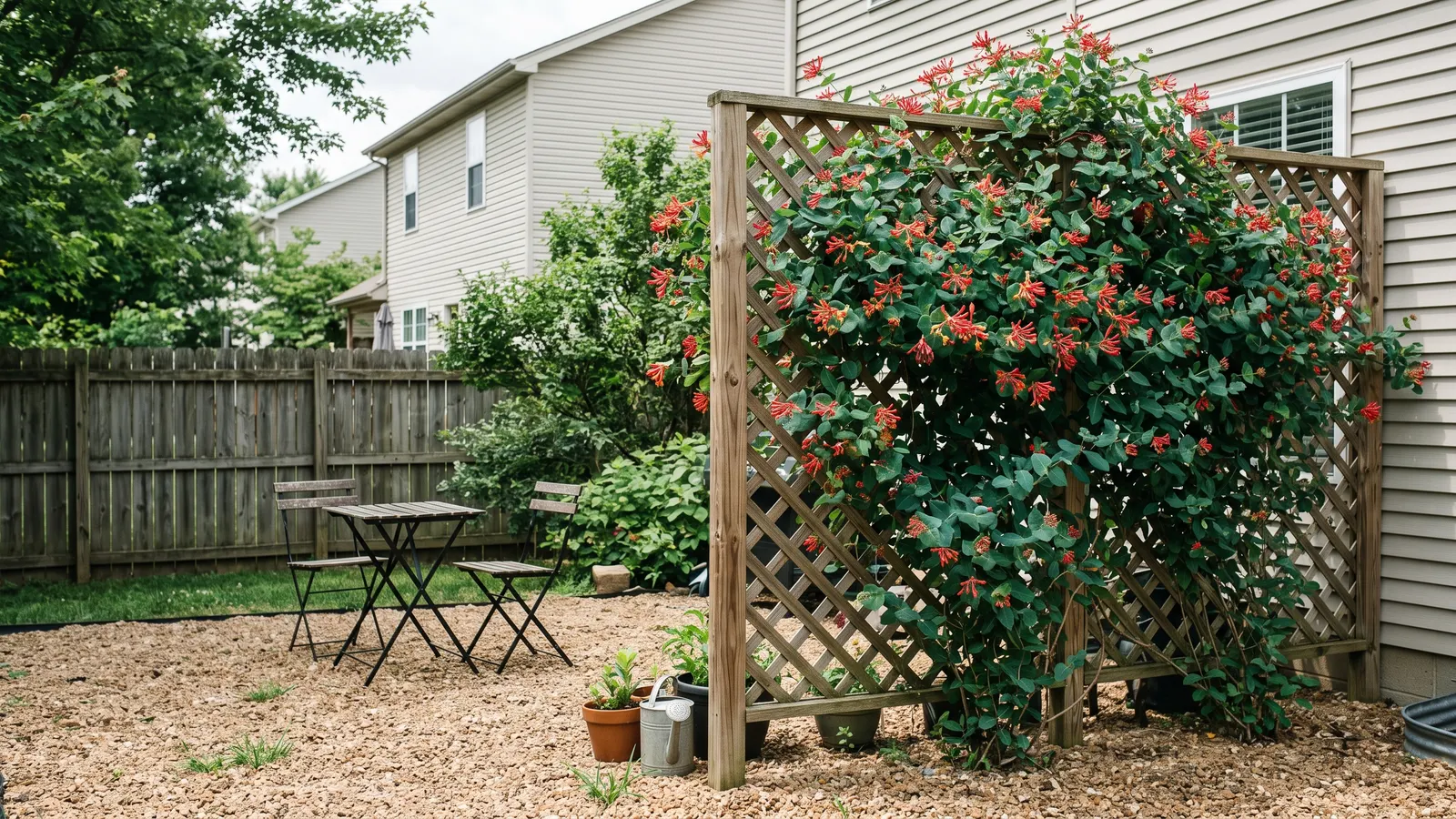
Where there's no room for a shrub, a vine on a trellis takes about a foot of depth. Coral honeysuckle is a native species that climbs 10 to 20 feet in zones 4 to 9 and grows fast. Its red tubular flowers open in mid-spring and draw hummingbirds, and NC State notes it stays evergreen in the warm winters of the Deep South. Use a sturdy trellis panel or an existing fence, a common way to add height to a short fence. Our cheap privacy fence ideas cover the panels.
21. Hyacinth bean (one-season screen)
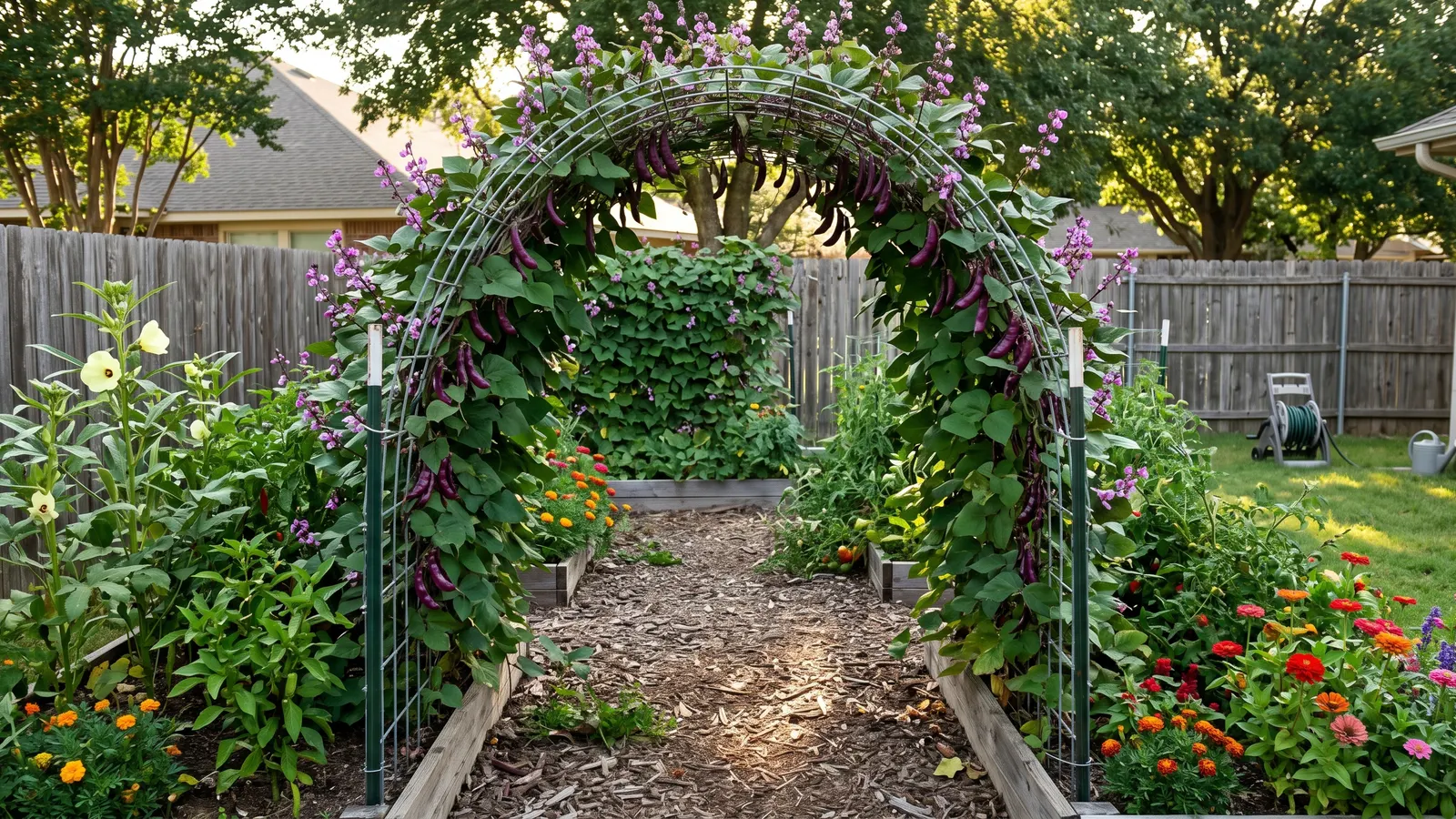
For privacy this summer while slower shrubs grow in, plant an annual vine. Hyacinth bean grows fast from seed after the soil warms and covers a trellis 10 feet or more by midsummer, with purple flowers and shiny purple pods. It's perennial only in zones 10 and 11, so most of us grow it as an annual and replant each spring. The Missouri Botanical Garden lists it among its annual vines for summer screening, alongside cardinal climber and cup-and-saucer vine.
Spacing and planting
The most common mistake with privacy plants is spacing them for instant coverage. Clemson Extension's advice for screens is to space by each plant's mature height and width, because crowded plants compete for light and water, shade each other out at the base, and decline.
- Sheared hedges: Washington State University Extension suggests about 18 inches apart for low hedges (3 to 4 feet tall) and 3 to 4 feet apart for tall hedges.
- Unsheared screens: use the mature width from the table below. If a plant spreads 8 feet, about 8 feet center to center lets neighbors just touch.
- Big conifers: UGA Extension recommends at least 10 to 15 feet between Leyland cypress so air moves through the canopy, which helps against disease.
- Need coverage sooner? Plant a staggered double row (zig-zag) instead of crowding one row, or mix fast and slow plants.
A few planting rules from UMD Extension apply to every screen: test your soil first, call 811 before you dig, keep mulch to 2 to 3 inches and off the trunks, and water through the first one to two summers. Our mulch calculator works out how much a long bed needs. Leave room from the lot line for the plant's full width, or half of it will end up in your neighbor's yard.
Privacy plants comparison table
| Plant | Type | Zones | Mature height | Mature width | Growth rate | Sun |
|---|---|---|---|---|---|---|
| Green Giant arborvitae | Evergreen tree | 5 to 8 | 40 to 60 ft | 12 to 18 ft | Fast (3 to 4 ft/yr) | Full sun to part shade |
| Leyland cypress | Evergreen tree | 6 to 10 | 60 to 70 ft | 10 to 15 ft | Fast (3 to 4 ft/yr young) | Full sun |
| Skip laurel | Evergreen shrub | 5b to 9 | 10 to 15 ft | 5 to 7 ft | Medium | Sun to shade |
| Wax myrtle | Evergreen shrub/tree | 7 to 11 | 20 to 25 ft | 8 to 10 ft | Fast | Sun to part shade |
| Nellie R. Stevens holly | Evergreen tree | 6 to 9 | 15 to 30 ft | 8 to 25 ft | Fast | Full sun to part shade |
| Emerald arborvitae | Evergreen tree | 2 to 7 | 12 to 14 ft | 3 to 4 ft | Slow | Full sun to part shade |
| Taylor juniper | Evergreen tree | 4 to 9 | 20 to 25 ft | 3 to 4 ft | Medium | Full sun |
| Italian cypress | Evergreen tree | 7 to 10 | 40 to 70 ft | 3 to 6 ft | Medium | Full sun |
| Sky Pencil holly | Evergreen shrub | 5 to 8 | 4 to 10 ft | 1 to 3 ft | Slow | Full sun to part shade |
| Hicks yew | Evergreen shrub | 4 to 7 | 12 to 20 ft | 8 to 12 ft | Slow | Sun to shade |
| Japanese plum yew | Evergreen shrub | 6 to 9 | 5 to 10 ft | 5 to 14 ft | Slow | Part shade to shade |
| Inkberry holly | Evergreen shrub | 4 to 11 | 5 to 10 ft | 5 to 8 ft | Slow | Full sun to part shade |
| Podocarpus | Evergreen shrub/tree | 7 to 9 | 15 to 50 ft | 6 to 8 ft | Slow | Sun to part shade |
| Limelight hydrangea | Deciduous shrub | 3 to 9 | 6 to 8 ft | 6 to 8 ft | Medium | Sun to part shade |
| Arrowwood viburnum | Deciduous shrub | 2 to 8 | 5 to 10 ft | 6 to 10 ft | Medium | Full sun to part shade |
| Common lilac | Deciduous shrub | 3 to 7 | 8 to 16 ft | 6 to 12 ft | Medium | Full sun |
| Oleander | Evergreen shrub | 8 to 10 | 5 to 19 ft | 6 to 10 ft | Fast | Full sun |
| Clumping bamboo ('Green Panda') | Evergreen grass | 5 to 8 | 6 to 10 ft | 6 to 10 ft | Fast | Full sun to part shade |
| Switchgrass | Perennial grass | 5 to 9 | 3 to 7 ft | 2 to 3 ft | Medium | Full sun |
| Coral honeysuckle | Vine | 4 to 9 | 10 to 20 ft (climbing) | 3 to 6 ft | Fast | Full sun to part shade |
| Hyacinth bean | Annual vine | Annual (10 to 11) | 10 to 25 ft (climbing) | 3 to 6 ft | Fast | Full sun |
Sizes and zones are from NC State Extension's Plant Toolbox, except Emerald arborvitae and Hicks yew (Missouri Botanical Garden Plant Finder). Growth rates are NC State's categories; the feet-per-year figures are from NC State and Clemson Extension.
Privacy plants by zone
Once you know your zone, start here. Each pick is rated for the whole band.
- Zones 2 to 4 (cold North): Emerald arborvitae, arrowwood viburnum, Limelight hydrangea and lilac (zone 3 up), plus Hicks yew, Taylor juniper, inkberry and coral honeysuckle from zone 4.
- Zones 5 to 6: Green Giant arborvitae, skip laurel (5b up), Emerald arborvitae, Taylor juniper, Sky Pencil holly, Hicks yew, inkberry, Limelight, arrowwood, lilac, clumping bamboo and switchgrass. From zone 6, add Leyland cypress, Nellie R. Stevens holly and plum yew.
- Zones 7 to 8: almost everything above works, plus wax myrtle, Italian cypress and podocarpus. Oleander joins at zone 8. Emerald arborvitae, Hicks yew and lilac top out at zone 7.
- Zones 9 to 11 (Deep South, desert, coastal): wax myrtle and inkberry (to 11), Leyland cypress, Italian cypress and oleander (to 10), plus Nellie R. Stevens, podocarpus, skip laurel, plum yew, Taylor juniper and switchgrass through zone 9. Hyacinth bean comes back on its own in 10 and 11.
Native options for a wildlife-friendly screen: arrowwood viburnum, inkberry, wax myrtle, Taylor juniper, switchgrass and coral honeysuckle are all native to parts of the eastern US. See native plants for why that matters, and check your state's invasive list before buying anything sold as a "fast hedge," since privet and running bamboo still turn up in nurseries.
For more ways to block a view, from pergolas to layered borders, see our privacy landscaping ideas. If the screen runs along a fence, the fence line landscaping ideas show how to plant the strip in front of it.
FAQ
What is the fastest growing privacy plant? Among evergreen trees, Green Giant arborvitae and Leyland cypress are the fastest, at about 3 to 4 feet a year when young according to NC State and Clemson Extension. For a one-season screen, an annual vine like hyacinth bean covers a trellis by midsummer. Leyland gets very large and is prone to canker, so Green Giant is usually the safer pick for an average lot.
How far apart should privacy shrubs be planted? For a sheared tall hedge, about 3 to 4 feet apart (Washington State University Extension); for a low hedge, about 18 inches. For an unsheared screen, space plants about their mature width apart so they just touch when grown. Large trees like Leyland cypress need 10 to 15 feet.
What are the best privacy trees for a small yard? Narrow columnar trees: Emerald arborvitae (3 to 4 feet wide), Taylor juniper (3 to 4 feet), Italian cypress in warm zones (3 to 6 feet), and Sky Pencil holly for the tightest spaces (1 to 3 feet). Avoid Green Giant and Leyland cypress on a small lot, since they spread 10 to 18 feet.
What privacy plants grow in shade? Hicks yew (zones 4 to 7), Japanese plum yew (zones 6 to 9) and skip laurel handle shade best among evergreens. Limelight hydrangea and arrowwood viburnum flower in part shade. Most fast conifers, including Leyland cypress, need full sun.
Are evergreen or deciduous privacy plants better? Evergreens give year-round privacy, which matters for a view from a neighbor's window. Deciduous shrubs and grasses screen only from spring to fall but add flowers, fall color and wildlife value. A mixed screen with evergreens at the back and flowering shrubs in front gives you both and holds up better if one plant fails.
How can I see what a privacy hedge will look like before planting? Take a photo of the view you want to block and try a few options on it with AI garden design. On OutdoorBrite's Plus plan, each design comes with a plant list picked for your region, which you can check against the zones above.
Sources: NC State Extension Plant Toolbox (Thuja 'Green Giant', x Hesperotropsis leylandii, Prunus laurocerasus 'Schipkaensis', Morella cerifera, Ilex 'Nellie R. Stevens', Juniperus virginiana 'Taylor', Cupressus sempervirens, Ilex crenata 'Sky Pencil', Cephalotaxus harringtonia, Ilex glabra, Podocarpus macrophyllus, Hydrangea paniculata 'Limelight', Viburnum dentatum, Syringa vulgaris, Nerium oleander, Fargesia rufa 'Green Panda', Panicum virgatum, Lonicera sempervirens, Lablab purpureus, Thuja occidentalis, Taxus x media), Missouri Botanical Garden Plant Finder: Thuja occidentalis 'Smaragd', Missouri Botanical Garden Plant Finder: Taxus x media 'Hicksii', Missouri Botanical Garden: Plants for Privacy Screening, University of Maryland Extension: Plants for Mixed Privacy Screens, Clemson HGIC: Leyland Cypress, Clemson HGIC: Mixed Screens, UGA Extension: Leyland cypress trees often planted incorrectly, WSU Extension: Spacing of Landscape Plants, all checked October 20, 2026