19 Front Yard Landscaping Ideas With Rocks, Pebbles to Boulders
Rock gives a front yard structure that never wilts, browns, or needs mowing. These 19 ideas run from pebble strips to three-man boulders, including the full no-grass layout, with costs and placement rules throughout.
Grass has one look and it needs mowing to keep it. Stone has a hundred looks and needs nothing, which is why the yards that stay sharp through August droughts are usually the ones that made rock a structural material instead of a filler. The best front yard landscaping ideas with rocks treat stone the way the house treats brick: as permanent architecture that plants get arranged around.
The 19 ideas below run from a $60 pebble strip to a delivered boulder, including the full no-grass layout that nobody explains properly. Each has a cost range and, where plants are involved, a hardiness zone. Every image is an AI-generated design concept from a typical front yard photo, the same kind of render AI front yard design makes from a picture of your own house.
A sizing note used throughout, because rock yards use it: suppliers class boulders as one-man (under 12 inches, 20 to 200 pounds), two-man (to 18 inches, up to 500 pounds), and three-man (to 36 inches, 800 pounds and up). The class tells you whether you're lifting it, wheeling it, or paying the delivery truck to place it.
1. Give the yard one three-man boulder
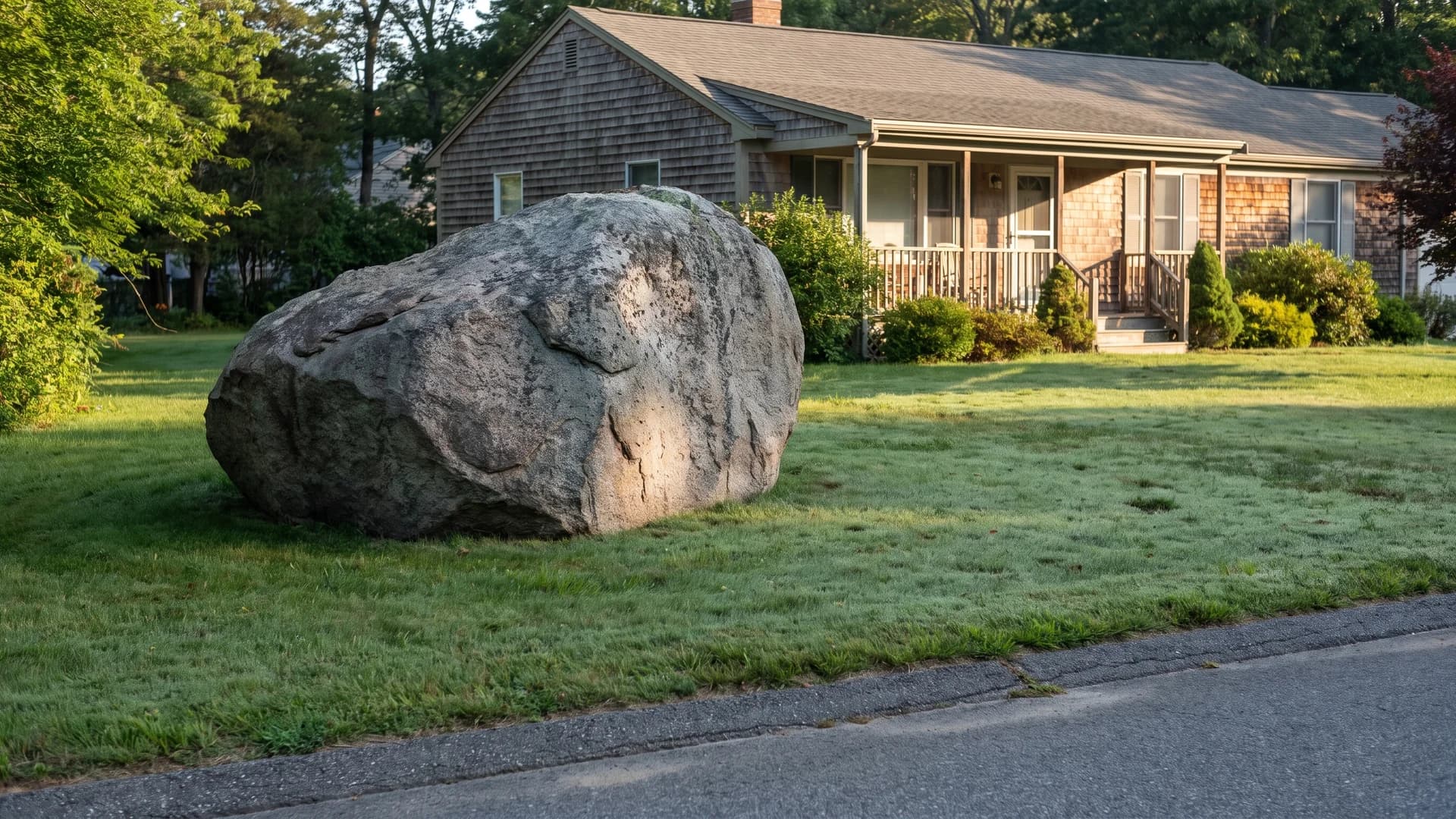
One serious stone changes a front yard's whole posture. Place it off-center, a third of the way into the yard, and bury the bottom third so it reads as bedrock the house was built beside. A three-man boulder runs $300 to $800 delivered and placed, and it is the last focal point you'll ever buy. Get placement right the first time; nobody moves it later.
2. Cluster small boulders where beds turn
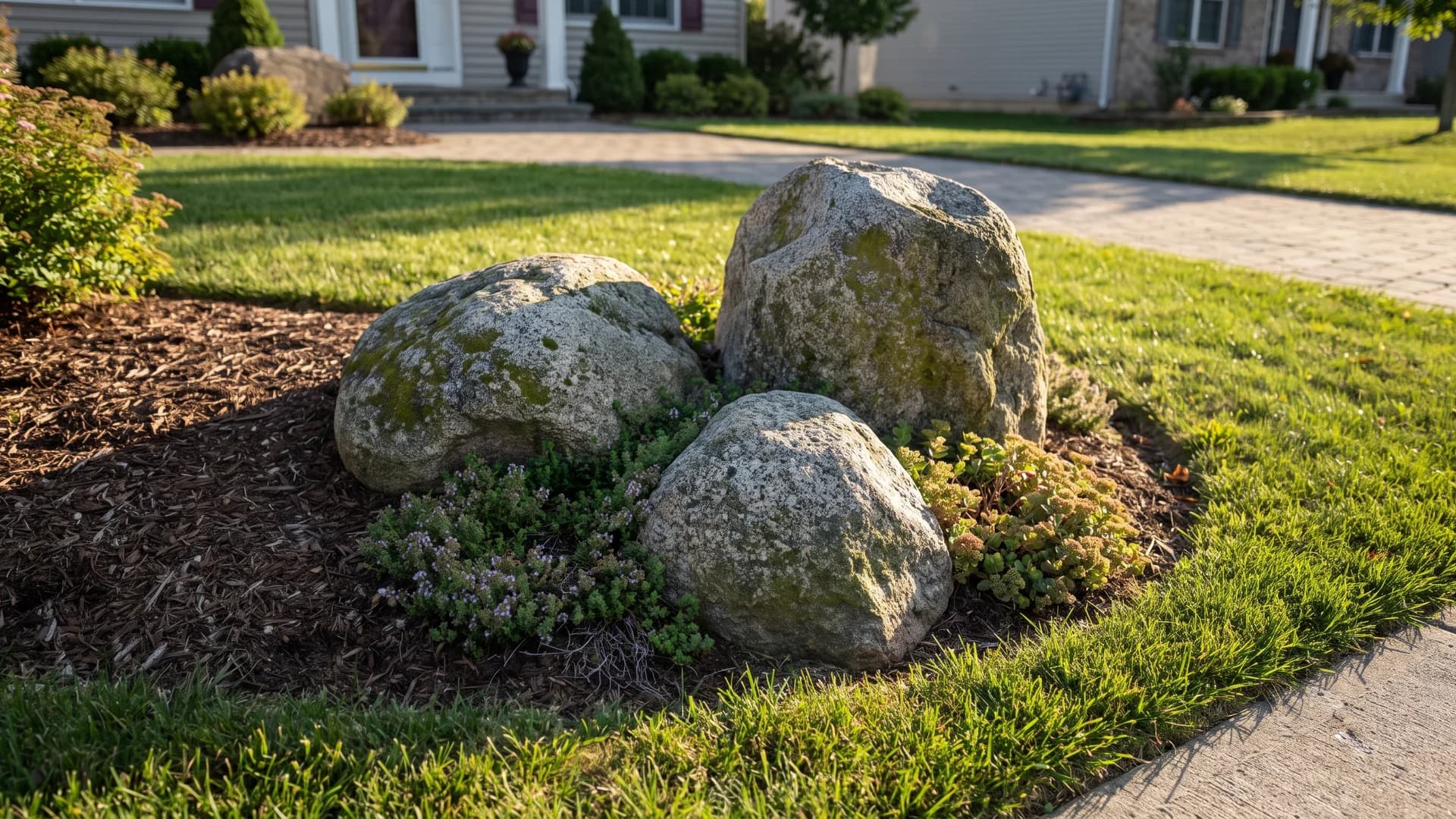
Bed corners collapse visually without weight. Three one-man boulders, $50 to $150 each and liftable with a hand truck, give every turn an anchor. Odd numbers, varied sizes, largest set back: the same composition rules sculptors use, applied at curb scale. Groundcover creeping against the stone finishes the illusion that they were always there.
3. Frame the walk with two-tone rock beds
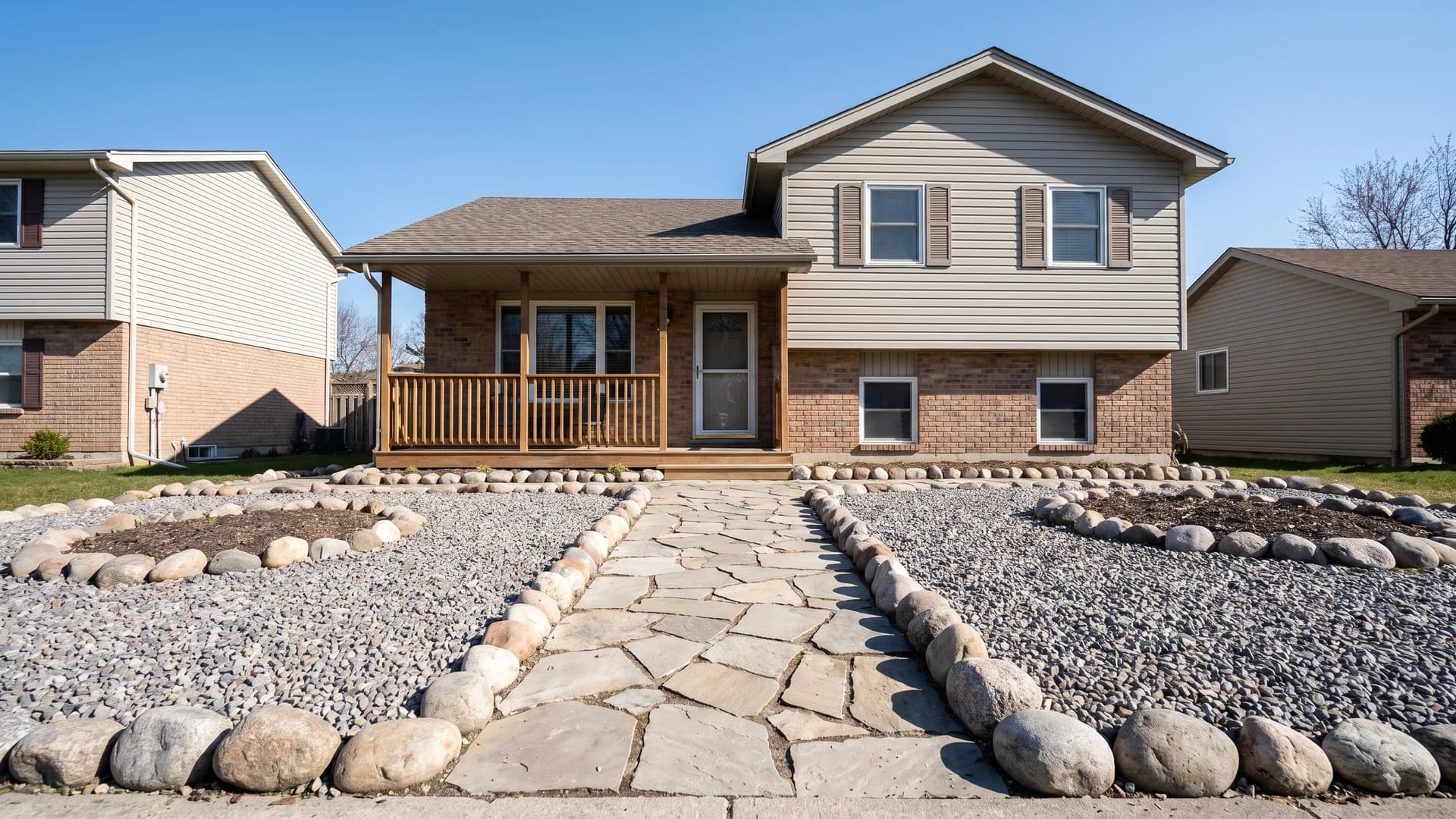
Beds on both sides of the front walk, mulched in 1-to-2-inch stone with a border band of larger river rock, turn the daily route to the door into the yard's best feature. The size contrast reads as intentional design and the big border stones keep the small ones off the concrete. Two tons covers most walk framings, $160 to $300.
4. Design the full no-grass rock yard
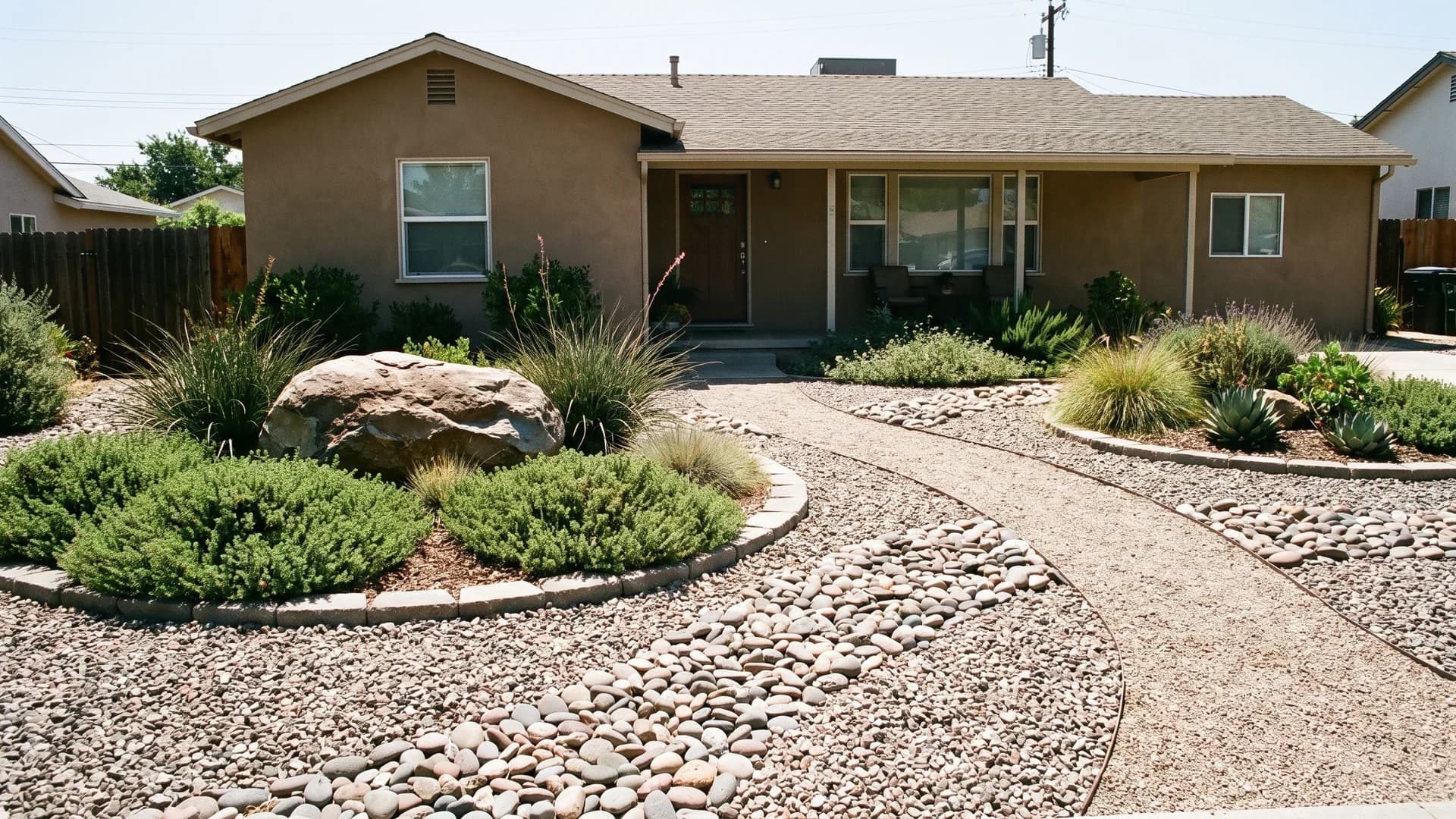
The all-rock front yard works when it follows a ratio: roughly two-thirds stone, one-third living material in defined pockets. Vary the stone (fields of gravel, bands of river rock, a boulder or two) and mass the plants instead of dotting them. A typical 600-square-foot conversion runs $1,200 to $2,500 in materials. Check HOA rules first; some still mandate turf percentages, and it's cheaper to know before the dumpster arrives.
5. Build a white-rock desert bed
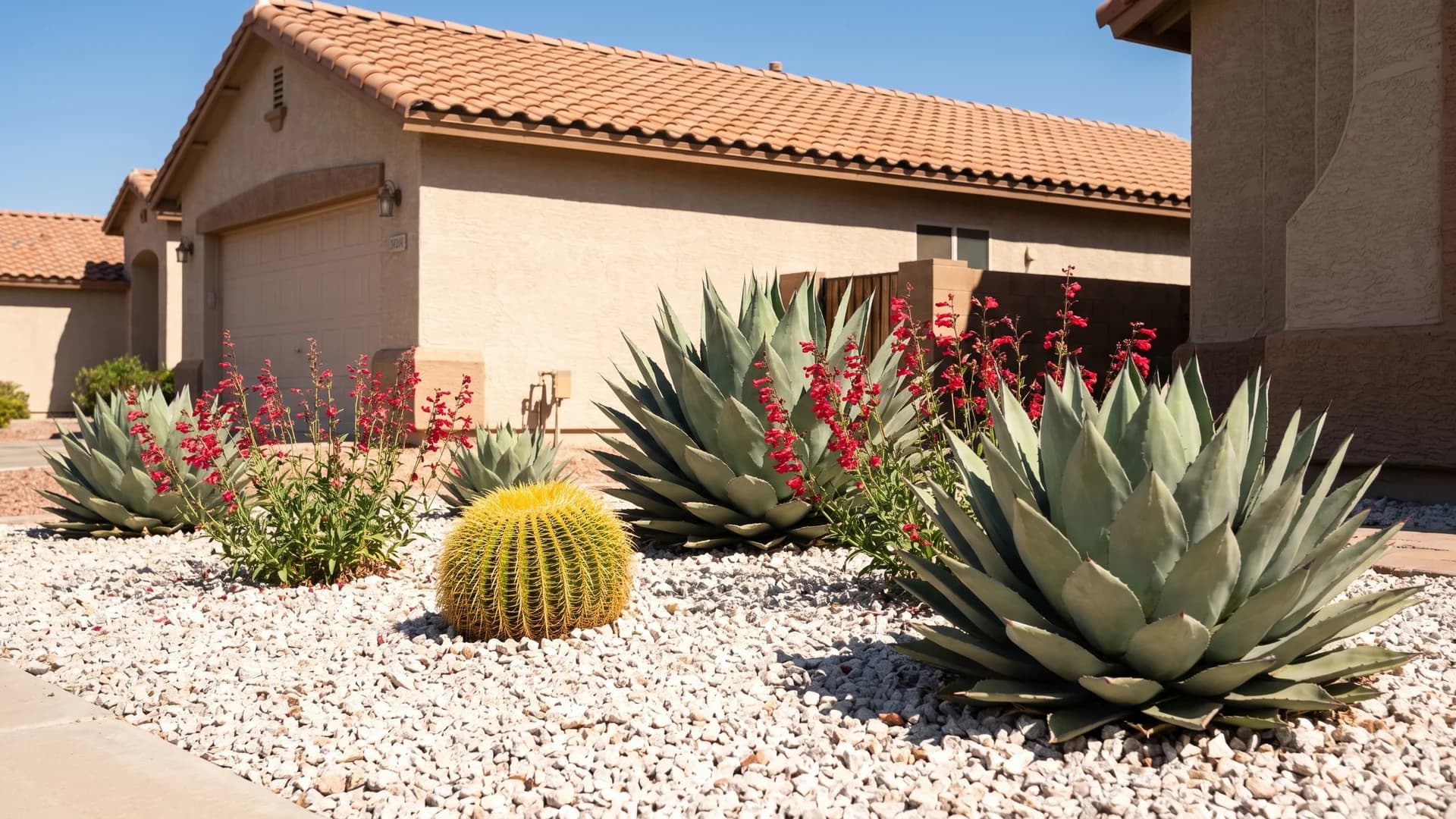
In hot-summer climates, white or pale rock reflects heat instead of storing it, and desert plants supply sculpture no shrub matches. Artichoke agave, golden barrel cactus, and firecracker penstemon for hummingbird traffic cover zones 8 to 11 outdoors, $15 to $60 a plant. This is xeriscaping at its most photogenic, and its water bill after year one is approximately zero.
6. Run a dry creek from downspout to street
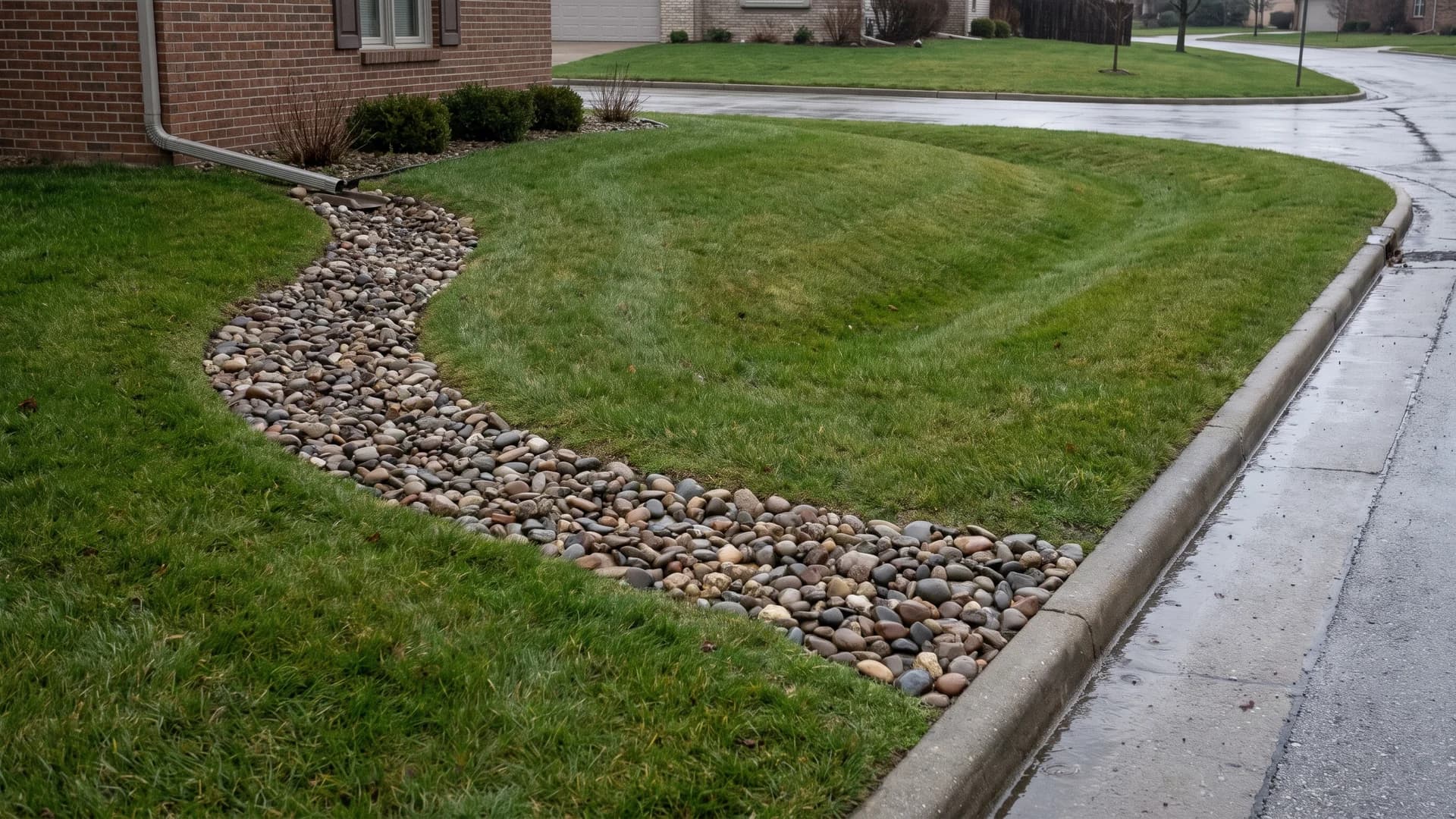
Front yards usually drain toward the street anyway; a dry creek makes the route deliberate. A shallow fabric-lined channel filled with mixed river rock swallows downspout surges that would otherwise carve a rut through the lawn. Fifteen feet takes about a ton, $80 to $150. Curve it; straight channels read as gutters, curves read as landscape.
7. Step the entry slope with boulders
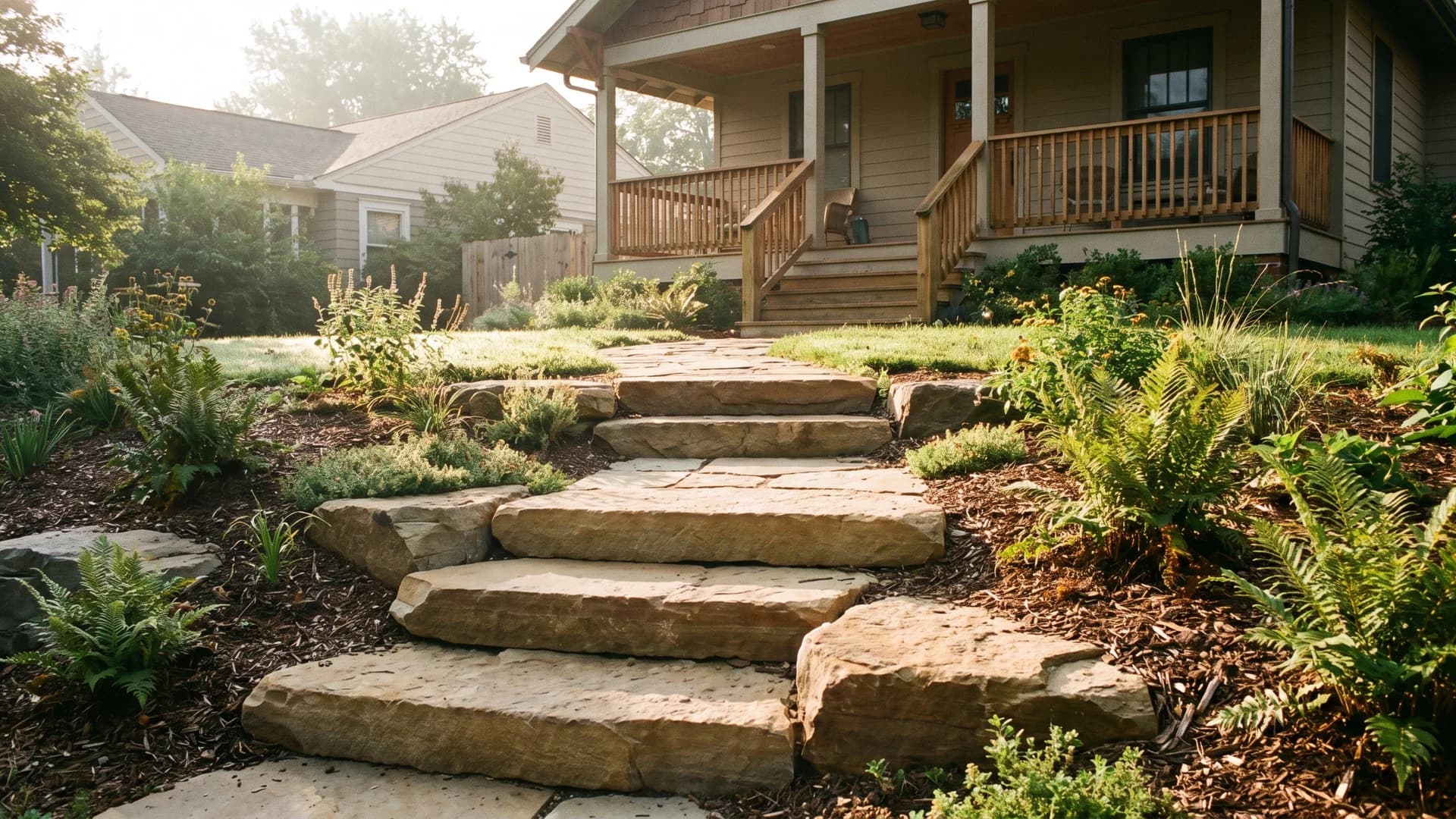
A sloped approach with a worn dirt shortcut is asking for flat-topped boulder steps. Two-man stones with broad faces, set 6 to 7 inches of rise apart and buried a third deep, make a stair that will outlive the house. Figure $150 to $300 per placed stone. It's the one idea on this list worth hiring muscle for; a rolling 400-pound step forgives nothing.
8. Stack a knee wall at the porch line
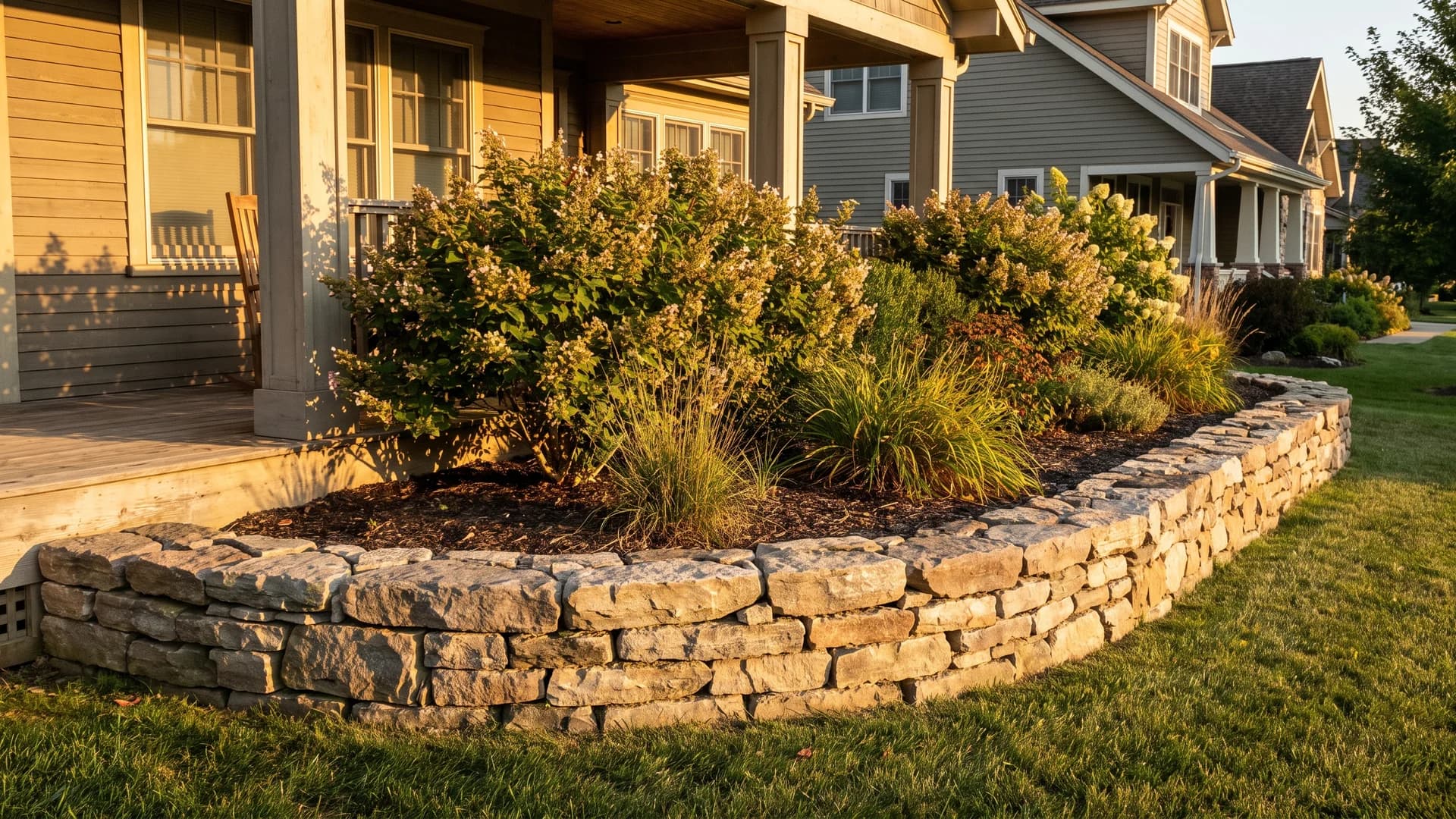
A dry-stacked stone wall, two or three courses high, along the porch or foundation line gives the house a plinth to sit on and creates a raised bed behind it. A pallet of wall stone runs $250 to $400 and builds 30-odd feet. No mortar needed at this height, just a gravel footing and a slight lean back into the soil it holds.
9. Edge the driveway in river rock
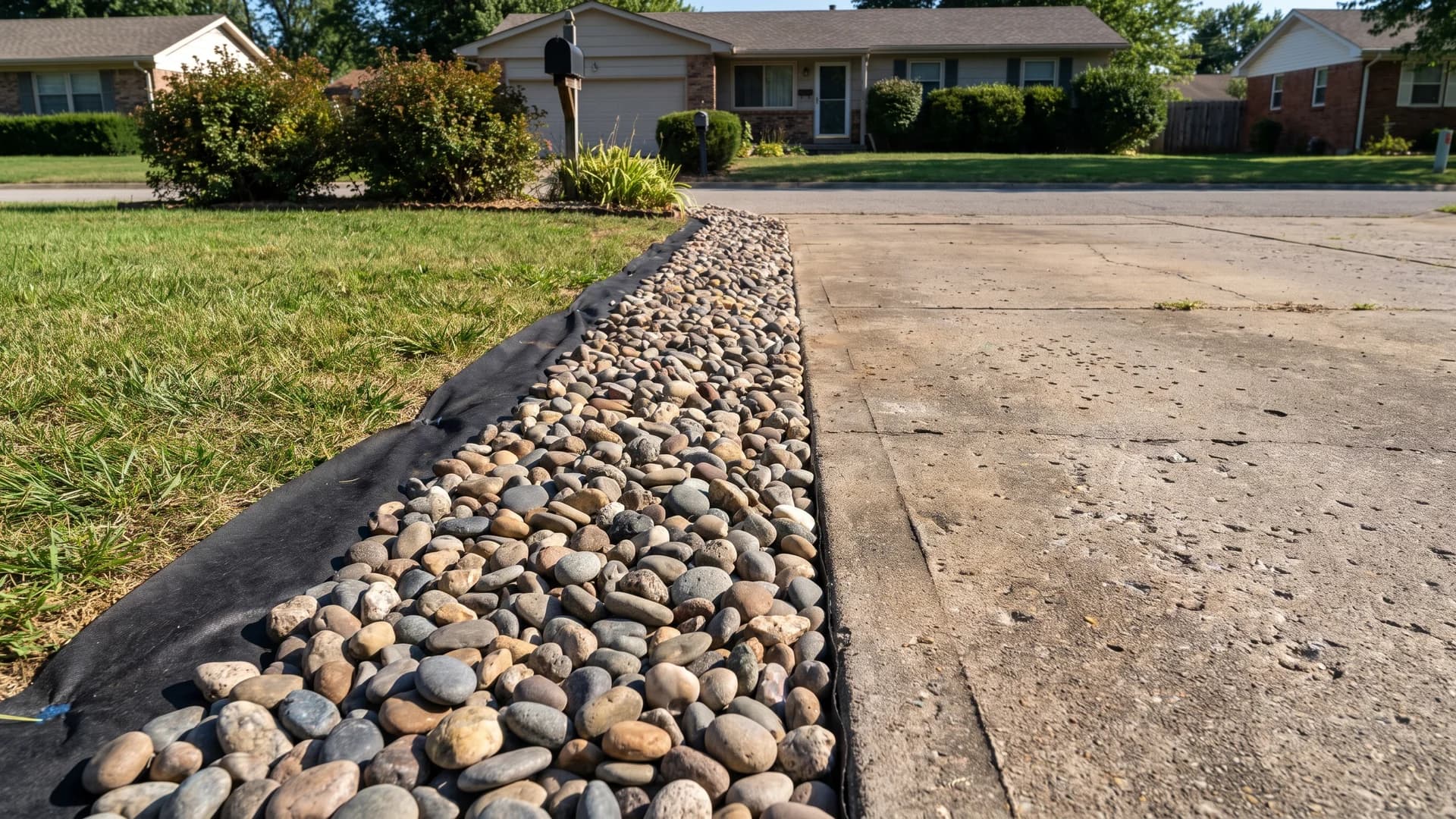
The grass strip beside a driveway dies from car doors, salt, and shortcuts, then stays dead. A 12-to-18-inch river rock band over fabric replaces it with something that ignores all three. One ton edges about 60 feet, $80 to $150. It also gives the snow shovel and string trimmer a hard boundary, which the siding and the car doors will both appreciate. A stone band is one way to finish that edge; our driveway landscaping ideas weigh it against planted borders, gravel, and mulch down the full run.
10. Widen the walk with pea gravel and steppers
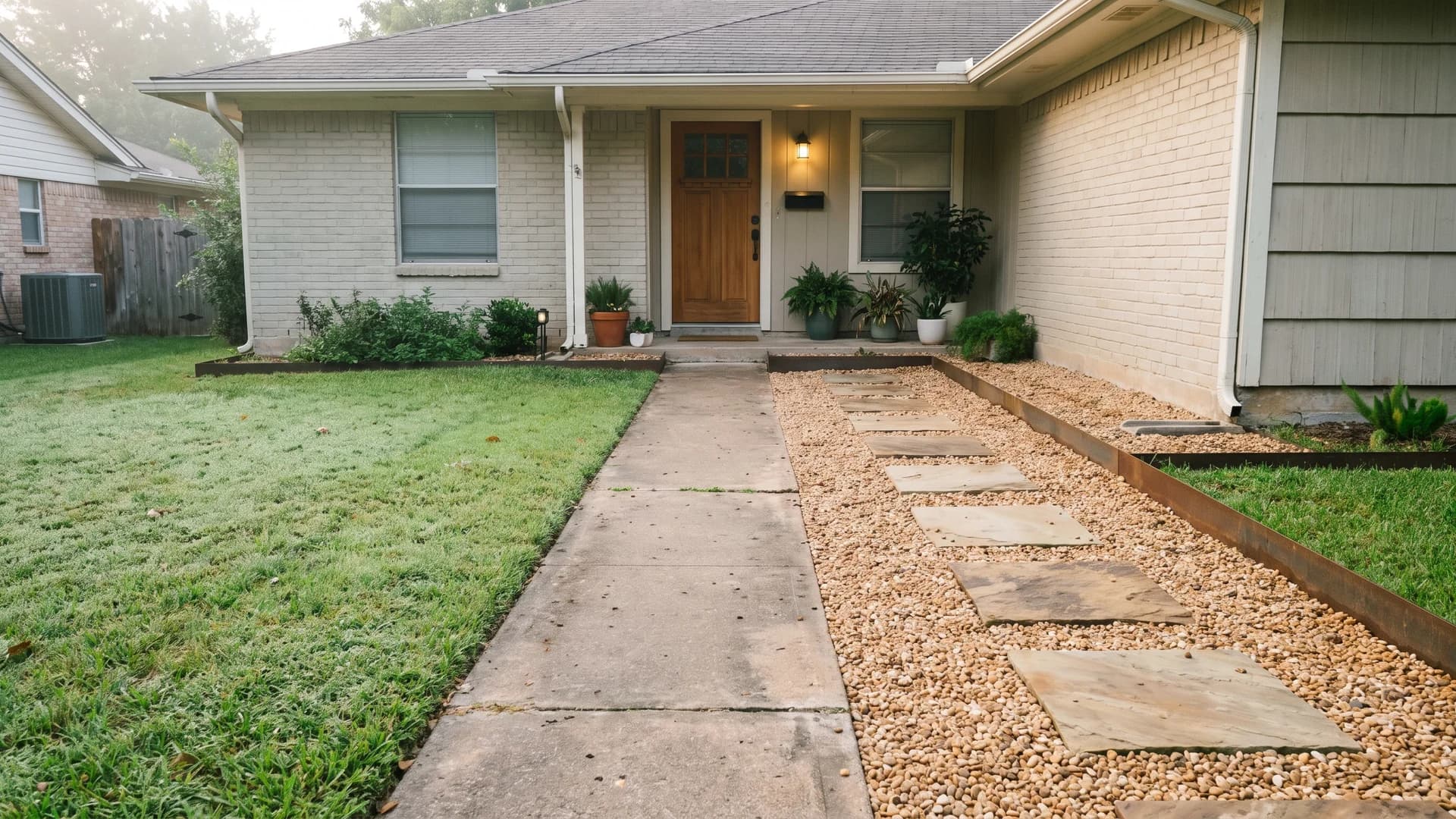
Most builder walkways are a 3-foot afterthought. Doubling the width with a pea gravel shoulder and oversized steppers upgrades the approach for $200 to $400, no demolition. The gravel field forgives the existing concrete's imperfections and the wider line makes the whole facade read more generous. Steel landscape edging on the lawn side keeps the gravel where you put it.
11. Lay a flagstone-and-gravel path to the door
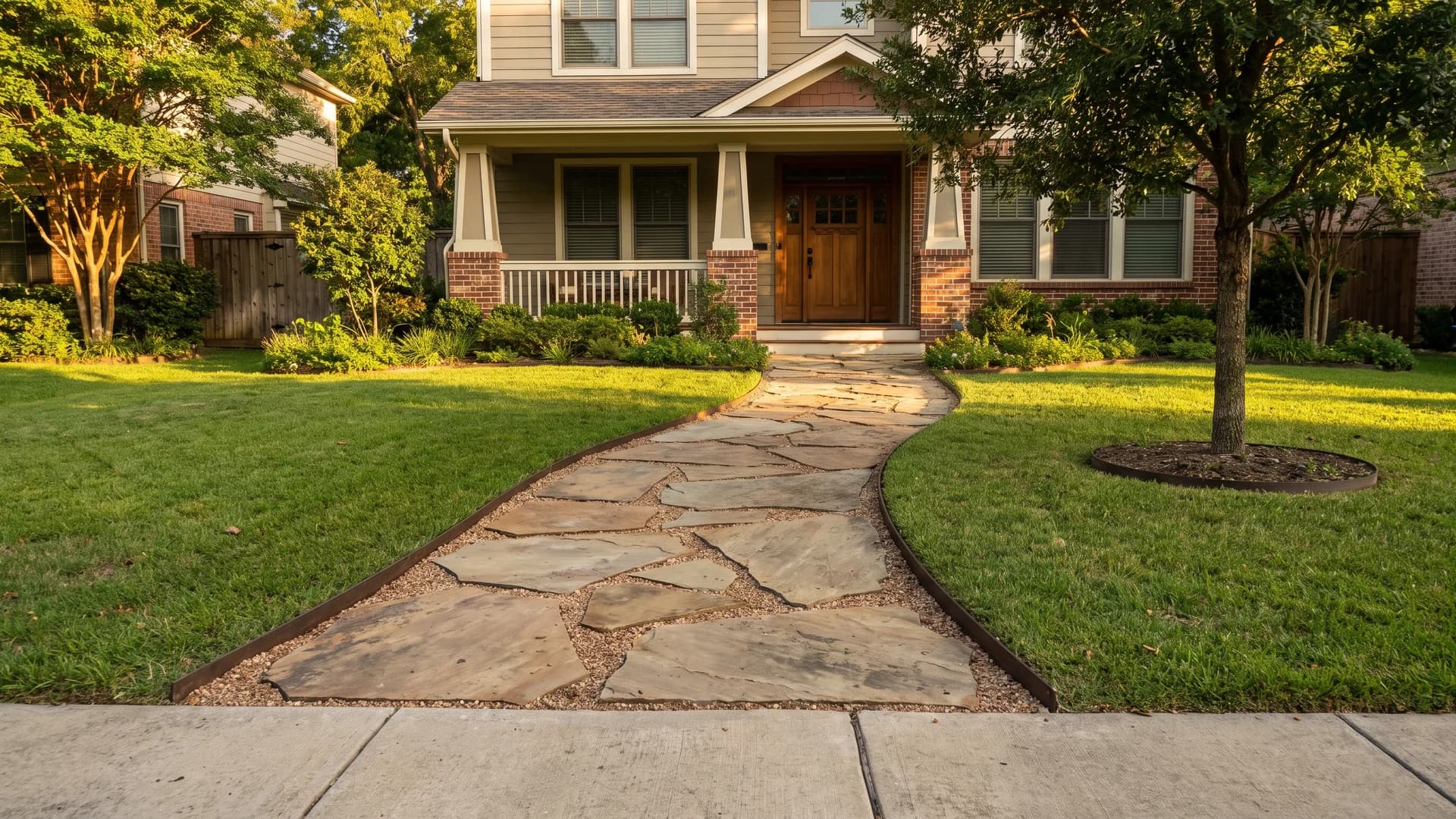
Where there's no front path at all, flagstone set in crushed gravel builds one without concrete work. Large irregular flags at $15 to $30 each, gaps filled with fines, edging both sides: a 25-foot path lands around $500 in materials. Size the tonnage with the gravel calculator before ordering. Permeable, plow-proof, and better looking every year it weathers.
12. Ring the tree and the mailbox in matching stone
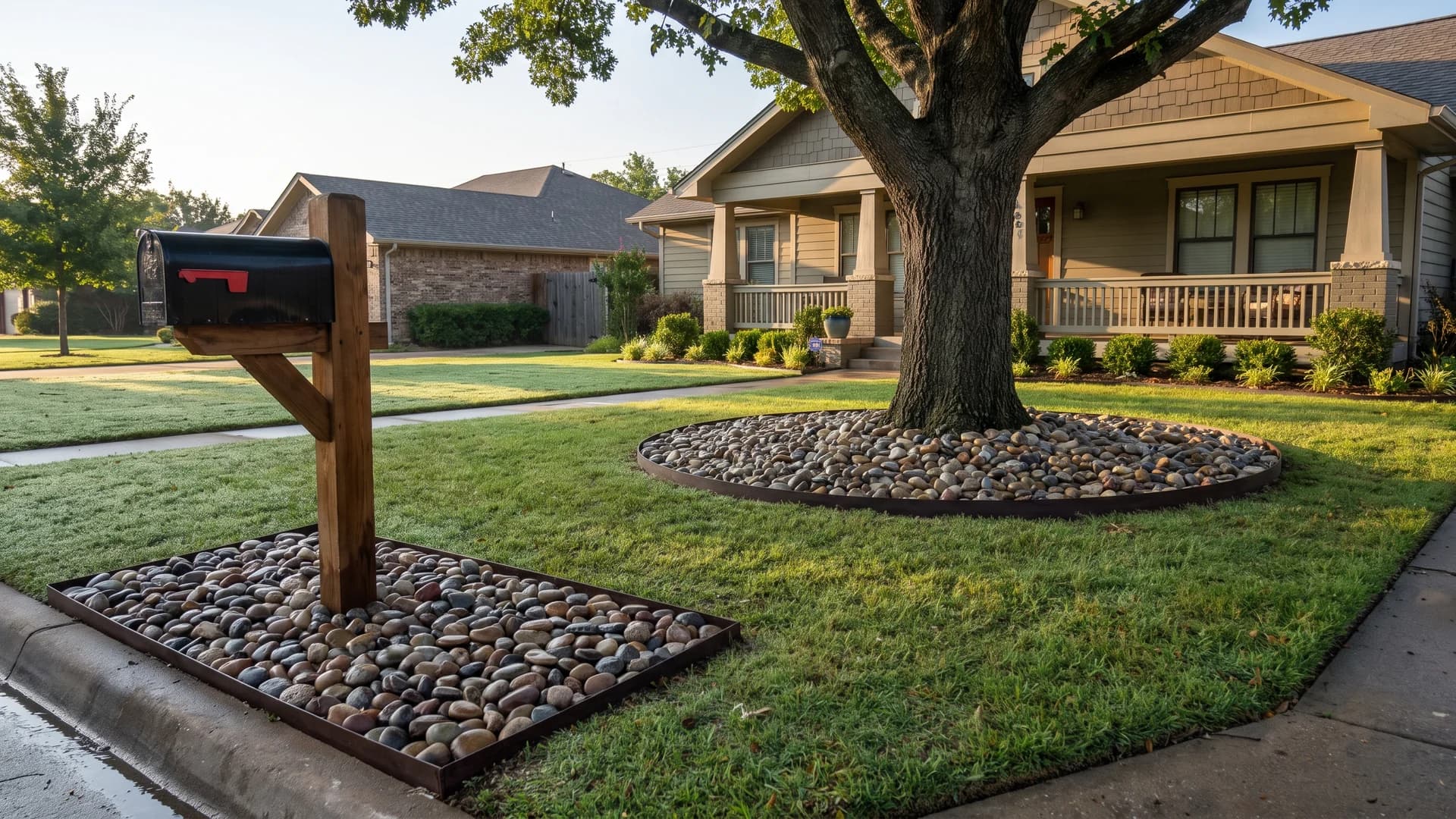
The tree circle and the mailbox bed are the two orphan spots in every front yard. Ring both in the same stone and edging and they suddenly belong to one design. Keep tree rings shallow and off the trunk, and skip fabric over the roots. Half a ton handles both spots, under $100. The mailbox end of this trick has its own full playbook in our mailbox landscaping ideas guide.
13. Alternate rock and mulch by function
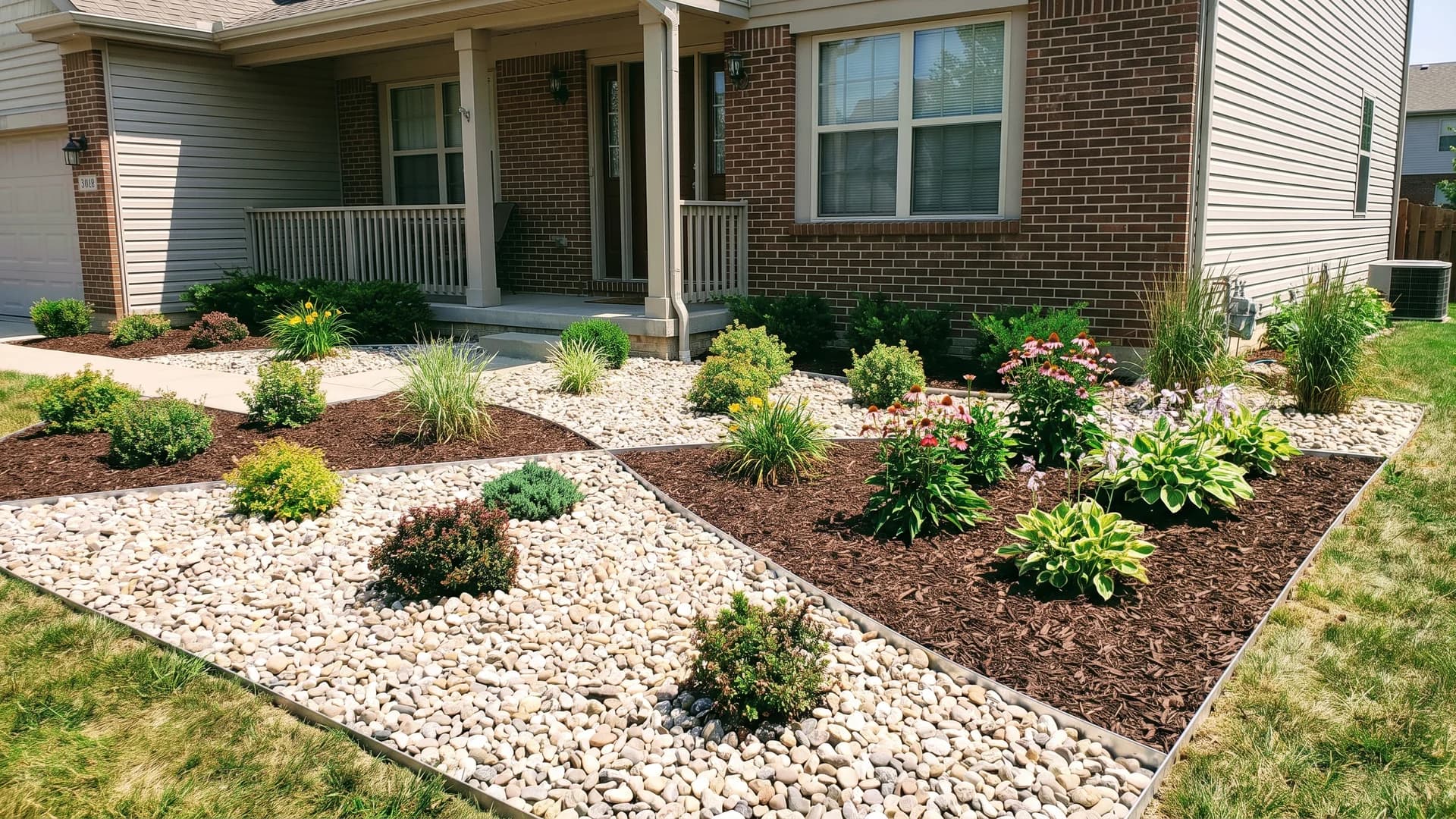
The rocks-and-mulch combination works when each material has a job: stone in the open, sun-baked stretches, mulch where things grow. The alternation gives the frontage rhythm, and the mulch beds keep roots cool where rock would cook them. Materials run $150 to $350 for a typical frontage split. This is the layout most searchers asking about rocks and mulch actually want; the full low-upkeep version of it is our low maintenance front yard landscaping plan.
14. Use lava rock where you want the color permanent
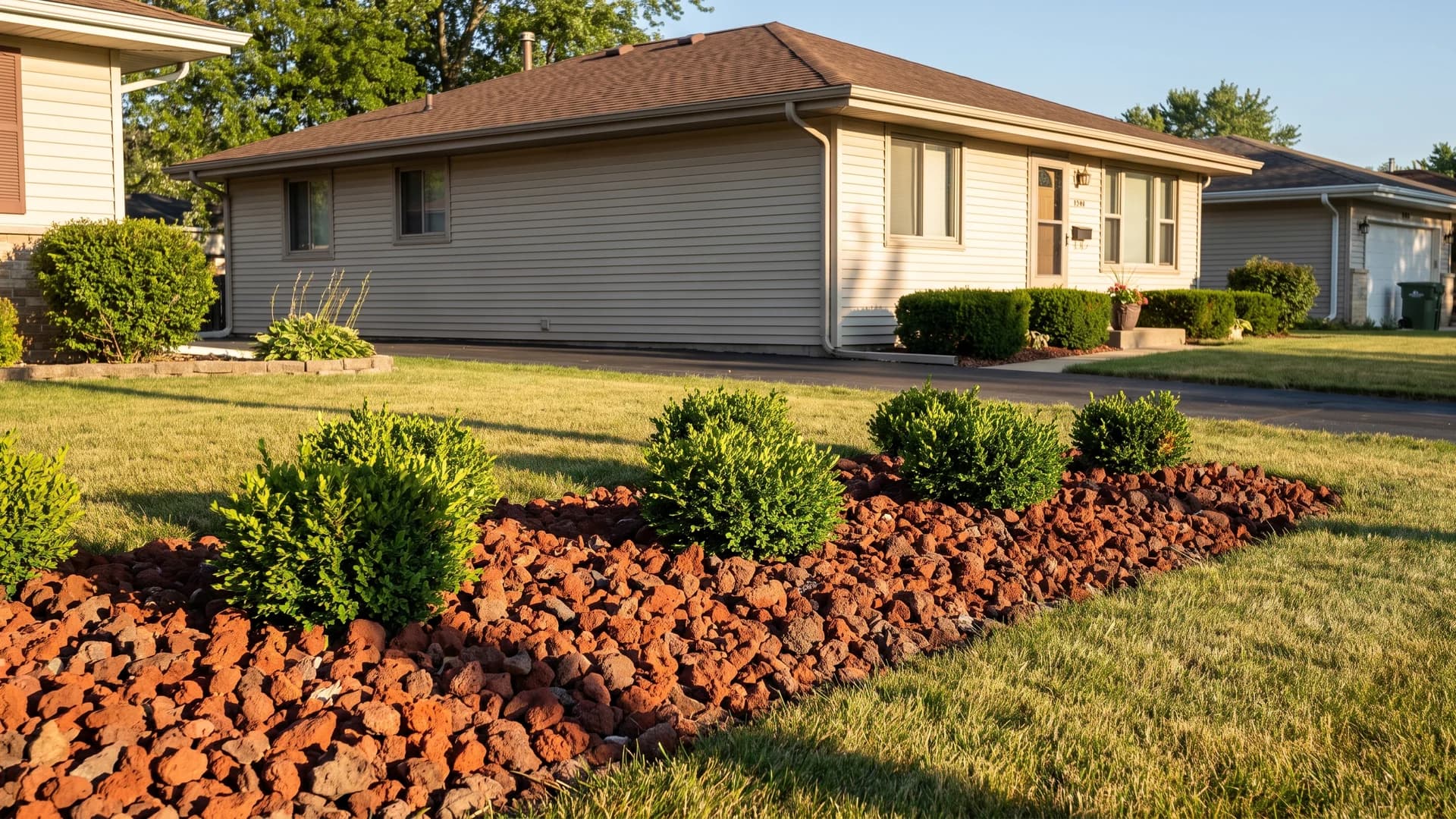
Lava rock weighs half what river rock does, never fades, and its rust-red or charcoal tones read intense against green foliage. It runs $120 to $180 a ton, and because it's porous it drains and dries fast. One caution: in hot climates, dark lava against a south wall becomes a radiator, so keep it to open beds and cooler exposures. As permanent colored mulch, nothing else competes.
15. Stack a gabion accent where modern fits
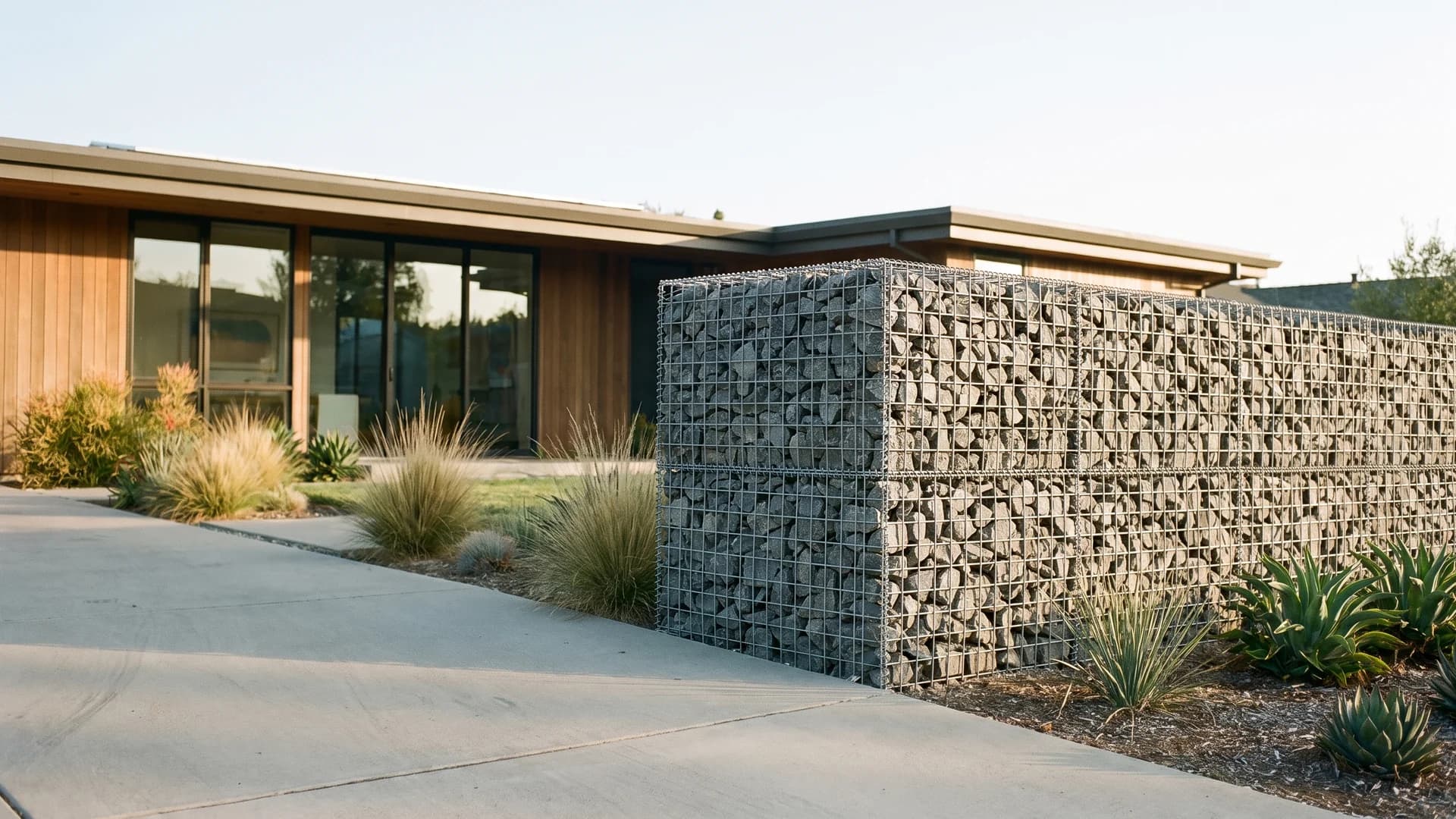
A gabion, a wire cage filled with rock, delivers a modern stone wall without a mason. Cages cost $40 to $100 each; fill them with the cheapest angular stone in your area and stack a low address-marker wall or bench base in an afternoon. On a contemporary or ranch facade the industrial texture lands exactly right. On a Victorian, skip it; materials have accents too.
16. Lay a pebble splash strip under the windows
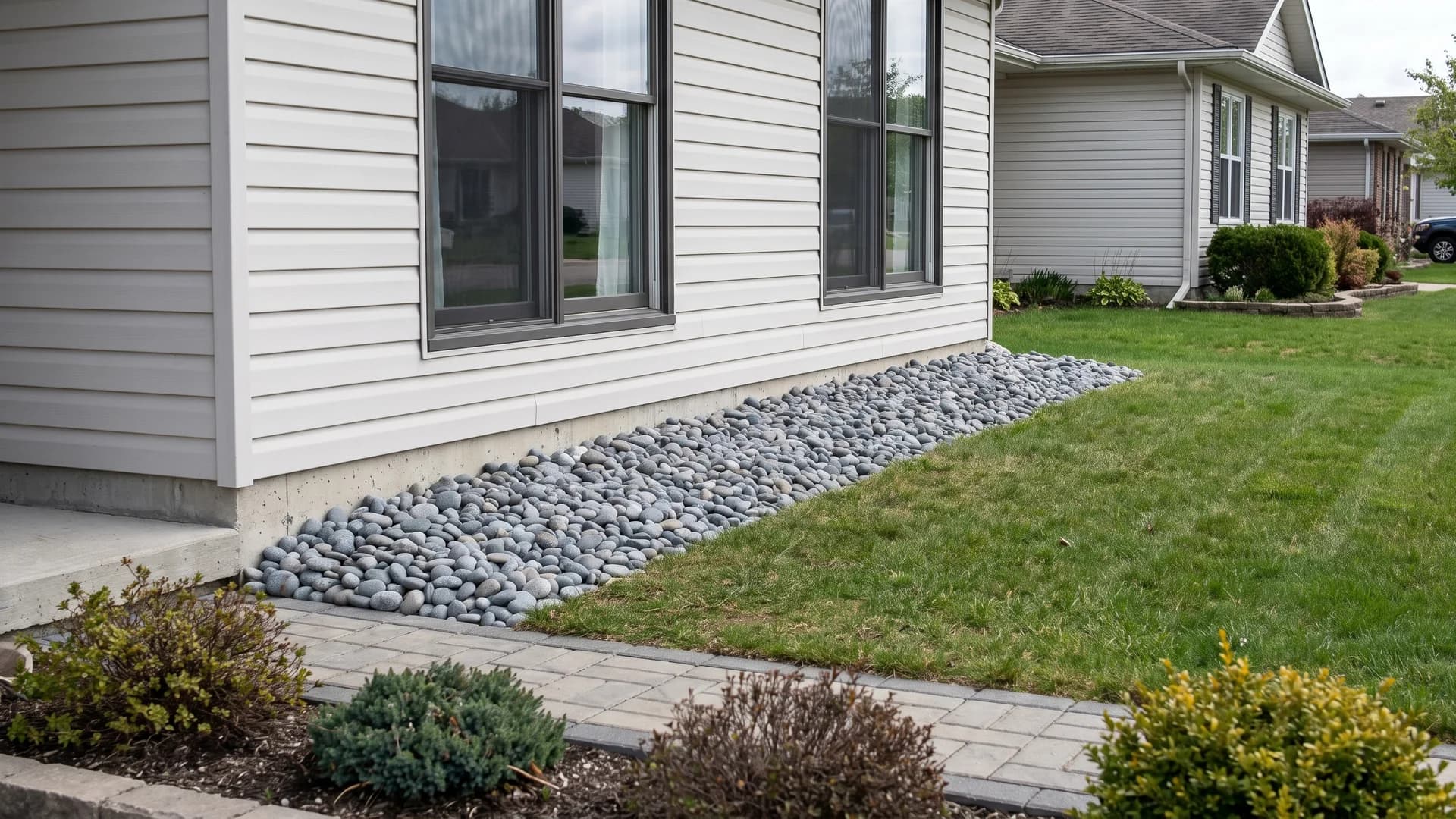
The 12 inches against the foundation takes roof splash, harbors weeds, and stains siding with mud. A pebble strip over fabric solves all three for about $60 per 40 feet. Grade it to slope away from the house, hold it with edging, and keep the stone an inch below siding level; rock piled against wood invites the moisture and termite problems it was supposed to prevent.
17. Plant the pockets, not the field
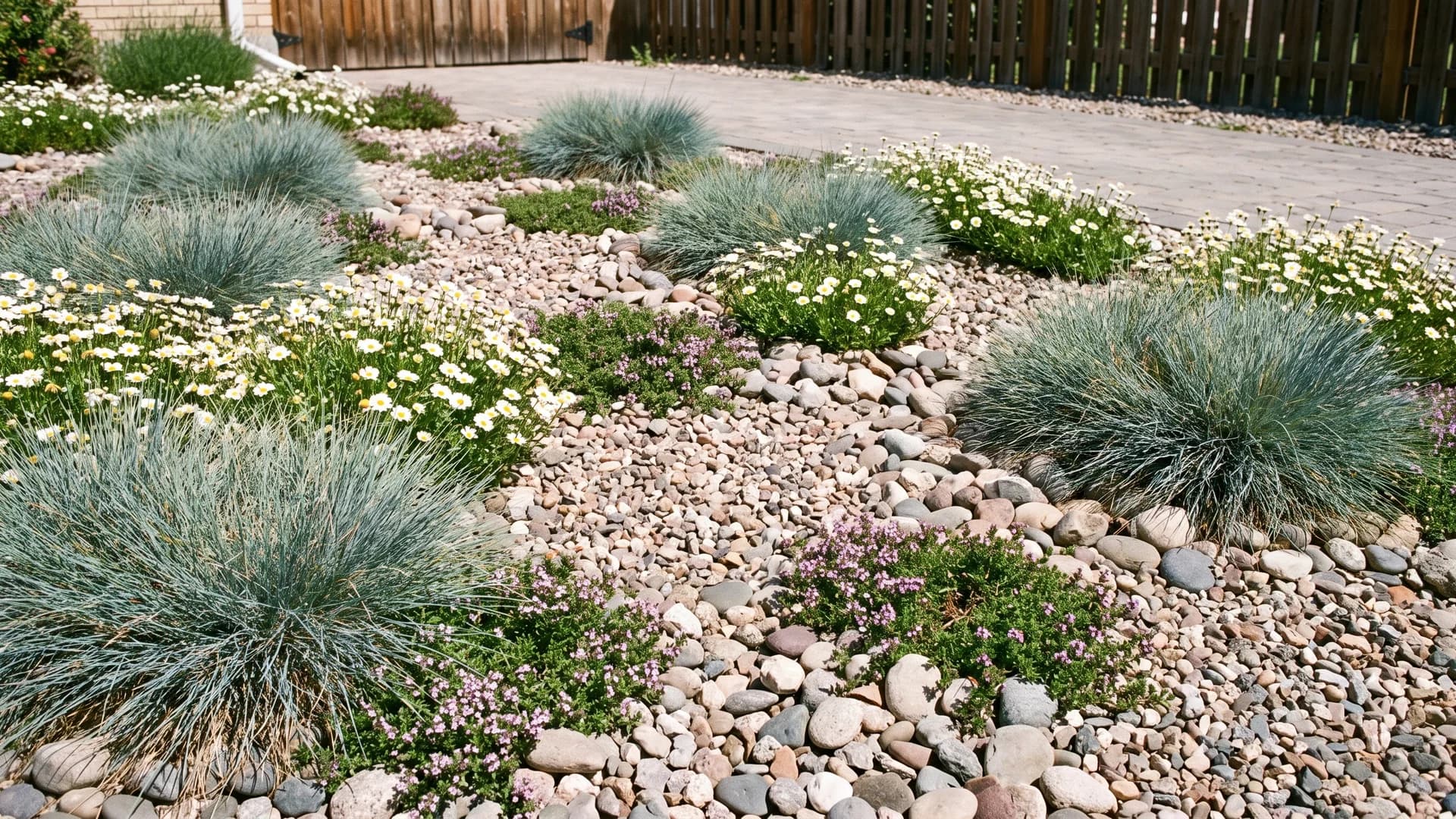
A rock yard without plants reads commercial. The fix is concentrated planting pockets cut through the fabric: a clump of blue fescue (zones 4 to 8), Blackfoot daisy that blooms through heat (roughly 5 to 10), a low lantana in warm zones. Ten plants in three pockets do more than thirty scattered singles, at $8 to $15 each. All are drought-tolerant plants that treat gravel as home.
18. Turn the driveway island into a rock garden
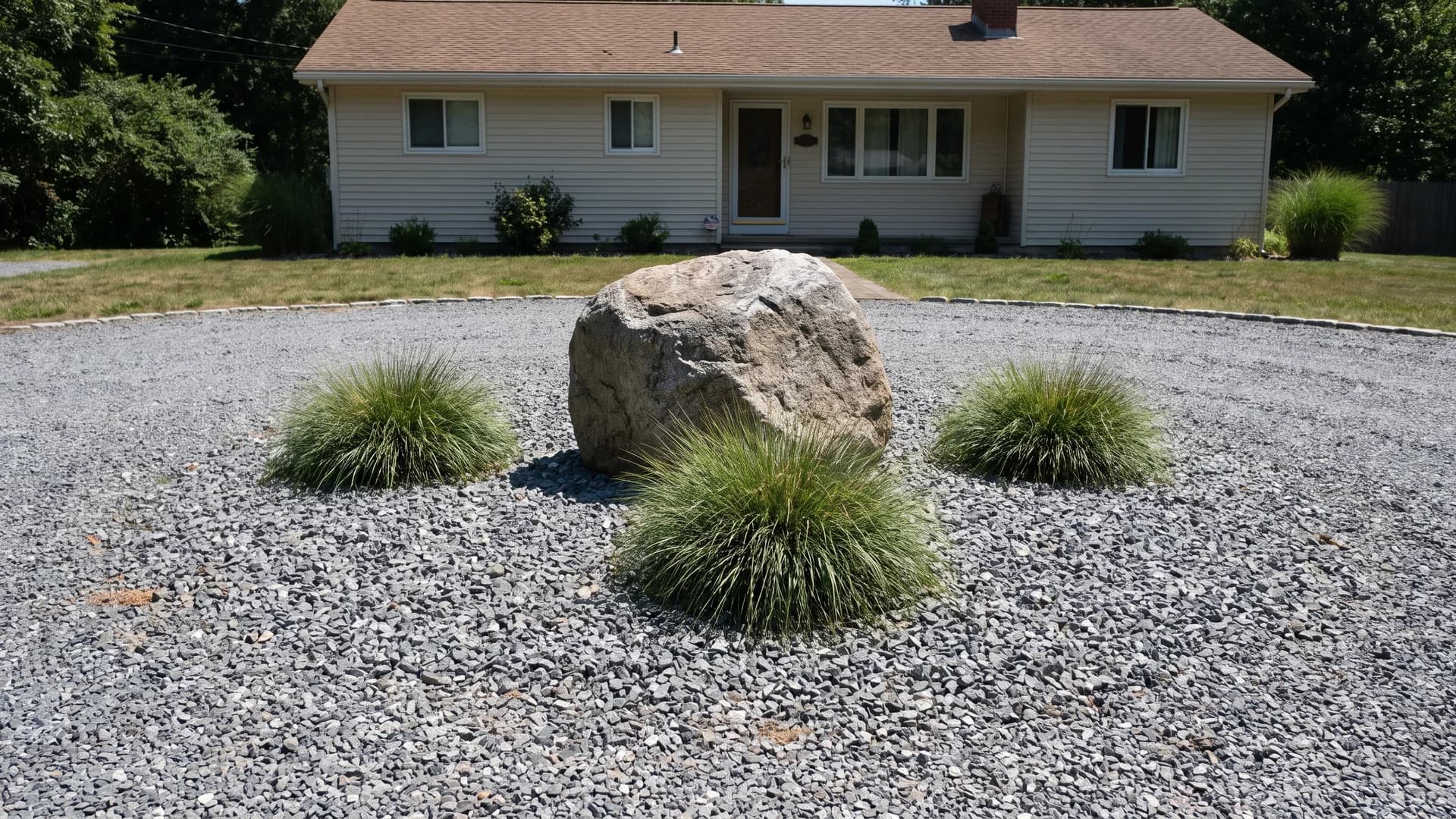
A circular drive's center island is a maintenance trap as lawn and a showpiece as stone. One two-man boulder, gravel field, three grass clumps, done: visible from every arrival, watered by nothing. Materials run $250 to $500 depending on the boulder. Keep plantings under 2 feet so the island never blocks the driver's view of the street.
19. Keep a third of it green
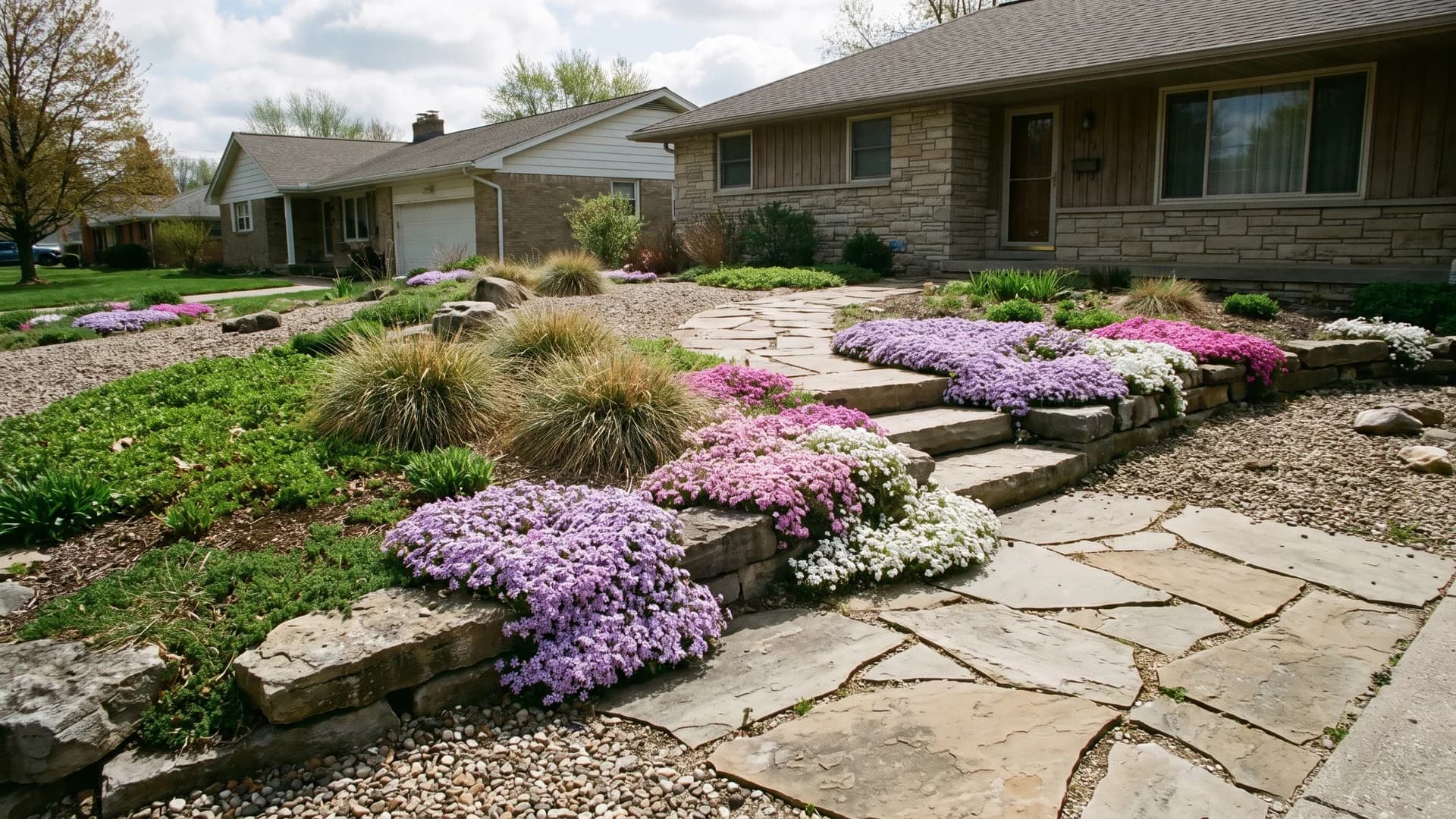
The rock yards that neighbors admire and the ones they report to the HOA differ by one ratio: living cover. Hold roughly a third of the visible surface in groundcover, grasses, and shrubs, creeping phlox pouring over stone edges is the classic move, and the design stays warm. All the hardscaping on this list is scaffolding; the green third is what makes it curb appeal instead of pavement.
Which rock idea first?
- One weekend, biggest visible change: 3 or 10.
- Slope out front: 7 and 6 handle feet and water in that order; the deeper slope playbook is our hillside budget guide.
- Killing the lawn entirely: read 4, then soften it with 17 and 19.
- Hot region: 5 and 14, light stone near walls, dark in the open.
- Under $150 to spend: 16, 12, or a start on 2.
FAQ
Is rock or mulch better for front yard landscaping?
Rock is better for open beds, borders, and anywhere you want to stop annual upkeep: it never fades or washes away. Mulch is better in planted beds, where roots want the cooler soil and organic matter. The strongest front yards alternate them by function rather than choosing a side.
How much does a landscaping boulder cost?
Small one-man boulders run $50 to $150, two-man stones $150 to $400, and large three-man focal boulders $300 to $800 or more delivered and placed. Delivery and placement are the real line items on big stones, so price the boulder sitting in your yard, not sitting in the supplier's lot.
How do I landscape a front yard with rocks and no grass?
Work to a ratio: about two-thirds stone in varied sizes and one-third living material massed in defined pockets. Vary the rock textures, anchor with at least one boulder, keep plantings in groups rather than scattered, and confirm your HOA allows turf-free yards before removing the lawn.
What do you put under landscaping rocks?
Commercial woven landscape fabric, overlapped 6 inches and pinned, with solid edging at every boundary, then 2 to 3 inches of stone. The exception is over tree roots, where fabric suffocates the exchange the tree needs; there, use a thicker shallow layer of stone alone and pull the rare weed by hand.
How many tons of rock do I need?
Multiply length by width by depth in feet and divide by 27 for cubic yards; a ton of most landscape rock covers 80 to 100 square feet at 2 to 3 inches deep. Round up, since thin coverage is how weeds win. For gravel paths and patios, a calculator saves the second delivery fee.