21 Florida Landscaping Ideas That Hold Up to Heat, Sand, and Storms
Florida punishes plants that were picked from a catalog photo. These 21 ideas each carry the zones they work in, whether they take salt, how they handle wind, and how much sun they want, from three-height palm beds and lawn conversions to coastal front rows and a rain garden for the corner that floods every August.
Sand drains before the water reaches the roots, the afternoon sun bleaches anything that wasn't built for it, and one named storm can take out a tree that stood for thirty years. Planting advice written for Ohio does not survive down here. The Florida landscaping ideas below are built around those constraints instead of ignoring them, which is why every one carries a short line telling you the zones it works in, whether it takes salt, and how much sun it wants.
Twenty-one ideas, grouped by what you're actually trying to fix: plants that read as Florida, low-upkeep beds, curb appeal, budget moves, shade, and the coastal and storm-water problems nobody else writes about. Zones 8a in the western panhandle through 11b in the Keys all get a mention, because a plant that shrugs off January in Naples will die in Tallahassee.
Every image here is an AI-generated design concept rendered from a typical Florida yard photo. It's the same output AI landscape design produces from a picture of yours, so you can see any of these on your own lot instead of on somebody else's.
Which Florida are you landscaping in?
The state covers four USDA hardiness zones. 8a and 8b sit in the western panhandle, where a hard freeze arrives most winters. 9a and 9b run down through Central Florida. 10a and 10b cover the southern peninsula, and 11a and 11b are the Keys, where frost is a rumor. Check yours on the USDA hardiness zone map before you spend money on anything in a 15-gallon pot.
Three other conditions change what works. Salt comes first on a coastal lot, where spray rides the wind and burns whatever isn't adapted to it; bay and canal lots get a milder dose. Wind is second, and in Florida it makes tree choice a storm decision as much as a shade decision. Sand is third: most of the state sits on it, it drains fast, and it holds close to no nutrition, which is why mulch depth matters more here than it does anywhere up north.
One more rhythm to plan around. The wet season dumps rain from June into September and the dry season delivers almost none, so the corner that floods in August is often the corner that needs irrigation in April.
Palms, natives, and plants that read as Florida
1. Build the front bed around three palm heights
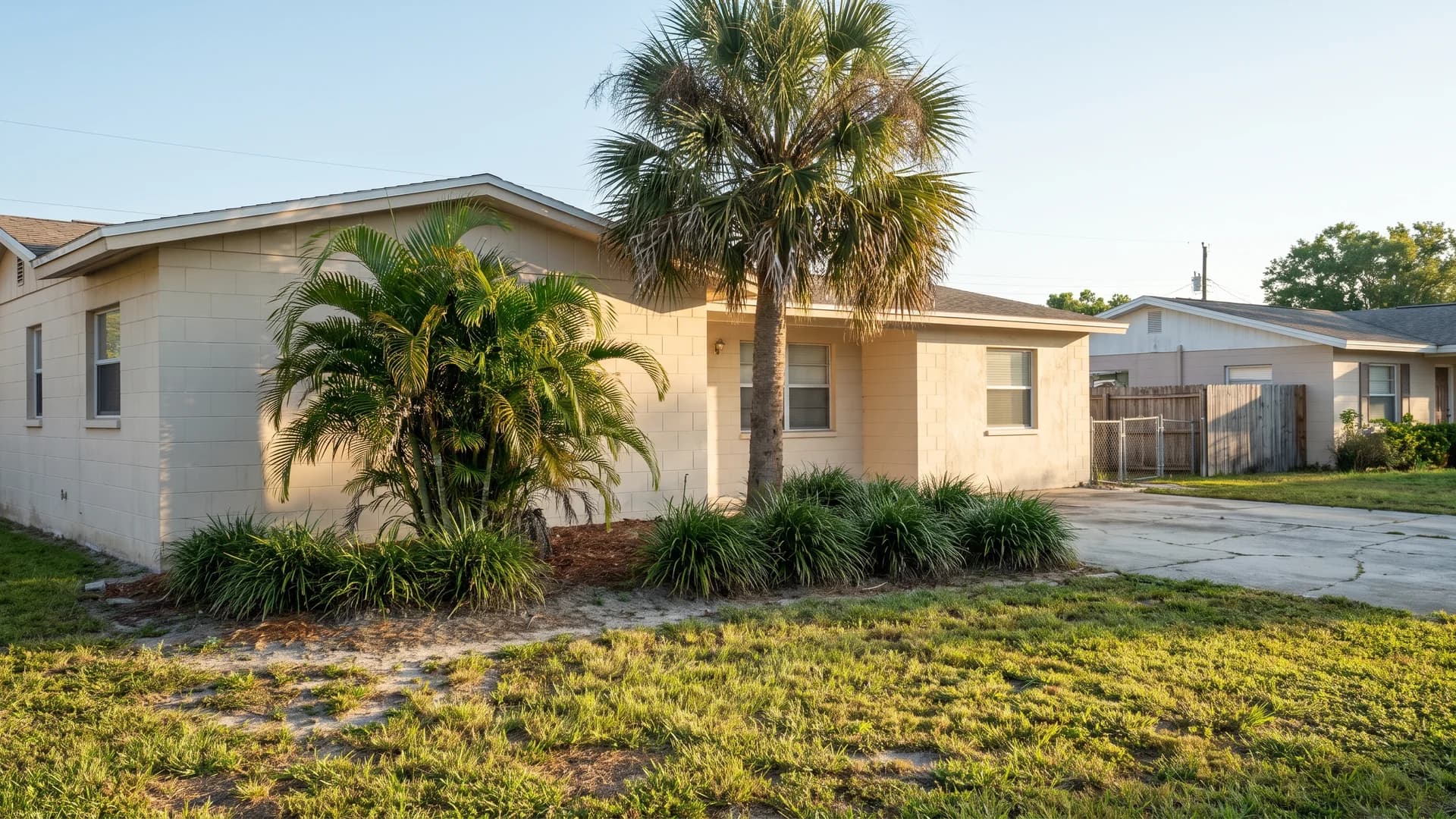
One palm alone in a bed looks like something a builder left behind. Three heights read as design: a sabal or pindo for the canopy, a cat palm or lady palm at eye level, and a low base of liriope or dwarf jasmine. Keep the tall one at least 8 feet off the wall so the fronds aren't scraping the roof in ten years. Field-grown sabals run $150 to $300 installed.
Works in: Zones 8b to 11b · sabal and pindo take a freeze · full sun to part shade
2. Pick a wind-smart tree instead of a fast one
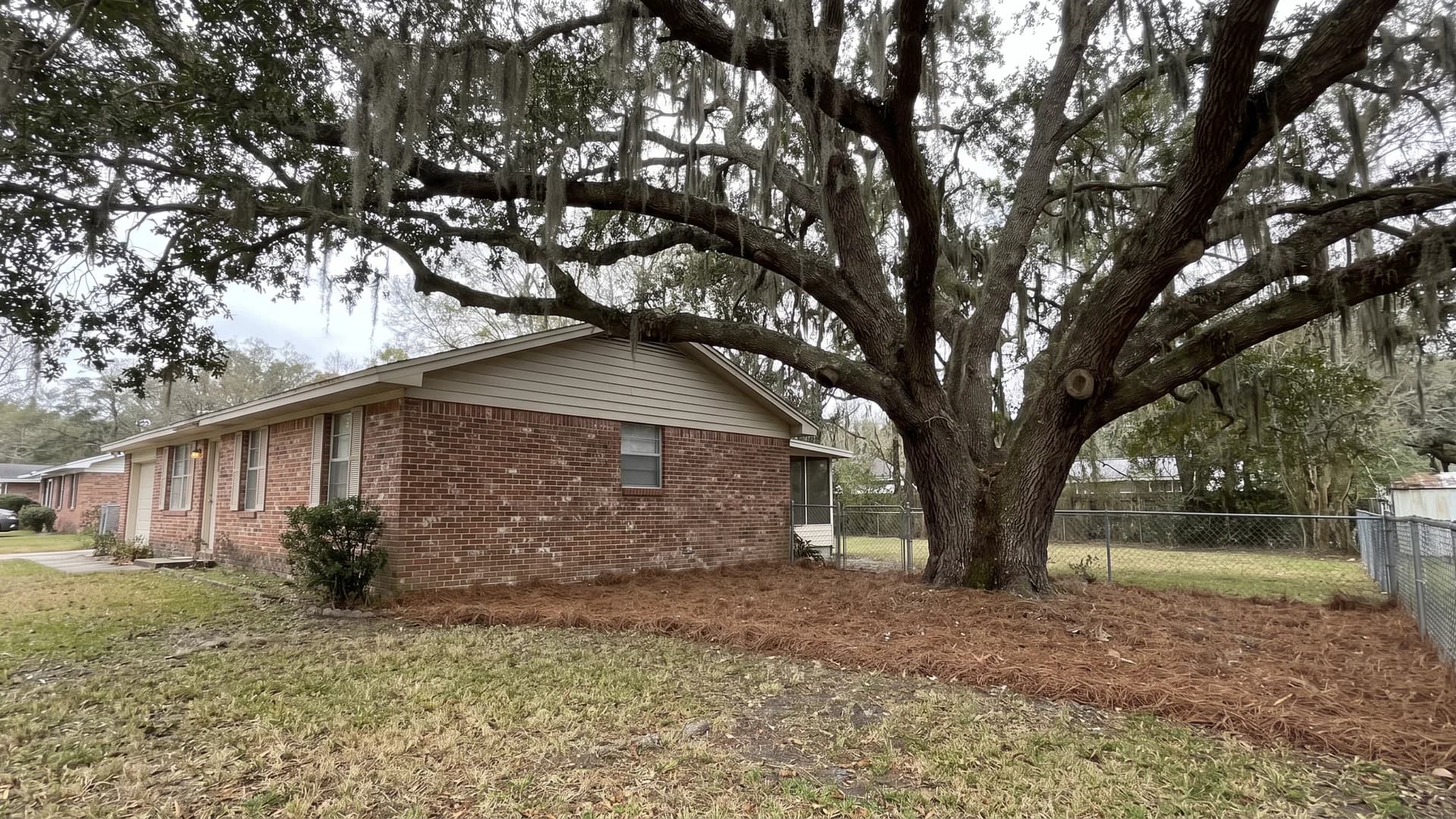
Sabal palmetto is the state tree partly because it bends. The trees that fail in storms are the quick growers people plant for fast shade: laurel oak, water oak, and the brittle softwoods. Live oak, southern magnolia, and cabbage palm hold up far better. If a fast-growing tree is already standing within falling distance of the roof, that's a pruning contract, not a landscaping idea.
Works in: Zones 8a to 10b · live oak and sabal rate high for wind · full sun
3. Layer crotons and ixora for color that isn't flowers
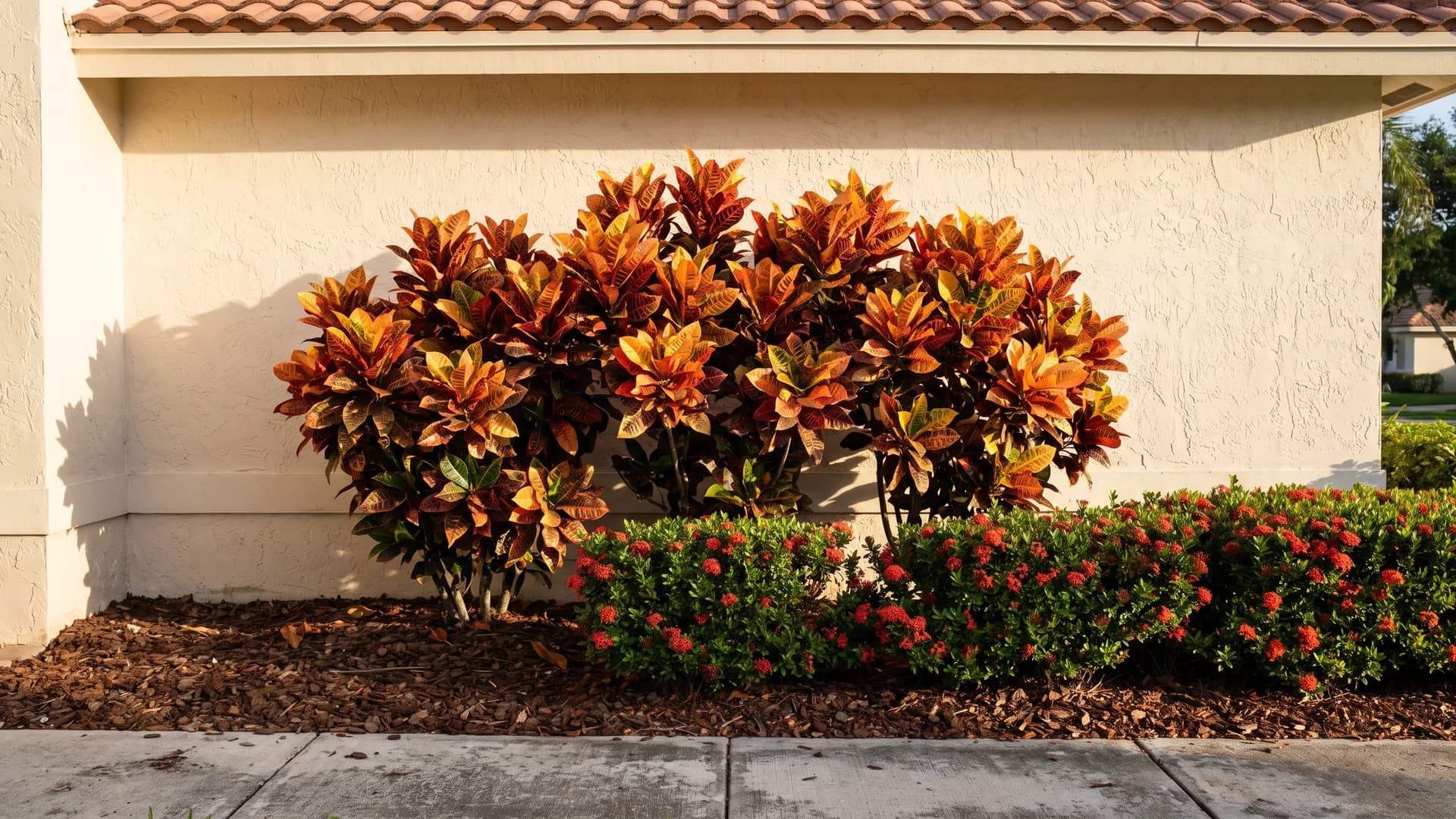
Flowering color is a maintenance schedule. Foliage color isn't. Crotons hold orange, red, and yellow year-round and ask for nothing but drainage, and dwarf ixora fills in below them with clusters that bloom most of the year. A five-plant group of 3-gallon crotons costs $75 to $120. This is the tropical landscaping look that survives on neglect, as long as you're south of the freeze line.
Works in: Zones 10a to 11b, 9b with freeze protection · low salt tolerance · full sun to part shade
4. Let muhly grass do the fall show
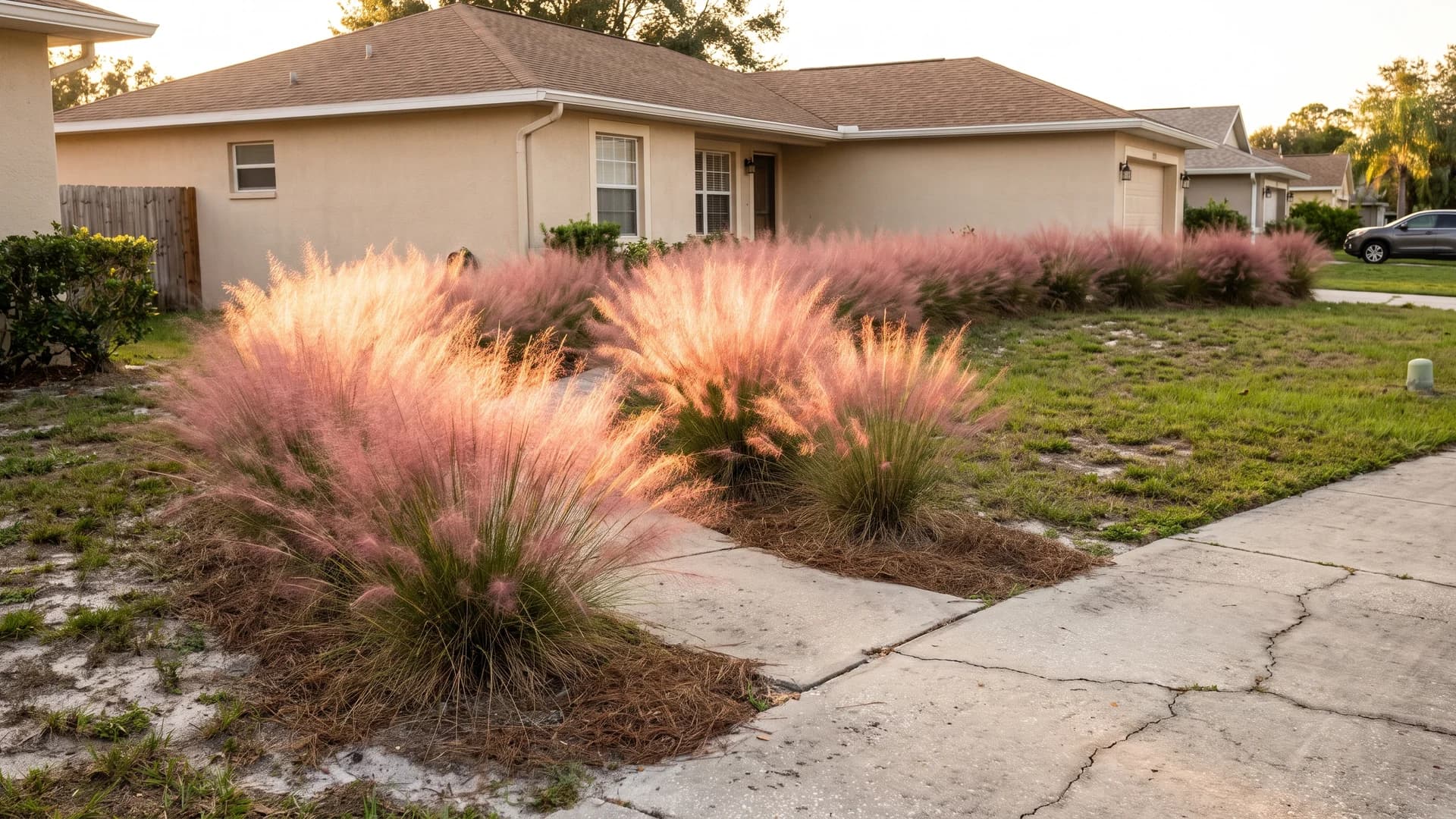
For about six weeks in October and November, pink muhly grass turns into a haze that makes people slow the car down. The rest of the year it's a tidy green clump wanting one cutback in late winter and no irrigation once it's rooted. It's native statewide, so it works from Pensacola to Key Largo. Plant it in drifts of five or seven; a single clump reads as an accident.
Works in: Zones 7a to 11b · salt-tolerant · full sun
5. Fill the dry shade under a live oak with coontie
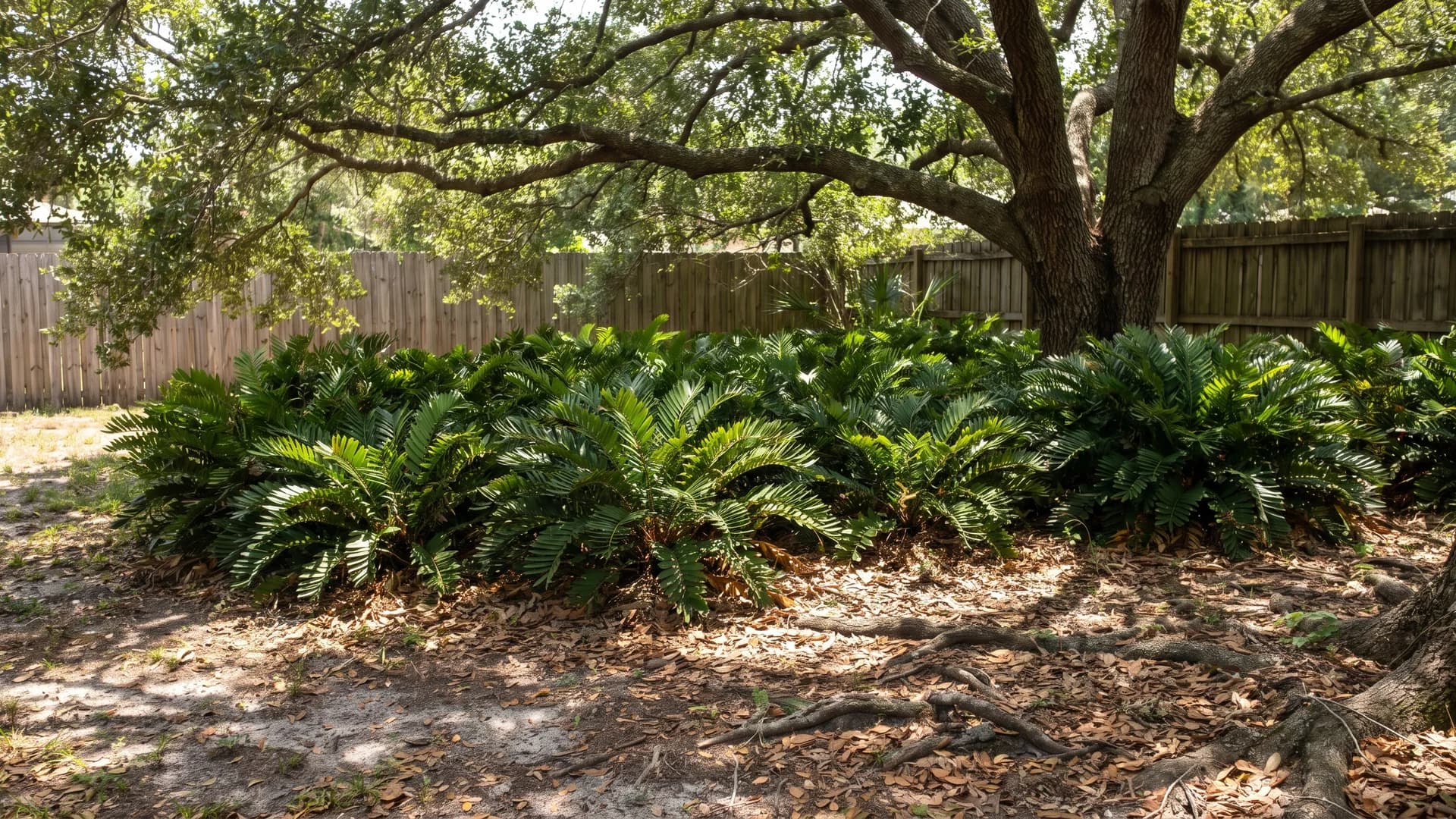
Nothing good happens when you try to grow St. Augustine under a mature live oak. Coontie does fine there. It's a Florida native plant, a low cycad that looks like a fern crossed with a palm, it takes deep dry shade, and it's the only host plant for the atala butterfly. Three-gallon plants run $20 to $35. Space them 30 inches apart and mulch between until they close.
Works in: Zones 8b to 11b · salt-tolerant · deep shade through full sun
Low-maintenance Florida landscaping ideas
6. Retire the strip of lawn you can never keep green
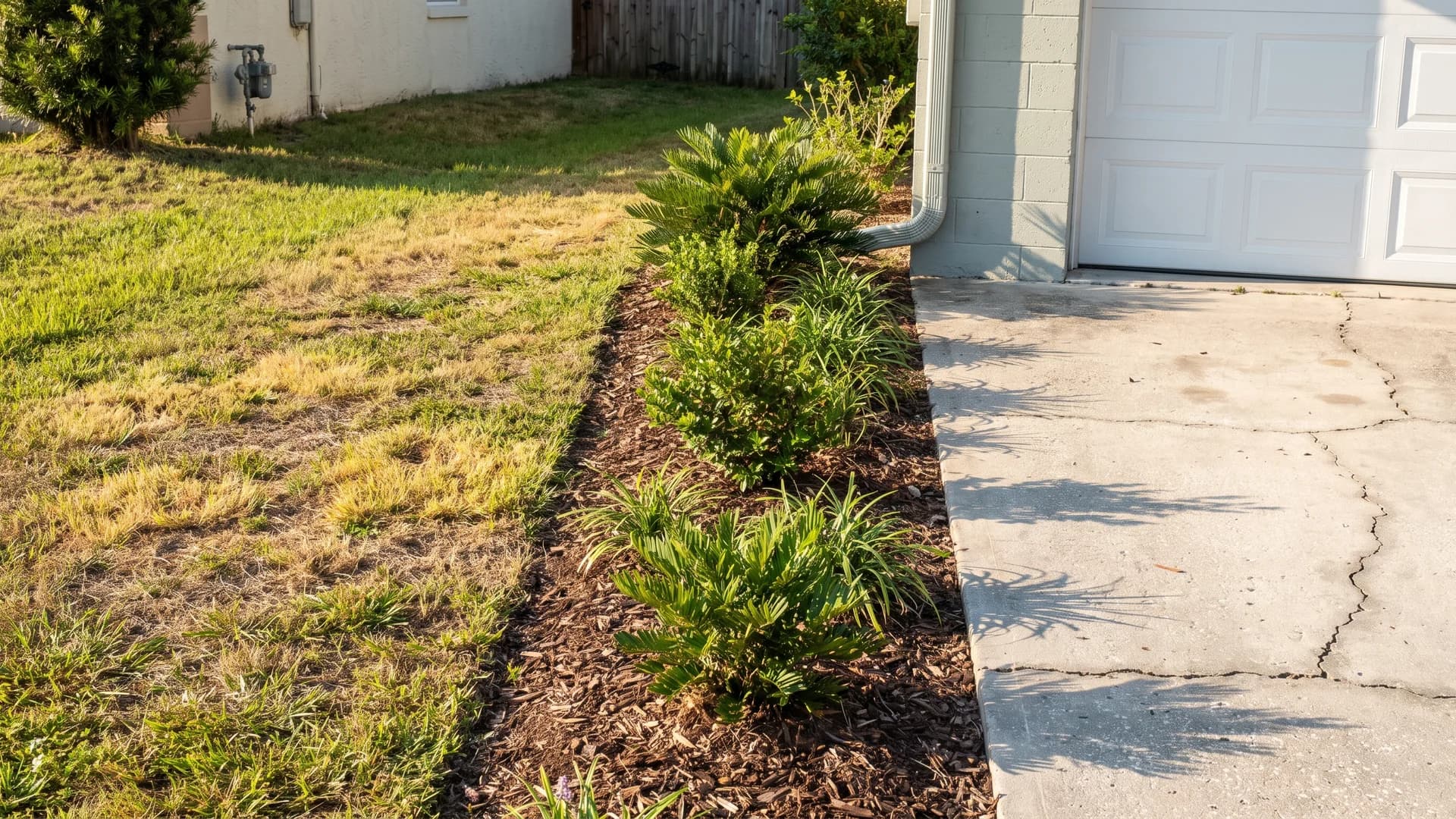
Every yard has one. The baked strip along the driveway, or the shaded run beside the house, where turf has been dying on a loop for years. That's not a lawn problem, it's a wrong-place problem. Convert it to Florida-friendly shrubs and groundcover and you delete the mowing, the irrigation, and the annual re-sod bill. As lawn alternatives go it's the cheapest, roughly $6 to $12 a square foot in plants and mulch.
Works in: Zones 8a to 11b · plant choice follows the sun · the hardest zone of the yard is the best place to start
7. Swap turf for perennial peanut
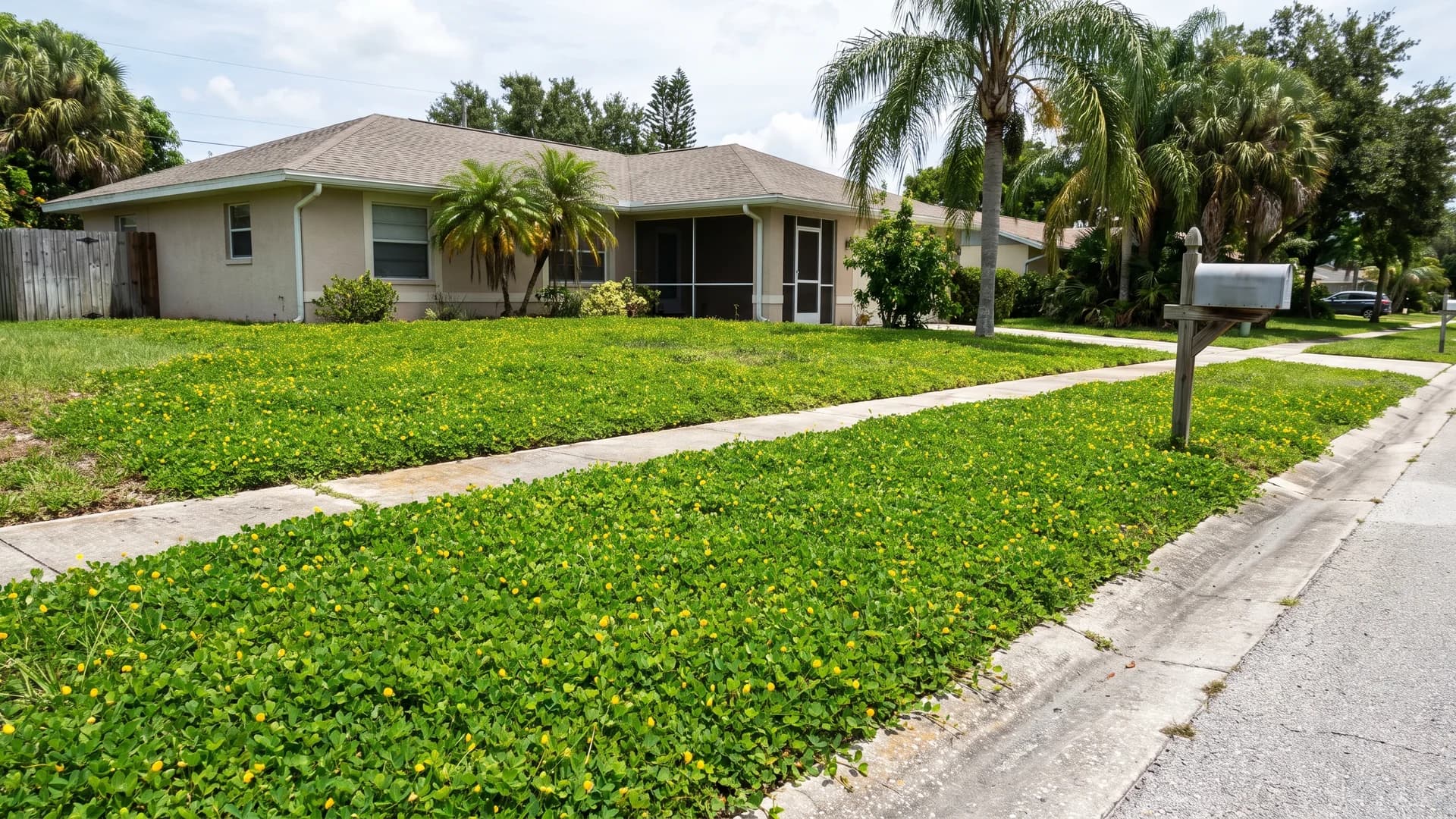
Perennial peanut is the closest thing Florida has to a lawn that looks after itself. It handles foot traffic, flowers yellow most of the year, fixes its own nitrogen, and once established it drinks a fraction of what St. Augustine demands. Plugs or sod cost more up front than turf, roughly $2 to $4 a square foot, and it goes off-color in a north Florida freeze before greening back in spring.
Works in: Zones 8b to 11b · moderate salt tolerance · full sun
8. Group plants by how much water they drink
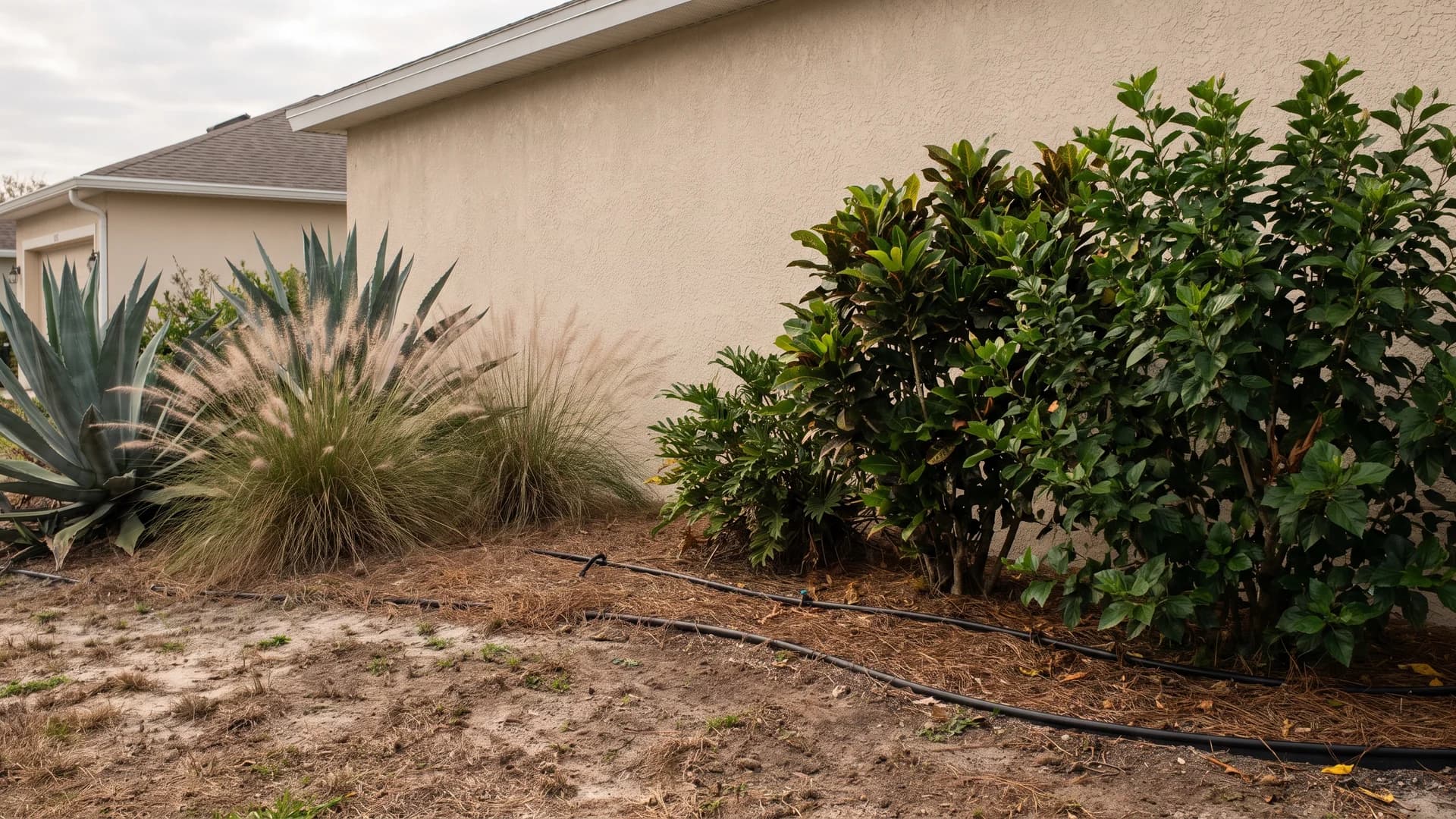
This is the second principle of Florida-Friendly Landscaping and the one that saves the most water: thirsty plants together on one irrigation zone, drought-tolerant plants on another. Mix them and half the bed drowns so the other half can live. Much of the state also caps landscape watering at two or three days a week year-round, so grouping correctly is what keeps a plant list legal and alive at the same time.
Works in: Zones 8a to 11b · designed around 2 to 3 day watering restrictions · sun or shade
9. Mulch deeper than you think, because it's sand under there
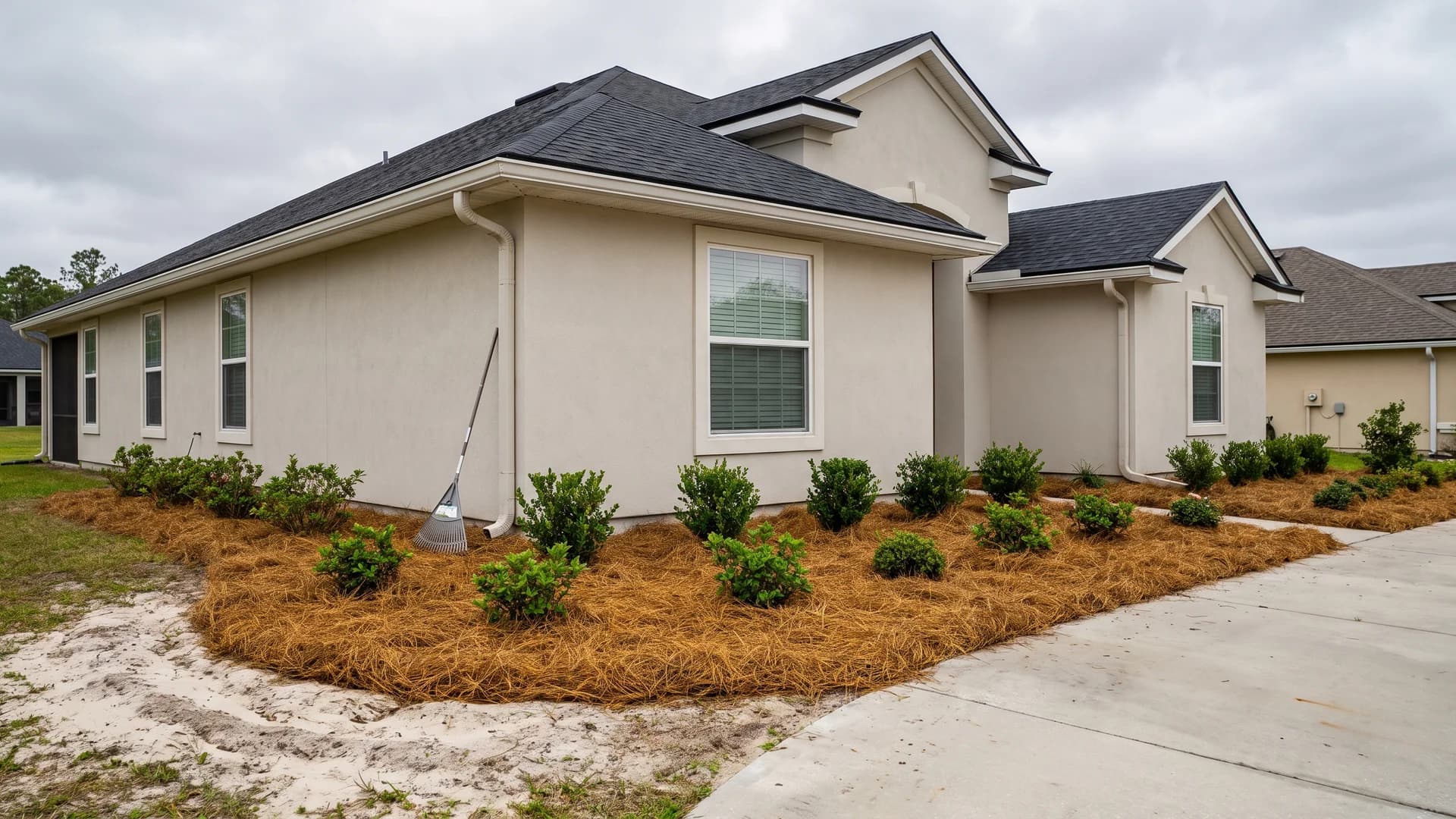
Two to three inches of pine bark, pine straw, or eucalyptus is the cheapest fix sandy soil will ever get. It slows evaporation, keeps root-zone temperatures down, and slowly adds the organic matter sand never had. Keep it a few inches back from trunks. Bulk mulch runs $30 to $45 a cubic yard delivered, and the mulch calculator turns bed dimensions into yards so you don't order three when you need one.
Works in: Zones 8a to 11b · every soil type in the state · top up once a year
10. Build one bed that gets through the dry season alone
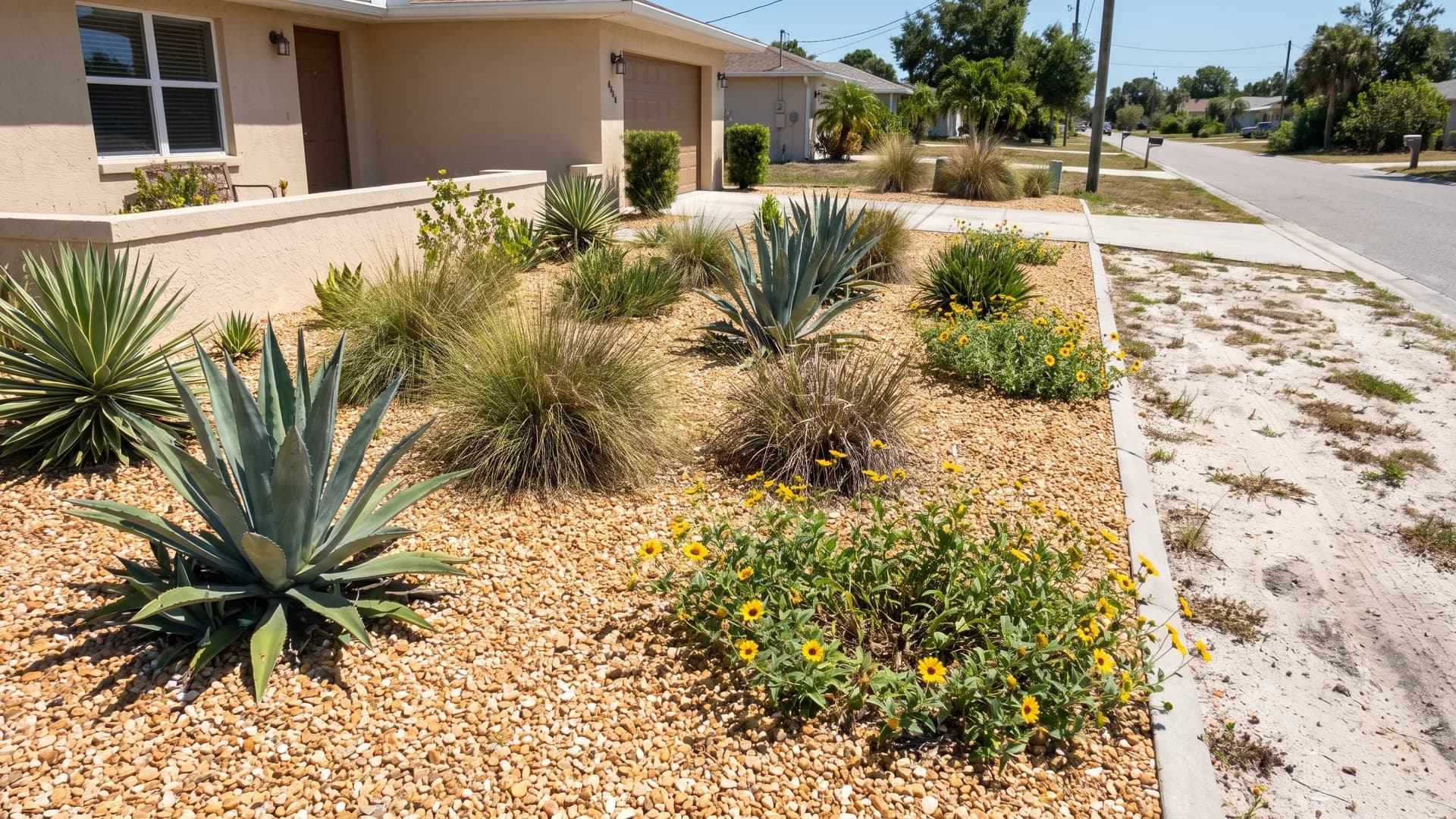
Xeriscaping isn't only a Southwest move. A full-sun bed of agave, Fakahatchee grass, dune sunflower, and coarse gravel rides out a Florida dry season on rainfall once the roots are down, and it doesn't go brown the week irrigation gets restricted in April. Skip landscape fabric under the gravel. It blocks the leaf litter layer that would otherwise build soil for you. The gravel work behind a bed like this comes straight from desert landscaping; in Florida only the plant list changes.
Works in: Zones 9a to 11b · agave and dune sunflower both take salt · full sun all day
Florida front yard landscaping and curb appeal
11. Keep the driveway hedge low and HOA-legal
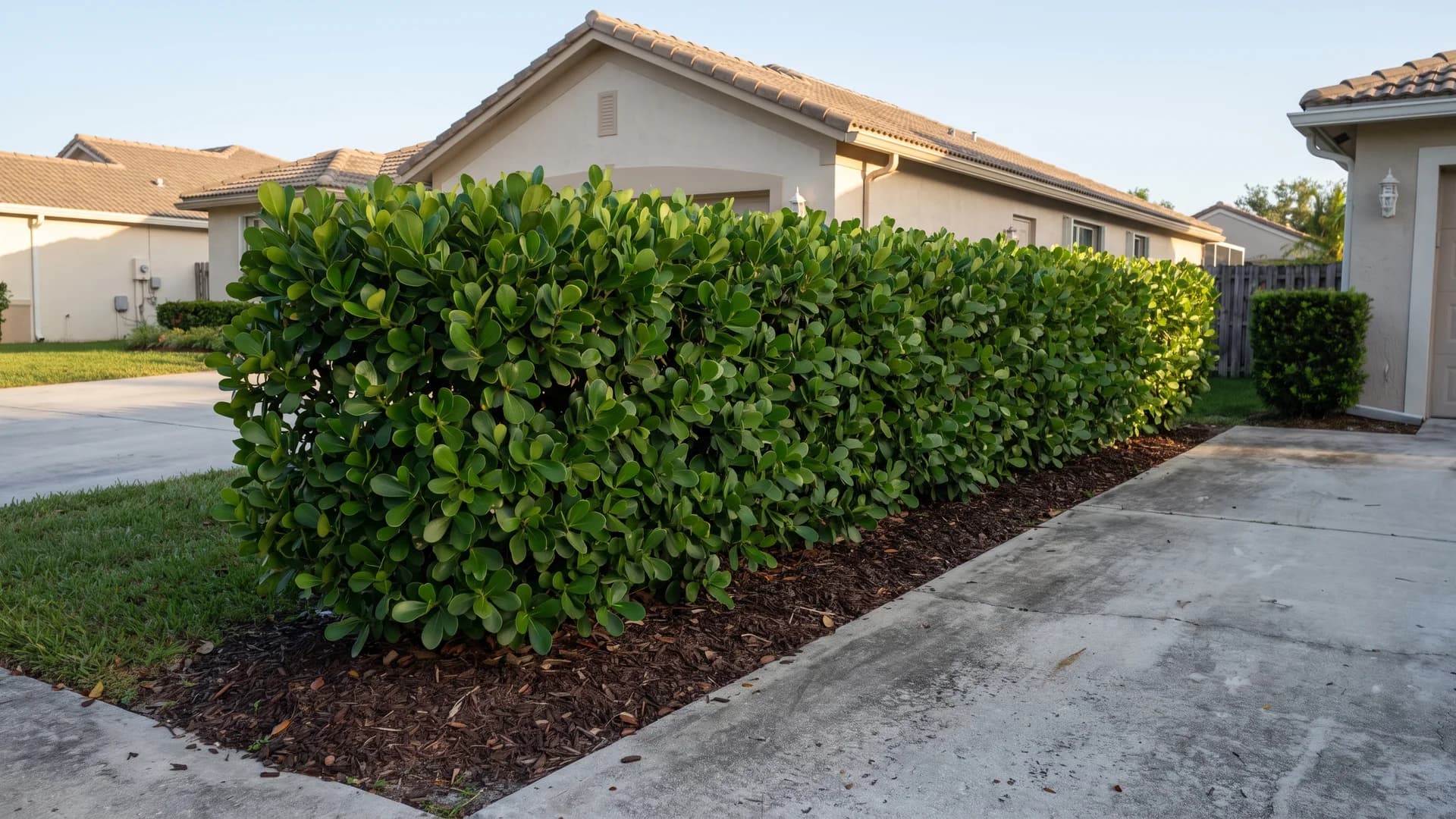
A hedge along the driveway tidies the whole front elevation, but most Florida HOA guidelines cap height near the apron for sightlines. Dwarf firebush and small clusia varieties top out around 3 to 4 feet, which stays under nearly every rule on one light trim a year. Firebush pulls hummingbirds all summer. Clusia takes coastal wind without flinching.
Works in: Zones 9a to 11b, firebush to 8b with winter dieback · clusia is salt-tolerant · full sun
12. Match the two sides of the entry
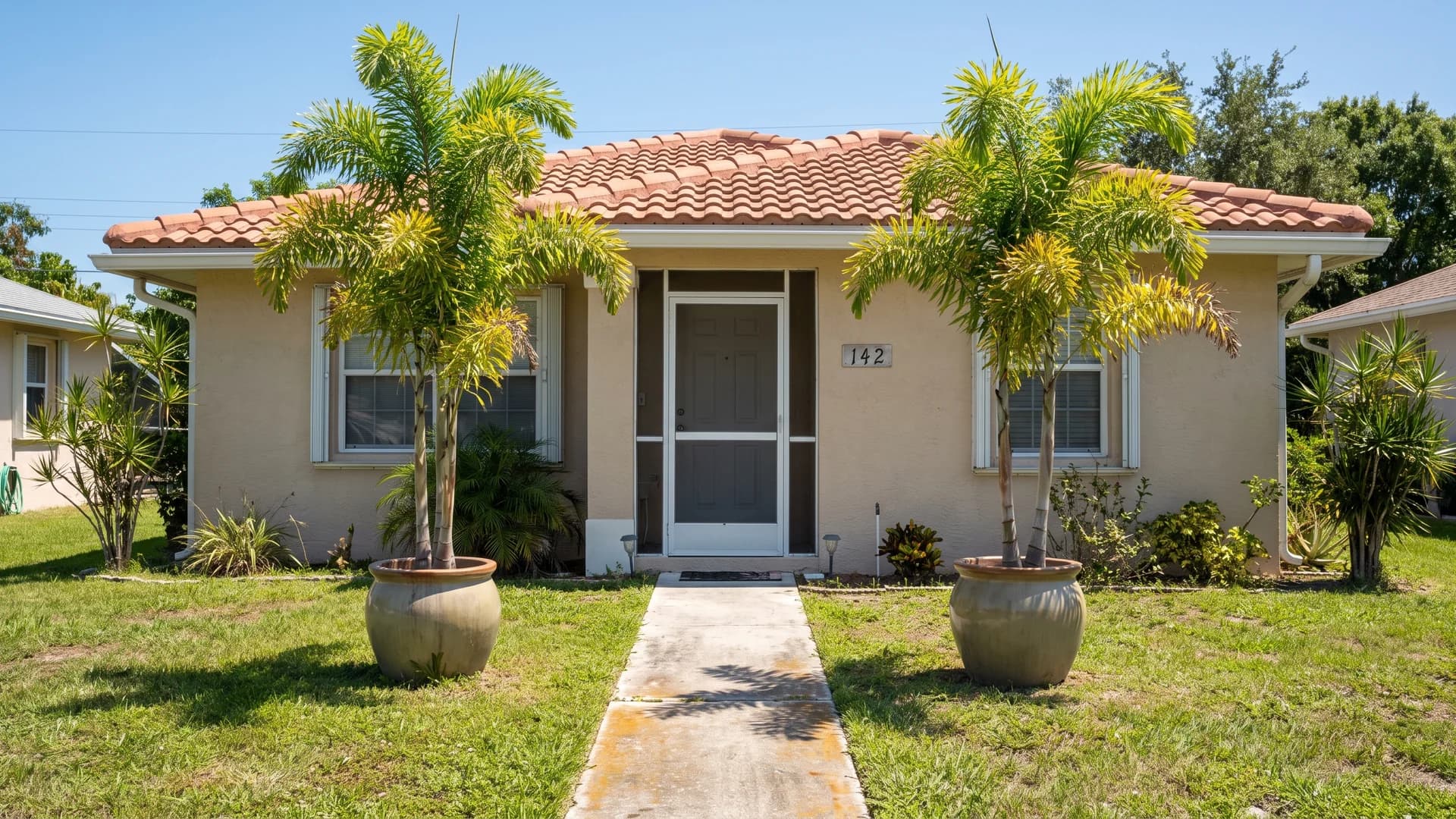
Curb appeal is mostly symmetry, and symmetry is cheap. Two matched pots, or two matched foxtail palms, one either side of the door, does more for a plain stucco front than any amount of scattered planting. Large ceramic pots cost $60 to $150 each. West-facing entry? Pick something that will take a wall radiating stored heat back at it until 8pm in July.
Works in: Zones 10a to 11b for foxtail palm · containers work in every zone · full sun
13. Uplight one palm and the whole house changes
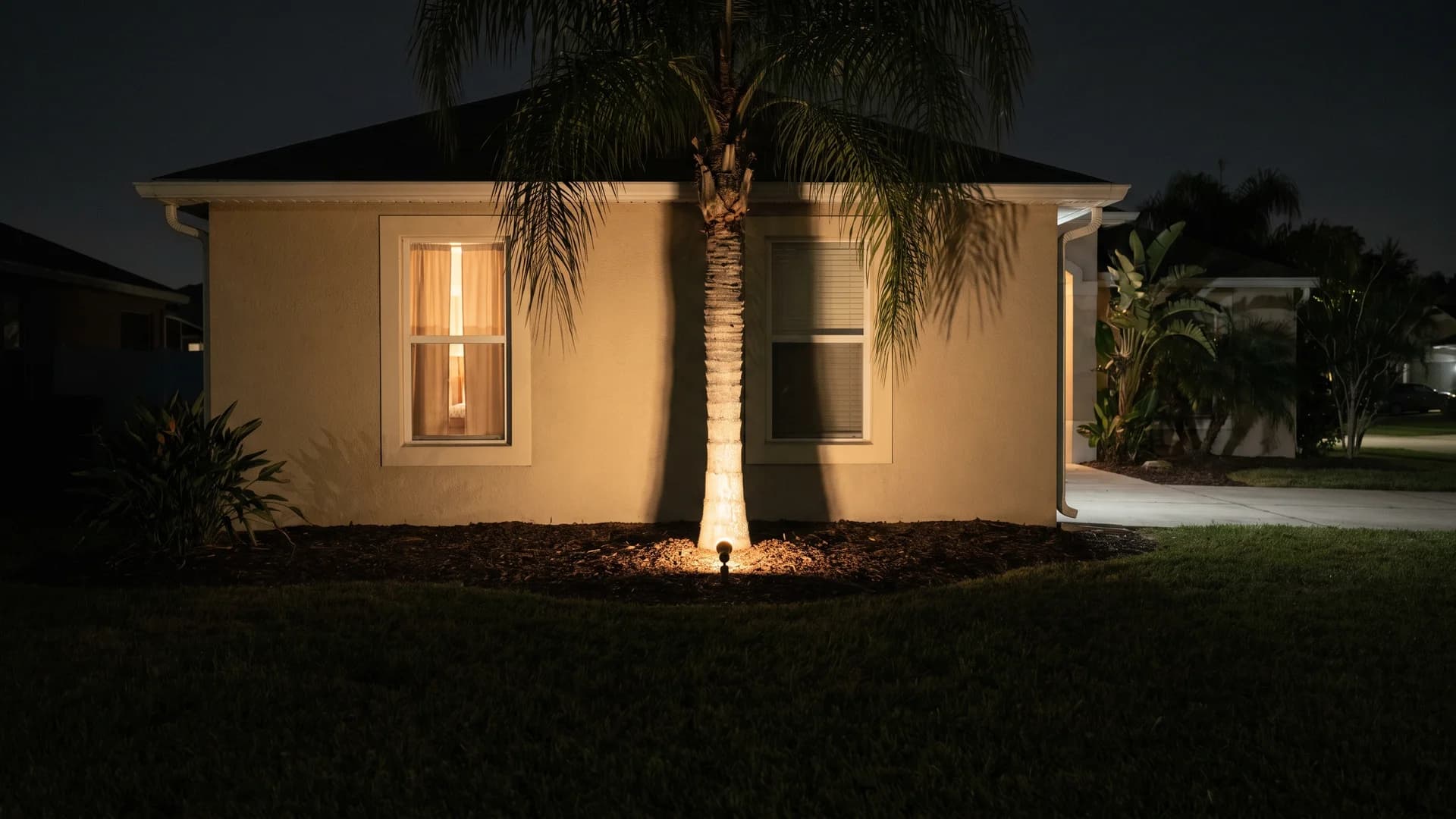
Half of Florida life happens after sunset, and an unlit front yard vanishes at 8pm. One well-aimed uplight at the base of a palm throws trunk texture and frond shadow across the wall behind it, which is a bigger change than another shrub would be. A low-voltage kit with a transformer and four fixtures runs $150 to $300, and landscape lighting is the rare upgrade that gets better as the plant grows.
Works in: Zones 8a to 11b · use brass or copper fixtures within a mile of salt water · evenings
Budget moves that still look designed
14. Put down shell or crushed coquina instead of concrete
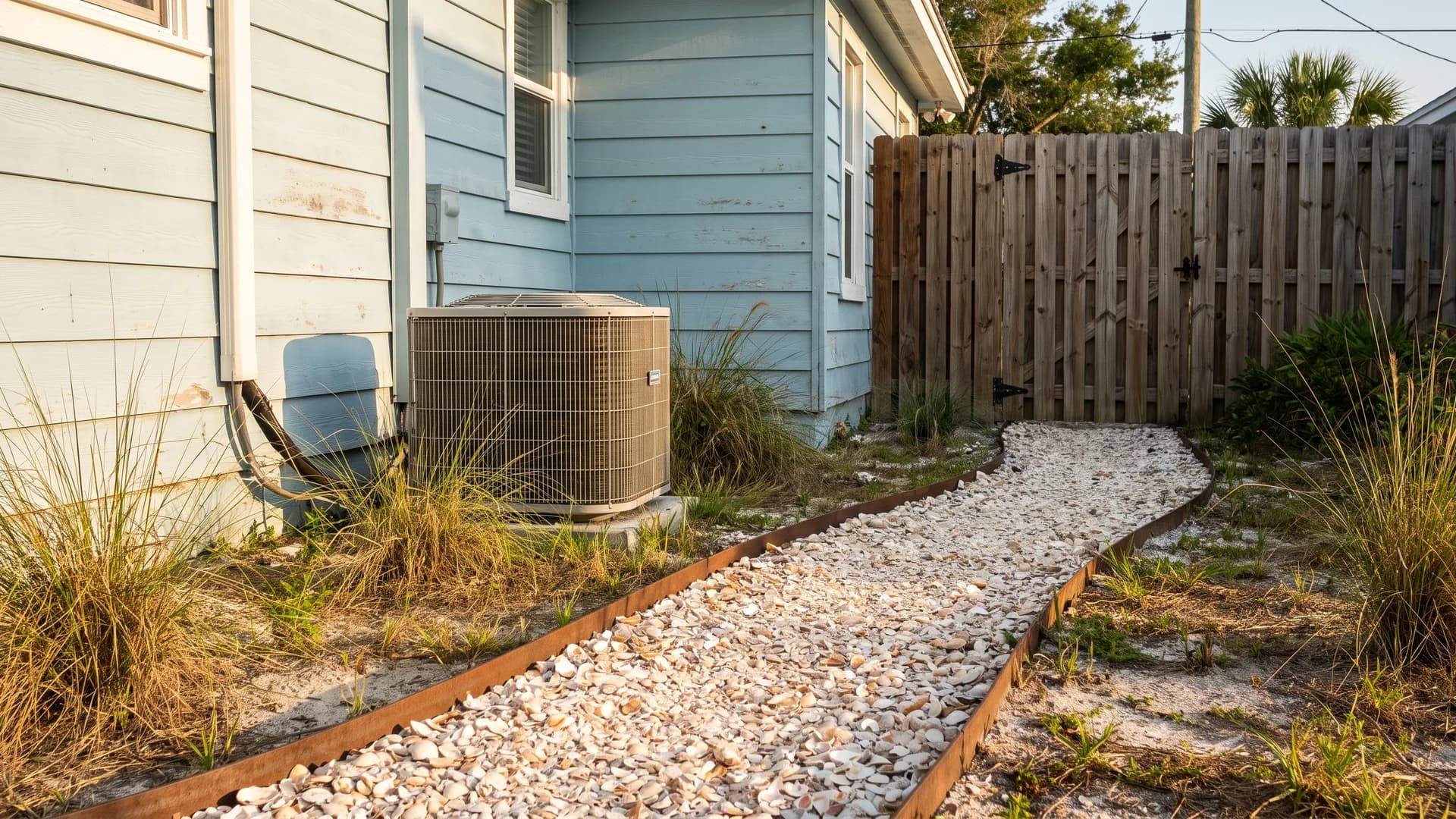
Poured concrete for a short path costs $8 to $15 a square foot installed. Shell or crushed coquina costs a fraction of that, drains straight through in a downpour, and looks like it came off the coastline the house sits on. Order it by the yard, hold the edges with steel or a brick soldier course, or it migrates into the lawn by spring. The gravel calculator handles the tonnage.
Works in: Zones 8a to 11b · shell is alkaline, so keep it away from acid-loving plants · full sun
15. Group containers on the lanai and keep the commitment low
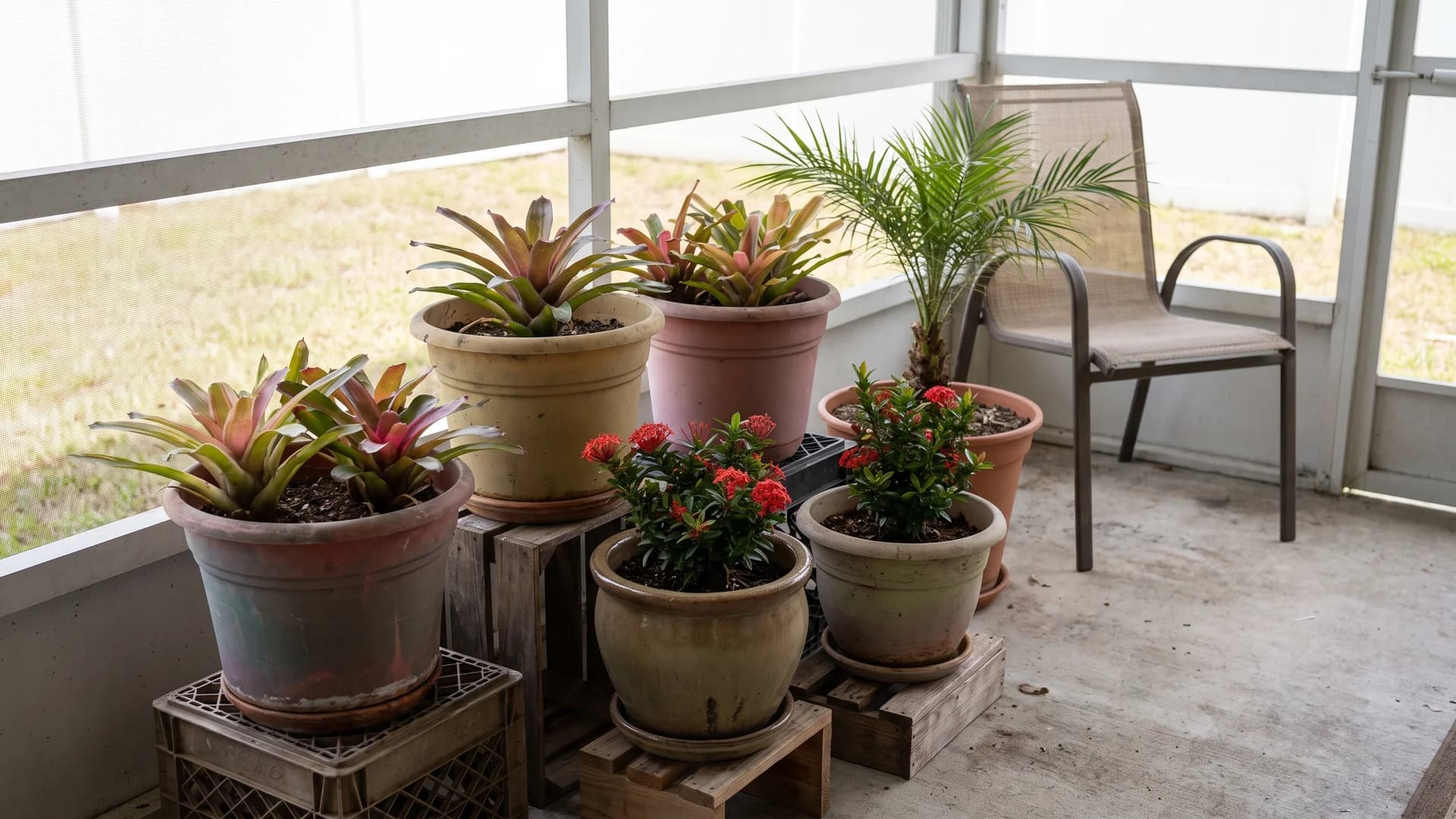
Renting, or here four months a year? Containers are the honest answer. Five or six pots at varied heights, planted with bromeliads, dwarf ixora, and one small palm, give a screened lanai the density of a planted bed and can be handed to a neighbor in May. Self-watering pots outlast terracotta here, since a clay pot in a Florida summer dries out in a day.
Works in: Zones 9a to 11b outdoors · move under cover before a freeze · bright shade under screen
Shade, screen, and outdoor living
16. Shade the west-facing patio before you furnish it
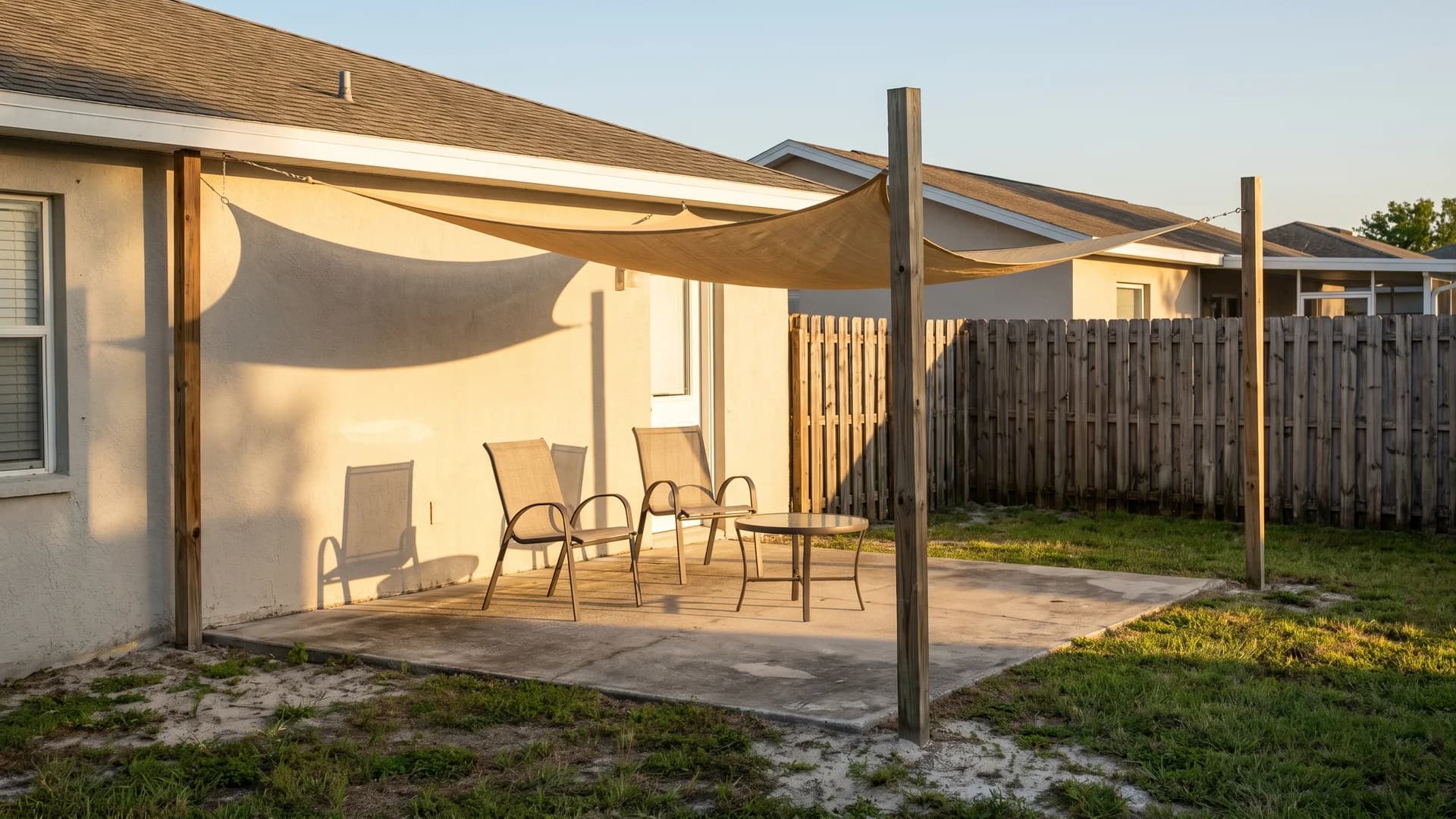
The reason that patio goes unused is the 4pm sun, not the furniture. A shade sail costs $80 to $250 and goes up in an afternoon. A pergola runs $2,000 to $6,000 and needs a permit in most Florida counties because of wind load. Either way, read the attachment rating, and take fabric down before a named storm, or the sail does exactly what a sail does.
Works in: Zones 8a to 11b · remove fabric before a hurricane · west and southwest exposures
17. Plant the shade tree where it shades the AC
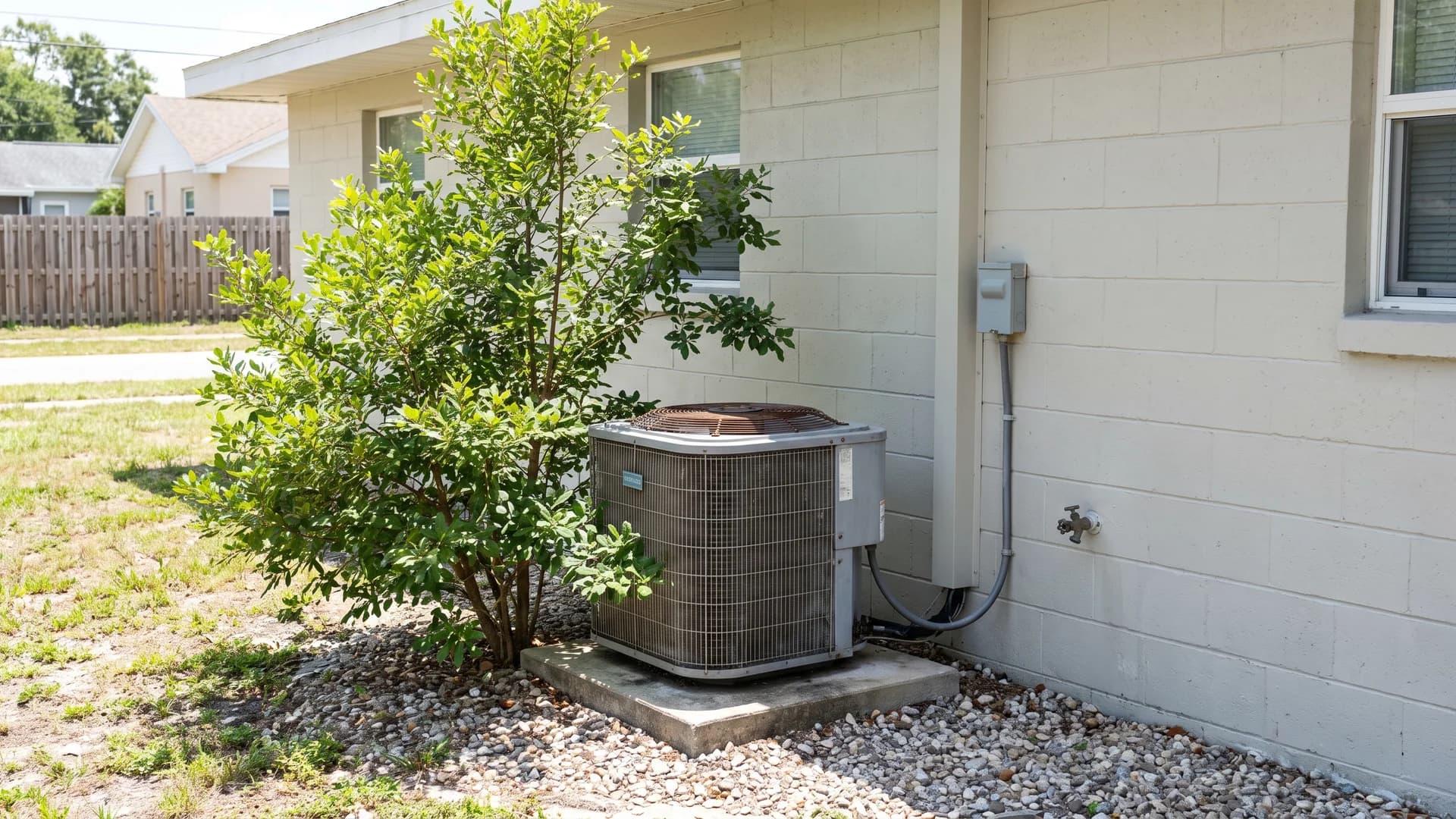
A condenser sitting in full afternoon sun works harder than one in shade, and in Florida that unit runs eight months a year. A tree or tall shrub placed to shade it through the afternoon cuts the load, provided you leave 3 feet of clear air around the coil and skip anything that rains debris into it. Simpson's stopper and southern wax myrtle both do the job.
Works in: Zones 8b to 11b · both species tolerate salt · plant on the west or southwest side
18. Plant the base of the pool cage so it stops looking like a cage
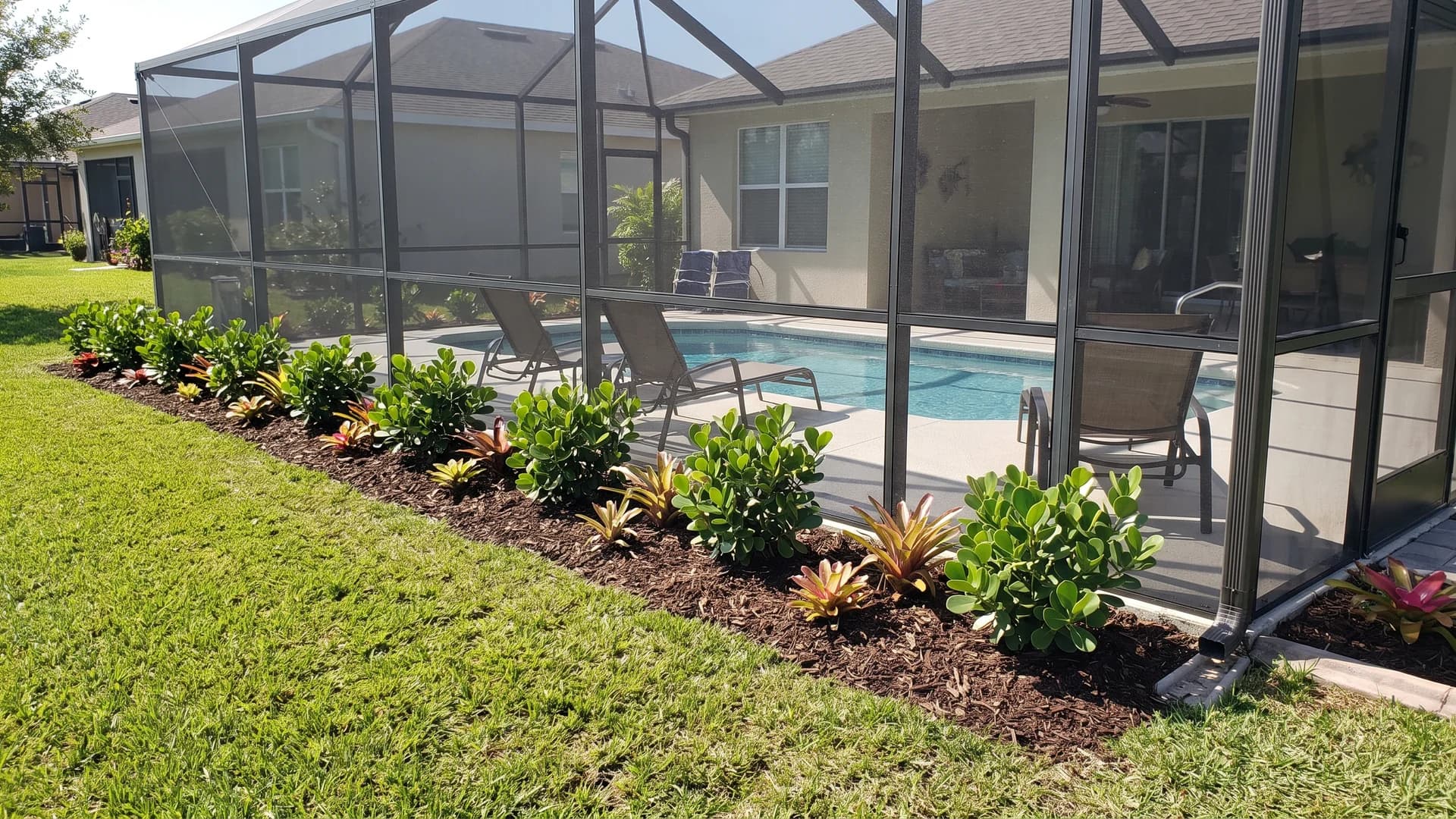
The screen enclosure is the most common structure in a Florida backyard and the least landscaped. A bed outside the cage wall, 24 to 30 inches deep, planted with dwarf clusia or bromeliads, breaks up the frame without blocking panels or maintenance access. Keep leaf-droppers away from the screen. For the planting inside the deck, our pool landscaping ideas cover it in detail.
Works in: Zones 9b to 11b · keep root systems clear of the cage footer · part sun
Coastal lots, salt, and storm water
19. Build the front row of a coastal lot from salt-tolerant natives
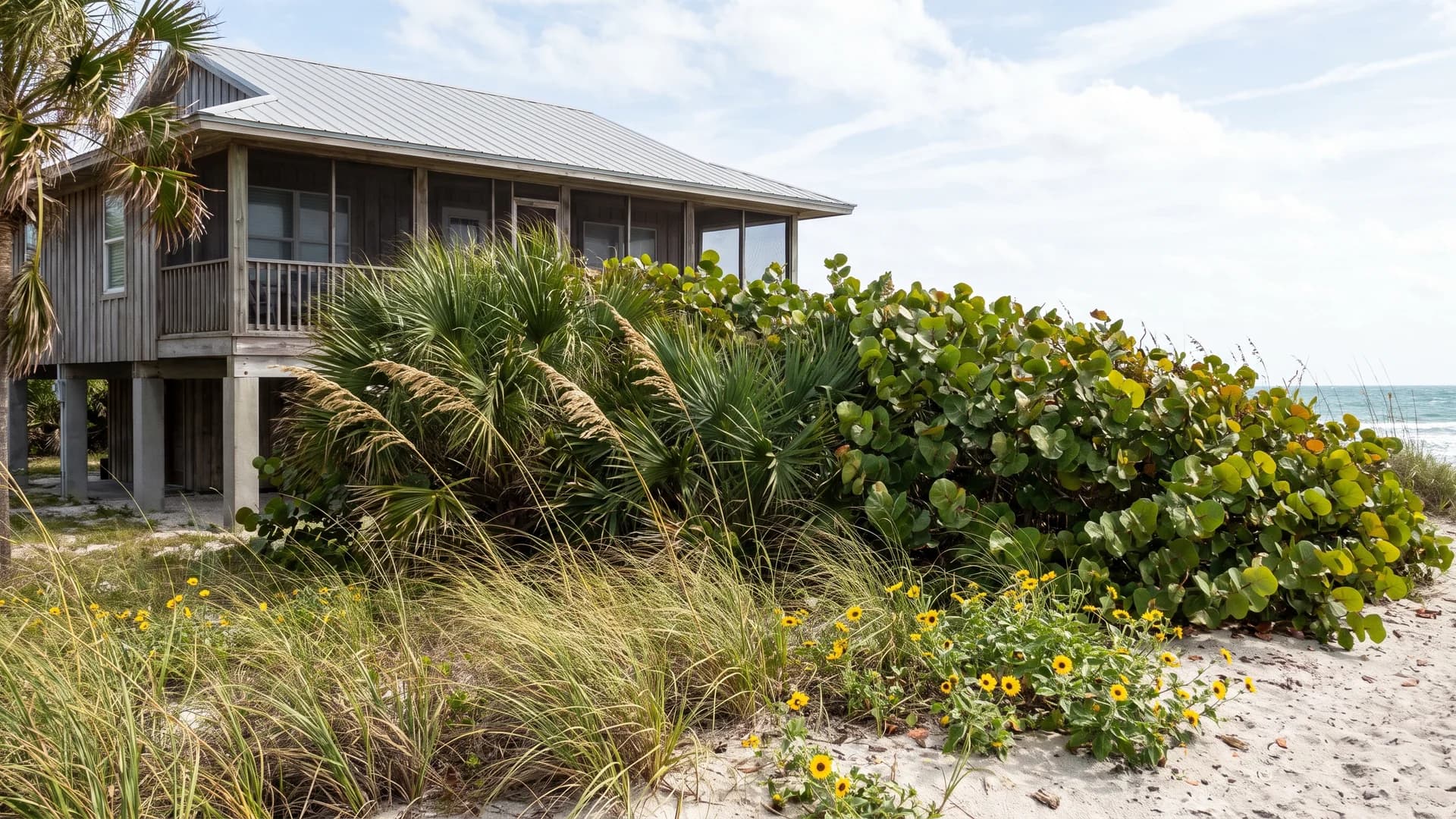
Salt spray travels on the wind and burns the windward face of anything unadapted. Sea grape, saw palmetto, dune sunflower, and Spanish stopper all take it head-on. Put those in the front row nearest the water and tuck tender plants behind them, where the salt has already dropped out of the air. Sea grape wants a hard prune every year or two to stay under window height.
Works in: Zones 9a to 11b · high salt tolerance · full sun and open wind
20. Leave a low buffer along the seawall or canal
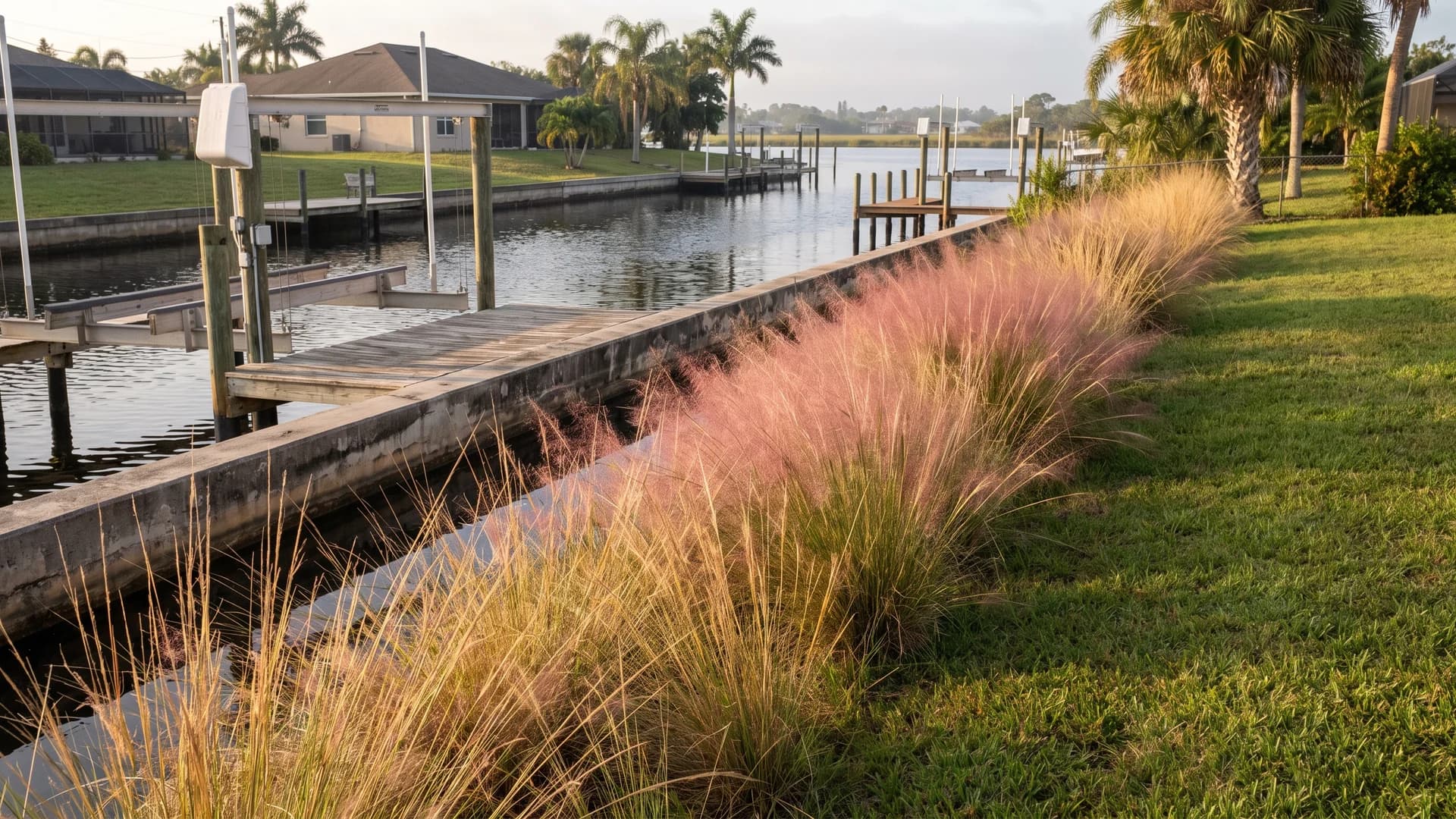
Waterfront lots turn every fertilizer application into a water-quality problem, which is why many Florida counties restrict application during the rainy season. A no-mow, no-fertilize buffer roughly 10 feet wide along the water, planted with muhly grass, sand cordgrass, or spartina, filters runoff before it reaches the edge. Check your county's shoreline and setback rules first; on canals and seawalls they get specific.
Works in: Zones 8a to 11b · salt-tolerant · full sun, tolerates wet feet
21. Make a rain garden of the corner that floods every August
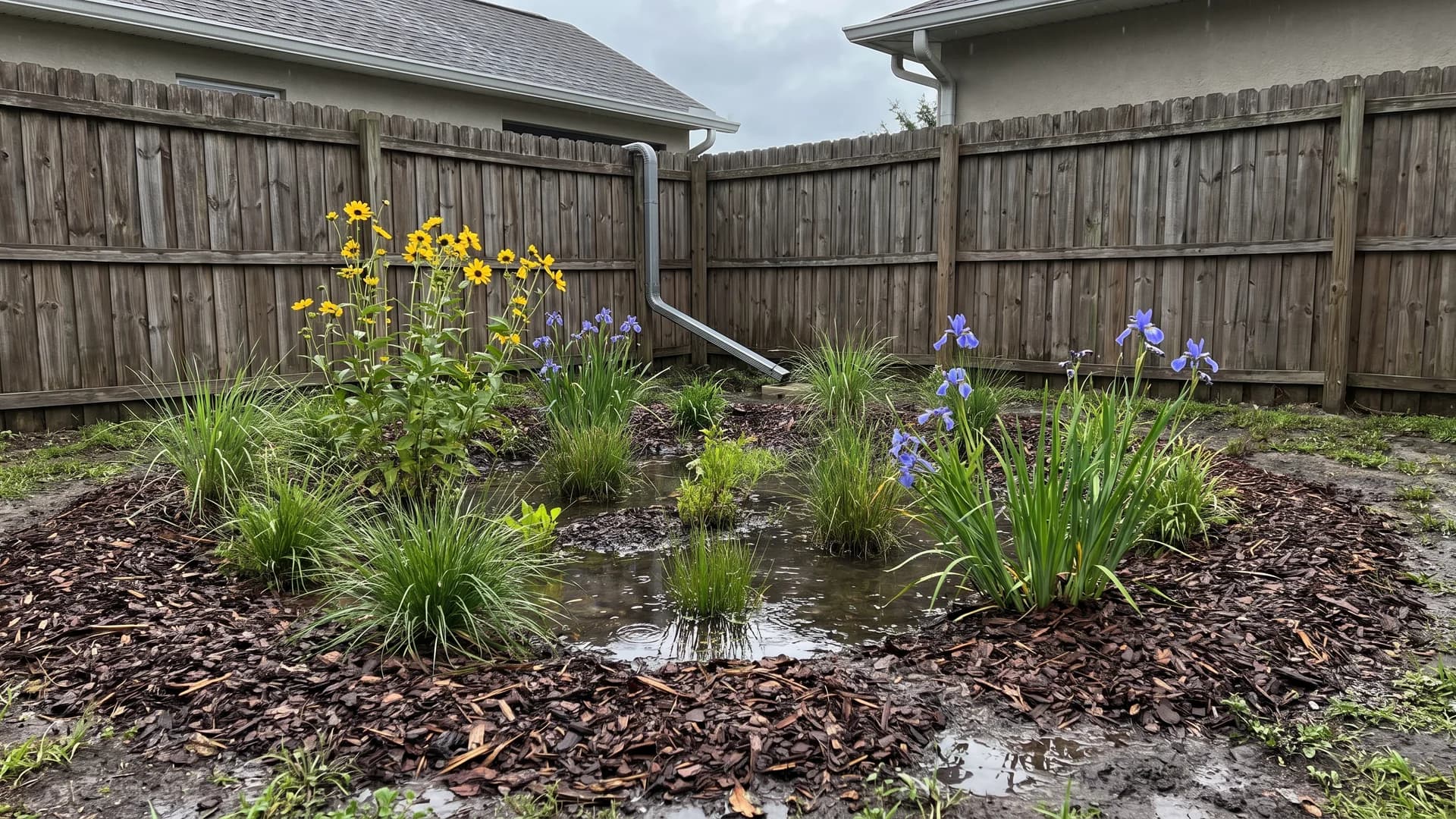
The low corner that stays soggy for a week after a wet-season storm isn't a problem to fill in. It's the best bed on the lot waiting for the right plants. A rain garden is a shallow saucer, 6 to 8 inches deep, planted with species that take both extremes: blue flag iris, swamp sunflower, Fakahatchee grass. Built right, it drains inside a day or two, so it doesn't breed mosquitoes.
Works in: Zones 8a to 11b · site it at least 10 feet from the foundation · full sun to part shade
Match the idea to your Florida yard
- Renting, or only here part of the year: 15 first, then 13. Neither leaves anything behind.
- Coastal or canal lot: 19 and 20 before anything else, then 4 for color that survives spray.
- North Florida with real freezes: 2, 5, 9, and 17. Skip 3 unless you enjoy replanting crotons.
- Tired of mowing: 6, 7, and 9 in that order. The general, non-Florida version of that play is in our low maintenance front yard landscaping guide.
- Under $500 for the whole project: 14, 15, and 9.
- Yard that floods in the wet season: 21, then 20 if you're on water.
- Working mainly in gravel, shell, or stone: rock landscaping ideas has the depths, per-ton costs, and base build.
FAQ
What are the 9 principles of Florida-Friendly Landscaping?
Right plant right place, water efficiently, fertilize appropriately, mulch, attract wildlife, manage yard pests responsibly, recycle yard waste, reduce stormwater runoff, and protect the waterfront. The program is run by UF/IFAS with the Florida Department of Environmental Protection, and its plant database sorts hundreds of species by region and site conditions.
What are the best landscaping tips for Florida?
Start with your hardiness zone, because 8a and 11b share almost no plant list. Mulch 2 to 3 inches deep, since sand holds neither water nor nutrients. Group plants by water need so one irrigation zone isn't drowning half of them. Keep brittle, fast-growing trees away from the roof. To test a layout before buying plants, an AI landscape design tool renders it on a photo of your own yard.
What is the lowest-maintenance flower in Florida?
Blanket flower and dune sunflower are the usual answers for full sun. Both grow wild on Florida dunes, both reseed themselves, and neither needs irrigation once established. In shade, bromeliads hold color for months and collect their own water in the cup. Pentas sits in the middle: it flowers nearly year-round in the south and dies back in a north Florida freeze.
Can an HOA stop me from putting in a Florida-Friendly yard?
Not outright. A 2009 Florida law prevents homeowners associations and local governments from prohibiting Florida-Friendly landscaping. What an HOA can still do is set design guidelines and require you to submit a plan for approval before you change anything. So submit the plan. The law protects the practice, not the paperwork you skipped.
Which plants handle salt spray on a coastal lot?
Sea grape, saw palmetto, dune sunflower, Spanish and Simpson's stopper, muhly grass, and sand cordgrass all take direct salt spray. Tolerance drops off fast with distance, so a plant that scorches in the front row often thrives 40 feet back behind a hedge. Bay and canal lots deal with far less airborne salt than an ocean-facing one.
Which trees hold up best in a hurricane?
Sabal palm, live oak, and southern magnolia rank near the top in post-storm surveys of Florida tree damage. Laurel oak, water oak, and fast-growing softwoods rank near the bottom. Placement counts as much as species: any tree tall enough to reach the house needs pruning on a schedule, and an undisturbed root plate matters more than trunk thickness.