25 Driveway Landscaping Ideas That Boost Curb Appeal
The border beside a driveway takes road salt, plow spray, piled snow, and car doors all year. These 25 ideas cover edging, entrances, circular and long drives, and lighting, with the widths, heights, and clearances that keep a driveway border alive past its first winter.
The strip of ground along your drive takes more abuse than any other bed on the property. Most driveway landscaping ideas skip straight past that and hand you a plant list that would be perfectly happy in a sheltered courtyard, which is why so many borders look sharp in June and ragged by March.
The 25 ideas below are written for the real conditions: road salt, plow spray, snow piled against the border in January, car doors swinging open all summer, and heat coming back off the pavement in August. They cover edging and borders, entrances, circular and long drives, the narrow strip beside the drive, and lighting, with the widths, heights, and clearances that decide whether each one survives.
Every image here is an AI-generated design concept built from a photo of an ordinary yard, the same kind of render AI front yard design produces from a picture of yours. None of them are stock photos of somebody else's house.
Get the bones right before you plant
1. Measure the strip before you buy a single plant
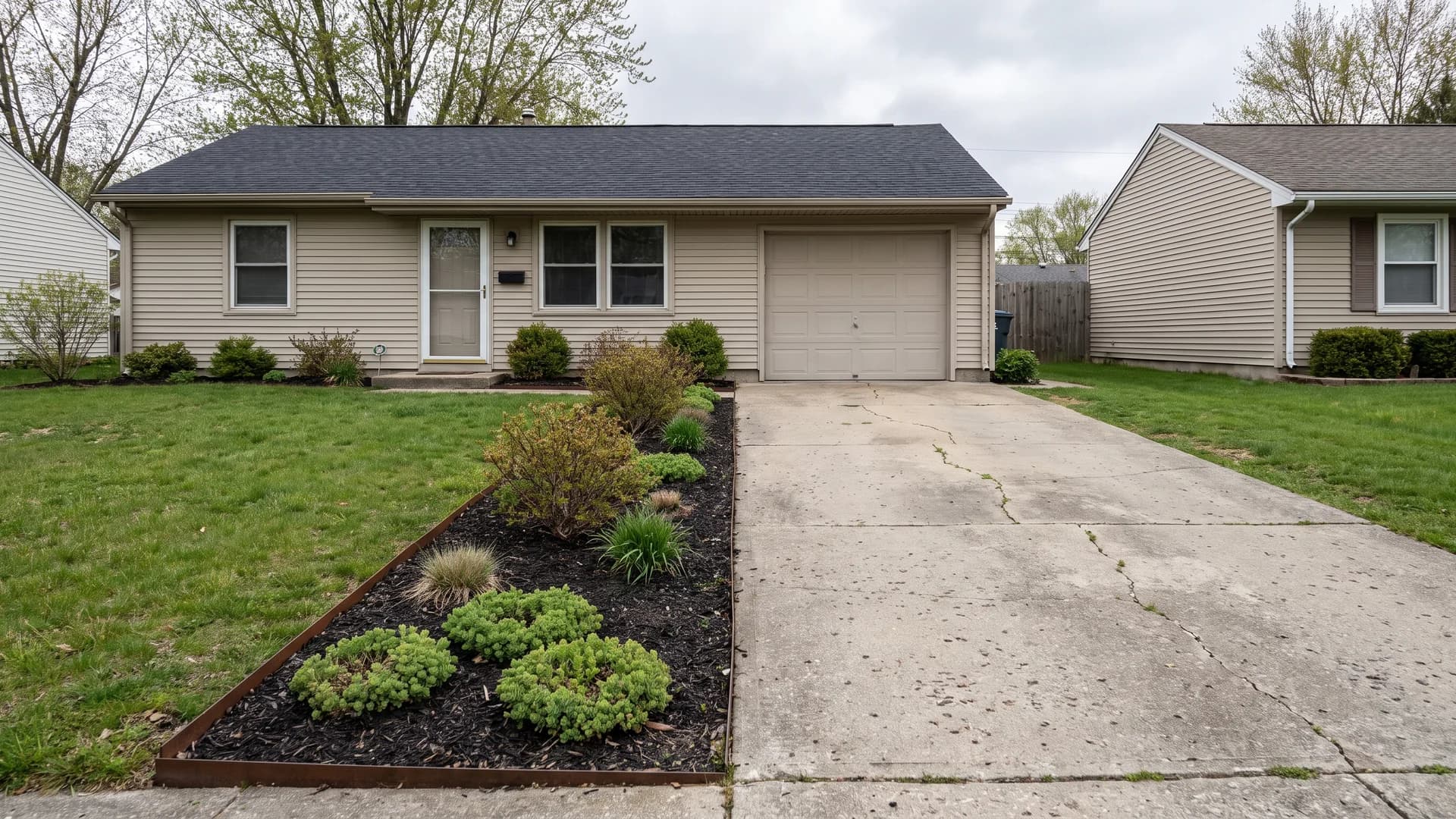
Pull a tape from the pavement edge to whatever stops you: lawn, fence, property line. Under 3 feet and you are planting groundcover and low grasses, nothing taller. Four to 6 feet buys a real layered bed with shrubs at the back. Most disappointing driveway borders are 30 inches wide holding plants that wanted 5 feet. The measurement decides the plant list, not the other way around.
2. Frame the drive with a hard edge
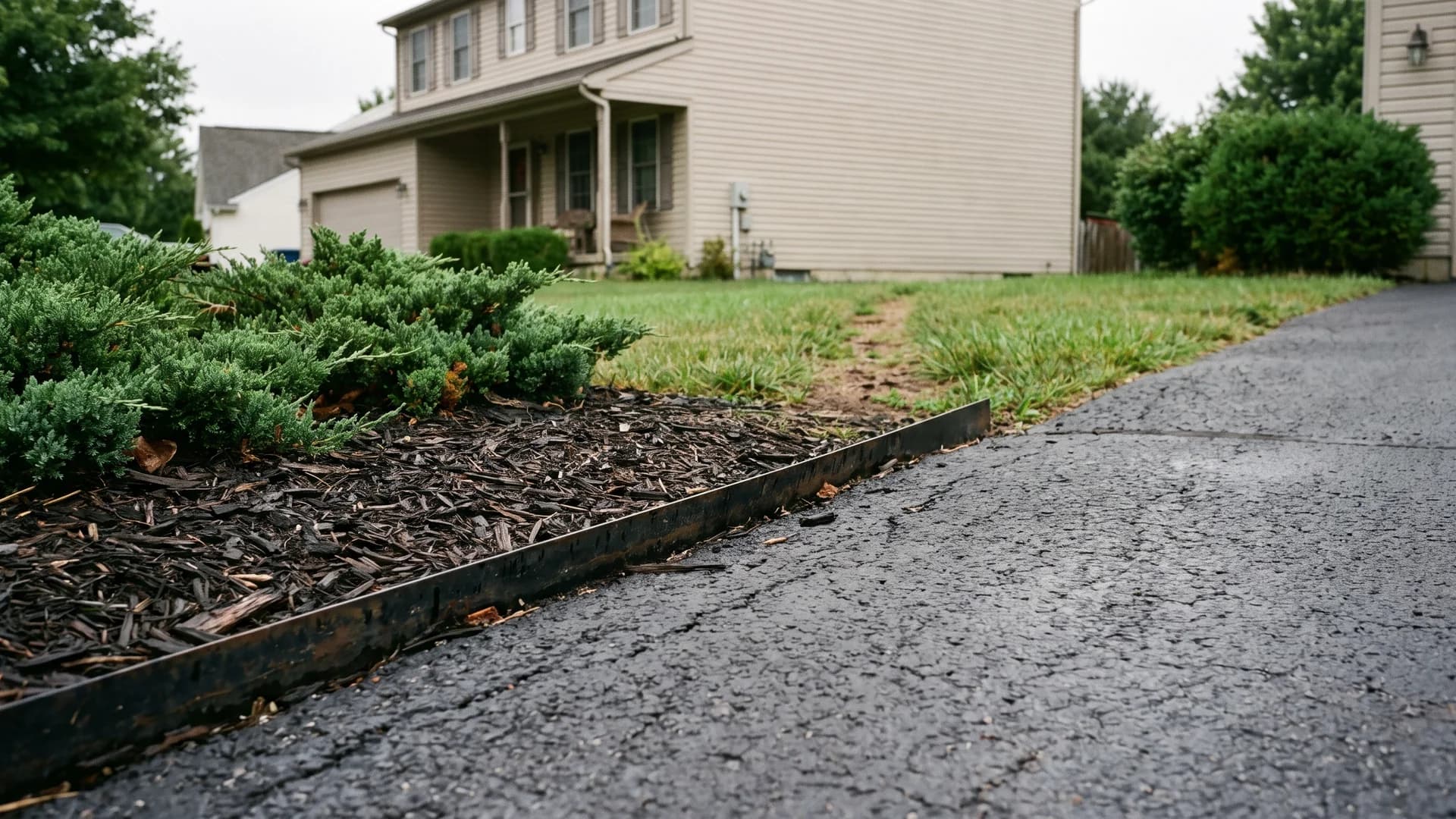
Mulch migrates onto pavement within a season unless something holds it back. Steel landscape edging at $2 to $4 a linear foot is the cleanest fix and disappears once the bed settles around it. A soldier course of cobble or brick costs more, roughly $8 to $15 a foot installed, but it takes a plow blade catching the corner without folding, which thin steel does not always do.
3. Curve the bed line even when the driveway is straight
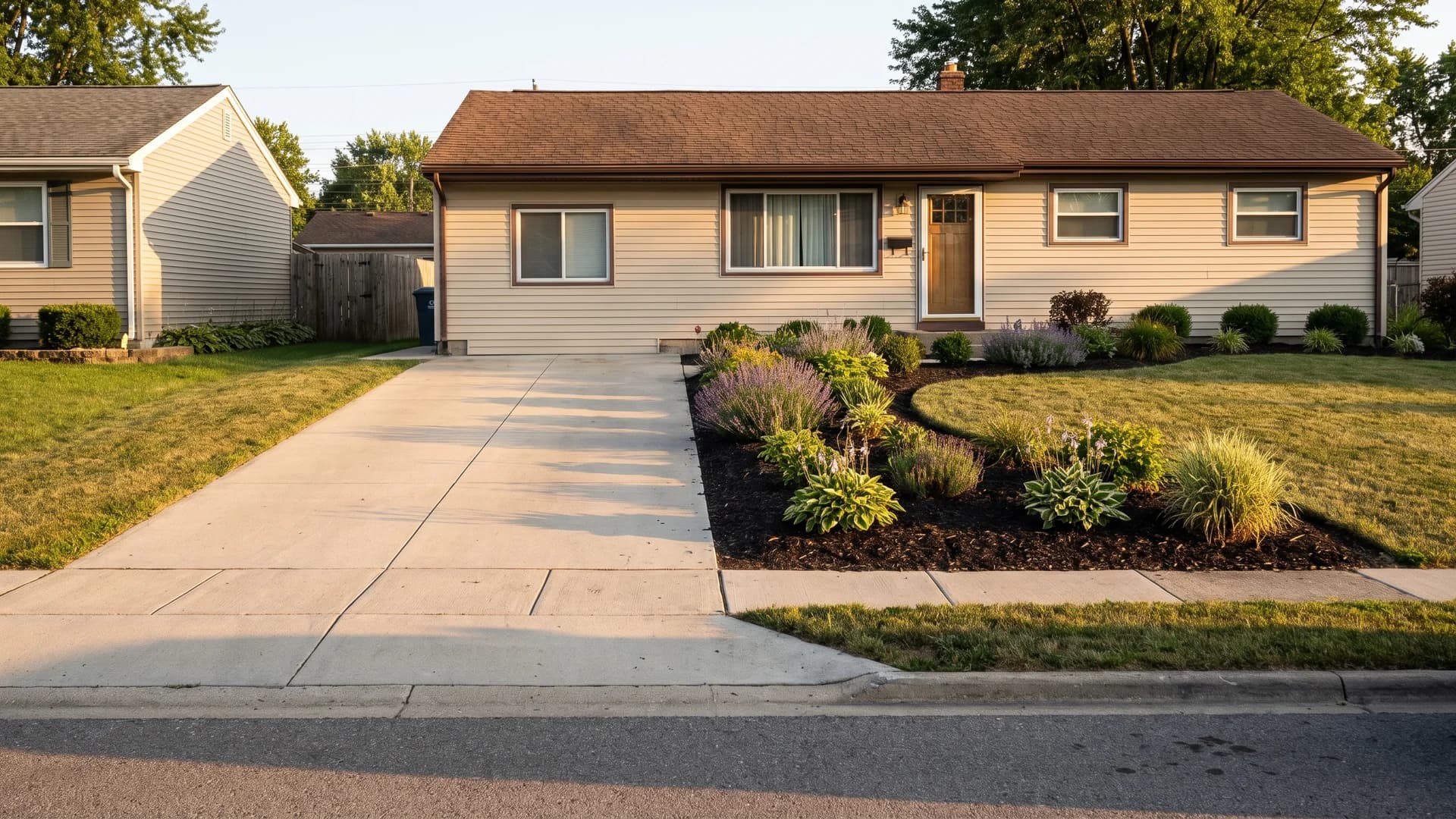
Straight pavement with a straight border reads like a parking lot. Let the bed swell to 6 feet at the middle and taper to 2 feet at each end, and the approach softens without anyone touching the pavement. Lay a garden hose on the ground and walk out to the street before you cut the edge. The curve has to be readable from the sidewalk, not a wobble you only notice up close.
Plants that survive salt, plows, and car doors
4. Pick the salt-and-plow survivors for the first three feet
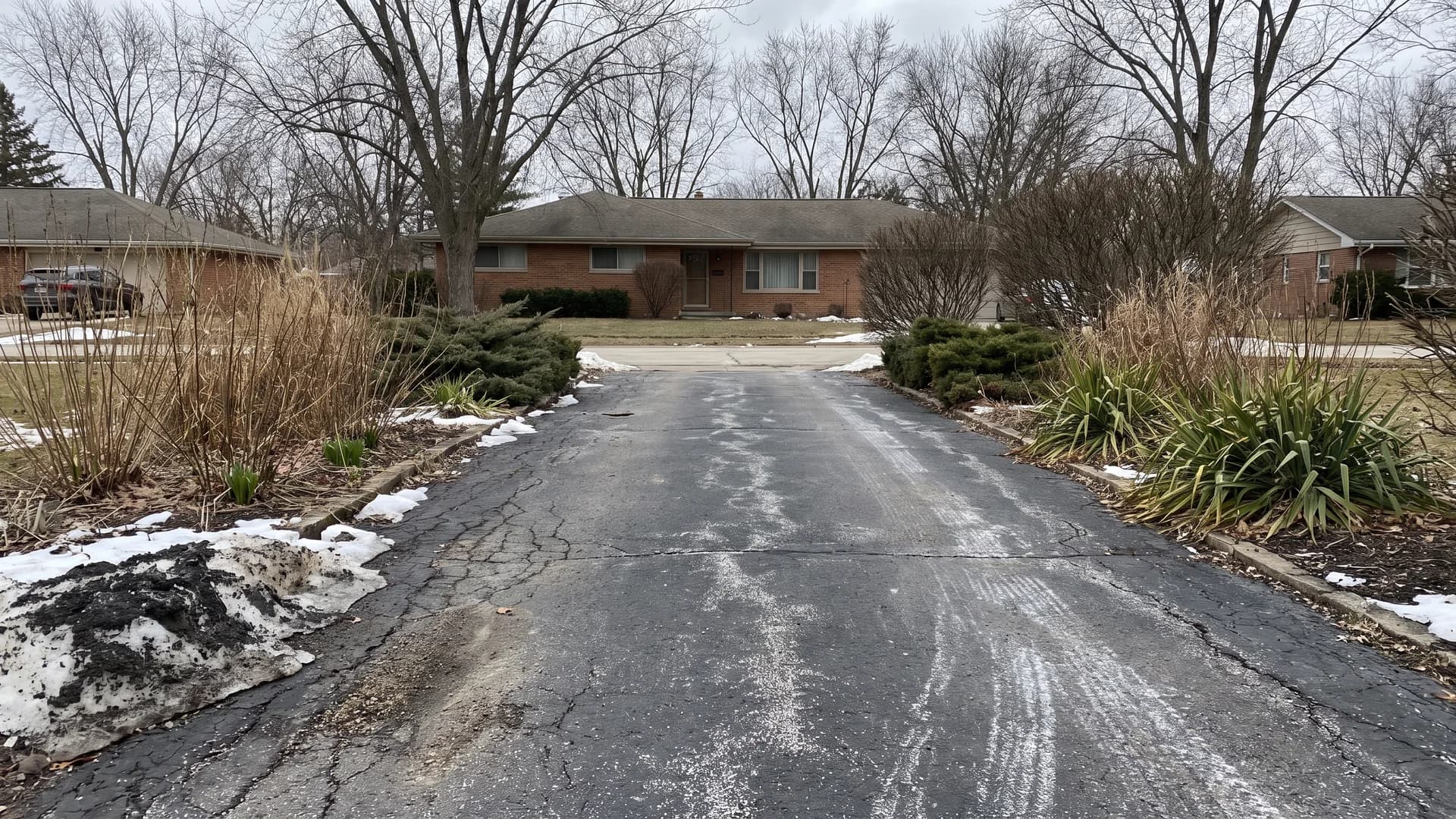
Everything within 3 feet of the pavement gets salted, sprayed, and buried under plowed snow. That band wants the tough list: daylily, sedum, catmint, juniper, and switchgrass all shrug off road salt across zones 4 to 9. Boxwood, azalea, and most conifers other than juniper and mugo pine do not, and they brown out on the driveway side and stay brown. Anything precious goes behind the 3-foot line.
5. Keep everything under 24 inches near the road
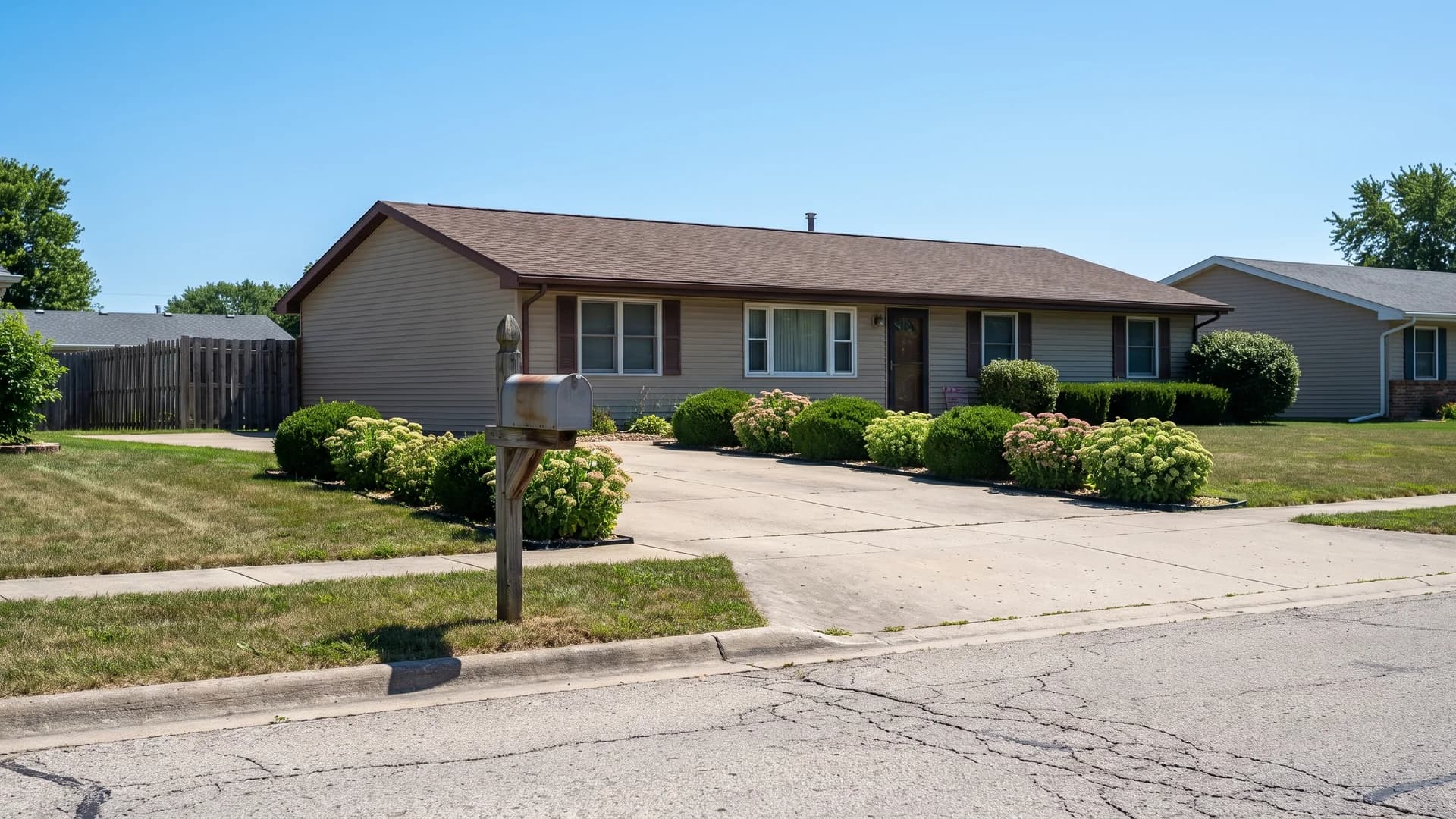
Backing out blind is the failure nobody plans for. Hold everything within about 15 feet of the street to 24 inches or lower, measured at mature size rather than nursery size. That rules out most upright shrubs and every ornamental grass that finishes at 5 feet. Plenty of towns write this into an ordinance as a sight triangle, so call the building department before you plant that corner.
6. Set plants back a car door's width
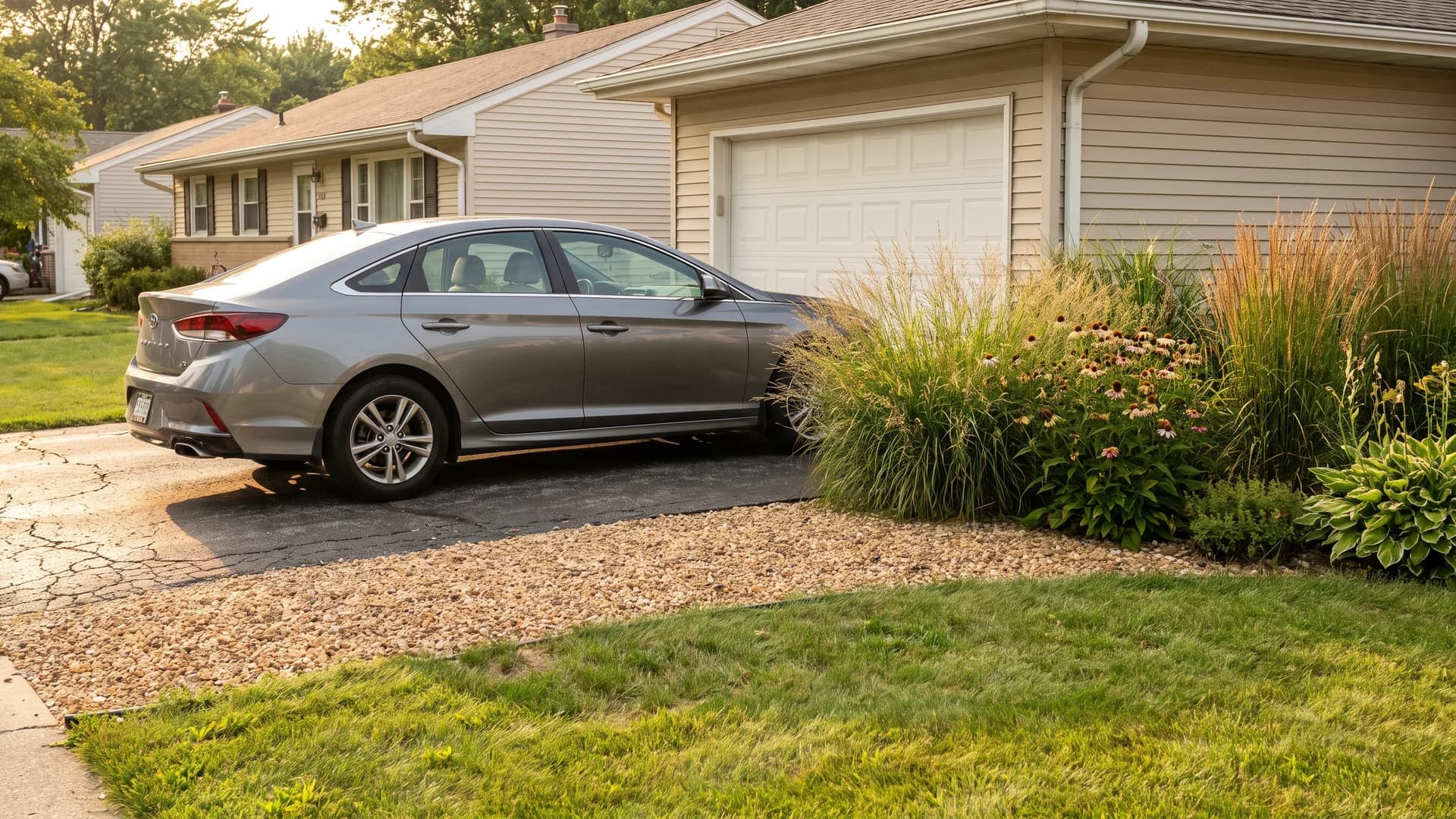
An open car door swings roughly 30 inches past the pavement edge. Whatever sits inside that arc gets stepped on or crushed every time a passenger climbs out. Leave 30 inches of gravel, groundcover, or plain mulch along the stretch where cars actually park, then start the planting behind it. You give up a foot of bed and keep the front row of it alive.
7. Repeat one ornamental grass down the whole length
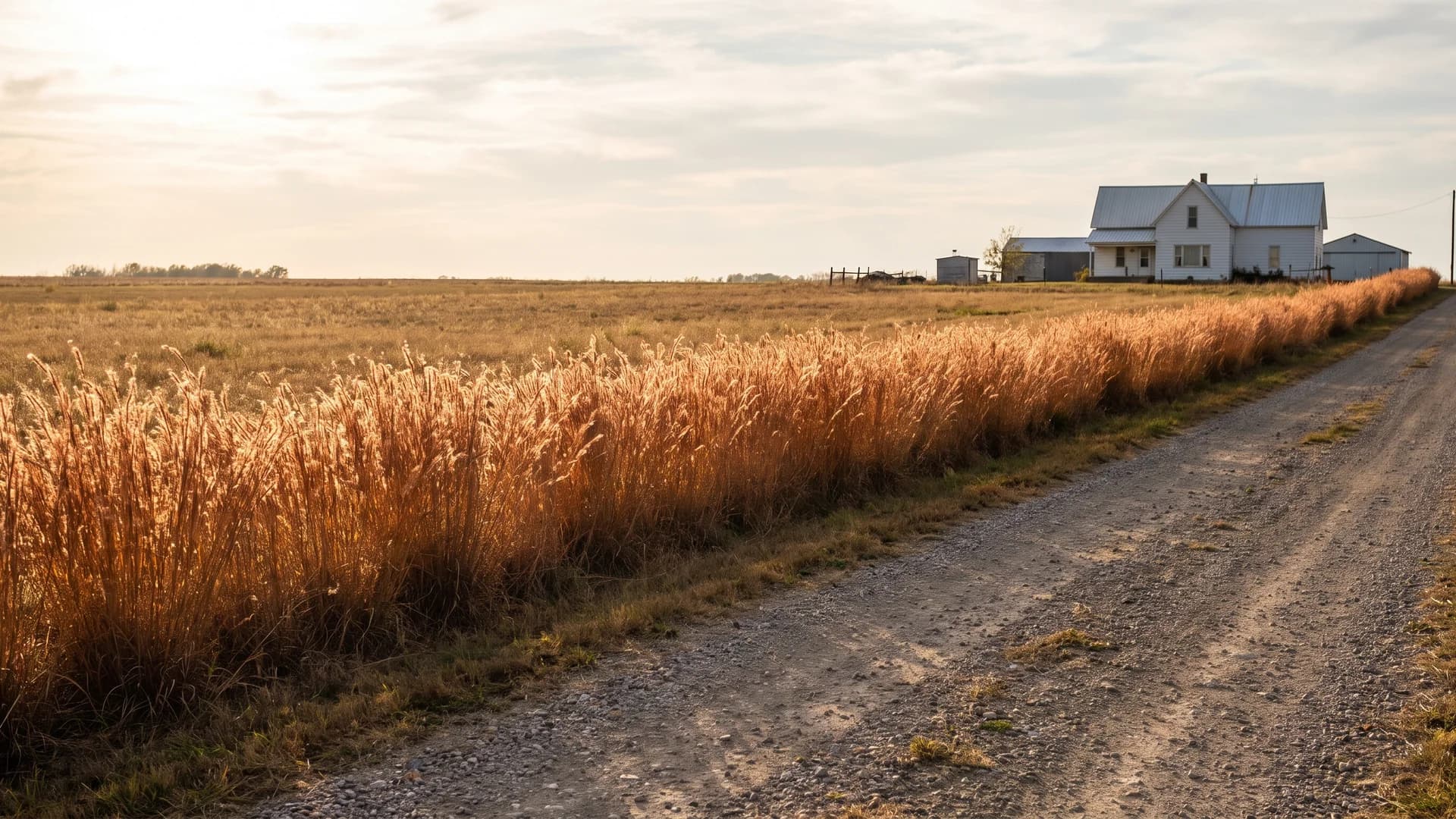
Twenty of one plant looks intentional. Twenty different plants looks like a clearance rack. Little bluestem or dwarf fountain grass at 30-inch spacing down a 40-foot run costs about $250 in 1-gallon pots, asks for one cutback in March, and holds color all winter while the rest of the border is brown. Salt does not bother either of them.
8. Layer three heights so a long run doesn't read flat
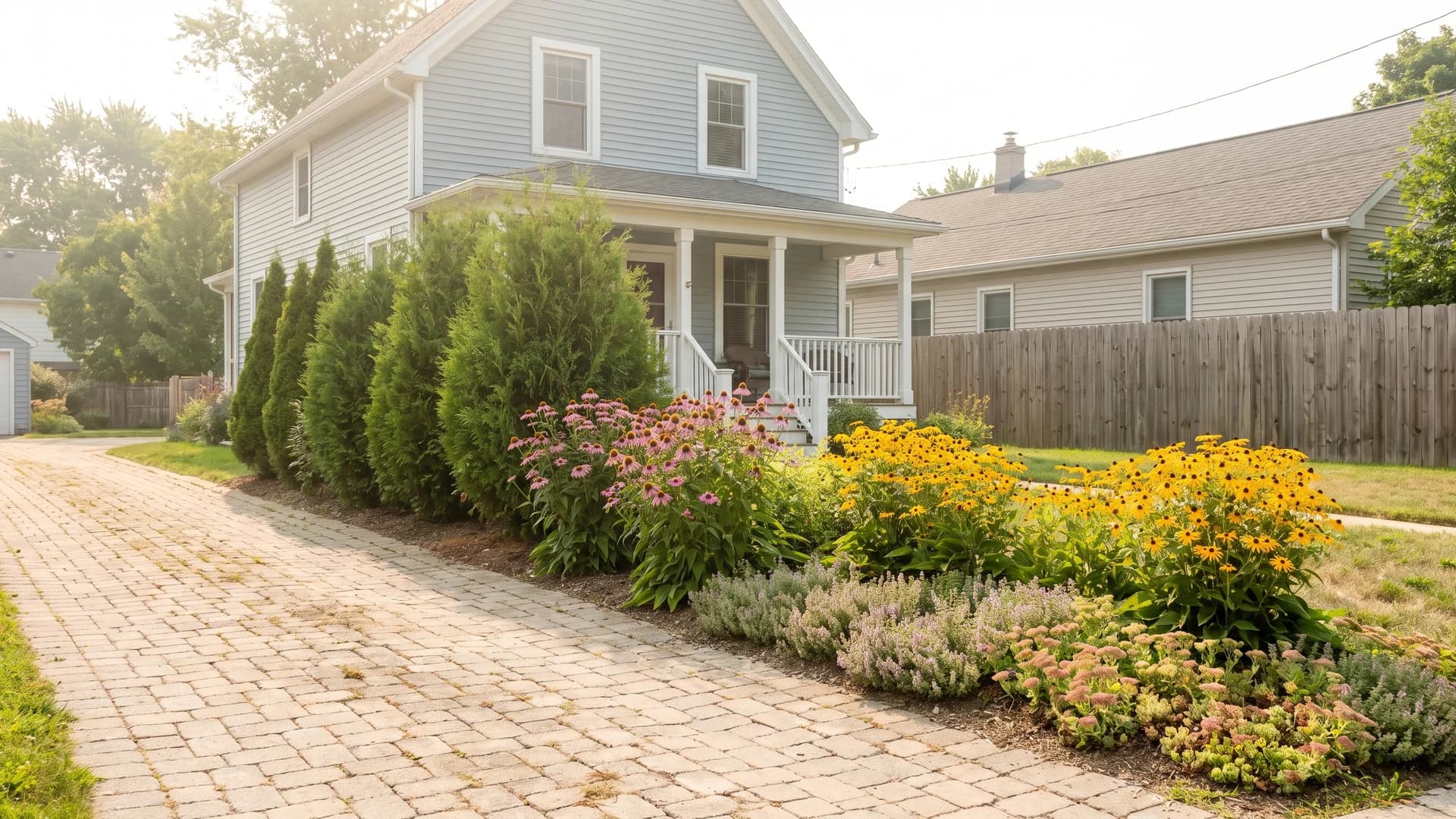
Single-row planting gets monotonous past about 30 feet. Put the back of the bed at 3 to 4 feet, the middle at 18 to 24 inches, the front at 6 to 12 inches, then repeat that group every 12 to 15 feet down the drive. Repetition at a fixed interval is what makes a long border read as designed from a car moving at walking speed.
The driveway entrance
9. Anchor the entrance with a matched pair
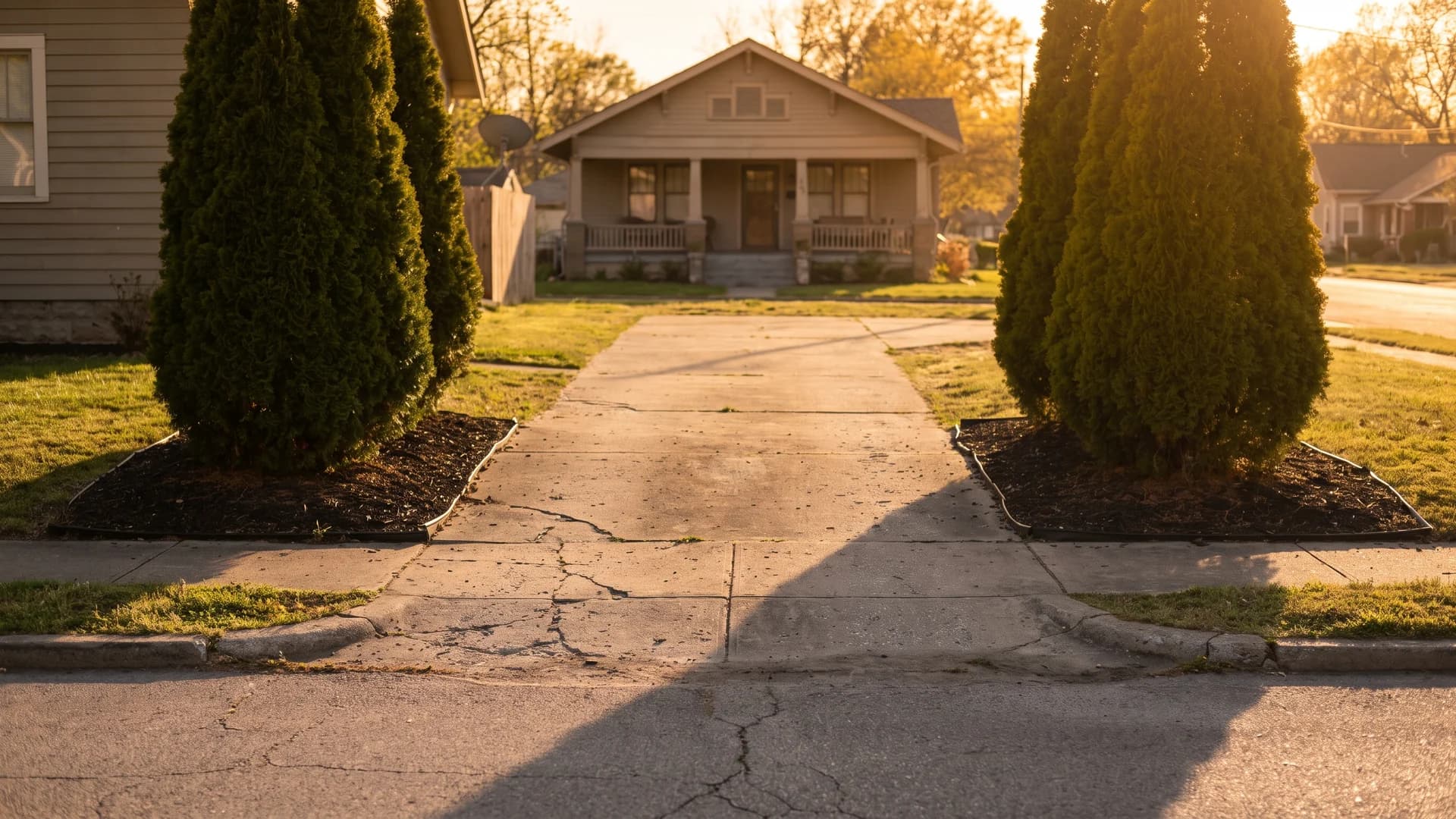
Two of anything at the mouth of the drive does more work than a mixed bed of ten. A pair of upright shrubs, two stone urns, or two clipped evergreens set 10 to 12 feet apart, one per side, reads as an entrance from a block away. Keep them identical and keep them square to each other. If your entrance also holds a mailbox, that bed plays by its own rules, and our mailbox landscaping ideas covers them.
10. Build low stone pillars instead of a gate
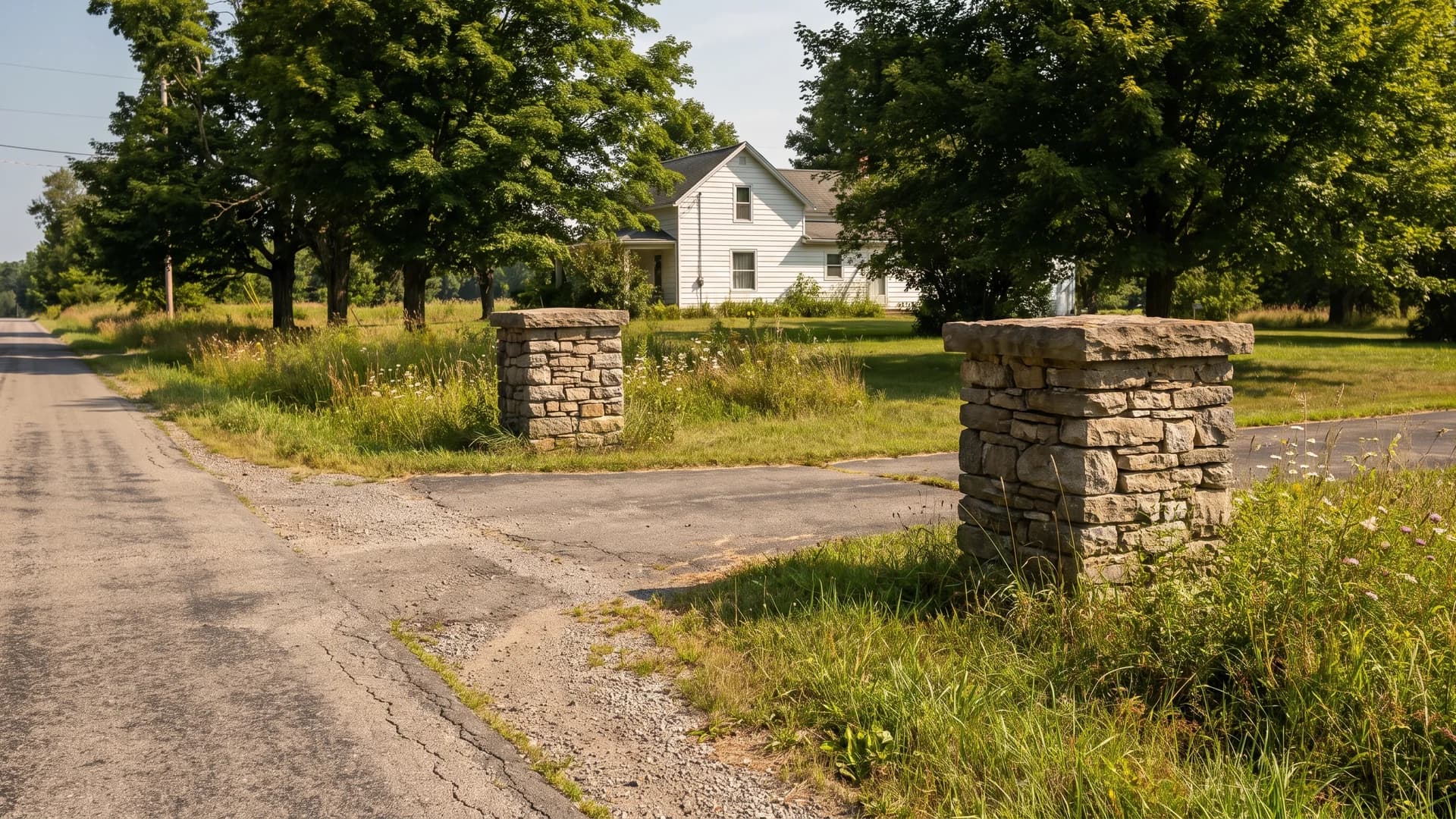
Stone or brick pillars at about 30 inches give an entrance the weight of a gate for a fraction of the money. Dry-stacked fieldstone with a cap runs $400 to $900 a pair in materials; a real gate with hardware and an opener starts around $5,000. Set each pillar at least 3 feet back from the pavement edge so a delivery truck cutting the corner does not take one out.
11. Plant an entrance bed that reads at 30 mph
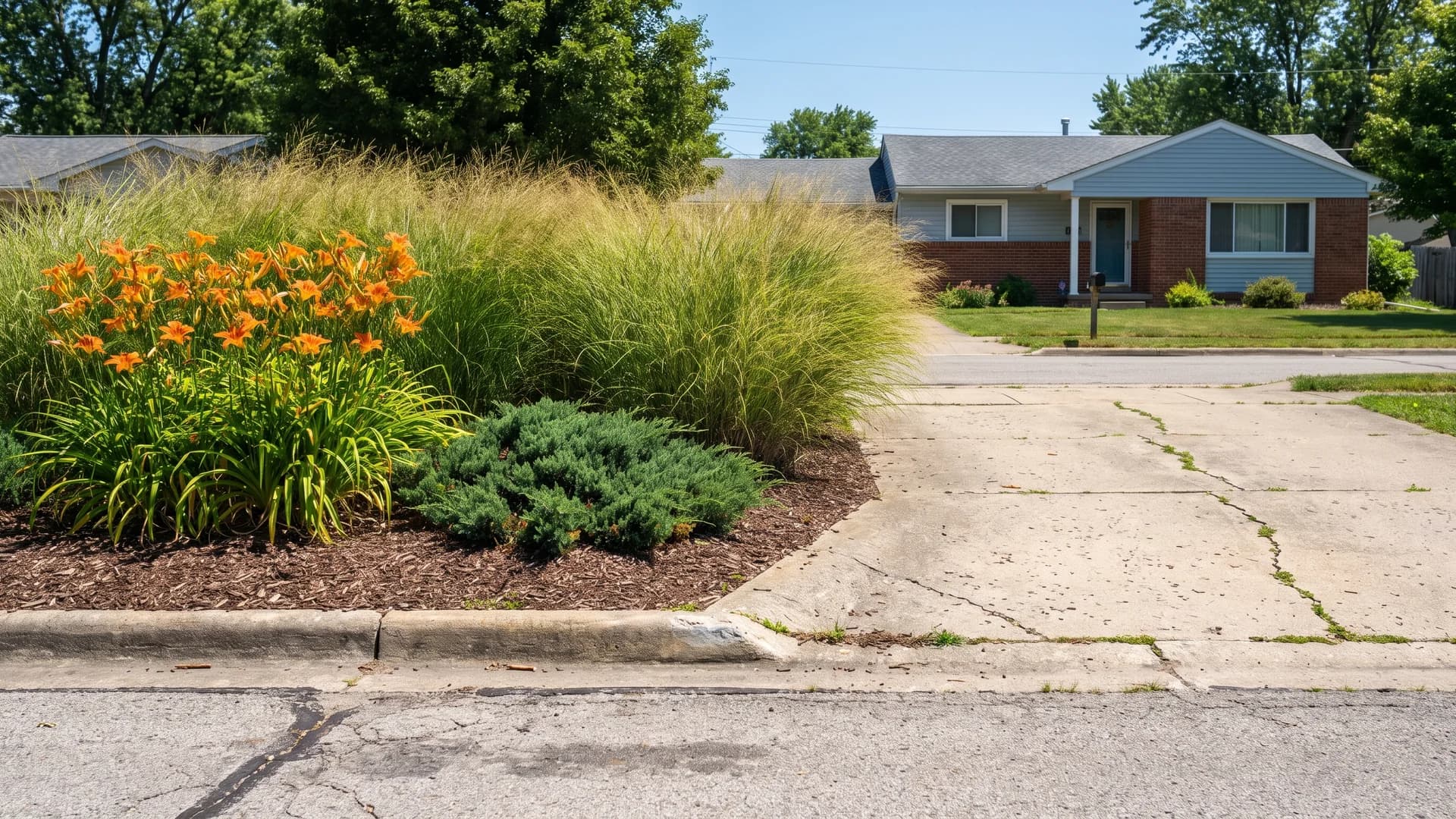
Nobody registers a mixed perennial bouquet from a moving car. Blocks work: nine of one daylily, then a mass of a single grass, then one low evergreen as the anchor. Three species in big drifts beat twelve in singles at the entrance every time. Save the plant collecting for the beds near the front door, where people are standing still.
12. Frame a rural entrance with split rail and a wildflower run
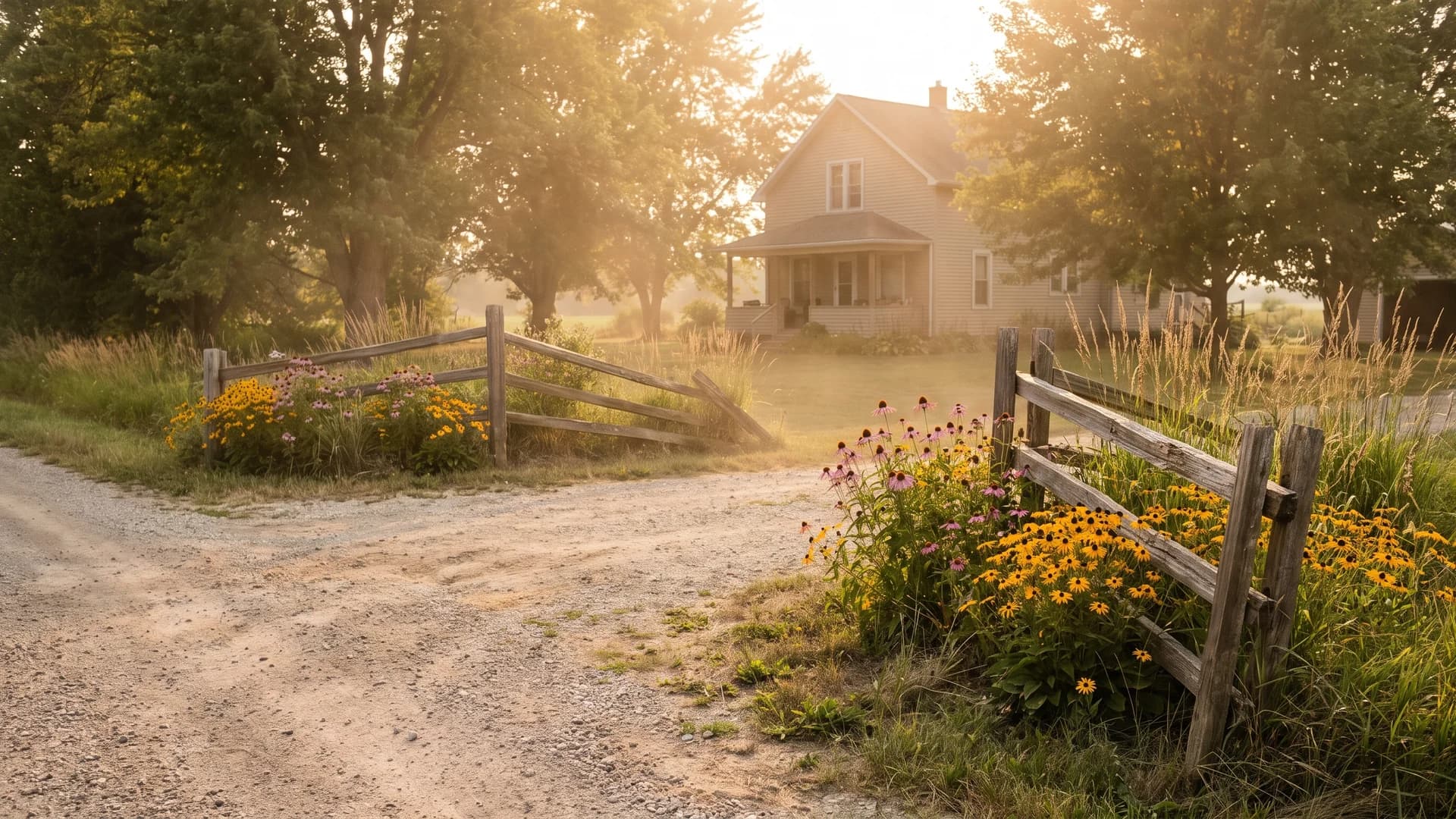
On a country drive, 20 feet of split rail on each side of the entrance does the framing that pillars do in a subdivision. Cedar rail costs $15 to $25 a section if you set the posts yourself. Behind it, a run of black-eyed Susan, coneflower, and bunchgrass mowed once in late winter costs less per year than the mowing it replaced, and native plants handle the salt spray better than a seed-mix annual meadow.
13. Hide the culvert with a stone headwall and grasses
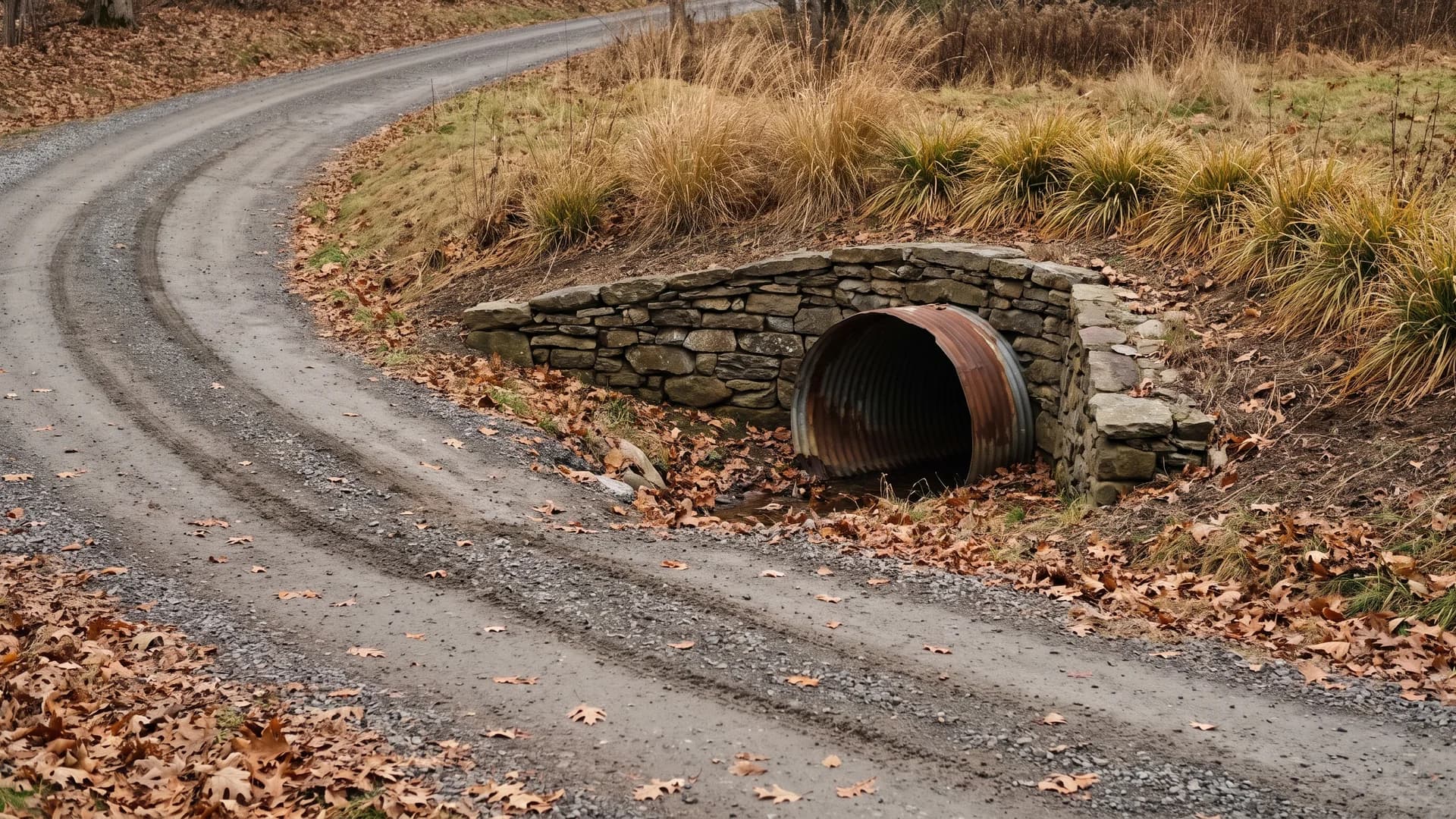
Corrugated pipe sticking out of the ditch is the first thing anyone sees at a rural entrance. A dry-laid stone headwall at each end, two courses of fieldstone on compacted gravel, covers the pipe and holds the bank. Plant switchgrass or sedge on the slope above it and skip anything woody, whose roots eventually crack the pipe. Keep the opening itself completely clear so the culvert still drains.
Ideas for your driveway's shape
14. Give a circular drive island one specimen tree and groundcover
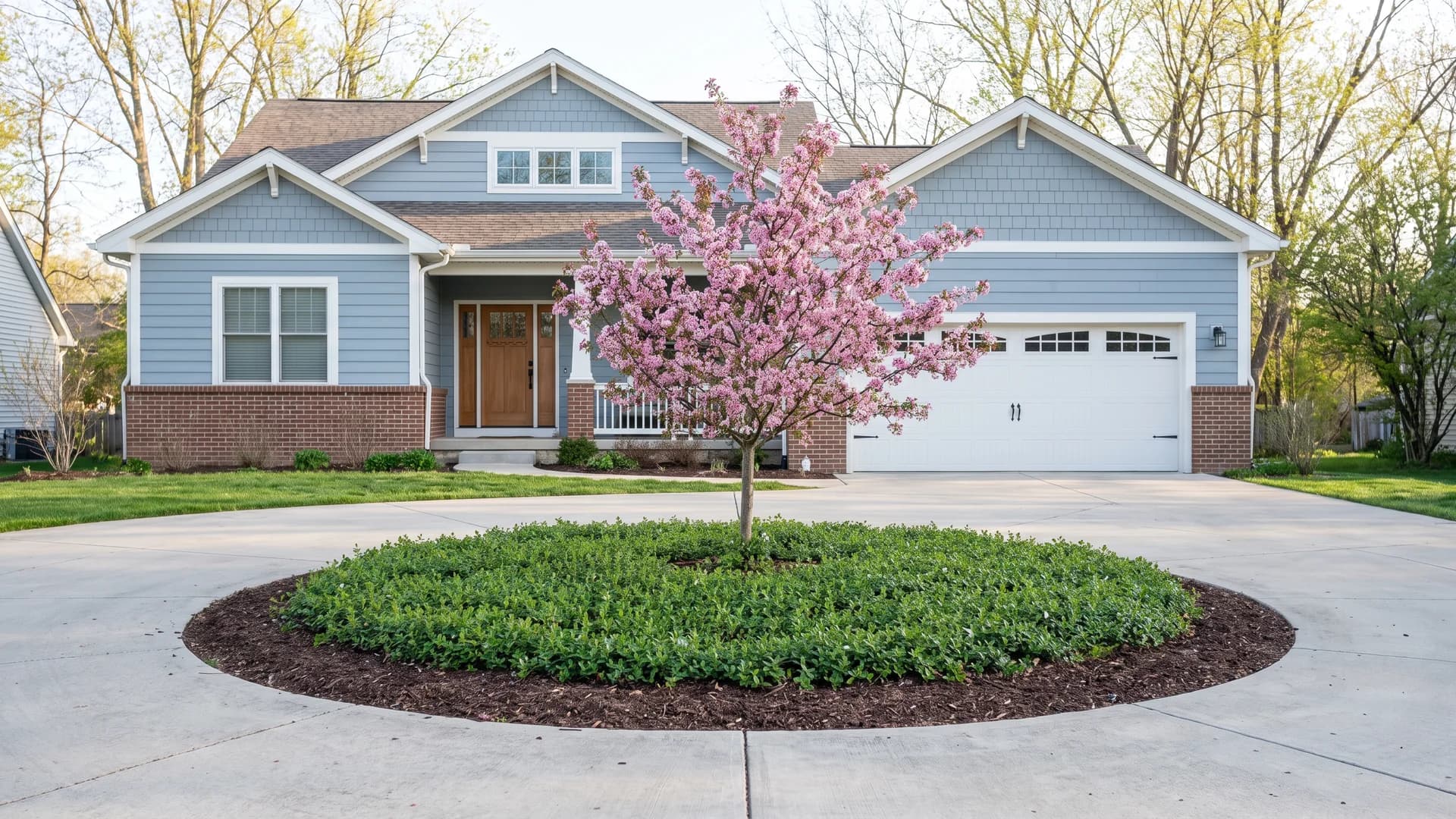
Circular drive islands want one idea, not five. One small ornamental tree in the center, a mass of low groundcover or gravel underneath, and nothing else competing. Serviceberry, crabapple, and Japanese maple all stop between 15 and 25 feet, which keeps the roofline visible from the street. Measure the island first: under 12 feet across, skip the tree and use a single focal point such as a boulder or an urn.
15. Keep a half-circle island low enough to see across
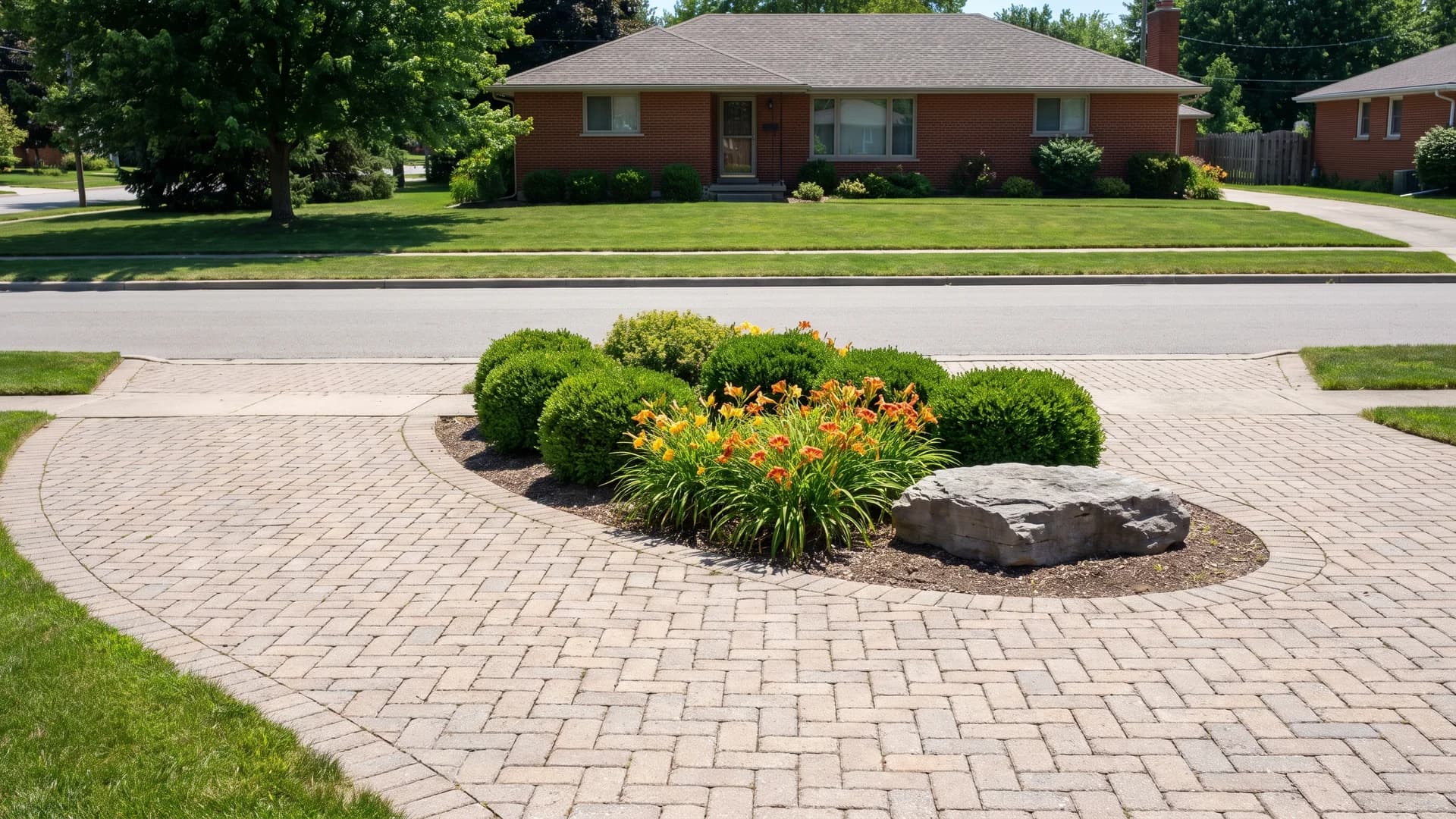
Half-circle drives put the island directly between two active openings, so anything over 30 inches blocks the view of a car coming the other way. Low mounded shrubs, a sweep of daylilies, and one flat boulder is the entire recipe. Want height anyway? Push it to the outside curve of the island, well clear of the sight line running between the two entrances.
16. Treat a long drive as an allée
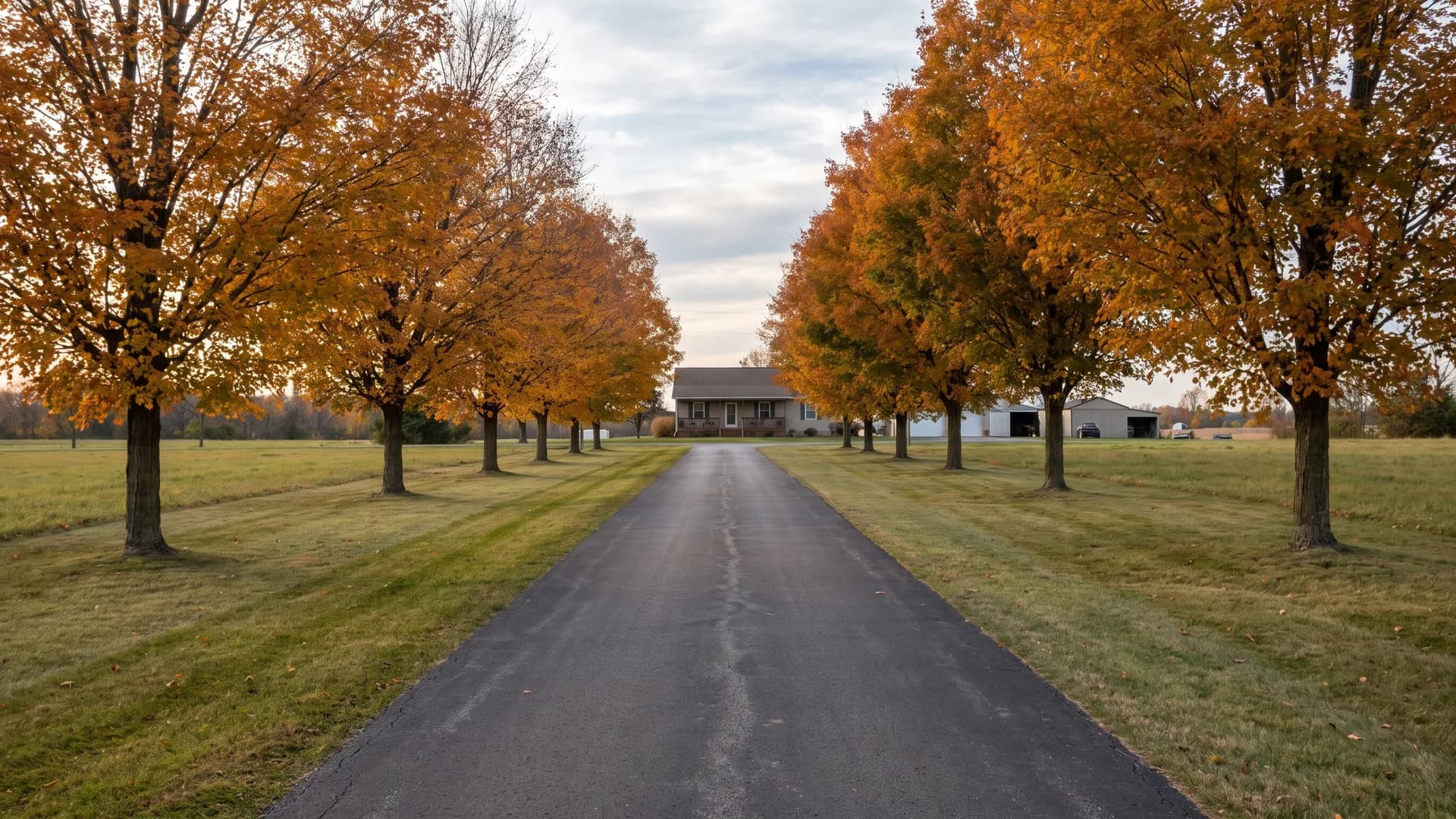
One tree species repeated at a fixed spacing down both sides turns 300 feet of pavement into an approach. Space small trees 25 feet apart and large shade trees 40 feet, and set every trunk at least 15 feet off the edge so roots stay out from under the drive. At $150 to $400 a tree it is a 15-year project, and it changes the property more than anything else on this list.
17. Soften a corner lot where two driveway edges show at once
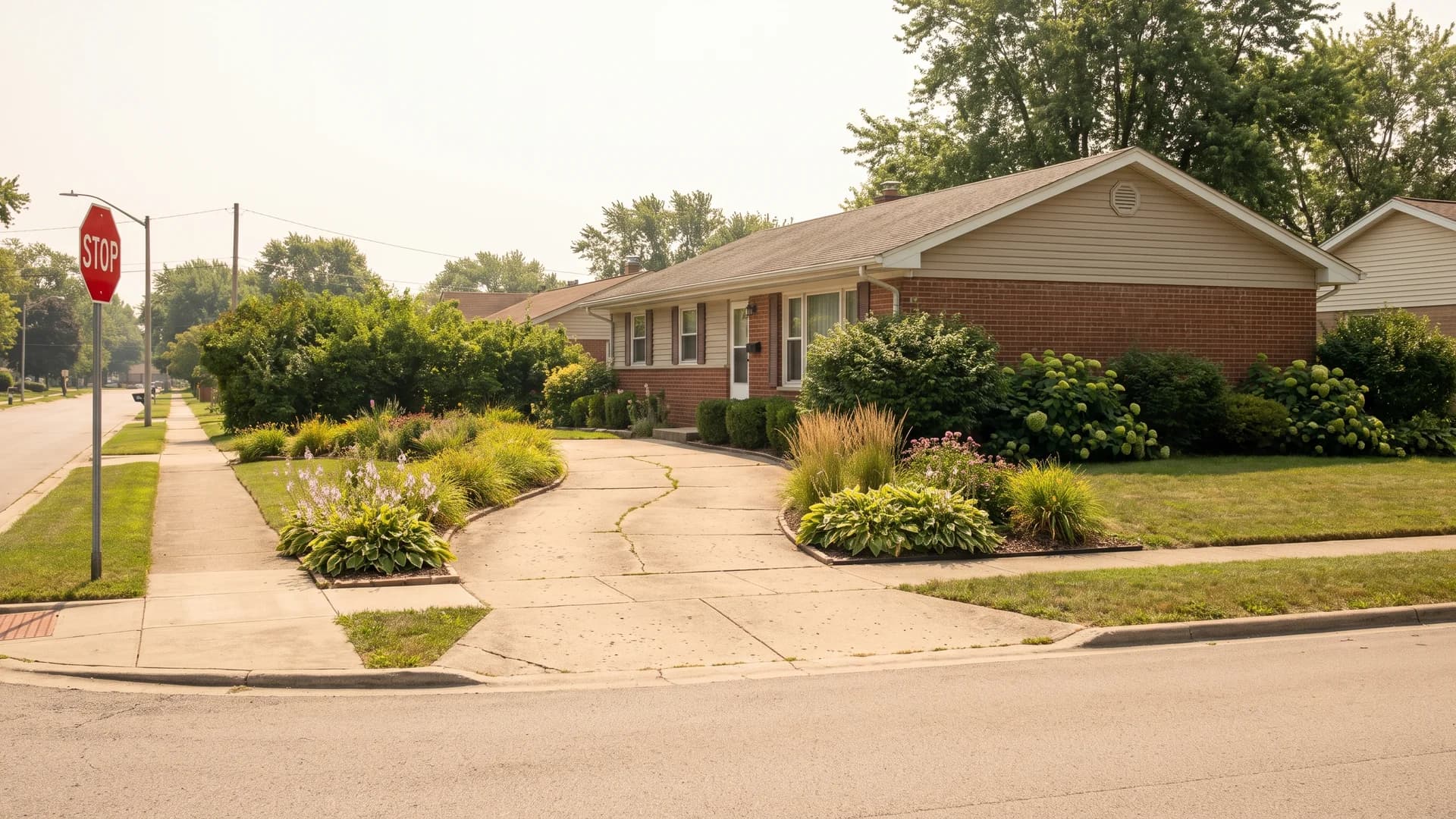
Corner lots put both sides of the drive on display, and neither one hides behind the house. Run the same border treatment down both edges instead of treating the street side as the front and the other as a back. Hold the corner itself at 24 inches or lower for the sight triangle, then let the planting build height as the bed moves away from the intersection.
18. Plant the narrow strip beside the drive instead of mowing it
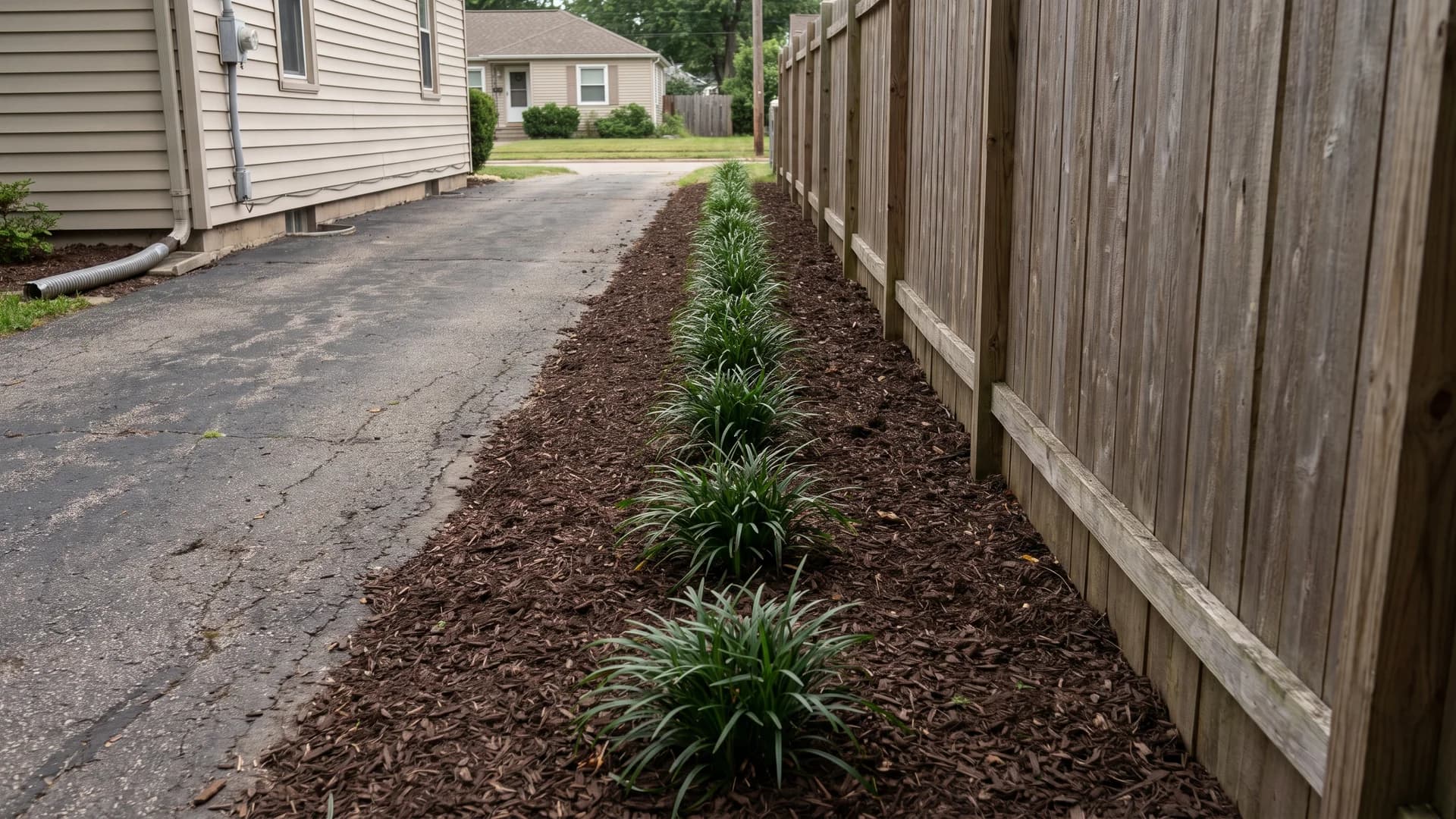
A 3-foot ribbon of grass beside the driveway is the worst square footage on any property: too narrow to mow cleanly, too visible to let go. Convert it. Fabric, 3 inches of gravel or bark, and a row of daylily or liriope every 18 inches ends the trimming permanently. Materials for a 40-foot strip run $120 to $200, which is roughly two seasons of somebody else's string trimmer.
Borders, materials, and budget stretches
19. Edge with gravel where plants won't survive
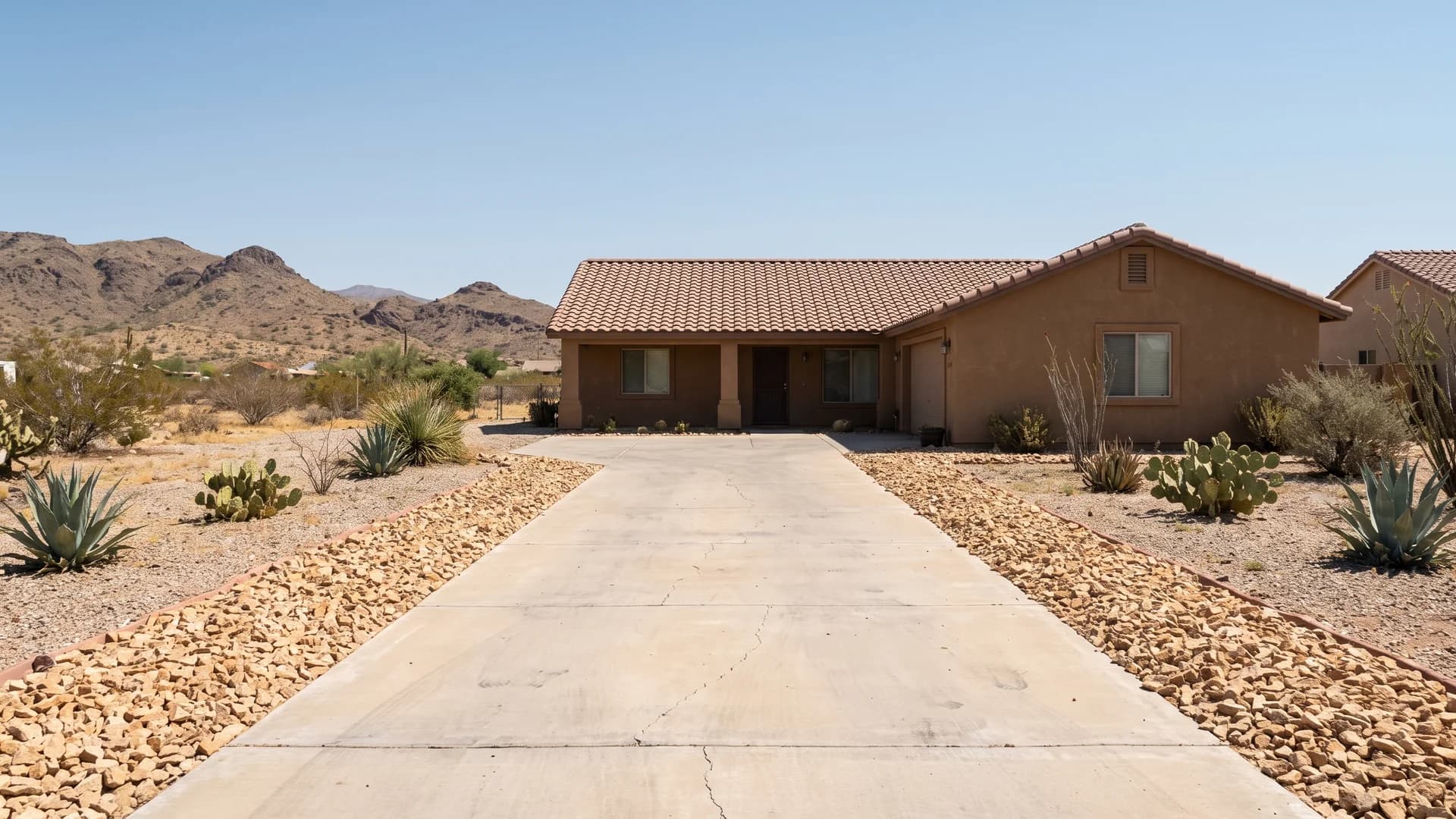
Some stretches along a drive are simply unplantable: full afternoon sun, heat bouncing off the pavement, and the heaviest salt load in the yard. A 2-foot gravel band over fabric costs $2 to $4 a square foot in materials and never browns out in August. Angular crushed stone stays put where round river rock rolls onto the pavement. The gravel calculator does the tonnage from your strip's dimensions.
20. Run a mulch-and-boulder stretch where nothing else works
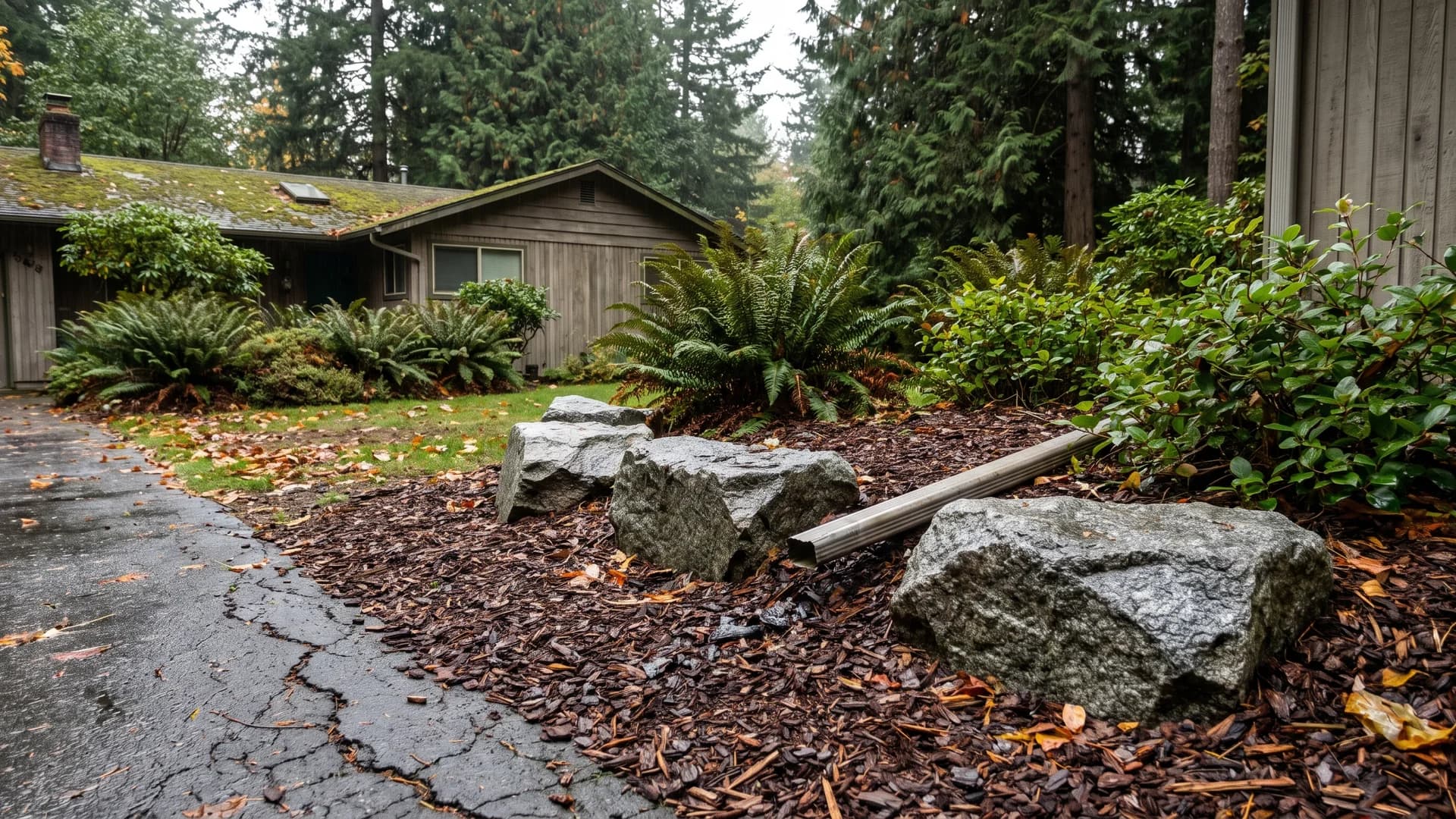
Where the border passes a downspout outlet, a bank, or ground too dry to plant, three or four boulders set into mulch carry the design without asking anything to grow there. Bury each stone a third deep so it looks like geology instead of a delivery. Boulders run $100 to $300 each delivered, and our front yard rock landscaping guide covers sizing and color selection.
21. Add a gravel apron at the end of the drive
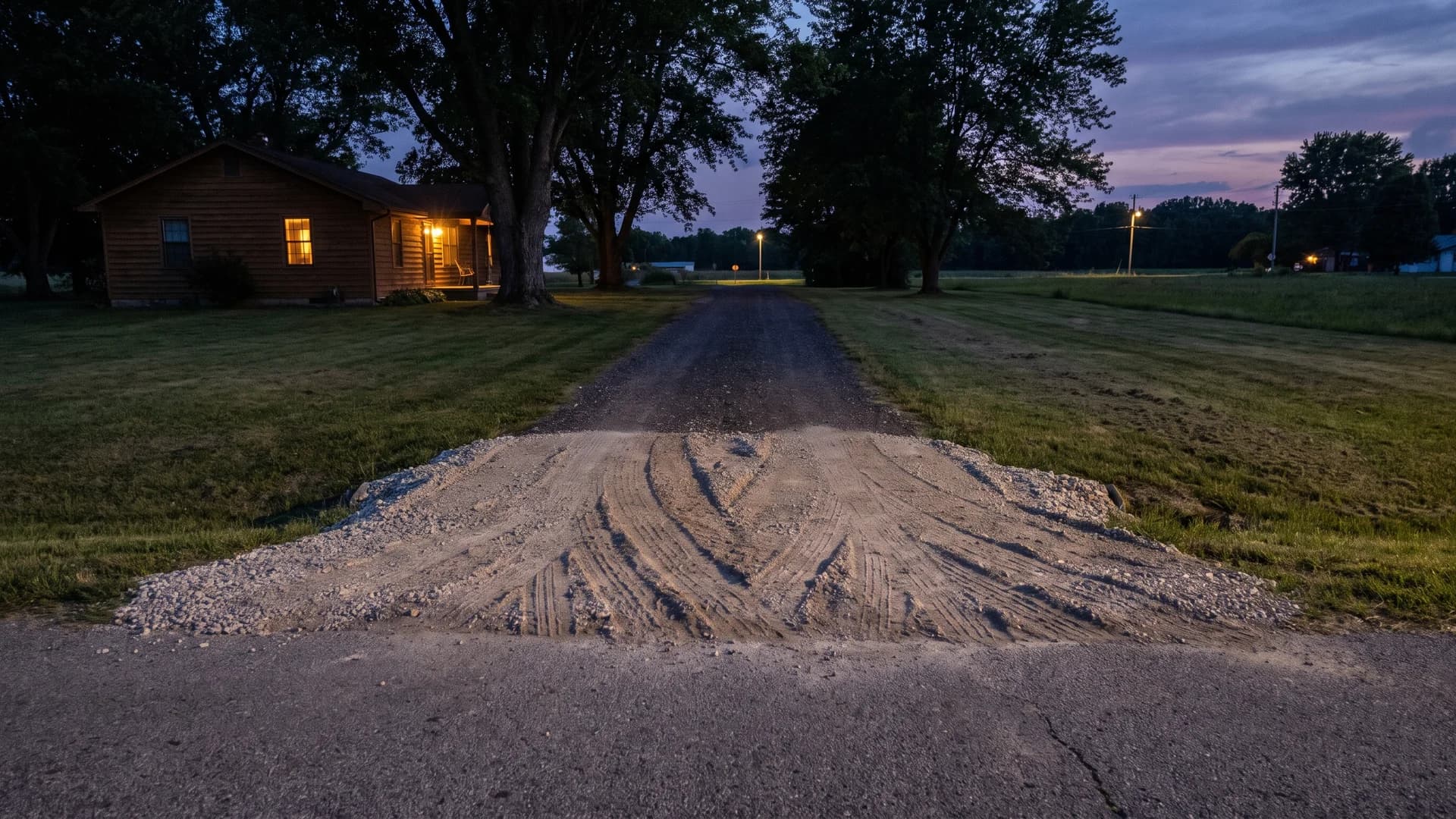
Turning tires rut the lawn at the end of a drive in every yard, every year. A 3 to 4-foot gravel apron along the last 15 feet absorbs the wear and looks deliberate rather than worn out. Compacted crushed stone at 3 inches deep holds under tires. Loose pea gravel does not, and half of it ends up in the street by the second winter.
22. Match the border stone to the house, not the driveway
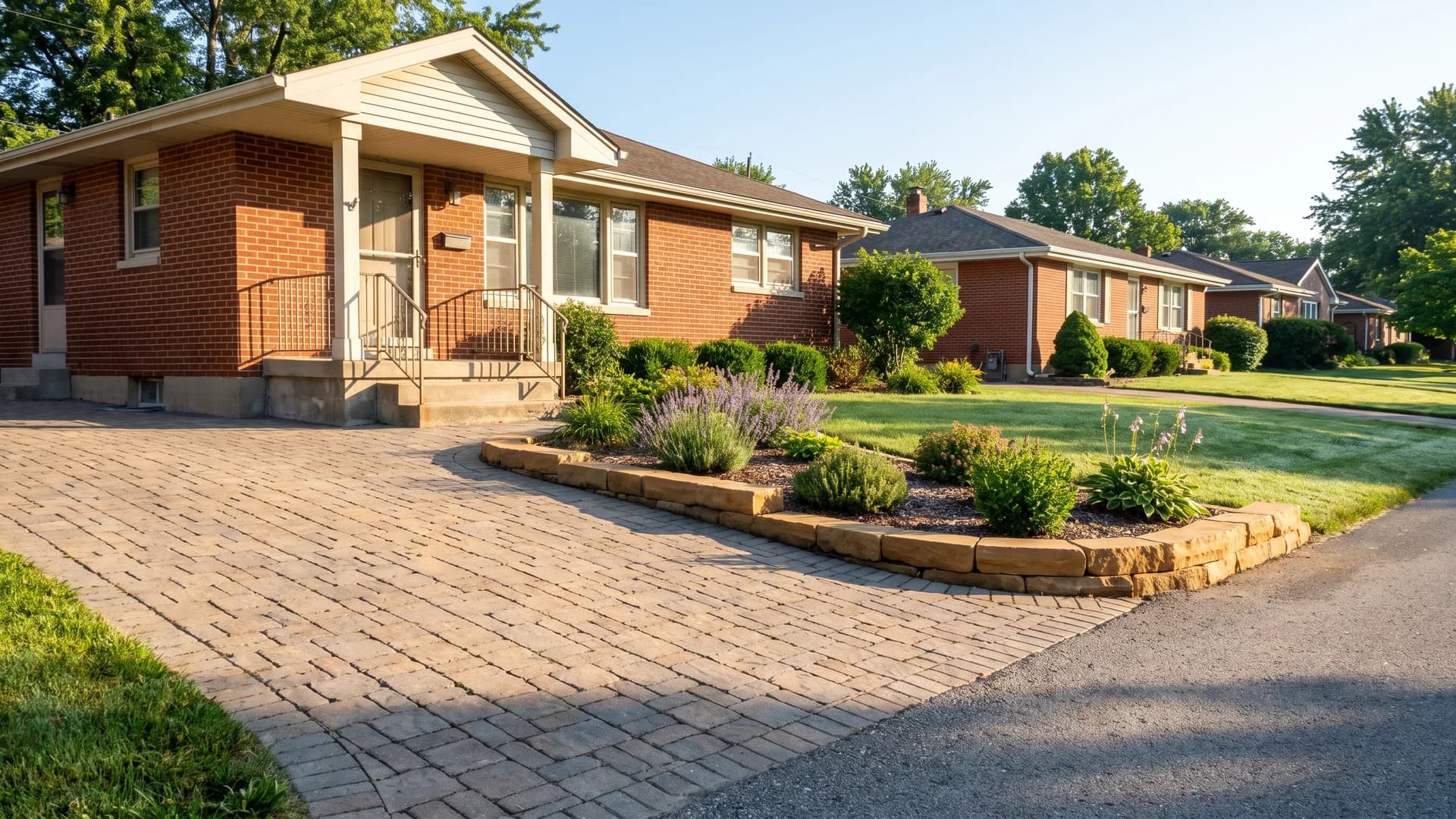
Border stone that matches the pavement disappears into it. Border stone picking up the house's brick, veneer, or roof color pulls the front of the property together and makes the drive look like part of a plan instead of an add-on. Carry a chip of the house material to the stone yard. The same rule governs any river rock band: warm gravel with warm brick, gray with gray.
Lighting and the finishing touches
23. Light the edges low and warm
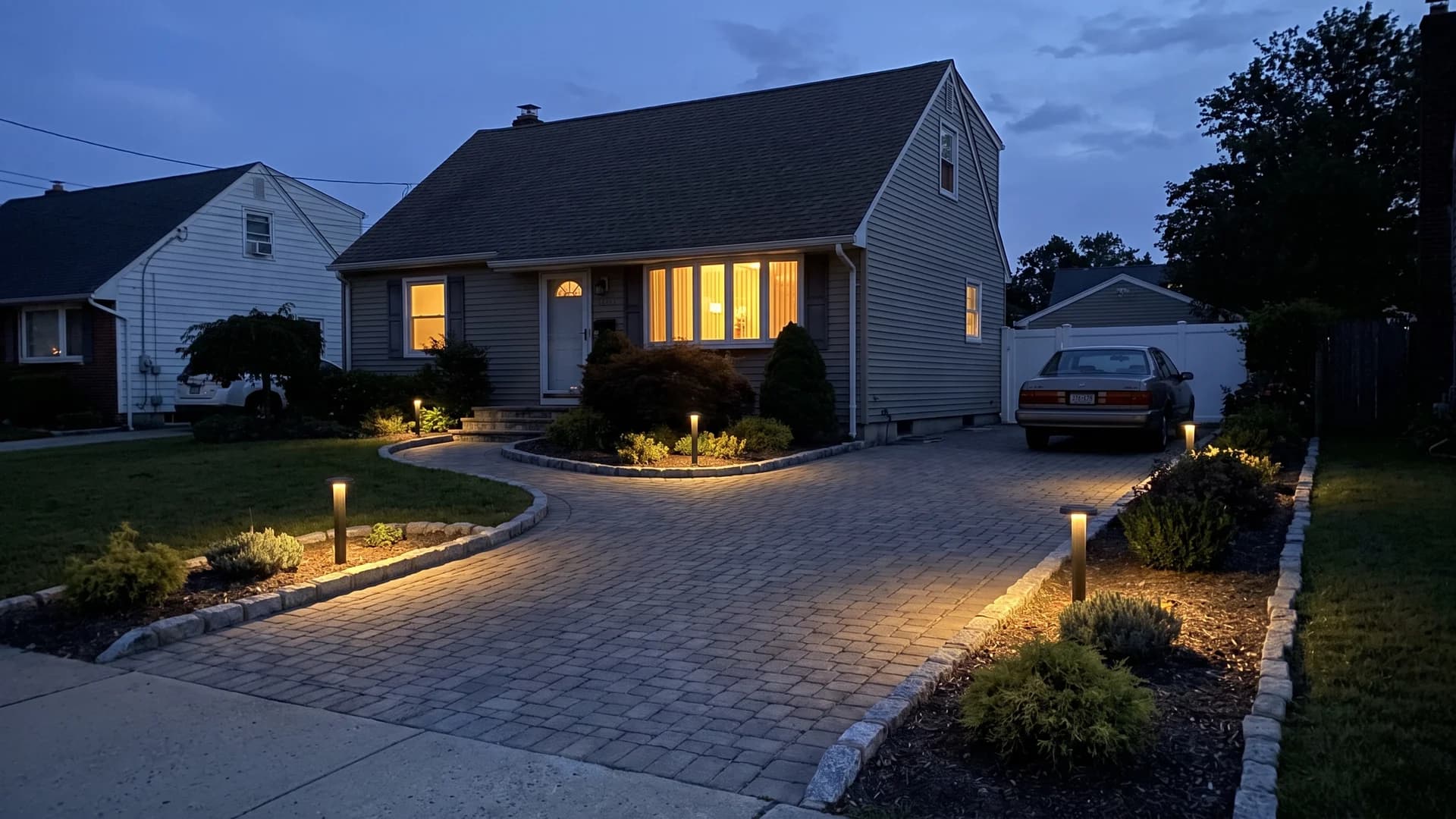
Runway lighting is the classic driveway mistake: twenty identical path lights at 6-foot spacing, all glaring outward at the same height. Use half as many, space them 12 to 15 feet apart, stagger the sides, and pick 2700K fixtures that throw light down. Low-voltage landscape lighting runs $40 to $90 a fixture. Set every one of them 18 inches back so plow blades and mower decks miss them.
24. Uplight one tree instead of lining the whole drive
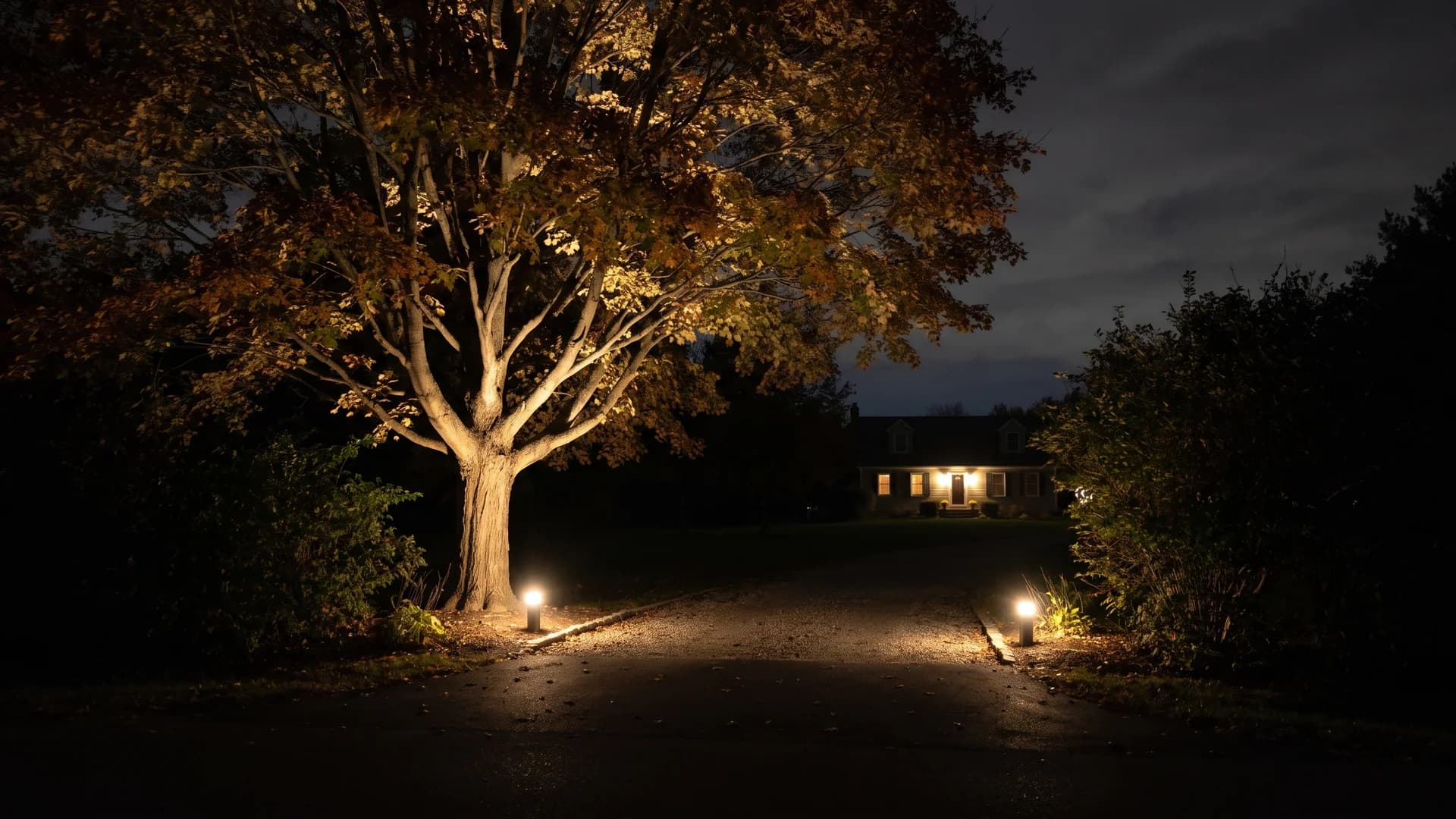
Uplighting a single tree at the entrance does more after dark than an entire row of path lights. Two fixtures at the base, aimed up through the canopy from opposite sides, cost about $150 together and make that tree the thing you see from the street. Bury the cable 6 inches deep and route it outside the salt band, where winter runoff eats connectors.
25. Plant the transition where the driveway meets the front walk
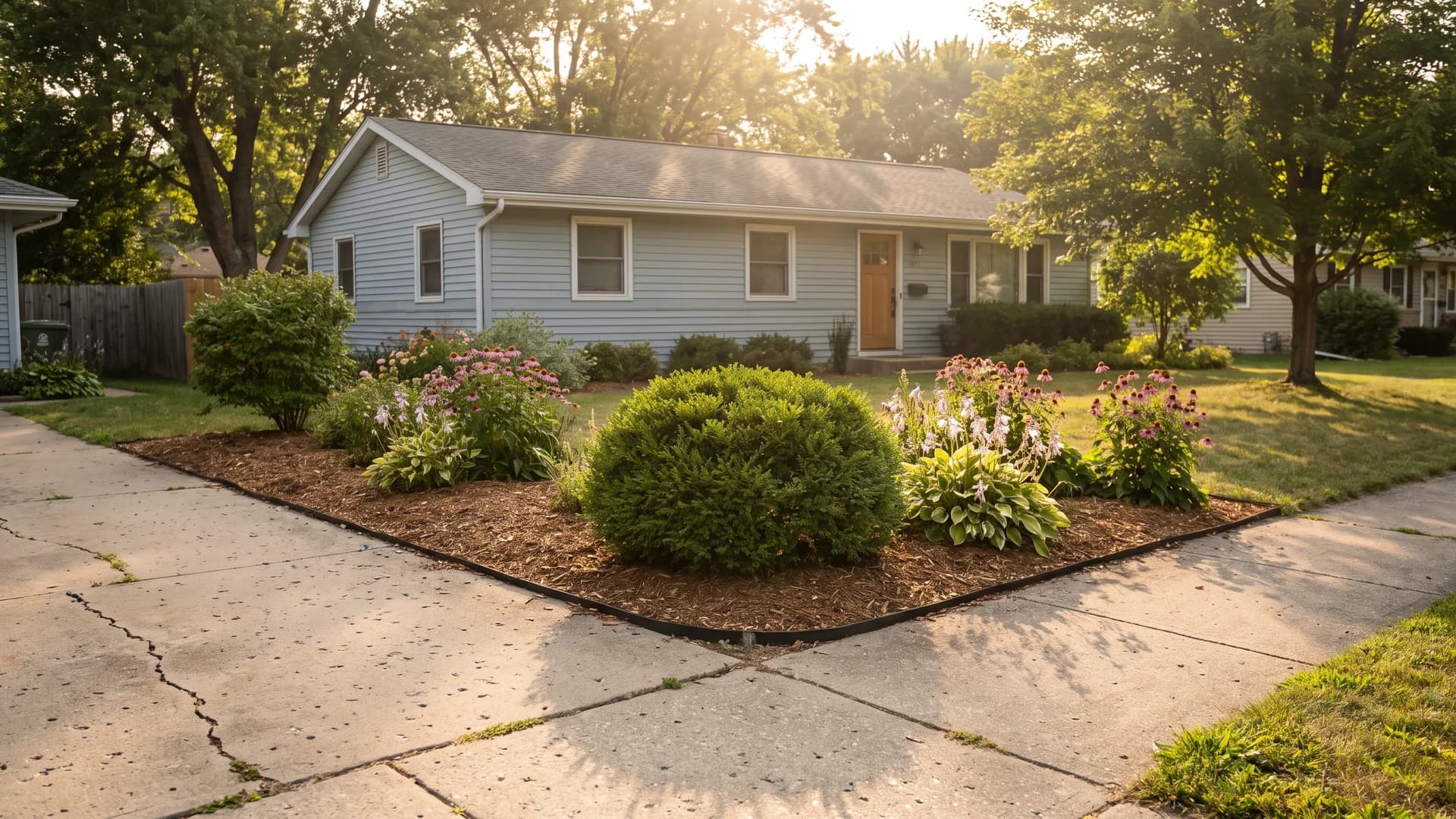
The junction where the drive meets the walk to the door is where most front yards come apart, because two beds meet there and neither claims the corner. Wrap a single planting around it so the whole thing reads as one shape, and widen the bed to about 4 feet at the junction. A low mounded shrub on the inside of the turn tells arriving guests which way to walk without a sign.
Which driveway is yours?
- Straight suburban drive, under 4 feet of room: start with 1, 2, and 7, then add 23.
- Long rural drive: 16 is the anchor idea, with 12 and 13 at the entrance.
- Circular or half-circle: 14 or 15 decides the island, and 5 keeps the sight lines legal.
- Corner lot: 17 first, because both edges are visible from the intersection.
- Cold climate with a plow contract: 4, 6, and 23 are the three that keep a border alive to spring.
- Want the whole front of the house to match: pair these with the low maintenance front yard landscaping plant plan so the driveway border and the foundation beds read as one design.
FAQ
How wide should a driveway planting strip be?
Four to 6 feet is the working range for a layered bed with shrubs, perennials, and a front row of groundcover. Between 2 and 3 feet you are limited to low grasses, sedum, and groundcover, which still looks finished if you repeat one or two plants down the length. Under 2 feet, gravel or a paved band beats anything living.
What plants work best along a narrow driveway?
Daylily, catmint, sedum, liriope, creeping juniper, and dwarf fountain grass all stay under 24 inches, tolerate road salt, and recover if a tire clips them. Repeat two or three of them down the whole run rather than mixing six species into a 3-foot strip. In zones 8 and warmer, dwarf yaupon holly and lantana do the same job.
Should I use gravel or mulch for driveway borders?
Gravel wins along the pavement edge because it does not wash onto the drive, does not need a spring top-up, and shrugs off the salt and reflected heat that shorten mulch's life. Mulch wins behind the first few feet, where plant roots benefit from the organic matter and cooler soil. Plenty of good borders use both, with a gravel band at the edge and mulch behind it.
Can I plant trees along my driveway?
Yes, with two rules. Keep the trunk at least 15 feet from the pavement so roots do not lift it, and pick a species with deep, non-aggressive roots such as oak, hornbeam, or serviceberry rather than silver maple, willow, or poplar. Space small trees 25 feet apart and large shade trees 40 feet, and check for buried utility lines before you dig.
What's the best edging material for a concrete driveway?
Steel edging at $2 to $4 a linear foot gives the cleanest line and nearly disappears once the bed settles. A cobble or brick soldier course at $8 to $15 a foot costs more but survives plow contact and doubles as a mowing edge. Plastic roll edging is the one to skip in cold climates, because frost heave lifts it out of the ground within a couple of winters.
How do I landscape a driveway edge on a budget?
Start with edging and one repeated plant rather than a mixed bed. Steel edging plus 15 grasses or daylilies down a 40-foot run comes in around $300 and looks intentional straight away. Bare-root and 1-gallon plants cost a third of what 3-gallon stock does and catch up within two seasons. If you want to test a layout before you buy anything, AI landscape design renders the border on a photo of your own drive.